
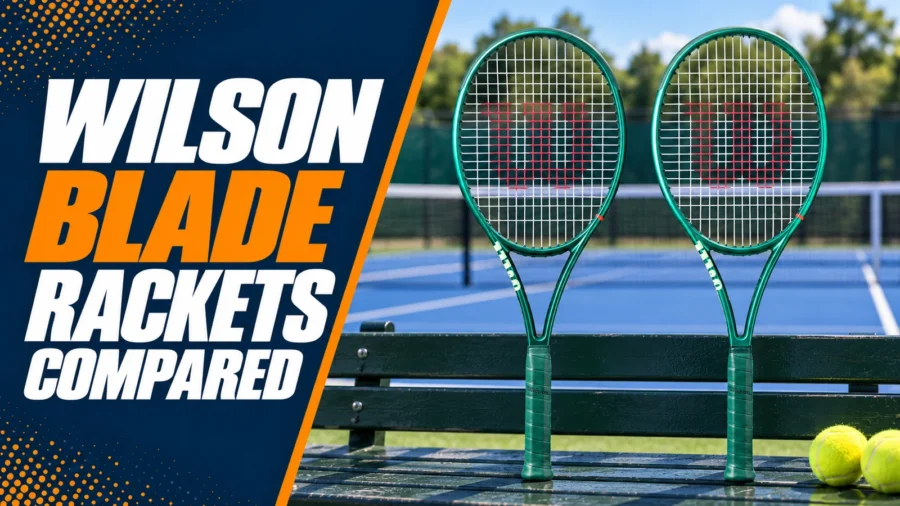
The Wilson Blade 100 is the best starting point for most intermediate players comparing the 2026 Blade range. Its 100in² head, 300g unstrung weight and 16×19 pattern make it more forgiving than the 98 models without giving up the connected, control-oriented identity of the Blade family.
Advanced players should compare the Blade 98 16×19 and 18×20. The 16×19 offers easier spin and launch, while the 18×20 produces a denser, more controlled response. The lighter 100L and 100UL suit developing players, and the extended Blade 104 prioritizes reach and forgiveness.
Wilson Blade Comparison Chart
| Model | Head | Pattern | Unstrung weight | Best for |
|---|---|---|---|---|
| Blade 98 Pro 16×19 | 98in² | 16×19 | 305g | Advanced players wanting a direct, stable Blade |
| Blade 98 Pro 18×20 | 98in² | 18×20 | 305g | Maximum control in the Pro construction |
| Blade 98 16×19 | 98in² | 16×19 | 305g | Advanced topspin and all-court play |
| Blade 98 18×20 | 98in² | 18×20 | 305g | Flat hitters and precision seekers |
| Blade 100 Pro | 100in² | 16×20 | 295g | Extended control with a larger head |
| Blade 100 | 100in² | 16×19 | 300g | Best all-around choice |
| Blade 100L | 100in² | 16×19 | 285g | Maneuverable intermediate frame |
| Blade 100UL | 100in² | 16×19 | 265g | Juniors and developing players |
| Blade 104 | 104in² | 16×19 | 290g | Extra reach and forgiveness |
All weights are unstrung catalog figures. Strings generally add about 15–18g, and production tolerances mean measured frames can vary.
The seven live model reviews linked below cover previous-generation Blade rackets. Use them as hands-on context for each model category, not as V10 reviews or as sources for current V10 specifications.
What Changed With Blade V10?
Wilson positions V10 as a more aggressive Blade. The generation introduces a variable Turbo Taper beam and StableFeel+ construction intended to improve stability and responsiveness at higher swing speeds.
The family remains focused on connected impact and control rather than effortless trampoline-like power. Players coming from a thick, stiff power frame should expect to supply more of their own pace.
Wilson also states tighter factory specification controls for V10, with published tolerances for weight, balance and swingweight. That is useful, but serious competitors should still measure and match multiple frames.
Blade 98 Pro 16×19
The Blade 98 Pro 16×19 combines a compact 98in² head, 305g unstrung weight and open 16×19 pattern. The Pro construction is aimed at highly competitive players who want a more direct and stable response than the standard Blade.
The open pattern makes this the more spin-friendly of the two Pro 98 models. It is still demanding because the head is small and the finished frame carries meaningful swingweight.
Choose it if: You have fast preparation, create your own pace and want the Pro response with a higher launch window.
Blade 98 Pro 18×20
The 18×20 Pro keeps the same 98in² head and 305g unstrung mass but uses a denser string bed. That generally lowers launch and adds directional structure compared with the 16×19 version.
It rewards clean, fast swings and flatter acceleration through the ball. Players who struggle for depth or spin should not choose it merely because 18×20 sounds more advanced.
Choose it if: You already know you prefer dense patterns and want the most controlled Pro option.
Blade 98 16×19
The standard Blade 98 16×19 is the most versatile 98in² choice in the range. At 305g unstrung, it has enough mass for stability while the open pattern supports topspin and easier net clearance.
Compared with the 100, it asks for more precise contact and supplies less forgiveness. Compared with the 98 18×20, it releases the ball on a higher trajectory.
For previous-generation hands-on context, read the Wilson Blade 98 16×19 review. Its play impressions describe an older Blade, not the V10 construction.
Choose it if: You are an advanced player who wants control without committing to a dense pattern.
Blade 98 18×20
The Blade 98 18×20 shares the 305g weight and compact head but tightens the string bed. It is the clearer choice for a player who hits through a low launch window and values predictable direction.
Its control comes with a cost. Defensive depth and topspin require racket-head speed, and a firm string can make the setup unnecessarily demanding.
The previous-generation Wilson Blade 98 18×20 review provides hands-on context for the dense-pattern category, but it is not a V10 review.
Choose it if: You are a confident ball striker who naturally supplies pace and prefers a dense response.
Blade 100 Pro
The Blade 100 Pro uses a 100in² head and 16×20 pattern in a 295g unstrung, 27.25in package. Its name can be confusing because it is lighter on the scale than the regular Blade 100, but its denser pattern, extended length, construction and swing behavior matter alongside static weight.
It is designed for a stable, performance-focused response with more head-size forgiveness than the Pro 98s. The extra 0.25in can add reach and leverage while changing timing, so demo it directly against the standard-length Blade 100 rather than deciding from “Pro” alone.
The previous-generation Wilson Blade Pro 100 review offers hands-on context for the older model. It does not review the V10 frame or its current 16×20, 27.25in specification.
Choose it if: You want a 100in² Pro-style Blade and can compare its swing feel before buying.
Blade 100: Best for Most Players
The Blade 100 has the most broadly useful specification in the family: 100in², 300g and 16×19. It offers more margin than the 98s while retaining enough mass for an intermediate or advanced player.
It handles singles and doubles without forcing one style. The 100 is the sensible demo baseline even if you eventually move lighter, heavier or denser.
The previous-generation Wilson Blade 100 review supplies hands-on context for the standard 100in² Blade category. Treat its construction-specific impressions as older-generation information, not a V10 test.
Choose it if: You want Blade feel in a balanced modern specification.
Blade 100L
At 285g unstrung, the Blade 100L is easier to accelerate than the 100. It suits intermediates with moderate swing speed, advancing juniors and adults who find 300g late during quick exchanges.
The tradeoff is less mass against heavy shots. A lighter frame can be maneuverable without being more stable.
Use the previous-generation Wilson Blade 100L review for hands-on context on the lighter model category, not as a review of V10.
Choose it if: A 300g frame slows your preparation but you still want a performance construction.
Blade 100UL
The 265g Blade 100UL is the easiest full-size V10 to swing. It is suitable for juniors transitioning into adult length, beginners who want a quality graphite frame and adults who genuinely need low mass.
Because it is light, it may feel less solid against fast incoming balls. Do not add large amounts of weight immediately. If stability becomes a consistent limitation, moving to the 100L may be simpler.
The previous-generation Wilson Blade 100UL review gives hands-on context on the ultralight category, but its playtest does not cover the V10 frame.
Choose it if: Maneuverability is the priority and heavier Blades arrive late.
Blade 104
The Blade 104 combines a 104in² head, 290g unstrung weight, 16×19 pattern and 27.5in length. It offers the most head-size forgiveness and extra reach in the family.
Extended length can help serve leverage and court coverage, but it also changes timing and swingweight. The frame may not feel as quick as its static weight suggests.
The previous-generation Wilson Blade 104 review offers hands-on context for an extended Blade. It should not be read as a V10 review.
Choose it if: You want Blade control with a larger hitting area and extra reach.
Do not confuse the retail Blade 104 with Serena Williams’ heavier, extended SW104 and SW102 signature frames.
Blade 16×19 vs 18×20
Choose 16×19 when you want easier spin access, a higher launch and more help creating depth. Choose 18×20 when you already create pace and prefer a flatter, more structured trajectory.
The pattern does not work alone. Head shape, string spacing, tension and string type can make one 16×19 feel controlled and another lively.
Blade 98 vs Blade 100
The Blade 98 rewards accurate contact and gives experienced players a compact response. The Blade 100 provides a larger contact area and more neutral forgiveness with only a small increase in head size.
Most intermediates should start with the 100. Move to the 98 after a demo proves that its precision helps more than its smaller margin hurts.
How to Choose the Right Blade
- Pick a playable weight before choosing a pattern.
- Demo the Blade 100 as the reference model.
- Try a 98 only if you consistently center the ball.
- Compare 16×19 and 18×20 with similar strings.
- Test serves, returns and defensive shots, not just cooperative groundstrokes.
The ultimate tennis racket buying guide explains how head size, balance and swingweight interact.
Final Verdict
The Blade 100 is the best fit for most intermediate players. Advanced players should choose the Blade 98 16×19 for versatile spin and control or the 98 18×20 for the densest precision. The 100L and 100UL reduce the swing burden, while the 104 supplies the most reach and forgiveness.
Ignore the idea that one model is universally “the best Blade.” The correct Blade is the one whose weight arrives on time and whose launch window matches your natural swing. Compare those same variables when testing the Blade against other current racket families.