
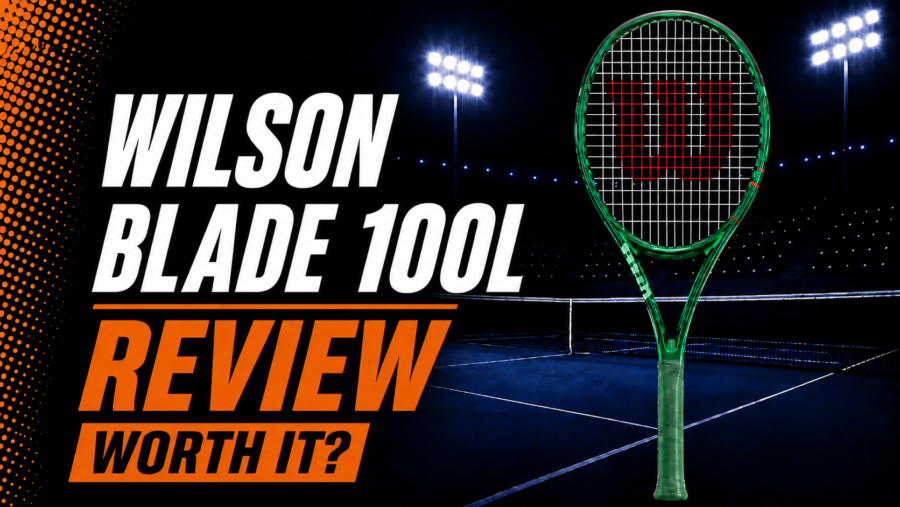
The Wilson Blade 100L V9 is the lighter 285 g model in Wilson’s ninth-generation Blade performance range, introduced for the 2024 model year. This review applies specifically to the V9 with a 100 sq in head, standard 27 in length and 16×19 string pattern, not the V8 or V10 version.
It occupies the middle ground between the ultra-light Blade 100UL V9 and the 300 g Blade 100 V9. Wilson positions it for intermediate players and juniors moving toward an adult performance racket, especially those who want faster handling without abandoning the Blade family’s emphasis on feel and controlled power.
The 100L retains the same 22 mm constant beam and open pattern as the other 100 sq in V9 models. Its 20 g advantage over the 100UL supports a more substantial response, while its 15 g reduction from the standard Blade 100 makes preparation and acceleration more accessible.
Wilson Blade 100L V9 Score
| Category | Score |
|---|---|
| Power | 8/10 |
| Spin | 8.5/10 |
| Control | 8/10 |
| Comfort | 7.5/10 |
These scores are editorial estimates based on the Blade 100L V9’s verified specifications, construction, intended player profile and place within the broader racket market. Strings, tension, finished specifications and technique can change the way the racket performs.
Wilson Blade 100L V9 Specifications
| Specification | Details |
|---|---|
| Head size | 100 sq in / 645 cm² |
| Length | 27 in / 68.6 cm |
| Unstrung weight | 285 g / 10.1 oz, official |
| Strung weight | Approximately 301 g / 10.6 oz, retailer-measured; string-dependent |
| Unstrung balance | 33 cm / 13.0 in, 4 pts HL, official |
| Strung balance | Approximately 33.7 cm / 13.3 in, 2 pts HL, retailer-measured |
| Swingweight | Approximately 308 kg·cm² strung, retailer/lab measurement |
| Stiffness | Approximately 69 RA, retailer/lab measurement |
| Beam width | 22 mm / 22 mm / 22 mm |
| String pattern | 16×19 |
| Composition | Braided graphite and basalt frame with a DirectConnect carbon-fiber handle |
| Recommended tension | 50-60 lb / 23-27 kg |
| Grip | Wilson Pro Performance |
Wilson’s official V9 listings confirm the unstrung dimensions and composition, and some regional Wilson pages also publish nominal strung figures. The approximate strung balance, swingweight and stiffness above are cross-checked retailer or laboratory figures; manufacturing tolerances, string gauge, grip size, overgrips, dampeners and other accessories can change the finished weight, balance and swingweight.
Design, Materials and Technologies
Head Size, Beam and Frame Geometry
The 100 sq in head is intended to make the Blade concept more forgiving than the 98 sq in V9 models. It provides a larger string-bed area and more margin around the center, but remains within the conventional midplus category rather than moving into oversize-racket territory.
Wilson uses a constant 22 mm flat beam instead of the thicker variable beams common in high-power rackets. That profile is designed to preserve a more controlled response and clearer sense of face position, with less built-in rebound than a wide-beamed alternative.
Standard 27 in length keeps leverage and timing familiar. The frame therefore gains accessibility primarily from its weight and head size, rather than from extra length or an unusually large head.
Weight, Balance and Swingweight
At 285 g unstrung, the 100L is light enough for quick acceleration but heavy enough to offer more substance than the 100UL. Its 33 cm unstrung balance is only 4 points head light, placing useful mass toward the hoop to support depth and prevent the frame from seeming empty at contact.
The approximate 308 strung swingweight is moderate and helps explain why the model can remain quick while offering more ball-facing stability than its static weight alone suggests. Swingweight describes resistance during rotation, so a light racket can still have a meaningful head presence.
Maneuverability and stability must nevertheless be separated. The 100L should be easier to prepare than the standard Blade 100, but its lower static weight and swingweight give it less resistance to twisting and deceleration when contact moves away from the center.
Materials and Construction
Wilson specifies braided graphite and basalt in the hoop and shaft, together with a DirectConnect carbon-fiber handle. The braid is intended to tune frame flex and feedback, while basalt forms part of Wilson’s vibration-management approach.
Material names are not independent proof of a particular result. The approximately 69 RA measurement is fairly firm, and the final response will also reflect string stiffness, tension, ball speed and where contact occurs.
This combination is notable because the 100L has a higher measured stiffness than the standard Blade 100 V9. Players should not assume that every racket carrying the Blade name has the same flex or impact character.
String Pattern
The 16×19 layout is open enough to support string movement, a medium-to-high launch window and spin when paired with adequate racket-head speed. Because the 100L is easy to accelerate, developing topspin players have a practical route to creating rotation without managing a heavy frame.
String spacing still matters as much as the count. The Blade 100L’s pattern should not be equated automatically with a dedicated spin racket, and flatter hitters can moderate launch through string selection, gauge and tension.
An open pattern may increase notching and movement compared with a dense 18×20 bed, particularly for players who hit with high spin. Durability depends on string material and stroke production, so the pattern is only one part of the calculation.
Technologies
FORTYFIVE° refers to Wilson’s patented carbon orientation intended to complement modern vertical swings while preserving flexibility and stability. The practical conclusion is that the layup is engineered to control bending behavior; the manufacturer’s broader feel claims remain subjective.
DirectConnect extends carbon fiber into the end cap, which Wilson associates with a more connected response and improved torsional stability. It adds a structural connection through the handle, but cannot give a 285 g frame the same mass-based stability as a heavier model.
StableFeel is the V9-specific construction update designed to produce a firmer response and reduce unwanted frame movement. This is especially relevant to the 100L because a lighter frame benefits from any improvement in torsional consistency, though off-center behavior still depends on mass distribution.
Parallel Drilling aligns the grommet channels to promote a consistent and more forgiving string-bed response. Top Grip Taper changes the upper-handle shape for the top hand on a two-handed backhand, while Click & Go is the replaceable bumper-and-grommet system designed for a secure fit and easier servicing.
Wilson Blade 100L V9 Performance
Comfort and Feel
The braided graphite-and-basalt construction and constant 22 mm beam are intended to preserve the Blade line’s connected, controlled identity. StableFeel makes the V9 deliberately firmer than the prior model, and the approximate 69 RA figure suggests a more direct response than the very flexible standard Blade 100 V9.
The 301 g approximate strung weight gives the racket more substance than the 100UL, which can help on clean contact. It is still relatively light, so late contact and hard impact near the frame may transmit a less settled response than a heavier racket.
Comfort is personal and depends on the complete system, including technique, grip size, string material, gauge and tension. A soft multifilament at a sensible tension can produce a very different result from a firm polyester installed tightly.
Comfort score: 7.5/10
Power
Power comes mainly from accessible racket-head speed, the 100 sq in head, the open pattern and the moderately hoop-oriented balance. The 22 mm beam limits the free rebound available from the frame, keeping depth more controllable than in many light, thick-beamed rackets.
The 100L can assist compact-to-medium swings because it is easier to accelerate than the standard Blade 100. It still rewards an active swing, and players expecting effortless depth from a short block may find a dedicated power frame more helpful.
Relative to the 100UL, the extra 20 g can support greater momentum and a more substantial ball when timing is equal. Relative to the 300 g Blade 100, it gives up some plow-through in exchange for speed.
Power score: 8/10
Control
The slim constant beam and standard length create a useful foundation for predictable directional control. Its 100 sq in head is more forgiving than the Blade 98, while the 16×19 bed gives the ball more launch than a dense player’s pattern.
The approximate 69 RA stiffness can provide a crisp sense of face response, but control ultimately depends on the player’s repeatable contact and swing path. The racket is best understood as controlled for its weight category, not as a substitute for technique.
Against heavier incoming balls, lower mass can allow the face to move more on off-center contact. Players who prioritize blocking stability and very small targets may prefer the standard Blade 100 or a denser, heavier alternative.
Control score: 8/10
Spin
Low-to-moderate swingweight and a 16×19 string bed give the 100L strong spin potential for developing and intermediate players. It should be easy to accelerate up the back of the ball, and the 100 sq in head provides useful clearance around the contact zone.
The pattern does not create spin by itself. Effective rotation still requires racket-head speed, an appropriate swing path and strings that have not become excessively notched or locked.
The 100L remains versatile rather than narrowly spin-focused. It can support topspin, slice and flatter drives, with the exact launch angle shaped heavily by gauge, material and tension.
Spin score: 8.5/10
Maneuverability
The combination of 285 g unstrung weight and an approximate 308 swingweight should allow quick preparation on groundstrokes, returns and volleys. It is a meaningful step up in substance from an ultra-light racket without reaching the repeated-swing demands of a 300 g performance model.
Because the balance is only moderately head light, the hoop remains present during the swing. This helps momentum but means the 100L may not seem as handle-fast as another 285 g racket with a more head-light balance.
Stability
StableFeel, DirectConnect and the braided layup are intended to control bending and twisting, while the 22 mm beam keeps the structural profile consistent. The approximate 308 swingweight provides enough rotational resistance for many intermediate exchanges.
Static mass remains the limiting factor. Central contact should be relatively dependable, but fast balls struck near the perimeter can expose less stability than the 318 g strung standard Blade 100.
Performance by Shot
Groundstrokes
The 100L should suit players who use compact-to-medium preparation and want to accelerate through forehands and backhands without a heavy frame slowing the sequence. Its open pattern supports topspin, while the controlled beam allows flatter drives when the face is managed carefully.
On defense, quick handling helps the player reach and shape late balls. Producing deep neutral shots from a stretched position still requires active racket speed because the frame does not carry the mass of a heavier Blade through contact.
One-handed backhand players may appreciate the low swing demand, though the near-even finished balance must still be timed consistently. Two-handed players can use the Top Grip Taper and added stability over the 100UL to drive through the ball more confidently.
Serves
The manageable weight supports racket-head speed on flat, slice and kick deliveries. Standard length keeps the contact geometry familiar, and the 16×19 bed gives spin serves a useful path to movement.
First-serve pace will depend on how effectively the player converts acceleration into clean contact. A heavier or extended racket may produce more leverage and ball weight, while the 100L’s advantage is the ability to repeat the motion without excessive swing demand.
Volleys and Net Play
At net, the racket should be quick enough for reflex volleys and doubles exchanges. The 100 sq in head and Parallel Drilling provide a more forgiving platform than a smaller Blade, and the firm layup can support a clear punching response.
Hard passing shots challenge its lower mass, particularly when contact is outside the center. Players who rely on compact blocks should compare the benefits of fast positioning with the standard Blade 100’s greater stability.
Returns
The 100L makes early shoulder turns and abbreviated swings accessible. On second serves, the player can use its speed to attack with topspin or drive through a higher contact point.
Against a powerful first serve, an active return is likely to be more effective than a passive block because the frame has limited mass to redirect pace on its own. Central contact and a stable grip become more important as incoming speed rises.
String and Setup Considerations
Multifilament and synthetic gut are sensible options for players who want accessible depth and a less rigid string-bed response. Natural gut offers high elasticity and tension stability, while hybrids can combine a softer main or cross with a more controlled companion string.
Polyester can complement the 16×19 pattern for players who generate enough speed to use its lower-powered response and who replace it before performance declines. The 100L’s approximate 69 RA stiffness makes it especially important not to assume that a firm full-polyester bed is necessary for every intermediate player.
Thinner gauges can add response and bite but may notch or break sooner, while thicker gauges can lower launch and improve durability. Tension changes should be moderate: lower tension generally increases rebound and launch, while higher tension can make trajectory more controlled and the bed less elastic.
Use the Tennis String Finder to compare material families and the Tennis String Tension Calculator to establish a general starting range. Evaluate comfort as a product of frame, string, tension, grip and technique together, and change one variable at a time when refining the setup.
Build Quality and Durability
The Blade 100L V9 uses a full graphite-and-basalt performance-frame construction rather than the fused construction found in many inexpensive beginner rackets. A bumper protects the upper hoop, and grommets separate the strings from the graphite at the drilled holes.
Click & Go is designed to make the compatible bumper and grommet assembly easier to fit and replace. Replacement availability varies by region and generation, so parts must match the Blade 100, 100L and 100UL V9 fitment rather than simply carrying the Blade name.
Scratches, bumper wear and matte-finish chips are usually cosmetic, while cracks, exposed fibers, soft areas or unusual movement can indicate structural damage. The frame should be inspected after hard impacts and during restringing, and no specific service life can be guaranteed.
Who Should Use It?
The Blade 100L V9 is best suited to intermediate players, competitive juniors moving to adult dimensions and recreational adults with compact-to-medium swings. It favors those who want a blend of spin, controlled power and quick handling rather than maximum mass or maximum free rebound.
All-court players and doubles players can benefit from its speed during transitions and rapid exchanges. Baseliners who create pace through acceleration rather than bodying a heavy frame through contact are also a logical fit.
The player should be able to manage an approximate 308 swingweight and a finished balance close to even throughout a match. Choosing by static weight alone can be misleading because the hoop remains more present than a strongly head-light 285 g frame.
Who Should Avoid It?
High-level players who routinely redirect heavy pace may find the 100L too light or too easily deflected. A standard Blade 100, Blade 98 or another racket with greater mass and swingweight should provide a more stable platform if the player can accelerate it reliably.
Beginners seeking the greatest free depth may prefer a thicker beam or larger head, while flatter hitters wanting the lowest possible launch may prefer a denser pattern. Players highly sensitive to a firm response should also compare softer-flexing frames and string setups rather than relying on the Blade label.
Anyone intending to add substantial weight should consider starting with a heavier stock model. Customization changes balance and swingweight quickly and can eliminate the accessible handling that makes the 100L distinct.
Pros and Cons
| Pros | Cons |
|---|---|
| Quick handling with more substance than the 100UL | Less stable against heavy pace than the standard Blade 100 |
| 100 sq in head balances margin and control | Approximate 69 RA response may be firm with stiff strings |
| 16×19 pattern supports spin and versatile trajectories | Open pattern can increase movement and setup sensitivity |
| Serviceable Click & Go bumper and grommet system | Moderate head presence despite the low static weight |
Wilson Blade 100L V9 Compared With Similar Rackets
The Blade 100UL V9 is 20 g lighter unstrung and carries a lower approximate swingweight. It is quicker and better suited to players making the first move to adult length, while the 100L provides more stability and potential ball weight; the Wilson Blade 100UL Review covers the lighter option.
The Blade 100 V9 adds another 15 g unstrung and rises to approximately 322 swingweight, with a more head-light unstrung balance. It is more stable and controlled against pace but requires fuller preparation and greater physical capacity, as detailed in the Wilson Blade 100 Review.
The Blade 104 V9 weighs 290 g unstrung but uses a 104 sq in head and 27.5 in length. It offers more reach, a larger hitting area and added leverage, while the 100L retains standard-length timing and quicker close-body handling; see the Wilson Blade 104 Review for the extended model.
The 2026 Blade 98 16×19 V10 is 305 g unstrung, has a smaller 98 sq in head and uses a tapered 21.5 mm / 21.5 mm / 20.5 mm beam. Its approximate 322 swingweight and narrower contact window make the Wilson Blade 98 16×19 Review useful for players considering a move from the lighter V9 100L to a more demanding V10 Blade.
Final Verdict
The Wilson Blade 100L V9 is the most balanced lightweight step into the ninth-generation Blade range. Its 285 g unstrung weight, 100 sq in head and 16×19 pattern combine quick acceleration with more substance than the 100UL, while the slim 22 mm beam keeps the response oriented toward controllable power.
Its main limitations are reduced stability against heavy pace and a fairly firm measured stiffness for a Blade. It suits intermediate players and advancing juniors who can generate racket speed but are not ready for a 300 g frame, with string choice and the near-even finished balance deserving careful attention before purchase.
Frequently Asked Questions
Is the Wilson Blade 100L V9 suitable for beginners?
It can suit athletic beginners who are developing full swings and want a performance-oriented frame. Players who need maximum free power or a larger hitting area may find a dedicated beginner racket easier.
What level is the Blade 100L V9 designed for?
Wilson positions it mainly for intermediate players and juniors transitioning toward an adult performance racket. Its quick handling can also suit recreational adults who prefer a lighter setup.
Is the Blade 100L V9 powerful?
It offers moderate, controllable power from its 100 sq in head, open pattern and easy acceleration. It is not as inherently powerful as many thicker-beamed 100 sq in rackets.
Is the Blade 100L V9 considered comfortable?
The braided construction and slim beam are designed around feel, but the approximate 69 RA measurement is relatively firm. Comfort depends heavily on strings, tension, technique, grip size and contact quality.
Does the Blade 100L V9 generate spin easily?
Its 16×19 pattern and approximate 308 swingweight make racket-head speed accessible, supporting good spin potential. Technique and a responsive string bed remain necessary to turn that potential into ball rotation.
What is the difference between the Blade 100L V9 and Blade 100 V9?
The 100L is 285 g unstrung with an approximate 308 swingweight, while the standard 100 is 300 g unstrung and approximately 322 swingweight. The 100L is quicker; the 100 is more stable and substantial against pace.
What strings should be used in the Blade 100L V9?
Multifilament or synthetic gut is a practical starting point for many intermediate players, while natural gut and hybrids offer additional setup options. Polyester can suit fast swingers and string breakers, but its gauge, tension and replacement schedule should be chosen carefully.