
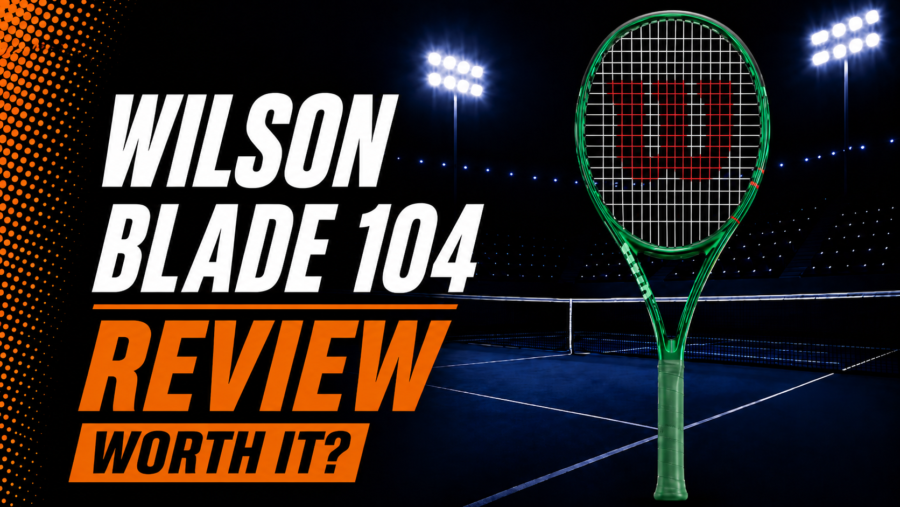
The Wilson Blade 104 V9 is the largest-headed and longest adult racket in Wilson’s ninth-generation Blade range, released for the 2024 model year. This review covers the verified V9 version with a 104 sq in head, 27.5 in length, 290 g unstrung weight and 16×19 string pattern, not an earlier Blade 104 or the V10 model.
It is designed to bring the Blade family’s control-and-feel positioning to players who want more hitting area, reach and leverage than the 98 and 100 sq in models provide. The likely audience is an intermediate or experienced recreational player with a medium-to-full swing who values forgiveness and depth but does not want a thick-beamed power racket.
The 104 is not simply a larger Blade 100. Its extended length changes the swing radius and timing, while its more head-light balance helps keep the longer frame manageable; those differences influence every shot, especially serves, returns and contact close to the body.
Wilson Blade 104 V9 Score
| Category | Score |
|---|---|
| Power | 8.5/10 |
| Spin | 8/10 |
| Control | 8/10 |
| Comfort | 8.5/10 |
These scores are editorial estimates based on the Blade 104 V9’s verified specifications, construction, intended player profile and position in the wider racket market. Strings, tension, manufacturing variation and technique can materially change the outcome.
Wilson Blade 104 V9 Specifications
| Specification | Details |
|---|---|
| Head size | 104 sq in / 671 cm² |
| Length | 27.5 in / 69.9 cm |
| Unstrung weight | 290 g / 10.2 oz, official |
| Strung weight | Approximately 306 g / 10.8 oz, official nominal figure and retailer-measured; string-dependent |
| Unstrung balance | 32 cm / 12.6 in, 9 pts HL, official |
| Strung balance | Approximately 33 cm / 13.0 in, 6 pts HL, retailer/lab measurement |
| Swingweight | Approximately 311 kg·cm² strung, retailer/lab measurement |
| Stiffness | Approximately 64 RA, retailer/lab measurement |
| Beam width | 22 mm / 22 mm / 22 mm |
| String pattern | 16×19 |
| Composition | Braided graphite and basalt frame with a DirectConnect carbon-fiber handle |
| Recommended tension | 50-60 lb / 23-27 kg |
| Grip | Wilson Pro Performance |
Wilson’s regional product pages confirm the model’s generation, dimensions, unstrung weight and balance, construction and nominal strung figures. Swingweight and stiffness are approximate independent measurements; finished weight, balance and swingweight vary with manufacturing tolerances, strings, grip size, overgrips, dampeners and other accessories.
Design, Materials and Technologies
Head Size, Beam and Frame Geometry
The 104 sq in head is the largest in the adult Blade V9 range and provides more string-bed area than the Blade 98 and Blade 100. That increases the geometric margin around the center and can help preserve depth on modestly off-center contact, although it does not make every part of the hoop equally responsive.
Wilson retains a constant 22 mm flat beam, which is slim for a 104 sq in racket. The frame therefore seeks additional power through head size, string-bed area and leverage rather than a wide, highly rigid beam.
The 27.5 in length adds 0.5 in of reach and increases the radius through which the head travels. That can support serve leverage and groundstroke depth, but it also raises timing demands and makes balls close to the body less convenient than with a standard-length racket.
Weight, Balance and Swingweight
The official 290 g unstrung weight places the 104 between the 285 g Blade 100L and the 300 g Blade 100. Its 32 cm unstrung balance is notably head light for the extended length, helping offset the leverage created by the longer frame.
An approximate 311 strung swingweight is moderate, not high, despite the added length. This makes the 104 easier to accelerate than its dimensions may suggest and demonstrates why length, static weight, balance and swingweight must be considered together.
The balance supports maneuverability, while the 104 sq in hoop and extended radius help supply useful momentum. Stability still depends on where the mass sits relative to impact, and the 104 should not be assumed more stable than every 100 sq in racket simply because it is longer.
Materials and Construction
Wilson specifies braided graphite and basalt for the Blade 104 V9, with carbon fiber extending through the DirectConnect handle. The layup is intended to tune flexibility and feedback while improving the structural connection to the end cap.
The approximate 64 RA measurement is moderate and lower than the measured figures for the V9 100L and 100UL. Combined with the thin beam and a larger string bed, it points toward a comparatively flexible, less rigid response, although comfort remains setup- and player-dependent.
Marketing descriptions of feel and stability should not be treated as measured guarantees. Two finished frames can differ within manufacturing tolerances, and a stiff string bed can dominate the response even in a moderate-flex frame.
String Pattern
The 16×19 pattern covers a 104 sq in face, so spacing and string-bed dimensions differ from the same count in the Blade 100. The larger area can create a livelier response and a more accessible launch window, while still allowing string movement that supports spin.
The pattern is versatile enough for topspin, flatter drives and slice, but technique and racket-head speed remain essential. A larger head and open count do not automatically produce heavy rotation if the player contacts the ball passively.
String movement and notching can be more noticeable in a spacious 16×19 bed, particularly with thin gauges and spin-heavy strokes. Players can manage launch and durability through material, gauge and tension rather than assuming a denser pattern is the only answer.
Technologies
FORTYFIVE° is Wilson’s patented layup designed to tune flexibility and stability for modern, more vertical swing paths. It is reasonable to infer that fiber orientation influences how the frame bends, but the claimed improvement in feel remains subjective.
StableFeel is the V9 construction update intended to make the Blade response firmer and more stable than V8. In the 104, it is meant to control the larger hoop without turning the frame into a thick-beamed power design.
DirectConnect extends the carbon-fiber handle to the end cap, which Wilson associates with better torsional stability and a more connected response. Top Grip Taper shapes the upper handle for the top hand on a two-handed backhand, a useful ergonomic detail on the extended frame.
Parallel Drilling aligns the grommet paths to promote a consistent, more forgiving string bed. Click & Go is Wilson’s replaceable bumper-and-grommet design, intended to improve fit and make future component replacement more straightforward.
Wilson Blade 104 V9 Performance
Comfort and Feel
The approximately 64 RA stiffness, 22 mm beam and braided construction suggest a relatively flexible response for a modern 104 sq in racket. The larger string bed can also offer more elasticity than a compact, dense bed when material and tension are equal.
StableFeel was designed to sharpen the V9 response, so the 104 should not be described as uniformly soft or muted. Its longer lever can magnify timing errors, and contact near the tip may seem different from centered contact despite the larger head.
Comfort is subjective and depends on the player’s technique, grip size, physical capacity, strings and tension. A moderate-flex frame does not prevent discomfort, and a firm polyester setup can make the overall system considerably less forgiving.
Comfort score: 8.5/10
Power
Power is more accessible than in the smaller Blade V9 models because the 104 combines a larger string bed with extra length and a 16×19 pattern. Those features can add rebound, reach and leverage without relying on a very stiff beam.
The approximate 311 swingweight remains manageable, so a player with a medium swing should be able to accelerate the head rather than merely guide it. Clean contact and full extension can produce useful depth, while defensive blocks benefit from the larger face.
This is still a Blade rather than a maximum-power oversize racket. Players with very short swings may receive more help from a thicker beam, and the 104’s power remains controllable only when its extended timing is consistent.
Power score: 8.5/10
Control
The slim constant beam, moderate stiffness and head-light balance create a control-oriented foundation despite the larger head. The 104 offers broader margin rather than the pinpoint response of a smaller, denser and heavier player’s frame.
Extended length can improve leverage but requires the contact point to be organized farther from the body. When spacing is correct, the player can use the 16×19 pattern to shape height and depth; when spacing collapses, the extra length can make face control harder.
Directional accuracy still comes primarily from technique. The racket can provide a predictable platform, but the larger string bed and open pattern may require string and tension adjustments for players moving from a low-launch 98 sq in frame.
Control score: 8/10
Spin
The 16×19 pattern offers room for string movement, and the extra length can increase tip speed when the player times the longer swing. The 104 sq in face also provides more contact margin during aggressive low-to-high acceleration.
The head-light balance and moderate swingweight help make that acceleration practical. Spin production nevertheless depends on swing path, speed, contact location and string snapback, not simply on the pattern count.
Because the string bed is larger than the Blade 100’s, launch may be more responsive to gauge and tension. Players who hit flatter can choose a controlled string setup, while topspin players may value the available net clearance.
Spin score: 8/10
Maneuverability
The 32 cm unstrung balance and approximate 311 swingweight are designed to keep the extended frame manageable. Preparation should be easier than with many high-swingweight extended rackets, especially when the player has room for a complete swing.
Length still matters around the body and during rapid grip changes. The 104 may seem quick in open space yet less compact than a standard 27 in Blade during reflex exchanges, so maneuverability should be judged in relation to the player’s spacing and stroke shape.
Stability
The larger hoop, braided construction, StableFeel and DirectConnect are intended to produce a consistent response. The extended length and moderate swingweight also put enough rotational resistance behind central contact for the model’s intermediate target group.
Off-center stability is not guaranteed by head size. Contact high on the hoop or toward the sides can still twist the frame, and the 306 g approximate strung weight is lower than many traditional player’s rackets.
Performance by Shot
Groundstrokes
The Blade 104 V9 should provide useful depth and margin on forehands and backhands, particularly for players with medium-to-full swings who maintain good spacing. Its 16×19 pattern can support topspin, while the slim beam lets flatter hitters drive through the ball without the response becoming exclusively power-oriented.
The extra reach helps on wide defensive balls and can preserve contact when the player is stretched. Balls close to the body require earlier footwork because a 27.5 in frame needs more room to travel than a standard-length racket.
Two-handed backhands may benefit from the longer handle and Top Grip Taper, while one-handed players should confirm that the swing radius remains manageable. The head-light balance reduces the burden but does not remove the adjustment entirely.
Serves
Serving is one of the clearest reasons to consider the 104. The extra 0.5 in provides leverage and a higher effective contact reach, while the 16×19 bed supports slice and kick when the player accelerates along the appropriate path.
Flat-serve pace can benefit from the longer radius, but timing must remain clean. The approximate 311 swingweight keeps the frame from becoming overly demanding overhead, though players accustomed to 27 in rackets may need time to coordinate the contact point.
Volleys and Net Play
The 104 sq in head creates generous coverage at net, and the head-light balance supports positioning the face for conventional volleys. The thin beam and moderate flex also suit players who use touch and angle rather than relying only on rebound.
During rapid exchanges, the extended length can be less convenient close to the body. Blocking hard passing shots should be more stable in the center than at the perimeter, and firm technique remains necessary because the racket is not especially heavy.
Returns
Extra reach helps the player contact wide serves, and the larger head offers useful margin on abbreviated return swings. The head-light balance allows early preparation despite the longer frame.
Aggressive returns can use the extended leverage for depth, but cramped first-serve returns may be harder to organize. Players who block frequently should practice keeping contact in front rather than assuming the larger face will correct late spacing.
String and Setup Considerations
Multifilament and natural gut can complement the Blade 104’s moderate flex and larger string bed by providing elasticity, depth and a broad response. Synthetic gut is a practical, less expensive starting point for players who want predictable all-around behavior.
Polyester or a polyester hybrid can help fast swingers manage launch and string movement. A full bed of firm polyester is not automatically the best choice for the 104’s target player, and its tension should account for the larger head and the individual’s swing speed.
The spacious 16×19 pattern can be responsive to gauge. A thicker or firmer string may reduce movement and launch, while a thinner or softer option can add pocketing and spin potential but may wear sooner.
Wilson’s 50-60 lb / 23-27 kg range is a general frame limit, not a personalized prescription. The Tennis String Finder can help compare materials, and the Tennis String Tension Calculator can provide a structured starting point before a qualified stringer accounts for playing style and prior setups.
Comfort must be evaluated across the full system: frame, string, tension, grip size, technique and contact quality. Small, documented changes are more informative than replacing several setup variables at once.
Build Quality and Durability
The Blade 104 V9 uses a braided graphite-and-basalt frame with a full upper bumper and individual grommets protecting the strings at the drill holes. Its Click & Go assembly is designed to fit smoothly and simplify compatible bumper-and-grommet replacement.
Wilson offers a generation-specific replacement set for the Blade 104 V9, so service parts should be matched to this exact head and generation. A Blade 100 or V10 set should not be assumed compatible merely because the frame comes from the same family.
Scuffs, paint chips and bumper wear are normally cosmetic, while cracks, exposed fiber, soft areas or changing frame shape can indicate structural damage. Inspect the longer frame after court contact and hard impacts, and ask a competent stringer to check worn grommets during restringing.
No fixed lifespan can be promised. Frequency of play, stringing, storage, impacts and court abrasion all affect how quickly cosmetic and replaceable components wear.
Who Should Use It?
The Blade 104 V9 best suits intermediate and experienced recreational players who want a larger hitting area and extra reach without moving to a thick-beamed power racket. Medium-to-full swings can use its head-light balance and moderate swingweight to create depth, spin and controlled acceleration.
It is relevant to all-court players, doubles players who value coverage and baseliners who want more margin than a Blade 98 or 100. Serve-focused players may also appreciate the extended leverage if they can coordinate the longer motion.
The player must be comfortable with 27.5 in length and the associated spacing. A demo is particularly valuable because two rackets with similar static weight can handle very differently when one is extended.
Who Should Avoid It?
Players who prefer compact preparation and frequently contact the ball close to the body may find the 104 cumbersome despite its head-light balance. A standard-length Blade 100L or Blade 100 should be easier to organize in tight exchanges.
Advanced players seeking maximum plow-through and the smallest targeting window may prefer a heavier 98 or 100 sq in frame. Beginners with very short swings who need the highest free power may receive more assistance from a wider beam and possibly a larger recreational head.
Players who want the lowest launch or break strings very frequently may find the large 16×19 bed too active. A denser pattern or more controlled setup could be a better starting point, provided its other demands suit the player.
Pros and Cons
| Pros | Cons |
|---|---|
| 104 sq in head provides more margin than smaller Blades | Extended length requires spacing and timing adjustments |
| 27.5 in length adds reach and serve leverage | Less compact in close-body and reflex exchanges |
| Head-light balance keeps the longer frame manageable | Not as inherently powerful as thick-beamed oversize rackets |
| Moderate flex and serviceable Click & Go grommets | Large 16×19 bed can be sensitive to string and tension choices |
Wilson Blade 104 V9 Compared With Similar Rackets
The Blade 100 V9 has a smaller 100 sq in head, standard 27 in length and 300 g unstrung weight. It offers a more compact swing and greater mass-based stability, while the 104 provides more reach and hitting area; the Wilson Blade 100 Review is the key standard-length comparison.
The Blade 100L V9 is 285 g unstrung, also uses a 100 sq in head and has an approximate 308 swingweight. It is slightly lighter and easier around the body, whereas the 104 adds leverage and margin with only a modest swingweight increase; see the Wilson Blade 100L Review for that choice.
The Blade 100UL V9 drops to 265 g unstrung and prioritizes maximum handling speed for transitioning juniors and developing adults. It is much quicker but less stable and substantial, making the Wilson Blade 100UL Review relevant for players who cannot comfortably manage the 104’s length or mass.
The 2026 Blade 98 16×19 V10 is standard length, 305 g unstrung and built around a smaller 98 sq in head with a tapered beam. Its approximate 322 swingweight and narrower hitting area make the Wilson Blade 98 16×19 Review useful for readers deciding between the V9 104’s reach and margin and the V10 98’s more compact, demanding profile.
Final Verdict
The Wilson Blade 104 V9 combines the largest head and longest frame in the V9 Blade family with a slim beam, moderate flex and manageable approximate swingweight. Its strengths are reach, margin, serve leverage and controllable depth, while its limitations are the spacing demands of extended length and less compact handling around the body.
It is a versatile option for intermediate and experienced recreational players who want a more forgiving Blade rather than a conventional oversize power racket. The most important question is not whether 104 sq in is easy to use, but whether the player’s timing and footwork suit the 27.5 in lever.
Frequently Asked Questions
Is the Wilson Blade 104 V9 suitable for beginners?
It can suit a coordinated beginner who is comfortable with an extended full-size frame, but it is aimed more naturally at intermediate and experienced recreational players. A shorter, thicker-beamed beginner racket may provide easier timing and more free depth for a new player with a compact swing.
Is the Blade 104 V9 more powerful than the Blade 100 V9?
The larger head and extra 0.5 in of length provide more rebound area and leverage, so power is generally more accessible. The standard Blade 100 has more static mass and a higher approximate swingweight, which can create a heavier response when swung effectively.
Is the Blade 104 V9 a comfortable racket?
Its approximately 64 RA stiffness, braided construction and 22 mm beam suggest a relatively flexible response. Comfort still depends on strings, tension, technique, grip size and the individual player.
Does the Blade 104 V9 generate spin?
The 16×19 pattern and extended length support spin potential when the player generates racket-head speed. The larger bed may also raise launch, so string setup and face control matter.
How demanding is the 27.5 in length?
The head-light balance and approximate 311 swingweight keep it manageable in open swings. It still needs more space around the body and slightly different timing than a standard 27 in racket.
What is the difference between the Blade 104 V9 and Blade 100L V9?
The 104 has a 4 sq in larger head, is 0.5 in longer and is 5 g heavier unstrung. It offers more reach and margin, while the 100L is more compact and quicker during close exchanges.
What strings work well in the Blade 104 V9?
Multifilament, synthetic gut and natural gut can provide elastic, accessible response, while hybrids can help manage launch. Polyester may suit faster swingers and string breakers, but material, gauge and tension should be chosen for the player’s needs rather than by default.