
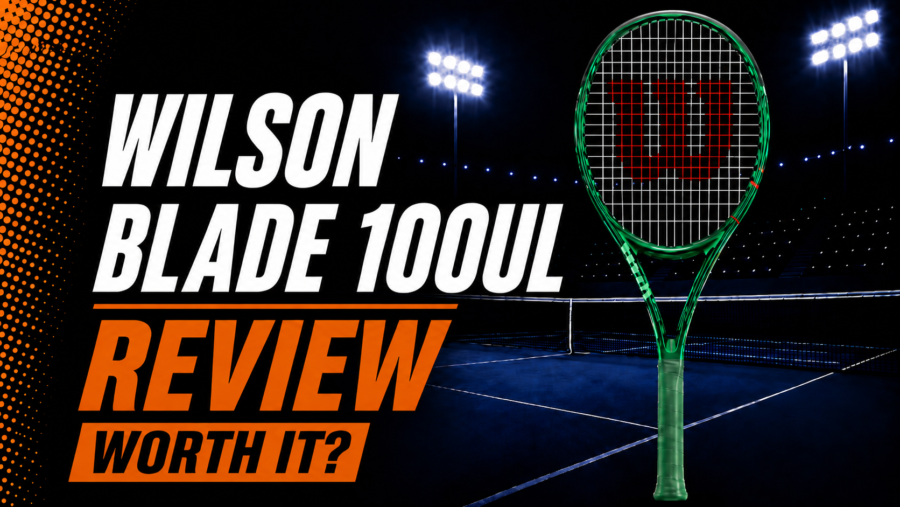
The Wilson Blade 100UL V9 is the lightest adult racket in Wilson’s ninth-generation Blade line, released for the 2024 model year. This review covers only the V9 100 sq in head with its 16×19 string pattern and 265 g unstrung weight, not the earlier V8 or the newer V10.
Wilson positions the Blade family around feel and control, but the 100UL makes that identity easier to access through very low static weight and quick handling. It is aimed mainly at transitioning juniors, beginners and lower-intermediate adults who can benefit from easy acceleration more than the mass and stability of a heavier performance frame.
The 100UL shares the standard 27 in length, 100 sq in head and constant 22 mm beam used by the Blade 100L V9, yet it is 20 g lighter before strings. That difference matters: the 100UL is easier to prepare and accelerate, while the 100L and standard Blade 100 offer more mass behind the ball and greater resistance to twisting.
Wilson Blade 100UL V9 Score
| Category | Score |
|---|---|
| Power | 7.5/10 |
| Spin | 8/10 |
| Control | 7.5/10 |
| Comfort | 7.5/10 |
These are editorial estimates based on the Blade 100UL V9’s verified specifications, construction, intended player profile and position within the wider tennis-racket market. The complete string setup, finished frame and player technique can materially change the response.
Wilson Blade 100UL V9 Specifications
| Specification | Details |
|---|---|
| Head size | 100 sq in / 645 cm² |
| Length | 27 in / 68.6 cm |
| Unstrung weight | 265 g / 9.3 oz, official |
| Strung weight | Approximately 283 g / 10.0 oz, retailer-measured; string-dependent |
| Unstrung balance | 33.5 cm / 13.2 in, 2 pts HL, official |
| Strung balance | Approximately 34.0 cm / 13.4 in, 1 pt HL, retailer-measured |
| Swingweight | Approximately 304 kg·cm² strung, retailer/lab measurement |
| Stiffness | Approximately 65 RA, retailer/lab measurement |
| Beam width | 22 mm / 22 mm / 22 mm |
| String pattern | 16×19 |
| Composition | Braided graphite and basalt frame with a DirectConnect carbon-fiber handle |
| Recommended tension | 50-60 lb / 23-27 kg |
| Grip | Wilson Pro Performance |
Wilson’s official V9 listing supplies the unstrung weight, balance, head size, length, string pattern and construction. The strung figures, swingweight and stiffness above are approximate cross-checked measurements; finished specifications can vary with manufacturing tolerances, string type and gauge, grip size, overgrips, dampeners and other accessories.
Design, Materials and Technologies
Head Size, Beam and Frame Geometry
The 100 sq in head gives the 100UL a larger usable hitting area than either Blade 98 V9. It should provide more margin on slightly off-center contact than a 98 sq in player’s frame, although head size alone does not guarantee forgiveness when the overall racket is this light.
Its constant 22 mm flat beam is relatively slim beside many power-oriented 100 sq in rackets. That geometry keeps the frame aligned with the Blade range’s control-focused identity, rather than relying on a thick aerodynamic beam to create maximum rebound.
The standard 27 in length avoids the extra leverage and timing demands of an extended frame. Players moving from a full-size junior racket therefore receive adult dimensions without also having to manage additional reach or swing radius.
Weight, Balance and Swingweight
At 265 g unstrung, the 100UL is built for preparation speed and easy racket-head acceleration. Its 33.5 cm unstrung balance places more of that limited mass toward the hoop than a strongly head-light player’s racket, helping prevent the frame from becoming entirely handle-dominant.
The approximate 304 strung swingweight is more substantial than the static weight might suggest. It remains quick by adult performance-racket standards, but it is not as low as some ultra-light frames, illustrating why static weight and swingweight should be considered separately.
That distribution supports usable momentum while preserving maneuverability, yet it cannot fully replace additional mass on hard, off-center contact. Players who routinely face heavy pace may notice the difference between easy acceleration and genuine impact stability.
Materials and Construction
Wilson identifies a braided graphite and basalt construction for the Blade 100UL V9. The braid and basalt are part of the frame layup, while the DirectConnect design extends carbon fiber through the handle to the end cap.
These materials are intended to tune flex, feedback and torsional behavior, but their presence does not independently prove that every player will find the racket comfortable or stable. String choice, contact quality and the individual finished frame remain important.
The approximately 65 RA measurement is moderate rather than exceptionally flexible. Because a light frame has less mass to absorb and redirect incoming pace, comfort cannot be inferred from the RA number alone.
String Pattern
The 16×19 pattern gives the mains room to move and return, which can support a higher launch window and spin than a denser pattern when the player supplies sufficient racket-head speed. The low overall mass makes that acceleration accessible, particularly for developing topspin mechanics.
Not every 16×19 string bed behaves the same way. Head shape, drilling, string spacing, gauge and tension all influence launch, movement and durability, so the pattern should not be treated as a guarantee of spin.
Frequent string breakers may find that an open pattern permits more main-string movement and notching than an 18×20 layout. Developing players who do not hit with high pace may value the livelier response more than they notice any durability tradeoff.
Technologies
FORTYFIVE° is Wilson’s name for a carbon layup arranged to complement the more vertical swing paths common in modern tennis. Wilson claims that it combines flexibility with stability, while the reasonable inference is simply that the layup is designed to tune how the frame bends in different directions.
DirectConnect continues the carbon-fiber handle into the end cap instead of ending the structural connection higher in the handle. Wilson associates this with a more connected response and improved torsional stability, though the 100UL’s very low mass still limits how much resistance it can offer against heavy impact.
StableFeel was introduced in the V9 line to produce a firmer, more stable response than the prior generation. It should be understood as a construction change and manufacturer claim, not proof that the 100UL matches the stability of a 300 g Blade.
Parallel Drilling aligns selected grommet holes to allow a more consistent string-bed response, while Top Grip Taper shapes the upper handle for the top hand on a two-handed backhand. The Click & Go bumper-and-grommet system is designed for a cleaner fit and easier component replacement, a practical serviceability feature rather than a direct performance guarantee.
Wilson Blade 100UL V9 Performance
Comfort and Feel
The 22 mm beam, braided layup and moderate approximate stiffness point toward a response that should be more controlled and less rigid than many thick-beamed power rackets. StableFeel is intended to sharpen the V9 response, so this model may seem more direct than a very soft or heavily damped recreational frame.
Low static weight is not automatically comfortable. A lighter racket can be easy to swing yet provide less mass behind the ball, particularly on late or off-center contact, and a firm polyester setup can make the string bed more demanding.
Comfort is subjective and depends on technique, timing, grip size, string material, gauge, tension and the individual player. A player prioritizing a softer response should evaluate the complete setup rather than relying on the Blade name or RA figure.
Comfort score: 7.5/10
Power
The 100 sq in head and open pattern supply some rebound assistance, while the near-even finished balance helps keep useful mass in the hoop. The racket’s very low static weight, however, means it does not create the same momentum or penetrating depth as the heavier Blade models when swing speed is equal.
Its most accessible source of pace is acceleration. Players with compact or developing swings should find it easier to bring the racket through contact, but deeper, heavier shots will still depend on timing, technique and adequate racket-head speed.
The 22 mm beam also keeps power below the level of many thick-beamed beginner frames. The result is accessible handling with moderate power, rather than a true high-power oversize design.
Power score: 7.5/10
Control
Control comes from the slim constant beam, standard length and Blade-oriented layup, which are designed to produce a relatively predictable response. The 100 sq in head gives more margin than a Blade 98, but the open pattern and light frame can make launch more setup-sensitive.
The racket cannot create directional accuracy without repeatable contact and swing mechanics. Players who accelerate smoothly should be able to use its speed to shape targets, while those who decelerate or contact the ball late may see depth fluctuate.
Against fast incoming balls, the lack of mass can reduce precision because the frame has less resistance to deflection. That is the principal control limitation compared with the 100L and standard Blade 100.
Control score: 7.5/10
Spin
The 16×19 pattern and low static weight make it relatively easy to generate the racket-head speed required for topspin and slice. The 100 sq in head also provides a practical contact area for players still learning a consistent low-to-high path.
Spin remains a product of technique, contact speed and string behavior. A player who pushes the ball will not receive heavy rotation from the pattern alone, and a worn or locked string bed can reduce snapback.
Compared with a dedicated spin frame, the constant 22 mm beam and Blade geometry keep the response more neutral. This is useful for players who want access to both flatter drives and shaped shots rather than a highly specialized launch profile.
Spin score: 8/10
Maneuverability
Maneuverability is the 100UL’s clearest strength. The 265 g unstrung weight and approximate 304 swingweight support early preparation, quick changes of direction and acceleration on serves, returns and reaction volleys.
The near-even finished balance means the head may be more noticeable than the static weight suggests, but the overall package remains fast. This can help juniors moving to adult length and adults with compact swings who struggle to prepare a heavier frame on time.
Stability
StableFeel, DirectConnect and the hoop-oriented balance are intended to reduce unwanted frame movement, while the 22 mm beam provides a consistent structural profile. These features give the 100UL a better foundation than static weight alone would imply.
Even so, a roughly 283 g strung racket has limited mass for absorbing heavy pace. Clean central contact should be much more predictable than contact near the frame, and players who frequently block fast serves may prefer the 100L or standard Blade 100.
Performance by Shot
Groundstrokes
From the baseline, the 100UL should favor compact-to-medium swings, quick preparation and active acceleration. It can help a developing forehand or two-handed backhand reach contact on time, with the 16×19 pattern supporting topspin when the swing moves decisively through the ball.
Flatter drives require disciplined face control because the open pattern and light mass do not automatically keep launch low. On defensive groundstrokes, the racket is easy to position, although recovering depth against a heavy ball may require more player-generated speed than its low weight initially suggests.
Serves
The low weight makes it easier to move the racket overhead and build racket-head speed. That can assist developing servers with slice and kick mechanics, while the standard length keeps timing conventional.
Flat-serve pace will depend more on acceleration and clean contact than on mass or extended leverage. Players who already swing quickly may produce a heavier serve with a higher-swingweight alternative, while players who struggle to complete the service motion may prefer the 100UL’s speed.
Volleys and Net Play
Quick exchanges suit this model because the head can be set rapidly and redirected with minimal effort. The 100 sq in face and Parallel Drilling are intended to provide a more forgiving string-bed response than a smaller Blade.
Punch volleys against pace reveal the tradeoff: the frame may be easier to position but less resistant to twisting than a heavier racket. Firm technique and central contact are therefore more important when trying to redirect a fast passing shot.
Returns
The 100UL allows a short backswing and fast preparation, useful when reacting to a serve with limited time. It should also be easy to accelerate on a second-serve return when the player wants to create spin.
Blocking a powerful first serve is more demanding because low mass provides less passive stability. Players should judge whether preparation speed or resistance to incoming pace matters more for their return style.
String and Setup Considerations
Synthetic gut or multifilament is a logical starting point for many players in the 100UL’s target group because either can provide accessible depth and a less rigid string-bed response than a full bed of firm polyester. Natural gut can offer elasticity and tension stability, while a gut or multifilament hybrid may balance response with added control.
Polyester can suit players who swing fast enough to benefit from its lower-powered response and who monitor string condition carefully. A full bed should not be selected merely because it is common among advanced players; gauge, stiffness, tension and replacement frequency all affect the result.
The 16×19 pattern may increase string movement and notching, especially with thinner or softer strings. Higher tension can lower launch, while lower tension can add depth and a more elastic response, but changes should remain conservative and within Wilson’s stated range.
The Tennis String Finder can help narrow the material options, and the Tennis String Tension Calculator provides a structured starting point for comparing setups. Comfort depends on the frame, string, tension, grip and technique together, so changing one variable at a time makes the effect easier to evaluate.
Build Quality and Durability
The frame uses a braided graphite-and-basalt layup with a full bumper protecting the upper hoop. Wilson’s Click & Go system is designed to make the bumper and grommet assembly fit securely and simplify replacement when compatible parts are available.
Court contact can scratch the matte finish and wear the bumper without indicating structural failure. Split grommets should be replaced before they expose strings to sharp frame edges, and worn bumper sections should not be allowed to leave the graphite unprotected.
Inspect the hoop, throat and handle after a hard impact for cracks, soft areas or unusual movement. Cosmetic chips are different from structural damage, and no fixed lifespan can be promised because use, stringing practices, storage and impacts vary widely.
Who Should Use It?
The Blade 100UL V9 best suits transitioning juniors ready for a 27 in adult frame, beginners developing full strokes and lower-intermediate adults who prioritize preparation speed. It also makes sense for recreational doubles players who value quick handling in compact exchanges.
Compact-to-medium swings benefit most from its low mass, while faster swings can use the 16×19 pattern for spin if the player accepts the stability tradeoff. The player should still be physically able to control its near-even finished balance and approximate 304 swingweight throughout a session.
It is a particularly relevant choice for someone who wants a control-oriented family identity without the 300 g unstrung weight of the standard Blade 100. It is less suitable as a shortcut to advanced-level ball weight, which depends on technique and adequate mass as well as speed.
Who Should Avoid It?
Advanced players who face heavy pace regularly may find the 100UL too light or too easily deflected. A heavier Blade 100L, Blade 100 or another stable 100 sq in frame should offer more mass behind returns, volleys and flatter drives.
Players seeking maximum free power may prefer a thicker-beamed recreational or power racket. Those who want the lowest launch and most exact response may instead consider a heavier, denser-pattern control frame if they can manage its demands.
The 100UL is also a poor match for anyone planning large amounts of hoop weighting without understanding the consequences. Added mass can raise swingweight quickly, alter balance and change the very maneuverability that defines this model.
Pros and Cons
| Pros | Cons |
|---|---|
| Very low weight supports quick preparation and acceleration | Less mass and torsional stability than heavier Blade models |
| 100 sq in head provides useful margin for developing players | Limited passive depth against heavy incoming pace |
| 16×19 pattern supports spin and adjustable launch | Open pattern can be setup-sensitive and increase string movement |
| Replaceable Click & Go bumper and grommet system | Near-even finished balance may feel more head-present than expected |
Wilson Blade 100UL V9 Compared With Similar Rackets
The Blade 100L V9 uses the same 100 sq in head, 27 in length, 22 mm beam and 16×19 pattern, but adds 20 g of unstrung mass. That produces more stability and ball weight while remaining lighter than the standard Blade 100, making the Wilson Blade 100L Review the most useful next comparison for improving adults.
The Blade 100 V9 rises to 300 g unstrung and approximately 322 swingweight, with a more head-light unstrung balance. It is substantially more stable and better suited to medium-to-full swings, but it is also more demanding to prepare repeatedly; the Wilson Blade 100 Review explains that tradeoff in detail.
The Blade 104 V9 has a 104 sq in head, 27.5 in length and 290 g unstrung weight. It offers more reach, a larger hitting area and additional leverage, while the 100UL remains easier to reposition; see the Wilson Blade 104 Review if forgiveness and extended reach matter more than minimum weight.
The 2026 Blade 98 16×19 V10 has a smaller 98 sq in head, 305 g unstrung weight and a tapered 21.5 mm / 21.5 mm / 20.5 mm beam. Its approximate 322 swingweight and narrower contact window make it substantially more demanding than the 100UL, so the Wilson Blade 98 16×19 Review is relevant only for players ready for that V10 performance profile.
Final Verdict
The Wilson Blade 100UL V9 is a specialized access point to the Blade family: adult length and a modern 100 sq in head in a 265 g unstrung package. Its main strengths are maneuverability, easy acceleration and a spin-capable 16×19 pattern, while its principal limitations are low passive stability and limited mass behind the ball.
It fits transitioning juniors, beginners and lower-intermediate players who value preparation speed and a slimmer, control-oriented beam. Before choosing it, compare the benefit of low weight with the greater stability of the 100L, because the lightest option is not automatically the easiest option against real match pace.
Frequently Asked Questions
Is the Wilson Blade 100UL V9 suitable for beginners?
Yes, it can suit beginners who are ready for a full-length racket and want very easy handling. Its 100 sq in head is practical, but players who need more free power may prefer a thicker-beamed beginner frame.
Is the Blade 100UL V9 a junior racket?
It is an adult-length racket that Wilson specifically positions as useful for juniors transitioning to a full-size frame. Younger players should still be able to control its 27 in length, grip size and approximate 304 swingweight.
Is it designed more for power or control?
The Blade family is positioned around feel and control, and the 22 mm beam supports that identity. The 100UL adds accessible speed and moderate rebound, but it is not a maximum-power frame.
Is the Blade 100UL V9 comfortable?
Its braided construction, moderate measured stiffness and thin beam suggest a relatively controlled response, but comfort is individual. Strings, tension, technique, grip size and contact quality can matter as much as the frame specification.
Can the Blade 100UL V9 generate spin?
The 16×19 pattern and low weight make racket-head acceleration accessible, which supports spin production. Actual rotation still requires suitable technique, contact speed and a string bed that can move and recover.
What is the difference between the Blade 100UL V9 and Blade 100L V9?
The 100UL is 265 g unstrung, while the 100L is 285 g unstrung with the same head size, length, beam and pattern. The 100UL is quicker, while the 100L offers more mass, stability and potential ball weight.
What strings work well in the Blade 100UL V9?
Synthetic gut and multifilament are sensible starting points for many developing players, while natural gut or hybrids can provide other balances of response and control. Polyester is best reserved for players whose swing speed and string-breaking needs justify its firmer, lower-powered response.