
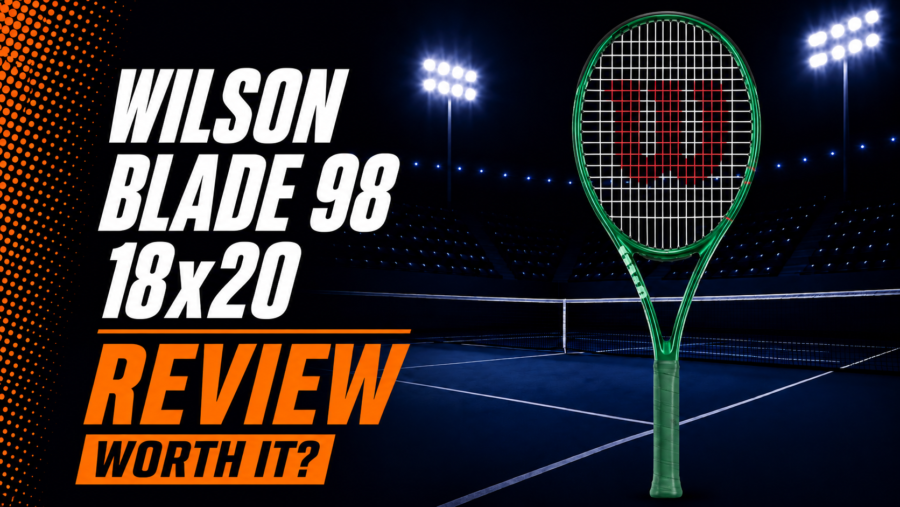
The Wilson Blade 98 18×20 V10 is the dense-pattern, 98 in² control model in Wilson’s 2026 Blade performance range. It combines a 305 g unstrung weight, a compact head and an 18×20 string bed with the V10 generation’s first tapered Blade beam, giving experienced players a more controlled alternative to modern 100 in² power rackets.
This is the standard Blade 98 18×20 V10, not the heavier-swinging Blade Pro, and its specifications should not be confused with the constant-beam V8 or V9 frames. The V10 remains aimed primarily at intermediate to advanced players with developed strokes, but Wilson has added a little more support in the upper hoop while retaining the line’s emphasis on feel, placement and player-generated pace.
Compared with the Blade 98 16×19 V10, this version has the same 98 in² head, 305 g unstrung weight and 32 cm unstrung balance. Its denser 18×20 pattern produces a lower, more contained launch and slightly greater string-bed predictability, while the 16×19 version offers easier net clearance, spin and depth.
Wilson Blade 98 18×20 V10 Score
| Category | Score |
|---|---|
| Power | 6.5/10 |
| Spin | 6.5/10 |
| Control | 9.5/10 |
| Comfort | 8/10 |
These scores are editorial estimates based on the racket’s verified specifications, construction, intended playing profile and position within the wider tennis-racket market. They describe its relative tendencies rather than guaranteed results, because technique, strings, tension and individual preference materially affect performance.
Wilson Blade 98 18×20 V10 Specifications
| Specification | Details |
|---|---|
| Head size | 98 in² / 632 cm² |
| Length | 27 in / 68.6 cm |
| Unstrung weight | 305 g / 10.8 oz |
| Strung weight | Approximately 323 g / 11.4 oz, retailer measured |
| Unstrung balance | 32 cm / 7 pts head light |
| Strung balance | Approximately 33 cm / 4 pts head light, retailer measured |
| Swingweight | Approximately 325, strung retailer measurement |
| Stiffness | Approximately 61 RA, retailer measured |
| Beam width | 21.5 mm / 21.5 mm / 20.5 mm |
| String pattern | 18×20 |
| Composition | Braided graphite and carbon construction |
| Recommended tension | 47-57 lb / 21-26 kg |
| Grip | Wilson Pro Performance |
Wilson publishes the head size, length, pattern, nominal unstrung weight and balance, while finished figures are based on retailer measurements of strung samples. Actual weight, balance and swingweight can vary because of manufacturing tolerances, string type and gauge, grip size, overgrips, dampeners and other accessories.
Design, Materials and Technologies
Head Size, Beam and Frame Geometry
The 98 in² head is smaller than the 100 to 105 in² heads common in recreational and power-focused frames. That gives the string bed a more concentrated response and supports precise targeting, but it also reduces the margin available when contact drifts toward the hoop or frame.
V10 introduces a tapered beam to the standard Blade 98 for the first time. The beam is approximately 21.5 mm through the lower and middle sections before narrowing to 20.5 mm, and Wilson says the additional height in the upper hoop is intended to improve stability and add some power without abandoning the Blade’s control identity.
The change is meaningful when comparing generations. V8 and V9 specifications used a thinner constant beam, so their stiffness, swingweight and playing descriptions should not be carried into this review even though the model names and basic 98 in², 305 g format look similar.
Weight, Balance and Swingweight
At 305 g unstrung and roughly 323 g strung, the Blade 98 18×20 V10 sits firmly in performance-racket territory. Its 32 cm unstrung balance is head light, which helps the player prepare the racket despite the substantial finished mass.
An approximate strung swingweight of 325 is moderate for this class rather than exceptionally high. It should provide enough inertia for a solid response when the swing is completed, while remaining quicker than tour-style frames with swingweights in the mid 330s or above.
Static weight and swingweight describe different things. The racket is not light in the hand, but its head-light distribution keeps it from feeling as cumbersome in motion as an equally heavy, more head-loaded frame; conversely, players still need the strength and timing to accelerate its 323 g finished mass repeatedly.
Materials and Construction
Wilson identifies braided composition as part of the V10 construction, with carbon fibers arranged to tune flex and feedback. Braiding can influence how the frame bends and recovers, but the material name alone does not prove that every player will prefer the response.
The carbon handle extends directly into the end cap through DirectConnect rather than relying on a more separate handle component. Wilson presents this as a way to improve connection and torsional stability, and the construction reasonably supports a more direct transmission of impact information to the hand.
String Pattern
Eighteen mains and 20 crosses create a dense bed within the 98 in² head. The spacing is intended to limit launch variation and excessive string movement, which can help flatter hitters and players who redirect pace trust the trajectory on committed swings.
The pattern can also improve notching resistance relative to a comparably strung open bed because the strings generally move less. It does not eliminate breakage, and thin shaped polyester can still wear rapidly for a strong hitter.
An 18×20 pattern can produce spin when the player creates sufficient racket-head speed and a steep swing path. It simply supplies less automatic launch and snapback space than the 16×19 Blade, so topspin production depends more heavily on technique and an appropriate string setup.
Technologies
FORTYFIVE is Wilson’s name for the carbon layup designed to manage frame bending in multiple swing directions. The manufacturer links it to Blade feel and stability; in practical terms, it is a layup choice rather than a guarantee of comfort or accuracy.
StableFeel+ and the V10 layup changes are intended to reduce unwanted frame movement, particularly on contact away from the center. Wilson also describes three-dimensional bending control through SI3D and a three-degree torsional-stability target through Zen Edge in regional V10 materials, but those are manufacturer design claims, not independent performance measurements.
Signature X-Loop refers to the geometry around the shoulders of the hoop, while Parallel Drilling lets the strings enter the frame more directly. Together with the denser pattern, these features are designed to balance response consistency with enough string movement to avoid an excessively rigid bed.
Click-and-Go is the replaceable bumper and grommet system used on V10. Its closer fit is intended to simplify maintenance and protect the frame, while Elite Spec Tolerance describes Wilson’s tighter factory targets for weight, balance and swingweight rather than a promise that every frame will be numerically identical.
Wilson Blade 98 18×20 V10 Performance
Comfort and Feel
The low measured stiffness, narrow tapered beam and braided construction point toward a more flexible, connected response than many thick-beamed power rackets. The dense string bed can still feel firm when paired with a stiff polyester at high tension, so frame flex should not be treated as the only determinant of comfort.
StableFeel+ is designed to make the hoop react more cleanly on imperfect contact, while DirectConnect transmits feedback more directly through the handle. That combination suggests a controlled and relatively crisp V10 response rather than the especially muted sensation some damping-heavy frames create.
Comfort remains personal and depends on contact quality, technique, grip size, string material, gauge and tension. No racket prevents or treats arm problems, and anyone managing persistent discomfort should evaluate the complete setup and seek qualified advice when appropriate.
Comfort score: 8/10
Power
Power here comes mainly from the player’s swing, the roughly 325 swingweight and the added support of the taller upper hoop. The V10 beam update should make depth a little more accessible than on a very thin constant-beam control frame, but the 98 in² head and 18×20 pattern still keep rebound relatively contained.
Players with long, fast swings can use the frame’s mass to send a heavy ball without the trajectory becoming difficult to manage. Short swings, late contact and defensive pokes receive less assistance than they would from a lighter 100 to 105 in² racket with a wider beam.
Power score: 6.5/10
Control
The Blade 98 18×20 V10 is built around trajectory control. Its compact head, dense pattern, head-light balance and low-to-moderate stiffness create a platform intended for players who accelerate confidently and want the string bed to respond predictably.
Directional accuracy still comes from preparation, spacing and face control. The racket can make a technically sound swing easier to trust, but it cannot correct an unstable wrist, changing contact point or late preparation.
The low launch is especially relevant for flatter drives, backhand slices and returns redirected through narrow targets. Heavy topspin players who rely on higher net clearance may need more deliberate lift or may prefer the 16×19 version.
Control score: 9.5/10
Spin
The 18×20 bed offers useful spin potential but is not the most spin-assisting Blade. Tight spacing controls the launch and limits string movement, so the player needs racket-head speed, brushing contact and a suitable string to create a high, sharply dipping ball.
Slice is a particular fit because the stable, predictable face supports a low trajectory and precise depth. On topspin, thinner strings or a lower-friction hybrid can increase string movement without changing the fundamental character of the frame.
Spin score: 6.5/10
Maneuverability
The 32 cm unstrung balance and approximate 325 swingweight help the Blade move more quickly than its 323 g strung weight might suggest. Experienced players should be able to set it early for returns and volleys, but repeated late preparation will expose the demands of its mass.
It is maneuverable relative to other player frames, not relative to 270 to 285 g recreational rackets. Players moving up from a light frame should assess whether they can maintain acceleration and technique over a full session.
Stability
The combination of finished mass, tapered upper hoop and V10 torsional-stability features is designed to resist twisting on off-center contact. An approximate 325 swingweight supplies useful momentum against incoming pace without turning the racket into a very high-inertia specialist frame.
Stability will be strongest when the player meets the ball in front with a complete swing. Contact near the outer edge of a 98 in² head still loses more response than it would on a larger, more forgiving model, and adding weight to compensate would also increase swingweight and handling demands.
Performance by Shot
Groundstrokes
From the baseline, the Blade 98 18×20 V10 is best suited to full, organized swings. Flatter forehands and backhands should benefit from the low launch and predictable bed, allowing a player to drive through the court without relying on extreme spin to control depth.
Topspin remains available, but the racket asks the player to generate the vertical racket-head speed. On defensive groundstrokes, the head-light balance helps preparation, yet the compact head and restrained rebound provide less rescue power when the player is stretched or contacting the ball late.
The frame can suit both one-handed and two-handed backhands if the player handles its mass. A one-hander may value the head-light balance and slice control, while a two-hander can use the strung weight for redirection and counterpunching.
Serves
The 27 in length and head-light balance allow an experienced server to accelerate through the motion, while the finished mass can support pace when timing is efficient. Placement is the primary strength because the dense bed keeps launch changes small across flat and slice targets.
Kick serves demand more upward acceleration than with a very open spin frame. The racket will not manufacture height over the net, but players with a developed brushing motion can still use its predictable response to vary location and shape.
Volleys and Net Play
At net, the Blade’s compact face and stable construction favor purposeful volleys. The head-light balance supports quick positioning, and the dense bed should help control punch volleys, angles and low skidding contact.
The smaller head leaves less room for reaction volleys struck away from center. Doubles players who prioritize a larger defensive surface may prefer a 100 in² alternative, while precise all-court players may value the Blade’s cleaner targeting.
Returns
The approximate 325 swingweight gives the racket enough substance to block pace, and the 18×20 pattern makes redirected returns easier to aim. Its head-light balance helps with the compact preparation required against a fast first serve.
Attacking second serves suits the frame when the returner can step in and complete the swing. Stretched returns receive limited free depth, so a larger or more powerful racket remains easier for players who often defend from compromised positions.
String and Setup Considerations
The dense pattern naturally reins in launch, so the setup should not remove more depth and comfort than the player can replace. A thin, moderately powered polyester can suit strong string breakers who generate their own pace, but a full bed of firm polyester is not necessary simply because this is an advanced frame.
Multifilament or natural gut can add rebound and soften the impact response for players who do not need maximum string control. A gut or multifilament main with a smooth polyester cross can combine easier depth with lower friction, while a polyester main hybrid prioritizes spin control and durability.
Gauge matters because an 18×20 bed can feel board-like with a thick string. A thinner gauge can open the response and improve pocketing, although it usually sacrifices some durability.
Use the Tennis String Finder to narrow choices by feel, control, spin and durability rather than copying another player’s setup. The Tennis String Tension Calculator can provide a sensible starting range, but final tension should account for string material, local conditions, playing history and the frame’s printed range.
Players changing from the 16×19 Blade should avoid assuming that the same string and tension will behave identically. The denser bed may justify a slightly more elastic string or a modestly lower reference tension, followed by gradual adjustments based on launch and comfort.
Build Quality and Durability
The V10 uses a full graphite performance-frame construction with a replaceable Click-and-Go bumper and grommet set. The bumper protects the outer edge during low contact and scraping, while the grommets isolate the strings from sharp graphite edges.
Green paint and exposed bumper areas will develop cosmetic marks with normal use, especially for players who reach close to the court. Paint chips and superficial scratches do not automatically mean the frame is unsafe, but they should be monitored if they expose deeper layers or appear after a hard impact.
Grommets can split, flatten or become sharp over time, and a worn bumper can leave the hoop vulnerable. Replacement parts should match the 18×20 V10 specifically because V8, V9, 16×19 and Blade Pro grommet layouts are not interchangeable by assumption.
Inspect the head, throat and handle after major impacts and during restringing. Cracks, soft spots, spreading lines through the graphite or unusual movement are structural concerns, unlike ordinary surface scuffs, and a damaged frame should be assessed before further play.
Who Should Use It?
The Blade 98 18×20 V10 best suits established intermediate, advanced and competitive players with medium-fast to fast, generally full swings. They should already create their own pace and spin and should value a low launch, direct feedback and precise ball placement more than easy defensive power.
It is a strong fit for flatter baseliners, counterpunchers who redirect pace, all-court players and doubles players who want dependable volleys. Players using heavy topspin can also make it work, but they need the acceleration and technique to lift the ball from the dense bed.
Physical suitability matters. A player should be able to prepare a roughly 323 g strung racket repeatedly and control an approximate 325 swingweight without shortening the stroke late in sessions.
Who Should Avoid It?
Most beginners will find the compact head, restrained power and finished mass unnecessarily demanding. A lighter 100 to 105 in² racket with a more open pattern will usually provide a larger contact area, easier depth and more manageable preparation.
Intermediate players with short swings or players who depend on high launch and easy topspin may also prefer the Blade 98 16×19 V10 or Blade 100 V10. Anyone who regularly arrives late against pace should prioritize a lower swingweight or a larger head instead of choosing the dense Blade solely for its control reputation.
Players seeking maximum free power should consider a wider-beamed power family. Those wanting even more mass and plow-through should not assume the Blade Pro is an automatic upgrade, because its substantially higher swingweight makes it more specialized and physically demanding.
Pros and Cons
| Pros | Cons |
|---|---|
| Highly predictable 18×20 response | Limited free depth on short or defensive swings |
| Excellent directional control for full strokes | Smaller margin for error than a 100 in² frame |
| Head-light balance supports preparation | Requires developed racket-head speed for heavy spin |
| V10 tapered hoop adds support without a thick beam | Roughly 323 g strung weight can fatigue some players |
Wilson Blade 98 18×20 V10 Compared With Similar Rackets
The Wilson Blade 98 16×19 Review covers the closest alternative. Both V10 models share the 98 in² head, 305 g unstrung weight, 32 cm balance and tapered beam, but the 16×19 launches higher, offers easier spin and supplies slightly more depth; the 18×20 is more contained and precise for flatter swings.
The Head Gravity Pro tennis racket represents another dense-pattern control option, but its larger 100 in² head and generally higher mass or swingweight profile create a broader contact area with more inertia. The Blade is quicker and more compact, while the Gravity Pro favors players comfortable managing a more substantial swing.
The Babolat Pure Strike 98 16×19 Review describes a firmer, more power-assisted 98 in² alternative with an open pattern. The Pure Strike supplies easier launch and spin, while the Blade 18×20 offers a denser trajectory, lower measured stiffness and a more specialized precision profile.
A Tecnifibre TF40 305 18×20 is also relevant for players comparing classic control frames. It follows a similarly dense 305 g concept, but exact swingweight and feel vary by generation, so the best choice depends on whether the player prefers the Blade V10’s tapered hoop and Wilson handle response or the TF40’s own layup and geometry.
Final Verdict
The Wilson Blade 98 18×20 V10 is a focused control racket with a compact head, dense pattern, head-light balance and enough strung inertia to meet pace confidently. The tapered V10 beam adds useful support, but it does not transform the frame into a high-powered or highly forgiving option.
Its main strengths are trajectory predictability, directional precision, slice control and a flexible, connected specification profile. Its limitations are the low amount of free depth, the technical demand of creating spin from an 18×20 bed and the physical requirement of swinging roughly 323 g consistently.
This is most rewarding for a developed player who knows why a low launch and dense string pattern suit the game. Before choosing it, the essential question is whether that control advantage outweighs the easier depth, spin and forgiveness available from the 16×19 Blade or a 100 in² alternative.
Frequently Asked Questions
Is the Wilson Blade 98 18×20 V10 suitable for beginners?
Generally, no. Its 98 in² head, dense pattern, restrained power and approximately 323 g strung weight make it better suited to established intermediate and advanced players.
Is the Blade 98 18×20 V10 designed more for power or control?
It is primarily a control racket. The V10 tapered beam adds some support in the upper hoop, but pace still depends mainly on a full, well-timed swing.
Is the Blade 98 18×20 V10 comfortable?
Its approximately 61 RA measured stiffness, narrow beam and braided construction suggest relatively flexible response for a modern performance racket. Comfort remains subjective and can change significantly with string material, gauge, tension, grip and contact quality.
Can the Blade 98 18×20 V10 generate spin?
Yes, but it provides less assistance than the 16×19 version. Heavy topspin requires sufficient racket-head speed, an upward swing path and a setup that allows useful string movement.
How demanding is its swingweight?
The approximate strung swingweight of 325 is manageable for many experienced players but demanding for beginners or players coming from very light frames. Its head-light balance helps handling, though it does not remove the effect of the finished weight.
What is the difference between the Blade 98 18×20 V10 and 16×19 V10?
The frames share their main dimensions and nominal weight, but the 18×20 produces a lower, more controlled launch with less string movement. The 16×19 offers easier spin, net clearance and depth.
What strings work well in the Blade 98 18×20 V10?
Controlled polyester can suit fast swingers and string breakers, while multifilament or natural gut can add power and comfort. Hybrids offer a middle ground, and the dense bed often benefits from avoiding an unnecessarily thick or stiff setup.