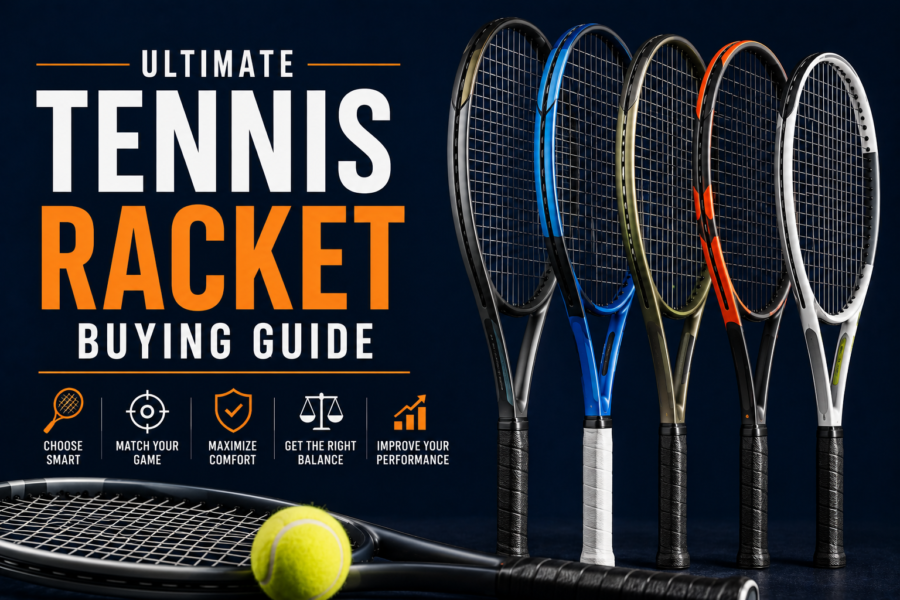
Choosing the right tennis racket can completely change the way you play. The right frame can help you generate easier power, hit with more spin, improve control, and feel more confident during matches. The wrong racket, however, can make tennis feel harder than it should, even for experienced players.
Many players assume expensive rackets automatically improve performance, but that is not how racket selection works. A racket that feels incredible for one player may feel uncomfortable or uncontrollable for another. Skill level, swing speed, playing style, physical strength, and even arm health all influence which racket works best.
Modern tennis rackets are also more specialized than ever. Some are built for heavy topspin and aggressive baseline play, while others focus on precision, comfort, or easy power. Small differences in head size, weight, balance, stiffness, string pattern, and swingweight can dramatically change how a racket performs on court.
This is why understanding racket specifications matters so much. Two rackets may look almost identical, but feel completely different once you start hitting with them. A lightweight power racket can help beginners generate depth more easily, while an advanced control racket may provide the precision competitive players want during aggressive rallies.
This guide is designed to simplify the process and explain exactly what matters when buying a tennis racket. Whether you are a beginner buying your first frame, an intermediate player looking to improve consistency, or an advanced player searching for more control and spin, this article will help you understand how to choose the right racket for your game.
Tennis Rackets Explained
A tennis racket does far more than simply hit the ball back over the net. The frame directly affects power, spin, control, comfort, stability, and even confidence during matches. Every racket is designed differently, which is why some feel explosive and easy to use, while others feel precise, stable, or more demanding.
Modern tennis rackets are built to emphasize specific playing styles. Some help players generate easy depth and spin, while others prioritize precision and feel for advanced shotmaking. Small changes in weight, balance, stiffness, or head size can completely change how a racket performs on court.
Understanding how rackets work is important because many players buy frames based only on popularity or professional endorsements without knowing whether the racket actually suits their game.
What Does a Tennis Racket Actually Do?
The racket acts as the connection between the player and the ball. Every shot depends on how the frame responds during impact, and different racket designs influence that response in different ways.
One of the biggest roles of a racket is power generation. Larger heads, stiffer frames, and thicker beams usually help players create easier depth and pace because they return more energy to the ball during contact. This is especially useful for beginners or players with slower swing speeds.
Rackets also affect spin production. Modern aerodynamic frames and open string patterns make it easier for players to accelerate the racket head and generate heavier topspin. However, the racket alone does not create spin. Swing speed and technique still matter far more.
Control is another major factor. Some rackets are designed to produce a more precise and predictable response, allowing advanced players to swing aggressively without losing accuracy. These rackets usually have smaller heads, thinner beams, or denser string patterns.
Comfort and shock absorption matter too. Flexible and arm-friendly rackets absorb more impact and vibration during contact, reducing stress on the wrist, elbow, and shoulder. Stiffer frames may provide more power, but they can also feel harsher if paired with the wrong strings or tensions.
The racket also influences stability. Heavier frames with higher swingweights resist twisting better on off-center shots, making the racket feel more solid during aggressive rallies.
Every racket is essentially a combination of trade-offs between power, control, spin, comfort, maneuverability, and stability.
Why Racket Choice Matters
Choosing the right racket can make tennis feel significantly easier and more natural. The right frame complements your swing style, physical strength, and skill level, while the wrong one can make consistency and confidence much harder to develop.
For example, a beginner using a heavy advanced control racket may struggle generating depth and timing shots consistently. Meanwhile, an advanced player using an overly powerful beginner frame may feel like they cannot control the ball during aggressive rallies.
This is why there is no universally perfect racket. The best choice depends on:
- Skill level
- Swing speed
- Playing style
- Physical strength
- Comfort needs
- Personal preference
Many players improve simply by switching to a racket better suited to their game. A more forgiving head size can increase consistency, a lighter frame can improve maneuverability, and a more arm-friendly racket can make long sessions feel far more comfortable.
Confidence also plays a huge role. When players trust their racket, they swing more freely and play more aggressively. When a racket feels unstable, uncomfortable, or difficult to control, hesitation usually follows.
The goal is not to use the racket professionals use. The goal is to find a frame that helps your own game feel more comfortable, consistent, and effective on court.
Understanding Tennis Racket Specifications
Tennis racket specifications are what determine how a racket actually performs on court. Two rackets may look very similar visually, but small differences in head size, weight, balance, stiffness, or string pattern can completely change the way they feel during rallies.
This is why understanding racket specs is so important. Instead of blindly buying the newest or most popular model, learning what these specifications mean helps players choose a racket that actually matches their game.
Every specification affects performance differently. Some influence power and spin, while others change stability, maneuverability, comfort, or control. Most rackets are built around specific trade-offs, so there is no perfect combination for everyone.
Head Size
Head size refers to the surface area of the racket head and is measured in square inches or square centimeters. It plays a huge role in power, forgiveness, sweet spot size, and overall feel.
Smaller head sizes, often called midsize rackets, usually provide more precision and control because the string bed feels more compact and predictable. However, they also have smaller sweet spots and are less forgiving on off-center shots.
Midplus rackets are the most common category in modern tennis because they balance control, spin, forgiveness, and power well. Most recreational and competitive players use midplus frames because they provide enough precision without becoming overly demanding.
Oversize rackets prioritize forgiveness and easy power. The larger sweet spot makes it easier to generate depth and maintain consistency, especially for beginners, seniors, or players with shorter swings.
In general:
- Smaller heads favor control and precision
- Larger heads favor power and forgiveness
Weight
Weight is one of the most important racket specifications because it affects stability, maneuverability, power, and comfort.
Lightweight rackets are easier to swing and accelerate, making them popular among beginners, juniors, and players who want faster racket speed. They often feel more maneuverable at the net and during quick exchanges.
However, lighter rackets are usually less stable against heavy pace. They can twist more on off-center contact and may feel less solid during aggressive rallies.
Heavier rackets provide more stability, plow-through, and control because the frame absorbs impact more effectively. Advanced players often prefer heavier setups because they feel more stable during fast rallies and produce a more solid response.
The downside is that heavier rackets require better technique and physical strength. If a racket is too heavy, swing speed and timing can suffer significantly.
Most players perform best with a balanced weight that feels stable without becoming difficult to swing consistently.
Balance
Balance refers to how the racket’s weight is distributed throughout the frame. Two rackets can weigh exactly the same but feel completely different because of balance.
Head-light rackets carry more weight toward the handle, making them feel quicker and easier to maneuver. These rackets are popular among advanced players, serve-and-volley players, and doubles players because they move faster through the air.
Head-heavy rackets place more mass toward the top of the frame. This helps generate extra power and depth more easily, especially for players with slower swings.
Even balance rackets sit somewhere in the middle, combining elements of both power and maneuverability.
Balance strongly affects how fast the racket feels during swings and how stable it feels during impact.
Swingweight
Swingweight is one of the most misunderstood but important racket specifications. It measures how heavy the racket feels while swinging, not just its static weight on a scale.
A racket with high swingweight feels more stable and powerful during impact because more mass moves through the ball. High swingweight rackets usually perform better against heavy pace and feel more solid on contact.
However, higher swingweight also makes the racket slower to accelerate. This can reduce maneuverability, especially during quick reactions at the net or defensive shots.
Lower swingweight rackets feel faster and easier to whip through the air, helping players generate quicker racket head speed. These setups are often easier for recreational players to handle over long matches.
Swingweight is extremely important because it affects both stability and maneuverability at the same time.
Stiffness (RA Rating)
Stiffness measures how much a racket frame bends during impact. This is usually represented by an RA rating.
Stiffer rackets flex less and return more energy to the ball, which creates easier power and a more explosive response. Many modern power rackets use stiff frames because they help players generate depth effortlessly.
However, stiff rackets also absorb less shock, which can make them feel harsher on the arm if paired with the wrong strings or tensions.
Flexible rackets bend more during impact, creating a softer and more controlled feel. Many advanced players prefer flexible frames because they offer better touch, comfort, and precision.
Comfort-focused players and anyone dealing with arm pain usually benefit from more flexible rackets because they absorb vibration more effectively.
In general:
- Stiffer frames provide more power
- Flexible frames provide more comfort and feel
Beam Width
Beam width refers to the thickness of the racket frame.
Thicker beams are usually associated with modern power rackets because they create a stiffer and more stable structure. These rackets generate easier pace and often feel more explosive during baseline rallies.
Thin beam rackets flex more and typically provide better feel and control. Many traditional player frames use thinner beams because they create a softer and more connected response.
Modern spin and power rackets often combine thicker beams with aerodynamic shapes to maximize pace and spin generation.
Beam width may seem like a small detail, but it significantly changes how a racket feels during impact.
Length
Most tennis rackets are standard length, but some models are slightly extended.
Extended length rackets provide extra reach on serves and groundstrokes while also increasing leverage and power potential. Many players notice easier serving pace and slightly heavier shots with extended frames.
However, longer rackets can also feel less maneuverable, especially during volleys or quick reaction shots.
For most recreational players, standard length rackets remain the safest and most balanced option.
String Pattern
String pattern refers to how many main and cross strings are used in the racket. The two most common patterns are:
- 16×19
- 18×20
Open string patterns like 16×19 usually provide more spin, power, and easier depth because the strings move more freely during impact. This is why many modern spin-oriented rackets use open patterns.
Dense patterns like 18×20 prioritize control and precision because the string bed feels firmer and more predictable. Many advanced players prefer dense patterns for flatter hitting and lower launch angles.
Open patterns generally:
- Create more spin
- Feel livelier
- Break strings faster
Dense patterns generally:
- Provide more control
- Feel firmer
- Improve durability
String pattern works closely with strings themselves, which is why the same racket can feel completely different depending on the setup installed.
How Tennis Rackets Affect Performance
Every tennis racket is designed to emphasize certain performance characteristics. Some rackets help players generate effortless power and spin, while others prioritize precision, feel, comfort, or stability. This is why two players can hit with completely different styles even when using similar techniques.
The most important thing to understand is that racket specifications work together. Power, control, spin, comfort, stability, and maneuverability are all connected. Improving one area often means sacrificing a bit of another.
The best racket is not necessarily the most powerful or the most control-oriented. It is the one that complements your swing speed, playing style, and physical abilities.
Power
Power-oriented rackets help players generate easier pace and depth without requiring huge swings. These rackets usually feature larger head sizes, thicker beams, and stiffer frames that return more energy to the ball during contact.
A larger head size increases the trampoline effect of the string bed, making shots feel livelier and more forgiving. Stiffer frames flex less during impact, which helps transfer more energy directly into the ball instead of absorbing it.
Modern power rackets are especially useful for:
- Beginners
- Seniors
- Players with compact swings
- Players who struggle generating depth consistently
The trade-off is usually control. More powerful rackets can sometimes feel harder to manage during aggressive swings because the ball launches more easily from the string bed.
This is why advanced players often prefer lower-powered frames that allow them to swing faster without overhitting.
Control
Control-oriented rackets are designed to produce a more predictable and precise response. These frames usually have smaller head sizes, thinner beams, denser string patterns, or more flexible constructions that reduce excess power.
Advanced players often prefer control rackets because they already generate enough pace naturally. Instead of needing help with power, they want confidence during full swings and aggressive rallies.
Control frames typically produce:
- Lower launch angles
- More precise targeting
- Better directional accuracy
- More connected feel
Flexible frames also contribute to control because they absorb more energy during impact, creating a softer and less explosive response.
The downside is that control rackets can feel more demanding for recreational players. Without enough racket head speed, they may feel underpowered or less forgiving on off-center shots.
Spin
Spin-friendly rackets are built to help players accelerate the racket head more easily and generate heavier topspin. Modern spin rackets often feature aerodynamic beam designs and open string patterns that allow the strings to move more freely during impact.
Open patterns like 16×19 create more spacing between strings, helping the ball sink deeper into the string bed and increasing snapback potential. Many modern spin-focused rackets are specifically designed around this concept.
However, the racket alone does not create spin. Technique and swing speed are still the biggest factors. A spin racket simply helps maximize spin potential for players who already swing aggressively.
Spin-oriented frames are especially popular among:
- Aggressive baseliners
- Heavy topspin players
- Modern all-court players
These rackets usually combine maneuverability with fast acceleration and higher net clearance.
Comfort
Comfort is one of the most overlooked aspects of racket performance, yet it can completely affect how enjoyable tennis feels. Comfortable rackets absorb shock and vibration more effectively, reducing stress on the wrist, elbow, and shoulder.
Flexible frames are generally more arm-friendly because they bend slightly during impact and absorb more vibration. Softer string setups also play a huge role in overall comfort.
Stiff frames may provide easier power, but they can feel harsher if paired with stiff polyester strings or high tensions. Players dealing with tennis elbow or arm discomfort usually benefit from more flexible rackets combined with softer strings.
Comfort-focused rackets often feature:
- Lower stiffness ratings
- Better vibration dampening
- Softer feel
- Larger sweet spots
For many recreational players, comfort is far more important than chasing maximum spin or professional-level control.
Stability
Stability refers to how solid the racket feels during impact, especially on off-center shots or against heavy pace. Stable rackets resist twisting better and maintain a more consistent response during aggressive rallies.
Weight and swingweight are the biggest factors behind stability. Heavier rackets usually feel more solid because they absorb incoming pace more effectively and drive through the ball with greater momentum.
High swingweight frames also increase stability because more mass moves through contact. This helps the racket feel steadier during fast exchanges and defensive shots.
Players who hit against heavy hitters often appreciate stable rackets because they feel more reliable under pressure. However, added stability usually comes with reduced maneuverability.
A racket that is extremely stable may feel slower during quick reactions at the net or rapid changes of direction.
Maneuverability
Maneuverability refers to how quickly and easily a racket moves through the air. Faster-feeling rackets are easier to accelerate during serves, topspin shots, volleys, and defensive reactions.
Lighter frames and lower swingweights generally improve maneuverability because less effort is required to change racket direction quickly.
Maneuverable rackets are especially useful for:
- Doubles players
- Serve-and-volley players
- Players who rely on fast racket head speed
- Defensive players
Quick handling becomes very noticeable during volleys, returns, and reaction shots near the net.
The trade-off is stability. Extremely maneuverable rackets can sometimes feel less solid against heavy pace, especially on off-center contact.
Finding the right balance between stability and maneuverability is one of the most important parts of choosing a tennis racket.
How Racket Weight Changes Performance
Racket weight is one of the most important factors affecting how a tennis racket feels and performs on court. It influences power, stability, maneuverability, comfort, swing speed, and even fatigue during long matches.
Two rackets may have similar head sizes and string patterns, but if their weights are different, they can feel completely different during rallies. Some players prefer lighter frames that move quickly through the air, while others want heavier rackets that feel more stable and solid during impact.
The key is finding the right balance between maneuverability and stability for your own game.
Lightweight Rackets
Lightweight rackets are easier to swing, accelerate, and maneuver. Because less effort is required to move the frame, many players find them more comfortable during long sessions and easier to handle during quick exchanges.
These rackets are especially popular among:
- Beginners
- Juniors
- Seniors
- Recreational players
- Doubles players
A lighter racket can help players generate faster racket head speed more easily, which may improve spin potential and make defensive shots feel quicker and more reactive.
Maneuverability is one of the biggest advantages of lightweight frames. They feel faster at the net, easier to reposition during returns, and more forgiving physically over long matches.
However, lightweight rackets usually sacrifice some stability. Against heavy pace, they can twist more on off-center shots and feel less solid during aggressive rallies. Some players also find that extremely light rackets produce less natural plow-through and depth compared to heavier frames.
Modern lightweight rackets often compensate with stiffer beams and larger head sizes to help maintain power and forgiveness.
Heavy Rackets
Heavier rackets provide more stability, plow-through, and overall solidity during impact. Because more mass moves through the ball, these frames often feel more controlled and stable against heavy hitters.
Advanced players frequently prefer heavier setups because they:
- Absorb pace better
- Twist less on mishits
- Feel more stable during rallies
- Produce heavier shots naturally
Heavier frames also tend to be more comfortable in some situations because the added mass helps reduce shock and vibration during contact.
One major advantage is plow-through. A heavier racket drives through the ball more effectively, helping players create penetrating shots with less instability during impact.
The downside is maneuverability. Heavy rackets require better strength, conditioning, and timing to swing consistently. If a frame becomes too demanding physically, racket head speed and reaction time can suffer.
This is especially noticeable during:
- Long matches
- Fast defensive exchanges
- Quick volleys
- Return games
Many recreational players actually use rackets that are too heavy for their current level, which can make tennis feel unnecessarily difficult and tiring.
Which Weight Should You Choose?
The ideal racket weight depends on skill level, swing speed, physical strength, and playing style.
Beginners usually perform best with lighter or moderately weighted rackets because they are easier to maneuver and less physically demanding. At this stage, consistency and confidence matter more than maximum stability.
Intermediate players often prefer balanced setups that combine maneuverability with enough stability for improving racket head speed and more aggressive rallies. Modern tweener rackets are especially popular in this category because they offer a strong mix of both qualities.
Advanced players generally use heavier and more stable rackets because they can handle the added physical demands and benefit from the extra control and plow-through during high-level hitting.
In general:
- Lighter rackets prioritize maneuverability and easier acceleration
- Heavier rackets prioritize stability and control
The goal is not to use the heaviest racket possible. The best racket weight is the one that allows you to swing comfortably, maintain racket head speed, and stay consistent throughout an entire match.
Understanding Tennis Racket Balance & Swingweight
Balance and swingweight are two of the most important racket specifications, yet they are also among the most misunderstood. Many players focus only on static weight, but how the weight is distributed throughout the frame often matters even more.
Two rackets can weigh exactly the same while feeling completely different during rallies because of differences in balance and swingweight. One may feel quick and maneuverable, while the other feels heavier, more stable, and harder to swing.
These specifications heavily influence:
- Maneuverability
- Stability
- Power
- Swing speed
- Net play
- Comfort
- Overall racket feel
Understanding them makes it much easier to choose a racket that fits your style and physical abilities.
Head-Light Rackets
Head-light rackets carry more weight toward the handle instead of the top of the frame. Even if the racket itself is relatively heavy overall, this balance makes it feel quicker and easier to maneuver during swings.
Head-light setups are extremely popular among advanced players because they allow faster racket acceleration and quicker reactions, especially at the net. These rackets often feel more maneuverable during:
- Volleys
- Returns
- Defensive shots
- Quick exchanges
- Serve-and-volley play
Heavier player frames are commonly designed head-light to maintain maneuverability despite their added mass.
Another advantage is comfort. Head-light rackets can sometimes feel easier on the arm because the weight distribution reduces the sensation of heaviness during swings.
However, head-light frames may produce slightly less free power compared to more head-heavy setups because less mass is concentrated toward the hitting zone.
Players who prioritize fast handling, precision, and maneuverability usually prefer head-light rackets.
Head-Heavy Rackets
Head-heavy rackets place more mass toward the top of the frame. This creates a more powerful and stable response because additional weight drives through the ball during impact.
These rackets often help players generate easier depth and pace without requiring huge swings, which is why they are common among:
- Beginners
- Recreational players
- Seniors
- Players with slower swings
The extra weight in the head increases momentum through contact, helping shots feel heavier and more explosive.
Head-heavy rackets can also feel very stable during groundstrokes because the upper hoop resists twisting effectively during impact.
The downside is maneuverability. Since more weight sits farther from the hand, these rackets can feel slower during quick reactions, fast volley exchanges, or rapid changes of direction.
Some players also find head-heavy setups more tiring over long matches because they require more effort to accelerate repeatedly.
Even Balance Rackets
Even balance rackets distribute weight more evenly throughout the frame, sitting between head-light and head-heavy designs.
These rackets aim to provide a balanced mix of:
- Stability
- Maneuverability
- Power
- Control
Many modern tweener rackets use even balance constructions because they suit such a wide range of players and playing styles.
An even balance frame usually feels more neutral overall. It does not move as quickly as a strongly head-light racket, but it also does not feel as sluggish or powerful as a heavily head-heavy setup.
For many recreational and intermediate players, even balance rackets provide one of the safest and most versatile overall options.
Why Swingweight Matters More Than Static Weight
Swingweight is often more important than static weight because it determines how heavy the racket actually feels during swings.
Static weight simply measures how heavy the racket is sitting still on a scale. Swingweight measures how difficult the racket is to swing once it starts moving.
A racket with high swingweight feels more powerful and stable because more mass drives through the ball during contact. These rackets usually:
- Absorb pace better
- Twist less on mishits
- Produce heavier shots
- Feel more solid overall
However, high swingweight also reduces maneuverability. The racket feels slower to accelerate and more physically demanding over long matches.
Lower swingweight rackets feel quicker and easier to whip through the air, helping players generate faster racket head speed and quicker reactions. These setups are usually easier for recreational players to handle comfortably.
This is why two rackets with the same weight can feel completely different. A lighter racket with very high swingweight may actually feel harder to swing than a heavier racket with a more head-light balance.
For most players, finding the right swingweight matters more than simply chasing the lightest or heaviest racket possible. The ideal setup is one that feels stable enough during impact while still allowing comfortable acceleration and maneuverability throughout an entire match.
Tennis Racket String Patterns Explained
String pattern is one of the most important racket specifications because it directly affects spin, power, control, feel, and durability. Even if two rackets have similar head sizes and weights, different string patterns can make them feel completely different during rallies.
String pattern refers to the number of main strings (vertical) and cross strings (horizontal) in the racket. The two most common patterns in modern tennis are:
- 16×19
- 18×20
The first number represents the mains, while the second represents the crosses.
More open patterns create larger spaces between strings, while denser patterns pack the strings closer together. This changes how the ball interacts with the string bed during contact and has a major effect on launch angle, spin generation, and overall response.
Open String Patterns
Open string patterns, such as 16×19 or 16×18, are designed to increase spin potential and create a livelier response. Because there is more spacing between the strings, the ball sinks deeper into the string bed during impact.
This increased pocketing allows the strings to move and snap back more aggressively, helping generate heavier topspin. Open patterns also tend to launch the ball slightly higher, which gives players more net clearance during aggressive baseline rallies.
Modern spin-oriented rackets almost always use open patterns because they complement the heavy topspin style seen in today’s game.
Open patterns usually provide:
- More spin potential
- Easier power
- Higher launch angle
- Better pocketing
- More lively response
However, there are trade-offs. Since the strings move more and experience greater friction, they usually wear out faster. Players who hit with heavy topspin often break strings much quicker in open-pattern rackets.
Some players also feel open patterns are slightly less precise during flatter hitting because the response feels more explosive and less compact.
Dense String Patterns
Dense string patterns, such as 18×20, place the strings closer together to create a firmer and more controlled response.
Because the string bed is tighter and more compact, the ball launches lower and more predictably during contact. Many advanced players prefer dense patterns because they feel more precise during aggressive swings and flatter ball striking.
Dense patterns usually provide:
- More control
- Lower launch angle
- Better directional accuracy
- Firmer response
- Improved string durability
The tighter spacing also reduces string movement, which helps strings last longer and creates a cleaner feel during impact.
However, dense patterns generally produce slightly less free spin and power compared to more open setups. Players often need faster racket head speed to generate heavy topspin consistently.
Traditional control-oriented player rackets commonly use dense patterns because they prioritize precision and stability over easy spin.
Which String Pattern Should You Choose?
The best string pattern depends heavily on your playing style, swing speed, and personal preference.
Open patterns are usually best for:
- Players who rely on topspin
- Aggressive baseliners
- Modern spin-focused games
- Players wanting easier depth and net clearance
Dense patterns are usually best for:
- Flatter hitters
- Advanced players
- Players prioritizing precision
- Players who want a firmer response
Most recreational and intermediate players prefer open patterns because they provide easier access to spin and power without requiring perfect timing. This is one reason why 16×19 patterns dominate the modern racket market.
Dense patterns remain popular among advanced players who want maximum control during full swings and aggressive shotmaking.
Neither pattern is automatically better. The goal is finding the setup that gives you the best balance between spin, control, launch angle, and overall confidence during rallies.
Choosing the Right Grip Size
Grip size is one of the most overlooked parts of choosing a tennis racket, yet it has a huge impact on comfort, control, and injury prevention. Even the best racket can feel uncomfortable or unstable if the grip size is wrong.
A proper grip allows players to hold the racket securely without excessive tension in the hand, wrist, or forearm. If the grip is too small or too large, players often compensate by squeezing the handle harder, which can reduce comfort and increase stress on the arm.
Choosing the correct grip size helps improve:
- Comfort
- Control
- Wrist mobility
- Confidence during swings
- Injury prevention
Many players focus heavily on racket specifications while completely ignoring grip size, even though it directly affects how the racket feels in the hand during every shot.
Why Grip Size Matters
Grip size changes how naturally the racket moves through the hand during swings. A correctly sized grip allows players to maintain control without gripping the racket excessively tight.
If the grip feels comfortable, players can swing more freely and relax the hand during rallies. This improves fluidity, touch, and overall shot production.
Grip size also affects wrist action and spin generation. Smaller grips usually allow more wrist movement, which some players prefer for topspin and racket acceleration. Larger grips tend to feel more stable but may slightly restrict wrist mobility.
Most importantly, the wrong grip size can contribute to arm discomfort over time. Gripping too tightly because of an uncomfortable handle often increases stress on the wrist, forearm, and elbow.
A properly fitted grip should feel secure without forcing the hand to squeeze constantly during play.
Grip Sizes Explained
Tennis racket grip sizes are usually measured in inches or numbered systems depending on the region.
Common grip sizes include:
- 4 1/8 (L1)
- 4 1/4 (L2)
- 4 3/8 (L3)
- 4 1/2 (L4)
- 4 5/8 (L5)
Most adult recreational players use grips between:
- L2
- L3
- L4
Smaller grips are generally more common today than in older generations because modern tennis relies heavily on topspin and faster racket acceleration.
A simple way to estimate grip size is the finger test:
- Hold the racket using a forehand grip
- There should be enough space between your fingertips and palm to fit roughly one finger comfortably
If there is no space, the grip is likely too small. If there is too much space, the grip may be too large.
Personal preference still matters, but comfort and relaxed hand positioning are the priorities.
Signs Your Grip Is Too Small
A grip that is too small usually causes the hand to work harder to stabilize the racket during impact. Players often squeeze tighter unconsciously because the racket feels less secure in the hand.
Common signs include:
- Excessive grip pressure
- Wrist discomfort
- Forearm fatigue
- The racket twisting during impact
- Blisters on the hand
- Elbow discomfort over time
Some players intentionally use slightly smaller grips for added wrist mobility and spin generation, but going too small can reduce stability and increase injury risk.
If the racket constantly feels like it moves around in your hand during heavy shots, the grip may be undersized.
Signs Your Grip Is Too Big
A grip that is too large can feel bulky and difficult to maneuver. Players often struggle generating natural wrist movement and racket acceleration with oversized grips.
Common signs include:
- Difficulty changing grips quickly
- Reduced wrist mobility
- Feeling disconnected from the racket
- Slower racket head speed
- Hand fatigue during long sessions
Large grips may also make touch shots and quick reactions feel less natural, especially during net play.
Because modern tennis emphasizes spin and racket speed, many players today prefer slightly smaller grips rather than oversized ones.
However, extremely small grips are usually more problematic than slightly larger ones when it comes to arm health and stability.
Overgrips vs Replacement Grips
Overgrips and replacement grips both affect how the handle feels, but they serve different purposes.
Replacement grips are the main base grips installed directly on the racket handle. They determine the core feel, cushioning, and overall grip size.
Overgrips are thinner layers wrapped on top of the replacement grip. Players use them to:
- Improve tackiness
- Absorb sweat
- Add comfort
- Slightly increase grip size
Overgrips are extremely common because they are easy to replace regularly and help maintain consistent feel during play.
Many players slightly customize grip size using overgrips. Adding one overgrip increases the grip size a small amount, while multiple overgrips can noticeably change the handle thickness.
For most players, it is usually safer to start slightly smaller and build up the grip gradually with overgrips if needed, rather than buying a grip that is already too large.
How Professional Players Choose Rackets
Professional players choose rackets very differently from recreational players. At the highest level, rackets are selected and customized around extremely specific performance needs, including swing speed, spin production, stability, feel, and consistency under pressure.
However, one of the biggest misconceptions in tennis is that professionals simply use stock rackets directly from stores. In reality, most professional setups are heavily customized and often very different from the retail versions recreational players buy.
This is why blindly copying professional equipment rarely works for most players.
Why Pros Use Heavier Frames
Professional players typically use much heavier rackets than recreational players because heavier frames provide superior stability, plow-through, and control during high-speed rallies.
At the professional level, incoming pace is extremely heavy. A stable racket helps absorb that pace more effectively and allows players to redirect the ball with confidence.
Heavier frames also produce:
- More solid contact
- Better control under pressure
- Improved stability on off-center shots
- Heavier ball penetration
Because professional players generate massive racket head speed naturally, they do not need lightweight power-focused rackets. Instead, they prioritize precision and stability during aggressive hitting.
However, these setups require elite physical conditioning and years of technical development. Most recreational players would struggle using the same swingweights professionals handle comfortably for multiple hours every day.
Pro Stock Rackets Explained
Many professional players use what are known as “pro stock” rackets. These are specialized frames built specifically for tour players and often differ significantly from the retail models sold in stores.
Sometimes a professional racket may cosmetically resemble a current retail model while actually being based on an older mold or heavily customized internal construction.
Professional frames are often:
- Heavier
- More flexible
- More customized
- Built to exact specifications
Even small details like grip shape, handle weight, and balance are carefully adjusted for each player.
Some professionals continue using older racket molds for many years because they are comfortable with the feel and response. Manufacturers often repaint these rackets to match newer retail cosmetics while the underlying frame remains largely unchanged.
This surprises many recreational players who assume pros constantly switch to the newest retail models every season.
Why Recreational Players Shouldn’t Copy Pros Exactly
One of the biggest mistakes recreational players make is assuming professional equipment automatically improves performance.
Professional rackets are built for:
- Elite swing speeds
- Advanced timing
- High physical strength
- Constant restringing
- Daily training
Most recreational players simply do not hit hard enough or consistently enough to benefit fully from extremely heavy, low-powered, or highly customized pro setups.
In many cases, copying a professional setup actually makes tennis harder. The racket may feel:
- Too demanding
- Too heavy
- Underpowered
- Less forgiving
- Harder on the arm
A recreational player usually performs far better with a racket that provides enough forgiveness, comfort, and easy depth for their own level.
The goal should never be using the same racket as your favorite professional. The goal is finding a setup that helps your own game feel more natural, confident, and consistent.
Final Thoughts
Choosing a tennis racket is one of the most personal decisions in the sport. The right frame can completely change how tennis feels, improving confidence, consistency, comfort, spin, power, and overall enjoyment on court.
There is no universally perfect racket because every player swings differently and values different aspects of performance. Some players need easy power and forgiveness, while others prioritize precision, stability, and control. The best racket is always the one that complements your own level, physical ability, and playing style.
This is why understanding racket specifications matters so much. Small differences in weight, balance, swingweight, stiffness, head size, and string pattern can dramatically change how a racket performs. Two frames may look nearly identical but feel completely different once you start hitting with them.
Testing rackets whenever possible is one of the smartest things players can do. Specifications provide helpful guidance, but personal feel still matters enormously. A racket that feels perfect for one player may feel uncomfortable or demanding for another.
Strings also play a massive role in overall racket performance. Even the best racket can feel completely different depending on the string type, tension, and setup installed. In many cases, changing strings transforms a racket more than changing frames entirely.
Comfort should never be ignored either. Many recreational players use rackets that are too stiff, too heavy, or too demanding simply because professionals use them. In reality, a more comfortable and forgiving setup often leads to better confidence and more enjoyable tennis overall.
The biggest takeaway is that the right racket should help your game feel easier and more natural, not more difficult. Whether you are a beginner buying your first frame or an advanced player searching for more control and spin, understanding how rackets work makes it far easier to choose a setup that truly fits your game.
