
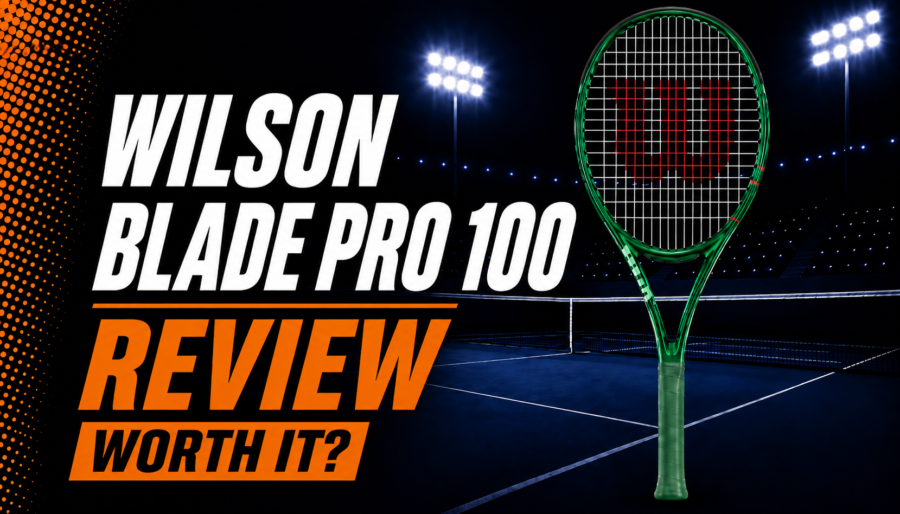
The Wilson Blade 100 Pro V10 is a new 2026 model in Wilson’s tenth-generation Blade range and part of the brand’s Pro Labs collection. Some retailers reverse the name to Blade Pro 100 V10, but the verified consumer racket is the same 100 sq in, 16×20 version covered here.
This is not a V9 model and it should not be confused with the standard Blade 100. The Pro has a 27.25 in extended length, 295 g unstrung weight, 23 mm constant beam and firmer construction, creating a quicker, more power-accessible Blade for advanced players who still want a controlled string pattern.
The unusual specification mix matters more than the word “Pro.” Its static weight is lower than many traditional player’s rackets, while the extra length, moderately firm beam and approximate 318 swingweight are designed to add reach, leverage and stability without making the frame slow.
Wilson Blade 100 Pro V10 Score
| Category | Score |
|---|---|
| Power | 8.5/10 |
| Spin | 8.5/10 |
| Control | 8.5/10 |
| Comfort | 8/10 |
These scores are editorial estimates based on the Blade 100 Pro V10’s verified specifications, construction, intended player profile and position in the broader racket market. The response can change with strings, tension, manufacturing variation, customization and technique.
Wilson Blade 100 Pro V10 Specifications
| Specification | Details |
|---|---|
| Head size | 100 sq in / 645 cm² |
| Length | 27.25 in / 69.2 cm |
| Unstrung weight | 295 g / 10.4 oz, official |
| Strung weight | Approximately 309 g / 10.9 oz, retailer/lab measurement; string-dependent |
| Unstrung balance | Approximately 32 cm / 12.6 in, 8 pts HL, retailer cross-check |
| Strung balance | Approximately 33 cm / 13.0 in, 5 pts HL, retailer/lab measurement |
| Swingweight | Approximately 318 kg·cm² strung, retailer/lab measurement |
| Stiffness | Approximately 68 RA, retailer/lab measurement |
| Beam width | 23 mm / 23 mm / 23 mm |
| String pattern | 16×20 |
| Composition | Braided graphite and basalt composite frame |
| Recommended tension | 47-57 lb / 21-26 kg |
| Grip | Wilson Pro Performance |
Wilson’s official pages verify the V10 generation, extended length, 295 g unstrung weight, 23 mm beam and 16×20 pattern. The approximate balance, strung weight, swingweight and stiffness are cross-checked retailer or laboratory figures; finished specifications also vary with manufacturing tolerances, strings, grip size, overgrips, dampeners and customization.
Design, Materials and Technologies
Head Size, Beam and Frame Geometry
The 100 sq in head supplies more usable string-bed area than the Blade Pro 98 models without turning the racket into an oversize design. It offers a practical balance between target control and margin around the center, which helps explain why Wilson can pair it with the less common 16×20 pattern.
At 23 mm throughout, the beam is the thickest adult performance beam in the V10 Blade family. The added section depth and approximate 68 RA stiffness are intended to produce more rebound and torsional resistance than the thinner, more flexible standard Blade 100.
The 27.25 in length adds 0.25 in over the conventional standard. That is a modest extension, but it still increases reach and swing radius, potentially adding serve and groundstroke leverage while requiring slightly more space around the body.
Weight, Balance and Swingweight
The official 295 g unstrung weight is relatively light for a racket carrying a Pro designation. It leaves room for acceleration and optional customization rather than arriving with the mass of a 305 g or 315 g player’s frame.
Retailer cross-checks place the unstrung balance near 32 cm, or about 8 points head light, although Wilson’s regional data is inconsistent. Strings move the finished balance toward approximately 33 cm, and the approximate 318 swingweight provides moderate rotational resistance without entering especially demanding territory.
This combination can be quick even though the frame is extended. Maneuverability comes from the weight and head-light distribution, while stability comes from the entire package, including swingweight, beam, layup and contact location, not from any single number.
Materials and Construction
Retailer and Wilson technology listings identify a braided graphite-and-basalt composite construction. The braid is part of the Blade lineage and is intended to tune flex and feedback, while the full composite handle maintains structural continuity through the grip area.
The approximately 68 RA figure is significantly firmer than the standard Blade 100 V10 and V9 measurements. That does not make the Pro automatically uncomfortable, but it indicates a more direct and power-oriented frame response that makes string selection especially relevant.
Pro Labs branding refers to Wilson’s performance collection and closer association with pro-stock concepts. It does not mean a retail frame is identical to an individual professional player’s customized racket, which may differ in weight, balance, swingweight, handle shape and layup.
String Pattern
The 16×20 pattern adds one cross string compared with the conventional 16×19 Blade layout. In a 100 sq in head, that extra cross is intended to moderate launch and improve directional predictability while retaining more main-string movement than a dense 18×20 bed.
Pattern count alone does not determine spin. Spacing, head speed, string friction, gauge and contact angle all matter, and independent evaluations have found the Pro capable of both shaped and flatter shots rather than behaving as a single-purpose spin frame.
The 16×20 bed may offer somewhat better string control and potentially less movement than an equally spaced 16×19 pattern. Durability still depends on the material and player, and high-spin hitters can notch mains even in a denser layout.
Technologies
StableFeel+ is Wilson’s V10 update intended to reduce frame wobble and improve responsiveness on off-center contact. It is an evolution of V9 StableFeel, and its benefit should be described as a design goal rather than a guarantee that every mishit will remain stable.
FORTYFIVE° refers to the orientation of carbon fibers used to tune bending for modern swing paths. Wilson links it to flexibility and stability, while the safe inference is that it changes the directional flex characteristics within an otherwise firm 23 mm frame.
DirectConnect extends the structural handle into the end cap, and the Full Composite Handle is intended to give a more responsive connection through the grip. These features influence construction and feedback, though string choice can still dominate how direct or muted the racket seems.
Signature X-Loop changes the shoulder geometry to add the stability and flex profile Wilson associates with the Blade identity. Wilson also describes Zen Edge as providing 3 degrees of torsional stability, which should be understood as manufacturer terminology for the frame geometry rather than an independently measured performance score.
Elite Spec Tolerance refers to Wilson’s tighter V10 manufacturing targets. Wilson publishes V10 tolerances of approximately ±5 g in weight, ±0.5 cm in balance and ±5 kg·cm² in swingweight, so even the tighter standard allows meaningful variation and players matching several rackets should still measure individual frames.
Click & Go is the replaceable bumper-and-grommet system intended to improve fit and servicing. The 23 mm beam and extended 100 Pro geometry require the exact compatible V10 part set, not a grommet labeled only for another Blade model.
Wilson Blade 100 Pro V10 Performance
Comfort and Feel
The braided layup, FORTYFIVE° construction and StableFeel+ are intended to preserve feedback while controlling unwanted frame movement. Independent evaluations describe a connected response, but the approximate 68 RA stiffness and 23 mm beam point toward a firmer, more direct impact character than the flexible standard Blade 100.
The approximately 309 g strung weight and 318 swingweight provide enough substance to keep central contact from being defined only by stiffness. Contact near the perimeter, a tight polyester bed or late timing can still produce a much less forgiving response.
Comfort is subjective and depends on technique, grip size, physical capacity, string material, gauge and tension. Players moving from a softer Blade should evaluate the complete setup instead of assuming that family branding produces the same response across models.
Comfort score: 8/10
Power
Power is more accessible than in most control-oriented Blades because of the 23 mm beam, extended length, moderate stiffness and 100 sq in head. Independent playtesting consistently identifies easy depth and useful first-serve pace as defining characteristics of this model.
The racket remains light enough to accelerate, which is its primary source of accessible pace. It does not rely on a very high swingweight, so the player can create speed quickly and use the extra 0.25 in for leverage.
The 16×20 pattern helps contain that rebound but does not eliminate launch variation. Fast, confident swings are rewarded, while defensive players who decelerate may not receive the same predictable result.
Power score: 8.5/10
Control
Control comes from the 16×20 pattern, head-light distribution and relatively modest 100 sq in head. The extra cross string helps provide a more defined launch window than an equally open 16×19 layout, supporting both flatter drives and controlled spin.
The firmer 23 mm frame supplies a direct response but also adds pace, so directional accuracy depends on committing to the swing rather than steering. Independent evaluations note that the racket can become lively in some setups, making string and tension choices important.
Player technique remains the largest source of control. The frame gives advanced players a useful balance of speed and predictability, but it does not substitute for clean spacing or face management, especially with extended length.
Control score: 8.5/10
Spin
The 16×20 pattern is not as open as a 16×19 count, yet the low static weight and quick approximate swingweight make acceleration readily available. The longer lever can also raise tip speed when timing and spacing allow a full path.
Independent evaluations report useful topspin and slice alongside strong flat-shot performance, though not every tester found kick-spin access exceptional. That split is consistent with a versatile pattern whose outcome depends heavily on technique and setup.
Players should not expect the racket to create rotation passively. Spin requires racket-head speed, an appropriate brushing path and strings that can slide and recover rather than remaining locked in place.
Spin score: 8.5/10
Maneuverability
The 295 g unstrung weight, head-light balance and approximate 318 swingweight make the Blade 100 Pro V10 quick for an extended racket. Independent playtesters consistently identify preparation speed and acceleration as strengths on groundstrokes, volleys and returns.
The added 0.25 in is still noticeable during close-body contact and rapid grip changes. Players with compact preparation may adapt quickly, while those who crowd the ball will need better spacing to exploit the speed.
Stability
Stability comes from the 23 mm beam, StableFeel+, X-Loop shoulder geometry, moderate swingweight and mass distribution. The design is intended to resist twisting without requiring the high static weight of a traditional Pro model.
Independent evaluations generally find the frame stable for its weight, but some also view it as a platform for customization. Players facing exceptionally heavy pace may want more mass, and any added weight should be measured because the extended frame can gain swingweight quickly.
Performance by Shot
Groundstrokes
The Blade 100 Pro V10 is best aligned with aggressive baseline play that combines early preparation with decisive acceleration. Its 23 mm beam and extended length support depth on forehands and backhands, while the 16×20 pattern helps keep the trajectory controllable.
Topspin players can exploit the head speed available from the low static weight, and flatter hitters can drive through the relatively direct string bed. Independent testing suggests that the racket is strongest when the player attacks, while neutral defensive balls may require more careful height and spacing.
The extra length helps on wide contact and adds leverage, but it can be less forgiving when the ball jams the body. Players who use a one-handed backhand should confirm that the swing radius fits their preparation, while two-handed hitters receive more reach without excessive static mass.
Serves
Extended length and a 23 mm beam give the Pro a useful platform for first-serve pace. The approximately 318 swingweight remains manageable overhead, allowing the player to build speed without handling a very heavy tip.
Slice and kick remain available through the 16×20 bed, though some independent testers found flat pace more immediately accessible than kick. The player must still accelerate fully, because extra leverage does not replace an effective kinetic chain or clean contact.
Volleys and Net Play
Quick handling makes the racket well suited to active net play, and the extended reach can help on stretched volleys. The firmer beam and StableFeel+ construction are designed to support a solid punch when contact occurs in front.
Touch depends heavily on string choice because the frame is more direct than a flexible Blade. During rapid body exchanges, the extra length demands compact mechanics, while central contact is more dependable than contact near the outer hoop.
Returns
The low static weight helps the player set the face early, and the 100 sq in head offers practical margin against fast serves. Extra reach is useful when stretching for wide deliveries, while the 16×20 pattern supports aggressive redirection.
Independent evaluations rate returns as a strength, particularly when the player steps in and commits. A passive block may not exploit the frame’s speed as effectively, and added customization should be considered only if more stability is genuinely needed.
String and Setup Considerations
The Blade 100 Pro V10’s firm 23 mm frame and 16×20 pattern can work with several string families. A multifilament or natural gut setup can add elasticity and moderate the direct response, while synthetic gut offers a practical all-around starting point.
Polyester can suit advanced players who swing quickly and want to manage launch, particularly because the frame provides accessible pace. A softer co-polyester, lower reference tension or hybrid may be preferable for players who find a firm full bed too direct, but these are general considerations rather than personalized prescriptions.
Independent testing indicates that the racket can be string-sensitive, which is plausible given the blend of power, firmness and a controlled pattern. A dead or heavily notched polyester bed can change launch and response, so condition and replacement timing matter.
Wilson lists a 47-57 lb / 21-26 kg range, lower than the V9 range. The Tennis String Finder can help compare material options, and the Tennis String Tension Calculator provides a general starting framework before a qualified stringer accounts for the player’s current setup and goals.
Customization is possible because the stock static weight is low, but small additions near the tip can raise swingweight rapidly on an extended frame. Record the starting weight, balance and swingweight, then make reversible changes in measured increments.
Build Quality and Durability
The Blade 100 Pro V10 uses a braided composite performance-frame construction with a full bumper protecting the top of the hoop. Grommets isolate the strings from the drilled graphite, and the Click & Go design is intended to improve bumper fit and make compatible replacement easier.
The Pro’s geometry is generation-specific, so replacement parts must match the Blade 100 Pro V10. A Blade 100, 100L, 104 or Pro 98 set should not be assumed interchangeable, even when the cosmetic and family name are similar.
Court scrapes, paint chips and bumper scuffs are normally cosmetic. Cracks, exposed fibers, soft spots, rattling accompanied by structural movement or a changing frame shape require closer inspection and may make continued use unsafe.
A stringer should inspect grommets and bumper wear during each restring. No exact lifespan can be promised because play frequency, stringing, storage, court contact and hard impacts vary substantially.
Who Should Use It?
The Blade 100 Pro V10 best suits advanced intermediates and advanced players with medium-to-fast swings who prefer proactive, attacking tennis. Aggressive baseliners, early ball strikers and all-court players can use its speed, extra reach and controlled power without managing a 305 g unstrung frame.
It is also relevant to players who like an extended racket but do not want a high swingweight. The 16×20 bed rewards those who alternate between flatter drives and shaped shots rather than requiring a single trajectory.
The player must be comfortable with a firmer response, extended spacing and the physical demands of repeating a 318 swingweight. The Pro label should not be the deciding factor; the actual fit comes from swing shape, timing and preferred launch.
Who Should Avoid It?
Beginners and players with short, inconsistent swings may find the extended length and lively firm beam difficult to control. A standard-length 100 sq in racket with more forgiving power delivery and a simpler timing window may be more appropriate.
Players who want the flexible, muted character associated with classic Blades should consider the standard Blade 100 or one of the Blade 98 models. The Pro’s approximate 68 RA stiffness and 23 mm beam create a distinctly more direct response.
Heavy hitters who expect a traditional high-mass Pro frame may also find the stock 295 g weight too light. Customization is possible, but players who already know they need more mass may be better served by a heavier stock model with the desired swingweight.
Pros and Cons
| Pros | Cons |
|---|---|
| Extended length adds reach and leverage without excessive swingweight | Extra length needs more spacing around the body |
| 23 mm beam provides more accessible power than thinner Blades | Firmer approximate 68 RA response is not classic soft-Blade territory |
| 16×20 pattern balances launch, spin and flat-shot control | Response can be sensitive to string and tension choices |
| Low stock weight leaves room for measured customization | Some advanced players may want more mass against heavy pace |
Wilson Blade 100 Pro V10 Compared With Similar Rackets
The standard Blade 100 V10 has a 27 in length, 300 g unstrung weight, 22 mm beam and 16×19 pattern. It is more flexible and conventionally timed, while the Pro provides extra reach, a firmer response and greater free power; Tennis Overload’s existing Wilson Blade 100 Review covers the earlier V9 standard model, so the generations must not be confused.
The Blade 100 V9 in that review is also 27 in and 300 g, with an approximate 60 RA stiffness and 322 swingweight. It supplies a softer, heavier-through-contact response, while the V10 Pro is longer, firmer and quicker in static terms despite their similar measured swingweights.
The Blade 104 V9 combines a larger 104 sq in head with 27.5 in length and a more flexible approximate 64 RA response. It offers more margin and reach for intermediate players, whereas the Pro uses a smaller head and denser 16×20 pattern for a more advanced attacking profile; see the Wilson Blade 104 Review.
The standard 2026 Blade 98 16×19 V10 has a smaller head, 305 g unstrung weight and a tapered 21.5 mm / 21.5 mm / 20.5 mm beam. Its approximate 61 RA stiffness gives it a more flexible, traditional control-frame profile than the 100 Pro’s 23 mm beam and approximate 68 RA construction; the Wilson Blade 98 16×19 Review covers that exact V10 alternative.
The Blade 100L V9 shares a 100 sq in head but is standard length, 285 g unstrung and built with a 16×19 pattern. It is easier for developing intermediates and juniors to time, while the Pro is firmer, longer and more performance-focused; the Wilson Blade 100L Review explains the lighter V9 route.
Final Verdict
The Wilson Blade 100 Pro V10 is a distinct 2026 model, not a heavier version of the old Blade 100. Its combination of a 100 sq in head, 27.25 in length, 295 g unstrung weight, 23 mm beam and 16×20 pattern produces a fast, power-accessible and controlled platform for aggressive players.
Its strengths are acceleration, reach, versatile trajectory and useful stability for the weight. Its limitations are a firmer response, extra spacing demands and less stock mass than some Pro buyers may expect, making exact string setup and an honest assessment of extended-length timing the most important considerations.
Frequently Asked Questions
Is the Wilson Blade 100 Pro V10 suitable for beginners?
It is not the most natural beginner choice because the extended length, firm response and controlled pattern reward developed timing. Beginners usually benefit from a more conventionally balanced standard-length racket with simpler power access.
Is the correct name Blade 100 Pro V10 or Blade Pro 100 V10?
Wilson’s official product title uses Blade 100 Pro V10, while several authorized retailers use Blade Pro 100 V10. Both refer to the same 2026 consumer model with a 100 sq in head, 27.25 in length and 16×20 pattern.
Is the Blade 100 Pro V10 designed more for power or control?
It blends both: the 23 mm beam, firm layup and extended length add power, while the 16×20 pattern and head-light distribution help control launch. It is more power-accessible than the thinner standard Blade models.
Is the Blade 100 Pro V10 comfortable?
Independent evaluations find the finished response comfortable for many advanced testers, but the approximate 68 RA stiffness is relatively firm. Comfort depends on strings, tension, technique, grip size and the individual player.
Can the Blade 100 Pro V10 generate spin?
Yes, its low stock weight and manageable swingweight support fast acceleration, while the 16×20 bed still permits main-string movement. The pattern is versatile rather than extremely open, so technique and string behavior remain decisive.
How demanding is the extended length?
The 27.25 in length is only 0.25 in above standard and the frame remains quick, but it still needs slightly more space and different timing. Players who are often jammed by the ball should test it before committing.
What strings work well in the Blade 100 Pro V10?
Polyester or a hybrid can help advanced players manage launch, while multifilament or natural gut can add elasticity to the firm frame. The best choice depends on swing speed, breakage, desired response and prior setup, and Wilson’s listed range is 47-57 lb / 21-26 kg.