
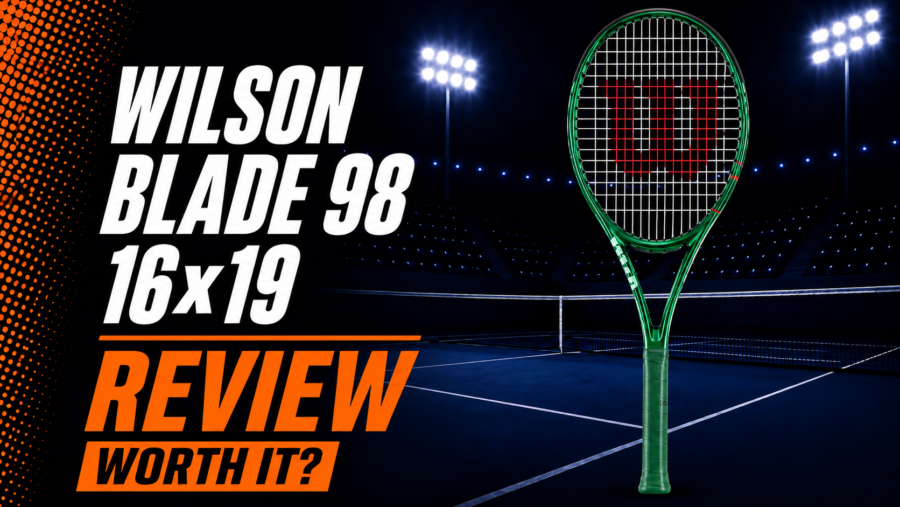
The Wilson Blade 98 16×19 V10 is the open-pattern 98 in² model at the center of Wilson’s 2026 Blade performance line. It combines a 305 g unstrung weight and head-light balance with the V10 generation’s new tapered beam, aiming to preserve Blade control while making power and spin more accessible than on the 18×20 version.
This review covers the standard Blade 98 16×19 V10, not the Blade Pro 98 and not a V8 or V9 frame in a different cosmetic. The standard V10 has a 98 in² head, 16×19 pattern and approximately 322 swingweight when strung, whereas the Blade Pro uses a different mold, balance and substantially higher swingweight.
The racket is designed for intermediate to advanced players with medium-full to full strokes who want to attack with placement, spin and player-generated speed. It is more versatile and higher launching than the Blade 98 18×20 V10, but it remains a compact performance frame rather than an easy-power 100 in² racket.
Wilson Blade 98 16×19 V10 Score
| Category | Score |
|---|---|
| Power | 7/10 |
| Spin | 8/10 |
| Control | 9/10 |
| Comfort | 8/10 |
These scores are editorial estimates based on the racket’s verified specifications, construction, target player and place within the broader market. They are relative assessments, not laboratory results or personal playtest claims, and the complete string and grip setup can change every category.
Wilson Blade 98 16×19 V10 Specifications
| Specification | Details |
|---|---|
| Head size | 98 in² / 632 cm² |
| Length | 27 in / 68.6 cm |
| Unstrung weight | 305 g / 10.8 oz |
| Strung weight | Approximately 323 g / 11.4 oz, retailer measured |
| Unstrung balance | 32 cm / 7 pts head light |
| Strung balance | Approximately 33 cm / 4 pts head light, retailer measured |
| Swingweight | Approximately 322, strung retailer measurement |
| Stiffness | Approximately 61 RA, retailer measured |
| Beam width | 21.5 mm / 21.5 mm / 20.5 mm |
| String pattern | 16×19 |
| Composition | Braided graphite and carbon construction |
| Recommended tension | 47-57 lb / 21-26 kg |
| Grip | Wilson Pro Performance |
Wilson publishes the model’s nominal dimensions, unstrung weight and unstrung balance. Strung weight, balance, swingweight and stiffness are approximate retailer measurements, and finished specifications can vary with manufacturing tolerances, grip size, string type and gauge, overgrips, dampeners and protective tape.
Design, Materials and Technologies
Head Size, Beam and Frame Geometry
The 98 in² head is compact enough to concentrate the response around a precise central hitting area. It gives experienced players a clear sense of face position, but offers less forgiveness than a 100 or 105 in² head when the contact point moves toward the frame.
The major V10 geometry update is a tapered beam. Wilson raises the upper-hoop height by roughly 1 mm, creating a profile of about 21.5 mm through much of the frame that narrows to 20.5 mm, with the goal of adding stability and easier power at the top of the bed.
That beam is different from the constant, thinner profile used on standard V8 and V9 Blade 98 frames. The familiar 305 g weight does not make the generations interchangeable, so older stiffness, swingweight or feel descriptions should not be applied to V10.
Weight, Balance and Swingweight
The 305 g unstrung weight becomes approximately 323 g with strings, placing the Blade above most beginner and recreational rackets. Its 32 cm unstrung balance keeps a useful amount of mass toward the handle, helping the player accelerate and adjust the face despite the substantial total weight.
At approximately 322 strung swingweight, the 16×19 V10 is comparatively quick for a 305 g player frame. That figure supports preparation and spin production while retaining enough inertia for a confident response when the player completes the swing.
Maneuverability should not be inferred from static weight alone. The Blade is heavy enough to demand conditioning over time, but its head-light balance and moderate swingweight make it easier to move than a lighter frame whose mass is concentrated farther toward the tip.
Materials and Construction
Wilson uses braided graphite and carbon construction to tune how the frame bends and returns to shape. The manufacturer associates this composition with feel and control, though material terminology cannot determine whether a specific player will prefer the feedback.
DirectConnect extends the carbon handle to the end cap for a more continuous structure. That design is intended to improve torsional stability and connection through the handle, and it can reasonably be expected to transmit more impact information than a heavily isolated handle system.
String Pattern
The 16×19 pattern provides more space between strings than the 18×20 version within the same 98 in² head. That extra space generally allows a higher launch, more string movement and easier net clearance, making the open Blade more adaptable to modern topspin swings.
Not every 16×19 bed behaves alike. Head shape, drill spacing and cross-string density matter, and this compact Blade pattern remains more controlled than many 16×19 layouts in larger, wider-beamed power frames.
String movement can increase snapback potential when the string surface and tension allow it. It can also accelerate notching and breakage for strong hitters, particularly with thin multifilament or natural gut, so spin access and durability must be balanced through setup.
Technologies
FORTYFIVE is Wilson’s carbon-fiber orientation system for managing frame bending in modern swing paths. It is intended to preserve the characteristic Blade flex while adding stability, but it does not guarantee more control without sound preparation and contact.
StableFeel+ is the V10 update intended to limit unwanted hoop movement and sharpen the response away from center. Regional Wilson materials also use SI3D and Zen Edge language for three-dimensional bending and a torsional-stability target; these are manufacturer engineering descriptions rather than independent proof of better results for every player.
Signature X-Loop describes the shoulder geometry that helps define the Blade frame shape. Parallel Drilling allows the strings to travel more directly through the grommets, which Wilson says enlarges the responsive hitting zone and supports a more forgiving string-bed response.
Click-and-Go is a closely fitted, replaceable bumper and grommet system. Elite Spec Tolerance refers to tighter V10 factory targets for weight, balance and swingweight, although Wilson still allows tolerances and players matching multiple frames should verify the finished numbers.
Wilson Blade 98 16×19 V10 Performance
Comfort and Feel
The approximately 61 RA measured stiffness, relatively narrow beam and braided layup suggest a flexible, feedback-rich response compared with many power rackets. V10’s added upper-hoop support is designed to make off-center contact react more cleanly without relying on a thick, rigid beam.
DirectConnect and StableFeel+ point toward a response that is more direct than heavily damped. A centered strike should communicate useful information, while a miss near the edge will still feel less protected than it would on a larger head.
Strings remain decisive. A firm polyester at high tension can make even a low-RA frame feel severe, while multifilament, natural gut or a softer hybrid can change impact feel and rebound substantially; comfort is subjective and no racket can prevent or treat an injury.
Comfort score: 8/10
Power
The 16×19 pattern and tapered upper hoop give this Blade more accessible depth than the dense version. Power still comes mainly from racket-head speed and an organized swing, but the open bed allows a little more launch and rebound when contact is centered.
An approximate 322 swingweight is enough to carry useful momentum without requiring the player to move an exceptionally high-inertia frame. It supports attacking from the baseline, yet a short block or defensive flick receives less help than with a 100 in² power racket built around a 24 to 26 mm beam.
The player must still regulate pace with technique and spin. The frame’s control orientation keeps the response from becoming overly lively, which gives faster swingers room to accelerate.
Power score: 7/10
Control
Control comes from the compact head, head-light balance, low measured stiffness and the player’s ability to reproduce face angle. The 16×19 launch is higher than the 18×20 Blade, but it remains predictable enough for aggressive targeting when the swing path is consistent.
The extra arc creates more margin over the net, which can be a form of practical control for topspin players. Flatter hitters may find the ball leaves the bed with more lift than on the dense Blade, so string choice and tension become important for keeping depth dependable.
The racket does not supply accuracy by itself. Footwork, spacing, timing and stable contact determine whether its precision-oriented construction translates into reliable placement.
Control score: 9/10
Spin
Sixteen mains and 19 crosses give the strings more room to move and return than in the 18×20 model. Combined with the moderate swingweight, this supports rapid acceleration and makes topspin or slice easier to shape for a player with the appropriate technique.
The 98 in² head prevents the pattern from becoming excessively open, so the launch should remain lower than that of many dedicated spin rackets. A smooth, low-friction string can increase snapback, but spin still depends on racket-head speed, swing angle and contact rather than pattern count alone.
Spin score: 8/10
Maneuverability
The 32 cm unstrung balance and approximate 322 swingweight make the 16×19 V10 relatively quick for its weight class. Those numbers favor early preparation, rapid exchanges and the acceleration required for spin.
Its roughly 323 g strung mass remains a real demand over long sessions. Players moving from a 270 to 285 g frame should evaluate whether the added weight improves contact quality without slowing preparation or shortening the follow-through.
Stability
The finished weight, braided layup, taller upper hoop and V10 torsional features are designed to keep the face from twisting excessively. Stability should be useful against pace when contact is reasonably centered and the swing continues through the ball.
The moderate swingweight keeps the racket mobile but provides less plow-through than a Blade Pro or other frame in the high 330s. This is an intentional balance between speed and resistance to deflection, not maximum stability at any cost.
Performance by Shot
Groundstrokes
The Blade 98 16×19 V10 fits baseline players who combine full acceleration with controlled topspin. The open bed helps the ball clear the net and dip, while the compact head and flexible specification give the player room to attack without excessive rebound.
Flatter drives remain precise, though their trajectory will sit slightly higher than with the 18×20 version. On a one-handed or two-handed backhand, the head-light distribution supports preparation and the finished mass can help redirect pace when the player meets the ball in front.
Defensive groundstrokes are more accessible than with the dense Blade because the open pattern supplies additional launch. The racket still requires cleaner timing than a larger, lighter frame, and late contact near the hoop will expose the smaller contact area.
Serves
The 16×19 version offers a balanced serving profile. Head-light handling helps acceleration, the strung mass supports pace on a complete motion, and the open bed assists slice and kick shape.
Flat serves benefit from the racket’s targeting, although it does not create the free speed of a very stiff power frame. Spin serves are the clearer advantage over the 18×20 model because the higher launch gives the player more room to brush up and across the ball.
Volleys and Net Play
At net, the head-light balance helps set the face during quick exchanges. The frame’s mass and V10 stability features support punch volleys, while the compact head and direct response suit players who use touch, angles and precise depth.
The 16×19 bed provides a little more rebound than the dense version, which can help on low or stretched volleys. It also asks for controlled hands on firm incoming pace, and a 100 in² model remains more forgiving during purely reactive contact.
Returns
The approximately 322 swingweight makes short return preparation realistic, and the 323 g strung mass gives the face useful substance when blocking first serves. The open pattern offers extra net clearance when the returner brushes an aggressive second-serve return.
Against very heavy pace, stability depends on meeting the ball on time rather than simply holding out the racket. Players who routinely return late may be better served by a larger head or lighter finished weight.
String and Setup Considerations
The Blade’s open pattern can work with polyester, multifilament, natural gut or a hybrid, but the best choice depends on swing speed and priorities. A controlled polyester suits strong hitters seeking predictable launch and durability, provided the player is comfortable with its firmer response and replaces it before it becomes excessively dead.
Multifilament or natural gut adds depth, pocketing and comfort for players who do not break strings quickly. In this 16×19 bed, softer strings may move and notch faster than in the dense Blade, so durability should be monitored rather than assumed.
A natural-gut or multifilament main with a smooth polyester cross can offer power with useful snapback. Reversing the hybrid gives polyester more influence over launch and durability while softening the bed compared with full polyester.
The Tennis String Finder can help filter options by control, spin, comfort and expected life. Use the Tennis String Tension Calculator for a starting point within the printed 47-57 lb / 21-26 kg range, then adjust gradually based on launch, depth and impact response.
Players changing from an older Blade should not copy tension automatically. The V10 tapered hoop and revised layup change the system, and the same string can respond differently from V8 or V9 even when the nominal head and pattern match.
Build Quality and Durability
The braided graphite frame is protected by a full bumper around the top of the hoop and grommets at the string holes. V10’s Click-and-Go system makes the bumper and grommet assembly replaceable, helping maintain protection after normal wear.
Scrapes, paint chips and bumper scuffs are expected when the racket contacts the court. These are usually cosmetic, but a sharp, crushed or missing grommet can damage string and should be replaced before it cuts through prematurely.
Replacement parts must match the standard Blade 98 16×19 V10. The 18×20, Blade Pro and previous-generation drill patterns or bumper shapes should not be treated as interchangeable without confirmation.
Inspect the frame after a hard impact and at each restring. A crack that crosses the graphite, a spreading line, unusual flex or separation around the handle is structurally different from a surface scratch and should be assessed before continued use.
Who Should Use It?
The Blade 98 16×19 V10 is best for established intermediate to advanced players with medium-fast or fast, medium-full to full swings. It suits those who already generate useful pace and want a blend of control, spin and feel rather than maximum free power.
Topspin baseliners, aggressive all-court players and precise doubles players can all fit its profile. It is particularly relevant for someone attracted to Blade control but unwilling to accept the lower launch and greater spin demand of an 18×20 bed.
The player should be physically comfortable with approximately 323 g strung and able to move an approximate 322 swingweight repeatedly. A short demo or gradual transition is sensible for anyone coming from a much lighter racket.
Who Should Avoid It?
Beginners usually benefit from a larger head, lighter finished weight and easier depth. The Blade’s 98 in² face and performance weight can punish late preparation, especially while stroke mechanics are still developing.
Players with compact swings or those seeking effortless defensive power should consider the Blade 100, a lighter 100 in² model or a purpose-built power frame. Players who hit almost entirely flat and want the lowest possible launch may prefer the 18×20 version.
Anyone seeking tour-style plow-through should not confuse this standard model with the Blade Pro. The Pro’s higher swingweight makes it more stable and powerful for players who can accelerate it, but much more demanding during rapid exchanges and long matches.
Pros and Cons
| Pros | Cons |
|---|---|
| Strong balance of control and spin | Less forgiving than a 100 in² racket |
| Moderate swingweight for a 305 g frame | Limited free power on short swings |
| Head-light handling suits all-court play | Approximately 323 g strung can be tiring |
| V10 tapered hoop adds useful support | Open bed can increase string wear |
Wilson Blade 98 16×19 V10 Compared With Similar Rackets
The Wilson Blade 98 18×20 Review covers the direct sibling. Both standard V10 frames share the same head size, nominal weight, balance and tapered beam, but the 16×19 offers more launch, spin and accessible depth; the 18×20 provides a lower trajectory and greater string-bed containment.
The Babolat Pure Strike 98 16×19 Review describes another 305 g, 98 in² open-pattern control frame. The Pure Strike generally presents a firmer, more powerful response and a slightly higher measured swingweight, while the Blade V10 is lower in stiffness, quicker through the air and more flex-oriented.
The Head Gravity Pro tennis racket is relevant for players considering a larger, denser control option. Its 100 in² head offers a broader contact area and its higher mass profile favors stability, whereas the Blade 16×19 is more maneuverable and easier to shape with spin.
A Yonex Percept 97 is another compact, flexible control alternative. Its 97 in² geometry and distinct isometric head create a different sweet-spot shape, so choosing between it and the Blade depends less on the printed one-inch difference than on preferred launch, handle shape and response.
Final Verdict
The Wilson Blade 98 16×19 V10 is a versatile control racket for players who want a compact face without committing to a dense string pattern. Its greatest strengths are predictable targeting, useful spin access, head-light handling and a relatively flexible measured specification.
The limitations are equally clear. It supplies less free power and forgiveness than a larger power frame, its finished weight requires conditioning, and the 16×19 bed can wear soft strings more quickly for a fast hitter.
For an established player who produces pace and wants to combine modern topspin with Blade-style placement, this is the more adaptable of the two standard Blade 98 V10 patterns. The key decision is whether its easier launch is worth giving up some of the dense model’s maximum trajectory control.
Frequently Asked Questions
Is the Wilson Blade 98 16×19 V10 suitable for beginners?
It is usually too demanding for a new player because of its 98 in² head and approximately 323 g strung weight. A lighter 100 to 105 in² frame generally offers an easier learning platform.
Is the Blade 98 16×19 V10 a power or control racket?
It is primarily a control racket with moderate power. The open pattern and tapered V10 hoop add depth, but the player still supplies most of the acceleration.
Is the Blade 98 16×19 V10 comfortable?
Its approximately 61 RA measured stiffness and narrow beam suggest a relatively flexible response. Actual comfort depends heavily on strings, tension, grip, contact quality and the individual player.
Does the Blade 98 16×19 V10 generate spin easily?
It offers strong spin access for a control frame because of its open pattern and manageable swingweight. Technique and racket-head speed remain essential, and it is less spin-assisted than some larger dedicated spin rackets.
How demanding is the Blade 98 16×19 V10?
The approximate 322 swingweight is moderate, but the racket still weighs around 323 g strung. It suits players who can prepare early and maintain full swings without fatigue.
What is the difference between the Blade 98 16×19 V10 and 18×20 V10?
The 16×19 launches higher and provides easier spin and depth. The 18×20 launches lower, limits string movement and favors flatter hitters who prioritize maximum predictability.
What strings suit the Blade 98 16×19 V10?
Polyester suits fast swingers who need control and durability, while multifilament or natural gut increases power and comfort. Hybrids can balance these traits, and tension should stay within the frame’s range while accounting for the selected material.