
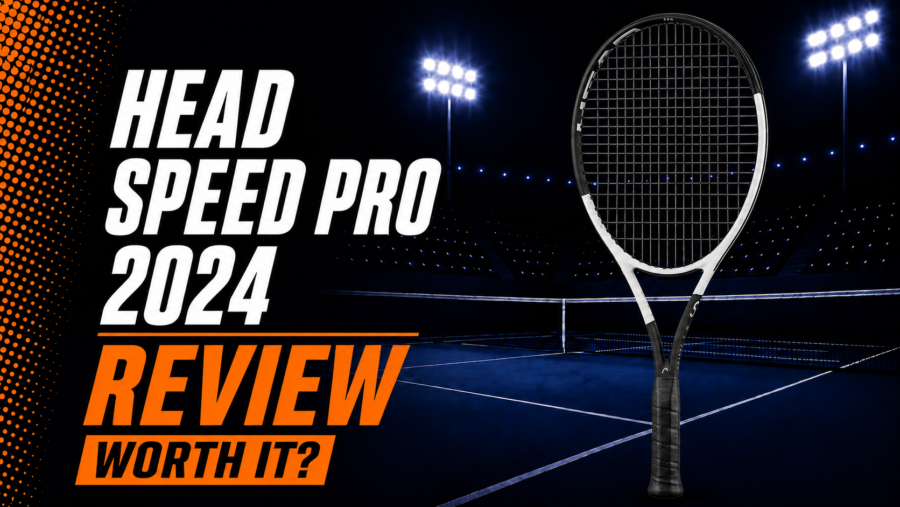
The HEAD Speed Pro 2024 is the heaviest and most control-oriented adult model in HEAD’s 2024 Speed family. It retains the 100 in² head, 18×20 string pattern and 310 g unstrung weight associated with the previous generation, while introducing Auxetic 2.0 construction in the yoke and at the end of the grip.
Its combination of a relatively large head, dense string pattern and substantial swingweight makes it more forgiving than many traditional 98 in² control rackets without turning it into an easy-power frame. It is designed primarily for advanced and tournament players with developed strokes who want predictable targeting, stability and enough mass to redirect heavy pace.
Compared with the HEAD Speed MP 2024, the Pro is 10 g heavier, more head-light and uses an 18×20 pattern instead of 16×19. The Pro produces a lower launch angle and greater directional control, while the MP provides easier access to topspin and depth.
HEAD Speed Pro 2024 Score
| Category | Score |
|---|---|
| Power | 8/10 |
| Spin | 7.5/10 |
| Control | 9/10 |
| Comfort | 8.5/10 |
These scores are editorial estimates based on the racket’s verified specifications, construction, approximate laboratory measurements, intended playing profile and position within the wider tennis-racket market. Individual results will depend on technique, strings, tension and physical ability.
HEAD Speed Pro 2024 Specifications
| Specification | Details |
|---|---|
| Head size | 100 in² / 645 cm² |
| Length | 27 in / 68.6 cm |
| Unstrung weight | 310 g / 10.9 oz |
| Strung weight | Approximately 329–334 g / 11.6–11.8 oz, depending on strings and sample |
| Unstrung balance | 310 mm / 31.0 cm / 1.3 in head-light, approximately 10 pts HL |
| Strung balance | Approximately 32.4–32.5 cm / 12.8 in / 6 pts HL |
| Swingweight | Approximately 333–335 |
| Stiffness | Approximately RA 60 |
| Beam width | Constant 23 mm |
| String pattern | 18×20 |
| Composition | Graphite composite with Graphene Inside and Auxetic 2.0 construction |
| Recommended tension | 22–26 kg / 48–57 lb |
| Grip | HEAD HydroSorb Pro |
The unstrung weight, balance, head size, length, beam and string pattern are manufacturer specifications. Strung weight, strung balance, swingweight and stiffness are approximate measurements from retailer laboratories and independent samples.
Finished specifications can vary because of manufacturing tolerances, string type, string gauge, replacement grips, overgrips, dampeners and other accessories. Players purchasing multiple frames for tournament use may want a professional matching service.
Design, Materials and Technologies
Head Size, Beam and Frame Geometry
The 100 in² head gives the Speed Pro 2024 more hitting-area margin than most 97 in² and 98 in² control rackets. This does not make it beginner-friendly, but it helps the racket remain more accommodating during defensive exchanges and slightly off-center contact.
Its constant 23 mm beam is thicker than the beams found on many traditional player’s rackets but narrower than those used on numerous power-focused frames. This construction contributes to the Speed Pro’s balance between controlled response, stability and enough frame-assisted pace to prevent it from feeling completely underpowered.
HEAD uses an aerodynamic cross-section called Speed Beam. The shape is intended to help the frame move efficiently through the air, although its approximate 333–335 swingweight means the racket still requires strength, preparation and developed swing mechanics.
Weight, Balance and Swingweight
At 310 g unstrung, the Speed Pro carries enough static mass to produce a heavy, penetrating ball when accelerated correctly. The official 310mm unstrung balance places more of that mass toward the handle, helping the racket remain manageable relative to its overall weight.
The head-light balance should not be confused with a low swingweight. Independent measurements around 333–335 place the Speed Pro firmly in demanding territory, especially for players with compact strokes or late preparation.
This weight distribution helps explain its combination of maneuverability and stability. Advanced players accustomed to substantial rackets may find it easier to handle than the numbers suggest, while players moving from a lighter frame may struggle during rushed exchanges, defensive shots and repeated serves.
Materials and Construction
The primary structure is a graphite composite reinforced with HEAD’s Graphene Inside technology. HEAD states that graphene is positioned strategically within the frame to improve strength, stability and energy transfer, but the racket is not made entirely from graphene.
Auxetic 2.0 construction is incorporated into the carbon-engineered yoke and the structure at the end of the grip. HEAD claims that these sections deform in response to impact to improve feedback, shock absorption and the consistency of the response.
These manufacturer claims should not be treated as proof that one technology independently produces the racket’s performance. Its feel and stability also depend on the graphite layup, head shape, beam geometry, static weight, swingweight, strings and tension.
String Pattern
The 18×20 string pattern is designed to produce a controlled and predictable response. It generally limits string movement, lowers the launch angle and improves directional confidence compared with the more open 16×19 pattern of the Speed MP.
However, not every 18×20 racket behaves identically. The Speed Pro combines its pattern with a 100 in² head and relatively playable string spacing, giving it better spin access and a more forgiving response than some tightly spaced 18×20 rackets with smaller heads.
The denser pattern may also improve string durability by reducing movement and friction. Players must still create sufficient racket-head speed and brushing contact to generate heavy topspin.
Technologies
Auxetic 2.0 is positioned in the yoke and at the end of the grip. HEAD claims that the construction responds to impact to improve feedback and shock absorption, while independent evaluations generally describe the 2024 response as softer and more dampened than the 2022 model.
Graphene Inside refers to strategically positioned graphene reinforcement within the graphite structure. HEAD associates it with frame strength, stability and energy transfer, although the precise contribution cannot be separated from the racket’s mass and geometry.
Speed Pattern is HEAD’s name for the string spacing selected to balance power and control. On the Speed Pro 2024, this technology uses an 18×20 layout rather than the 16×19 configuration found on the Speed MP.
Power Grommets are enlarged grommets designed to permit additional string movement. HEAD claims this movement contributes to power, but it does not turn the Speed Pro into a high-powered racket or increase the installed string tension.
Directional Drilling refers to the orientation of the drilled string channels. HEAD claims this arrangement supports power, sweet-spot response and a softer impact sensation.
Speed Beam is the aerodynamic cross-section of the constant 23 mm frame. It is intended to help players generate racket-head speed, but the relatively high swingweight remains an important consideration.
The soft-touch lacquer gives the frame a distinctive matte and slightly velvety finish. This is a cosmetic and tactile feature rather than a structural vibration-dampening technology.
HEAD Speed Pro 2024 Performance
Comfort and Feel
The approximate RA 60 stiffness measurement places the Speed Pro 2024 among the more flexible modern performance rackets. Its flex, substantial mass and Auxetic 2.0 construction produce a response commonly described as plush, dampened and solid rather than stiff or hollow.
The ball remains on the string bed long enough to provide useful pocketing and directional feedback. Some players will appreciate the muted response, while those who prefer very crisp and immediate feedback may find it slightly disconnected.
Impact comfort does not guarantee that the racket will suit every arm. String material, tension, grip size, technique and the physical effort required to swing its substantial weight all influence comfort.
Comfort score: 8.5/10
Power
The Speed Pro produces more player-generated power than freely accessible power. Its 100 in² head and 23 mm beam provide some assistance, but the dense pattern and flexible construction keep the response controlled.
Most of its penetrating pace comes from the racket’s mass and swingweight. Players who prepare early and accelerate through contact can produce a heavy, deep ball, while shorter or slower swings may leave shots landing short.
The result is controlled power that rewards confident mechanics. It is more powerful than many thin-beamed control rackets, but it does not provide the easy depth of a stiffer, wider-beamed power frame.
Power score: 8/10
Control
Control is the Speed Pro 2024’s clearest strength. The 18×20 pattern, flexible construction and relatively low launch angle create a predictable ball flight that encourages players to accelerate toward precise targets.
The racket performs particularly well on flatter drives, penetrating backhands, slices and shots taken early. Its mass also helps players redirect incoming pace without relying on an excessively long swing.
This does not mean the racket creates accuracy independently. Players still need clean timing and appropriate racket-face control, but the frame provides a consistent platform for developed technique.
Control score: 9/10
Spin
Spin potential is respectable for an 18×20 racket because the pattern is spread across a 100 in² head. Players with sufficient racket-head speed can produce effective topspin, slice and serve variation.
However, the lower launch and substantial swingweight make heavy topspin less accessible than with the Speed MP or a dedicated spin racket. High, dipping trajectories require more deliberate acceleration and brushing contact.
Slice is a particular strength because the dense bed, stability and low trajectory help produce penetrating shots that stay close to the court. Topspin remains available, but it is created primarily by technique rather than automatic string-bed lift.
Spin score: 7.5/10
Maneuverability
The 310mm unstrung balance places considerable mass toward the handle, helping the racket change direction more efficiently than a similarly weighted frame with a less head-light balance. The Speed Beam profile also aims to reduce resistance through the air.
Nevertheless, the approximate 333–335 swingweight makes the racket demanding during late preparation, wide defensive shots and rapid exchanges. It is manageable for strong players accustomed to substantial frames, but it should not be described as genuinely lightweight or whippy.
Stability
The combination of strung mass, swingweight, beam construction and weight distribution gives the Speed Pro dependable stability against heavy incoming shots. It resists being pushed backward at contact and allows compact blocks to return pace effectively.
The 100 in² head also provides more margin than smaller control frames. Stability can still decrease on contact near the edge of the string bed, and individual samples may perform differently because of manufacturing tolerances.
Performance by Shot
Groundstrokes
The Speed Pro 2024 is especially effective for players who hit through the court with flatter or moderately spun groundstrokes. Its lower launch angle allows aggressive swings without producing an excessively high ball flight, while the substantial swingweight helps shots maintain pace and depth after the bounce.
Two-handed backhands, flatter forehands and penetrating slices match the racket particularly well. Players who take the ball early can use its stability and predictable response to redirect pace or change direction confidently.
Topspin remains available, but defensive forehands and high-margin looping shots require more physical effort than with a lighter 16×19 racket. Players who become late to contact may find it difficult to accelerate the frame quickly enough to create depth and net clearance.
Serves
On serves, the Speed Pro rewards smooth acceleration and complete mechanics. Its mass can produce strong pace on flatter first serves, while the controlled string bed supports confident placement around the service box.
Slice serves benefit from the racket’s directional accuracy and stable response. Kick serves are possible, but the dense pattern and higher swingweight require more racket-head speed to create sharp upward rotation.
Players capable of maintaining acceleration throughout a match should find a useful combination of pace and precision. Those who struggle to move heavier rackets overhead may experience fatigue or lose speed during longer serving sessions.
Volleys and Net Play
Volleys are one of the Speed Pro’s strongest areas. Its mass and stability help the racket absorb incoming pace, while the controlled string bed makes it easier to place firm volleys without the ball launching unpredictably.
The flexible response also supports touch on drop volleys and low contact. Quick body volleys can be more challenging because of the swingweight, but players who prepare the racket early receive a stable and dependable platform.
Returns
The Speed Pro is highly effective when returning powerful serves. Its mass allows players to use compact strokes and block the ball back with useful depth rather than attempting to create all the pace themselves.
The controlled launch angle also supports aggressive cuts at second serves. Preparation must remain early because the racket is not especially easy to flick into position when reacting late to high kick serves or serves directed into the body.
String and Setup Considerations
The dense 18×20 pattern works well with strings that provide controlled response and dependable tension maintenance. Experienced polyester users may appreciate a thinner 1.20mm or 1.25mm polyester that adds bite and improves spin access without making the string bed excessively unpredictable.
A string such as HEAD Lynx Tour can complement the racket’s control-focused playing profile, although its relatively firm response will not suit everyone. Players seeking more accessible depth and comfort can consider multifilament, natural gut or a hybrid combining a softer string with polyester.
A full bed of polyester provides control and physical durability for players who swing quickly and break strings regularly. It can also make the response firmer and less powerful, particularly after the string loses tension and elasticity.
Multifilament and natural gut increase power, pocketing and impact comfort. A hybrid can sit between these approaches, although the exact response depends on which string is installed in the mains.
The official recommended tension range is 22–26 kg or 48–57 lb. This range is a boundary rather than a universal ideal tension, and the final setup should account for the string material, gauge, playing style and desired response.
The Tennis String Finder can help narrow down suitable materials and models. The Tennis String Tension Calculator can then provide a practical starting range within the manufacturer’s recommendation.
Build Quality and Durability
The Speed Pro 2024 uses a premium graphite-composite frame with a full bumper guard protecting the upper hoop. Its grommets separate the strings from the graphite edges and should be inspected whenever the racket is restrung.
Compatible replacement bumper and grommet sets are available for the 2024 Speed Pro. Replacing worn components can help protect the frame and prevent damaged grommets from cutting into the strings.
The soft-touch lacquer can develop scratches, scuffs and paint chips through regular use. Cosmetic damage does not necessarily affect performance, but exposed graphite, deep fractures or changes in the frame’s shape may indicate structural damage.
Players should periodically inspect the hoop, throat and handle after court contact or accidental impacts. The article on how long a tennis racket lasts explains the difference between ordinary cosmetic wear and more serious warning signs.
Who Should Use It?
The HEAD Speed Pro 2024 is best suited to advanced players, tournament competitors and strong intermediates with developed full swings. Players should be able to prepare early, accelerate a racket with a swingweight above 330 and maintain that acceleration throughout a match.
It particularly suits aggressive baseliners, counterpunchers and all-court players who prefer predictable targeting over automatic power. Flatter hitters, two-handed backhand players and competitors who use penetrating slice should find its trajectory especially compatible.
Players who regularly face heavy pace can benefit from its stability on returns, volleys and compact defensive strokes. It is also a strong option for someone who wants the forgiveness of a 100 in² head without giving up the control of an 18×20 string pattern.
Who Should Avoid It?
Complete beginners and recreational players with short or slow swings will usually find the Speed Pro unnecessarily demanding. Its weight and swingweight can make preparation difficult, reduce racket-head speed and cause shots to land short.
Players who depend heavily on high topspin trajectories may prefer a lighter 16×19 frame with a higher natural launch angle. The Speed MP offers easier spin than the Pro, although its measured swingweight means the 2024 version is not dramatically quicker through the air.
Anyone seeking effortless power should consider a stiffer or wider-beamed alternative. Players who prefer a very crisp and direct response may also dislike the Speed Pro’s softer, more dampened feedback.
Although the frame has a relatively flexible laboratory measurement, it should not automatically be considered suitable for every player experiencing discomfort. The complete setup, technique and physical effort required to swing the racket remain important.
Pros and Cons
| Pros | Cons |
|---|---|
| Excellent directional control and predictable launch angle | Requires developed technique and a full swing |
| Stable against heavy pace on groundstrokes, volleys and returns | Approximate 333–335 swingweight can become demanding |
| Plush and flexible response for a performance racket | Less accessible topspin than a 16×19 spin racket |
| More forgiving than many smaller 18×20 control frames | Provides limited free power for slower swings |
HEAD Speed Pro 2024 Compared With Similar Rackets
HEAD Speed Pro 2024 vs HEAD Speed MP 2024
Both rackets use a 100 in² head, 27 in length, constant 23 mm beam and Auxetic 2.0 construction. The Pro weighs 310 g unstrung, balances at 310mm and uses an 18×20 pattern, while the MP weighs 300 g, balances at 320mm and uses a 16×19 pattern.
The Pro offers a lower launch angle, greater directional predictability and more mass behind the ball. The MP provides easier spin and depth, but retailer measurements around 330 swingweight for the MP and 333 for the Pro mean the difference in maneuverability is smaller than their static weights suggest.
HEAD Speed Pro 2024 vs Wilson Blade 98 18×20
The Wilson Blade 98 18×20 uses a smaller 98 in² head, a thinner beam and lower static weight. It offers a more compact hitting area and classic control-oriented response.
The Speed Pro supplies greater forgiveness, more mass and easier depth from its 100 in² head and 23 mm beam. The Blade should appeal more to players who want a smaller, more precise frame, while the Speed Pro offers the broader sweet-spot response and greater stability.
HEAD Speed Pro 2024 vs Babolat Pure Strike 100 16×20
The Babolat Pure Strike 100 16×20 combines the same 100 in² head size with a slightly more open 16×20 pattern and a lower 305 g unstrung weight. It sits between a traditional 16×19 racket and the denser Speed Pro.
The Pure Strike provides easier spin access and a slightly more responsive attacking profile. The Speed Pro offers the lower launch angle, greater strung mass and more substantial stability for players who can handle its swingweight.
Final Verdict
The HEAD Speed Pro 2024 is a versatile advanced-player racket built around control, stability and a plush impact response. Its 100 in² head makes it more forgiving than many traditional control frames, while the 18×20 pattern keeps the trajectory predictable enough for confident, aggressive swings.
Its power comes mainly from mass, swingweight and player acceleration rather than a lively string bed. This produces excellent penetration when timing is clean, but it can leave slower swings without enough depth.
The racket is particularly effective on flatter groundstrokes, slices, returns and volleys. Topspin remains available, but players seeking automatic lift and easy racket-head speed will find more suitable options elsewhere.
For advanced competitors who want an 18×20 racket without moving down to a smaller head, the Speed Pro 2024 is a strong and unusually complete option. The most important consideration is whether the player can handle its approximate 333–335 swingweight consistently throughout a full match.
Frequently Asked Questions
Is the HEAD Speed Pro 2024 suitable for beginners?
No. Its 310 g unstrung weight, substantial swingweight and controlled power level make it unnecessarily demanding for most beginners.
Is the HEAD Speed Pro 2024 designed more for power or control?
It is primarily a control-oriented racket. Its mass can produce strong pace, but players must supply sufficient acceleration and clean contact.
Is the HEAD Speed Pro 2024 comfortable?
Its approximate RA 60 flex and Auxetic 2.0 construction produce a relatively plush and dampened response. Comfort still depends on the strings, tension, grip size, technique and individual player.
Is the HEAD Speed Pro 2024 good for spin?
It provides respectable spin for an 18×20 racket, particularly because the pattern covers a 100 in² head. It does not produce topspin or a high launch angle as easily as the 16×19 Speed MP.
How demanding is the HEAD Speed Pro 2024?
It is demanding for players who are not accustomed to rackets with swingweights above 330. Its head-light balance helps, but it still requires early preparation, strength and developed swing mechanics.
What is the difference between the Speed Pro 2024 and Speed MP 2024?
The Pro is 10 g heavier, more head-light and uses an 18×20 pattern instead of 16×19. It offers more control and a lower launch angle, while the MP provides easier spin and depth.
What strings work well in the HEAD Speed Pro 2024?
Polyester can suit advanced players seeking control and durability, while multifilament or natural gut adds power and comfort. A hybrid can provide a balance between these characteristics.