
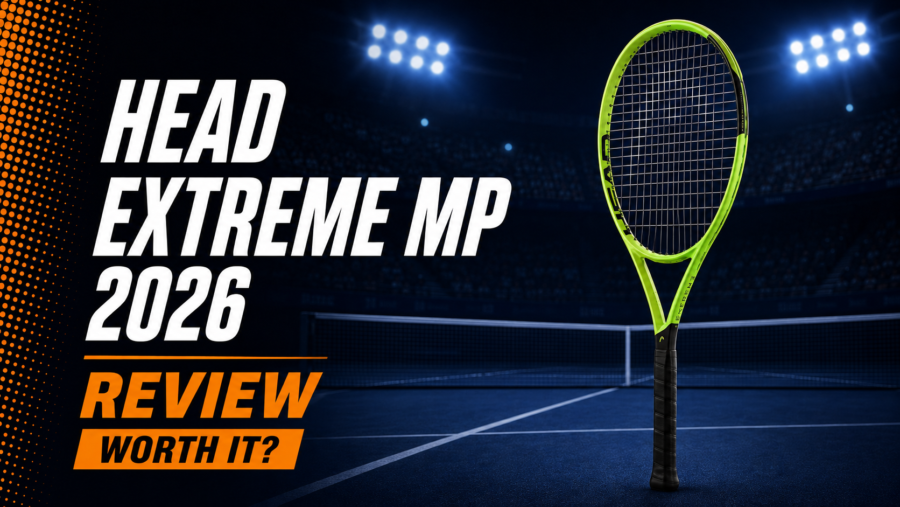
The HEAD Extreme MP 2026 is the standard-length, 300 g model at the center of HEAD’s spin-focused Extreme range. This exact version has a 100 in² head, a 16×19 string pattern and a 27 in length, combining accessible depth and forgiveness with the racket-head speed needed for topspin.
HEAD positions the Extreme MP for intermediate through tournament-level players. Its specifications are most relevant to players with medium-to-full swings who want a modern baseline racket that can create net clearance and spin without the smaller hitting area or greater precision demands of the Extreme Pro.
Within the family, the MP is heavier and more substantial than the Extreme MP L and MP UL. It is more forgiving than the 98 in² Extreme Pro and easier to maneuver than the 27.5 in Extreme MP XL, making it the most broadly applicable performance model in the line. Players still deciding between head sizes may also find the tennis racket size guide useful.
HEAD Extreme MP 2026 Score
| Category | Score |
|---|---|
| Power | 8.5/10 |
| Spin | 9.5/10 |
| Control | 8/10 |
| Comfort | 7.5/10 |
These scores are editorial estimates based on the racket’s verified specifications, construction, intended playing profile, position within the wider tennis-racket market and reliable independent evaluations. They are comparative ratings rather than laboratory values, and individual results will vary with technique, strings, tension and physical preferences.
HEAD Extreme MP 2026 Specifications
| Specification | Details |
|---|---|
| Head size | 645 cm² / 100 in², official |
| Length | 68.6 cm / 27 in, retailer-listed |
| Unstrung weight | 300 g / 10.6 oz, official |
| Strung weight | Approximately 318 g / 11.2 oz, retailer-listed |
| Unstrung balance | 320 mm / 32.0 cm / 1 in HL, official |
| Strung balance | Approximately 330 mm / 33.0 cm / 4 pts HL, retailer-listed |
| Swingweight | Approximately 318 to 322 kg·cm², retailer-measured strung range |
| Stiffness | Approximately 67 to 68 RA, retailer-measured range |
| Beam width | 23/26/21 mm, official |
| String pattern | 16×19, official |
| Composition | Graphite composite with Hy-Bor boron-fiber reinforcement and Auxetic construction, manufacturer-described; Graphene Inside, retailer-listed |
| Recommended tension | 48 to 57 lb / approximately 22 to 26 kg, retailer-listed and not stated on the official HEAD product page |
| Grip | Hydrosorb Pro, retailer-listed and not stated on the official HEAD product page |
Finished weight, balance and swingweight can vary because of manufacturing tolerances, string type and gauge, replacement grips, overgrips, dampeners and other accessories. The approximate strung figures should therefore be treated as reference values rather than guaranteed specifications for every frame.
Design, Materials and Technologies
Head Size, Beam and Frame Geometry
The 100 in² head provides more usable hitting area and off-center margin than a 98 in² performance frame while remaining compact enough for experienced players to control with full swings. This places the Extreme MP in the familiar middle ground between demanding control rackets and larger recreational frames.
Its variable 23/26/21 mm beam is widest through the upper-middle frame and narrows toward the throat. The 26 mm section is designed to support rebound power and torsional support, while the 21 mm throat prevents the entire frame from having the uniformly thick profile of a pure power racket.
Weight, Balance and Swingweight
At 300 g unstrung and approximately 318 g strung, the Extreme MP has enough static mass to suit competitive rallying without entering the heavier player-racket category. The official 320 mm unstrung balance and approximate 33.0 cm strung balance keep the finished setup head-light, which should help preparation and recovery between fast exchanges.
The approximate 318 to 322 kg·cm² strung swingweight is moderate rather than exceptionally low. This is important because a manageable 300 g static weight does not automatically produce a very low swingweight, and the racket should still carry meaningful resistance as it is accelerated and redirected.
Maneuverability and stability are related but separate. The head-light finished balance supports handling, while the moderate swingweight, beam and material distribution are more relevant to how well the frame resists pace and twisting at contact.
Materials and Construction
The frame uses a graphite-composite construction with Hy-Bor reinforcement. HEAD describes Hy-Bor as boron fibers integrated at strategic points in the graphite layup, with the Extreme MP’s product page specifying the shaft as the key location.
HEAD claims that this reinforcement increases compressional strength and perceived stability, particularly during faster swings. That claim explains the design intent, but it is not independent proof of a universal performance gain; independent evaluations are more appropriately used to support the narrower conclusion that the 2026 model produces a crisper, more connected response than the previous generation.
Retailer composition lists also identify Auxetic 2.0 and Graphene Inside. These are parts of HEAD’s broader frame-construction system rather than separate materials that guarantee a particular result for every player.
String Pattern
The 16×19 pattern is intended to allow more string movement than a typical 18×20 pattern, supporting a higher launch window and greater snapback potential. In a 100 in² head, that combination can make topspin and defensive depth more accessible, provided the player creates sufficient racket-head speed and brushes the ball effectively.
Not every 16×19 string bed performs identically because spacing, drill pattern, grommet design and head shape all matter. The Extreme MP uses spin-oriented grommets to encourage movement, which may also increase launch, string displacement and wear for players who hit with heavy spin.
Technologies
Hy-Bor is HEAD’s name for the boron-fiber reinforcement added to the graphite layup. The manufacturer says it firms the frame under compression and improves perceived stability and energy transfer; the reasonable construction-based inference is a more supported and direct shaft response, not guaranteed extra pace on every shot.
Auxetic 2.0 is used in the yoke and handle area to tune how the frame deforms and communicates impact. HEAD presents it as a way to improve feedback and connection, while the actual sensation remains dependent on the complete setup and the individual player.
Graphene Inside is listed by retailers as reinforcement in selected parts of the frame. Its presence supports HEAD’s intended distribution of strength and mass, but the name alone does not establish that the racket is more powerful, stable or comfortable than every competing graphite frame.
Spin Grommets permit additional string movement to support snapback and rotation. The Spin Shaft is the line’s shaft geometry intended to complement upward swing paths and resist torsional movement, while Sound Grommets are designed to tune string movement, sound and vibration.
These technologies describe how HEAD has engineered the frame, but none can replace technique. Spin production, directional control and comfort still depend strongly on contact quality, racket-head speed, strings, tension and the player using the racket.
HEAD Extreme MP 2026 Performance
Comfort and Feel
Independent measurements place the frame at approximately 67 to 68 RA, which suggests a moderately firm response rather than an especially flexible one. The 26 mm central beam and the crisper Hy-Bor update are likely to make contact more direct than on the softer, more muted previous generation.
Auxetic 2.0, Sound Grommets and the graphite layup are intended to manage feedback and vibration, but they do not make comfort objective or universal. Technique, contact location, string material, gauge, tension, grip size and individual sensitivity can change the experience substantially, so players who prefer a very soft response should test the full setup before choosing it.
Comfort score: 7.5/10
Power
The Extreme MP’s accessible power comes from the interaction of its 100 in² head, 26 mm central beam, moderate swingweight and open 16×19 string bed. These specifications should help produce depth and net clearance from medium-to-full swings without requiring the player to supply all of the rebound energy.
It is not an oversize, ultra-light power frame, and its best results should still come from purposeful acceleration and clean contact. Compared with thinner control rackets, it offers easier depth; compared with the most powerful 100 in² frames, its spin-oriented response provides a more important part of its margin.
Power score: 8.5/10
Control
Control is expected to come primarily from the player’s topspin, the manageable head-light balance and a string bed that independent evaluators describe as more predictable than the previous generation. The racket should reward committed swings by using rotation and net clearance to bring aggressive shots back into the court.
The open pattern and lively beam can create a higher launch angle than a dense-pattern control frame, so flatter hitters may need more precise face control. Directional accuracy remains technique-driven, and players seeking the lowest launch and most exact response will generally find a 98 in² head or denser pattern more suitable.
Control score: 8/10
Spin
Spin is the Extreme MP’s defining performance category. The 16×19 layout, 100 in² head, Spin Grommets, Spin Shaft and manageable swingweight are all intended to support string movement and fast upward acceleration.
An open pattern does not create heavy spin on its own. Players still need appropriate swing direction, racket-head speed and contact, but the frame’s geometry should make those mechanics easier to apply than with a heavier, denser and less maneuverable racket.
Spin score: 9.5/10
Maneuverability
The 300 g unstrung weight, approximate 4 pts HL strung balance and moderate swingweight should permit relatively quick preparation on groundstrokes, returns and reflex volleys. The racket is not exceptionally light, but its specifications suggest that many intermediate and advanced players will be able to accelerate it without the delayed preparation associated with higher-swingweight frames.
Players accustomed to lighter 270 to 285 g models may still notice the added mass over a long session. Maneuverability should therefore be judged against the player’s current racket and ability, not from the 300 g label alone.
Stability
The variable beam, moderate swingweight, Hy-Bor shaft reinforcement and Spin Shaft geometry are intended to help the frame hold its line and resist twisting. Independent evaluations generally describe the 2026 MP as more solid, particularly in the upper hoop, than the preceding model.
Its stability should be appropriate for its 300 g category, but the frame cannot offer the same mass-based resistance as every heavier 305 to 315 g racket. Contact far from the center can still reduce pace and directional consistency, especially when returning heavy shots.
Performance by Shot
Groundstrokes
From the baseline, the Extreme MP is best matched to forehands and backhands struck with medium-to-fast acceleration and an upward path. The open string bed and 100 in² head should support topspin, net clearance and deep defensive replies, while the moderate swingweight provides enough substance for rally pace without making preparation excessively slow.
Flatter drives remain possible because independent evaluations describe a reasonably controlled launch rather than an unpredictable trampoline effect. Even so, flat hitters must manage the open pattern and lively beam more carefully than they would with a smaller head or denser string bed.
Serves
The head-light balance and moderate swingweight should help generate racket-head speed on serves. Slice and kick deliveries are the most natural match for the spin-oriented pattern and grommet system, while the beam and 100 in² head can contribute accessible pace on flatter first serves.
Placement and consistency still depend on the server’s mechanics. Players who can accelerate a 318 g strung frame should find a useful blend of spin and pace, while those with slower service motions may prefer the lighter MP L.
Volleys and Net Play
At net, the head-light finished balance should support quick positioning and reaction volleys. The approximate 318 g strung mass, variable beam and updated shaft construction are intended to provide enough support for firm blocks and punch volleys against moderate pace.
Touch is likely to be more crisp and direct than plush because of the beam and measured stiffness range. Players who prioritize delicate feedback above easy depth may prefer a thinner, more flexible control frame, while all-court players who value quick handling should find the MP more adaptable.
Returns
The manageable swingweight should help shorten preparation against fast serves, and the 100 in² head adds useful contact margin when timing is limited. The frame’s mass and beam should also allow compact block returns to carry reasonable depth.
On aggressive returns, its spin access can help control a faster swing. Against especially heavy pace, the MP’s moderate mass may be less resistant than a heavier frame, so clean contact and early preparation remain important.
String and Setup Considerations
Advanced players who generate high racket-head speed may use a full bed of polyester to reduce launch and emphasize spin and directional control. Polyester is comparatively firm and loses performance over time, so it should not be selected simply because the frame is marketed for spin.
A multifilament can provide a softer, more powerful response, although the open 16×19 pattern may allow more movement and a higher launch. Natural gut or a gut, multifilament and polyester hybrid can balance feel, power, control and durability, but the best arrangement depends on budget, weather, string-breaking frequency and personal preference.
Players who break strings frequently may prefer a more durable gauge, while players prioritizing response may choose a thinner option and accept shorter life. The open pattern and Spin Grommets can increase string movement, so the string bed should be inspected regularly for notching, fraying and tension loss.
The retailer-listed tension range is 48 to 57 lb, but tension choices should remain general rather than prescriptive. A lower tension normally increases launch, depth and pocketing, while a higher tension can reduce launch and increase directional predictability; neither setting guarantees comfort or control for every player.
The Tennis String Finder can help narrow the choice by material and playing goal, while the Tennis String Tension Calculator provides a structured starting point. Comfort depends on the complete system, including frame stiffness, string material, gauge, tension, grip size, technique and frequency of restringing.
Build Quality and Durability
The graphite-composite frame uses a conventional bumper-and-grommet system to protect the string contact points and upper hoop. Compatible bumper and grommet components can be replaced when available, which is preferable to continuing with cracked grommets or exposed string contact against the frame.
Normal use can produce paint chips, bumper scuffs and superficial scratches, especially around the top of the hoop. These marks are usually cosmetic, but deep fractures, spreading cracks, soft areas, significant distortion or persistent internal rattles require closer inspection.
Players should check the frame, bumper and grommets during restringing and after any hard impact. No specific lifespan can be promised because court contact, stringing quality, storage, temperature, frequency of use and impacts all affect durability.
Who Should Use It?
The HEAD Extreme MP 2026 is best suited to intermediate and advanced players with medium-to-full strokes and enough strength to accelerate an approximately 318 g strung racket. Its clearest match is a topspin-oriented baseliner who wants accessible depth, a generous 100 in² hitting area and enough maneuverability to attack from different court positions.
It can also suit all-court players who use spin on serves, approach shots and angles but do not want the smaller head or greater precision demands of the Extreme Pro. Players who value a blend of spin, power, forgiveness and quick handling should find it more versatile than its Extreme name might suggest.
Who Should Avoid It?
Beginners with short swings or players moving up from a very light racket may find its finished weight and swingweight unnecessarily demanding. A lighter 100 to 105 in² model, including the Extreme MP L or Team, should be easier to prepare and sustain through a long session.
Flat hitters who prioritize a low launch angle and pinpoint placement may prefer a 98 in² frame, a denser string pattern or a thinner beam. Players who want maximum free power may prefer a power-focused 100 in² racket, while those who want more mass and plow-through may need a heavier model.
The moderately firm, crisp response may also be a poor match for players who strongly prefer a soft and flexible setup. In that case, the alternative should combine a lower measured stiffness with an appropriate string material, tension and grip size rather than relying on a single comfort label.
Pros and Cons
| Pros | Cons |
|---|---|
| High spin potential from the 16×19 pattern, Spin Grommets and maneuverable setup | Open launch can require extra face control on flatter drives |
| Accessible depth and net clearance from a 100 in² head and 23/26/21 mm beam | Crisper 67 to 68 RA response may not suit players seeking a very soft frame |
| Approximate 318 to 322 kg·cm² swingweight balances acceleration with useful substance | Spin-oriented string movement can accelerate notching and breakage |
| Hy-Bor update is designed to improve shaft support and a more connected response | Moderate mass provides less plow-through than heavier performance rackets |
HEAD Extreme MP 2026 Compared With Similar Rackets
HEAD Extreme Pro 2026
The Extreme Pro has a smaller 98 in² head, a slightly heavier 305 g unstrung weight, a thinner 22/23/21 mm beam and the same nominal 16×19 pattern. Retail measurements place it at approximately 323 g strung, 6 pts HL and around 319 kg·cm² swingweight, so its extra static mass does not automatically make it harder to swing than every MP sample.
The Pro’s smaller head, thinner beam and lower approximate stiffness favor a lower launch, more directional precision and a more control-oriented response. The MP provides greater forgiveness, easier depth and more accessible spin for a broader range of intermediate players, while the Pro is the stronger choice for advanced players who consistently find a smaller sweet spot and generate their own pace.
Babolat Pure Aero Gen9
The standard Pure Aero Gen9 is an especially close current competitor because it also has a 100 in² head, 300 g unstrung weight and 16×19 pattern. Babolat lists a 321 mm unstrung balance, 290 kg·cm² unstrung swingweight and 69 RA target with manufacturing tolerances, while independent strung measurements place its average swingweight near 320 kg·cm², broadly similar to the Extreme MP range.
Both are intended for spin and aggressive baseline play, but their construction approaches differ. The Pure Aero uses an aerodynamic frame, a comparatively controlled FSI Spin layout and flax-fiber vibration filtering, while the Extreme uses a more visibly open pattern, Spin Grommets and Hy-Bor shaft reinforcement. The Extreme should appeal to players seeking easy net clearance and a connected but damped response, while the Pure Aero remains the more aerodynamically specialized alternative; comfort and forgiveness depend on the exact string setup and player.
Wilson Defyer 100
The Wilson Defyer 100 Racket Review covers another 100 in², 300 g and 16×19 spin-and-power frame. Wilson officially lists a more head-light 315 mm unstrung balance and a 295 kg·cm² unstrung swingweight, but that unstrung figure cannot be compared directly with the Extreme MP’s retailer-measured 318 to 322 kg·cm² strung range.
The Defyer uses Torq Shaft, SI3D and an Airfoil Bumper to emphasize acceleration, energy transfer and shot shaping. Both target intermediate and advanced attackers, but the Defyer’s more head-light nominal balance favors quick positioning, while the Extreme’s open string bed and spin grommets place more emphasis on launch and string movement. Their 100 in² heads offer similar forgiveness on paper, and comfort should be evaluated with matched strings and tensions rather than assumed from technology names.
Babolat Pure Drive 2025
The Babolat Pure Drive 2025 Review covers a power-focused alternative with the same 100 in² head, 300 g unstrung weight, 320 mm unstrung balance and 16×19 pattern. Its 23/26/23 mm beam stays thicker at the throat, Babolat publishes a 290 kg·cm² unstrung swingweight and its 72 RA target is firmer on paper than the Extreme MP’s approximate retailer-measured 67 to 68 RA range.
The Pure Drive is more naturally aligned with direct rebound power and flatter penetrating pace, while the Extreme MP gives spin, net clearance and racket-head acceleration a larger role in controlling depth. Both are forgiving performance frames, but the Extreme is the more spin-specialized option and the Pure Drive is the more power-specialized one. Babolat’s flax-fiber system and HEAD’s Auxetic, grommet and Hy-Bor construction tune feedback differently, so neither should be declared universally more comfortable without a matched setup.
Final Verdict
The HEAD Extreme MP 2026 combines high spin potential, accessible depth, a forgiving 100 in² head and manageable performance-racket mass. Its most meaningful generation change is the addition of Hy-Bor reinforcement, which HEAD says improves perceived stability and which independent evaluations associate with a crisper, more connected response than the previous model.
Its main limitations are the higher launch and potential string movement of the open 16×19 layout, a moderately firm response and less mass-based plow-through than heavier frames. These characteristics make it better suited to confident intermediate and advanced players than to beginners with short swings or players seeking the softest possible response.
Overall, it is a versatile spin-and-power racket rather than a narrow specialist, although topspin remains its strongest quality. The most important consideration is whether the player can control its launch and comfortably manage the approximate 318 g strung weight and 318 to 322 kg·cm² swingweight with the intended string setup.
Frequently Asked Questions
Is the HEAD Extreme MP 2026 suitable for beginners?
It is not the most appropriate choice for most beginners because its approximate 318 g strung weight rewards developed preparation and swing mechanics. A strong, rapidly improving player may grow into it, but the Extreme MP L or Team provides a more accessible starting point.
Is the HEAD Extreme MP 2026 designed more for power or control?
It is designed primarily for spin and accessible power. Its control comes mainly from topspin, predictable technique and string selection rather than a small head, thin beam or dense string pattern.
Is the HEAD Extreme MP 2026 considered comfortable?
Its approximate 67 to 68 RA stiffness and crisp construction suggest moderate rather than exceptionally soft comfort. The experience depends heavily on technique, contact quality, strings, tension, grip size and individual sensitivity.
Is the HEAD Extreme MP 2026 suitable for generating spin?
Yes. Its 16×19 pattern, Spin Grommets, 100 in² head and manageable swingweight are designed to support string movement and racket-head acceleration, although the player must still supply the technique and speed that produce spin.
How demanding are its weight and swingweight?
The approximately 318 g strung weight and 318 to 322 kg·cm² swingweight are manageable for many established intermediate players but can be tiring for players accustomed to much lighter frames. Manufacturing tolerances and the chosen strings can also shift those figures.
What is the difference between the HEAD Extreme MP 2026 and Extreme Pro 2026?
The MP has a 100 in² head and weighs 300 g unstrung, making it more forgiving and powerful. The Pro has a 98 in² head, weighs 305 g unstrung and uses a thinner beam, giving advanced players a more precise, lower-powered and control-focused option.
What strings work well with the HEAD Extreme MP 2026?
Polyester can complement fast swings and spin-based control, multifilament can add power and a softer response, and natural gut or hybrid setups can balance several qualities. The best option depends on playing level, swing speed, comfort preferences, durability needs and restringing habits.