
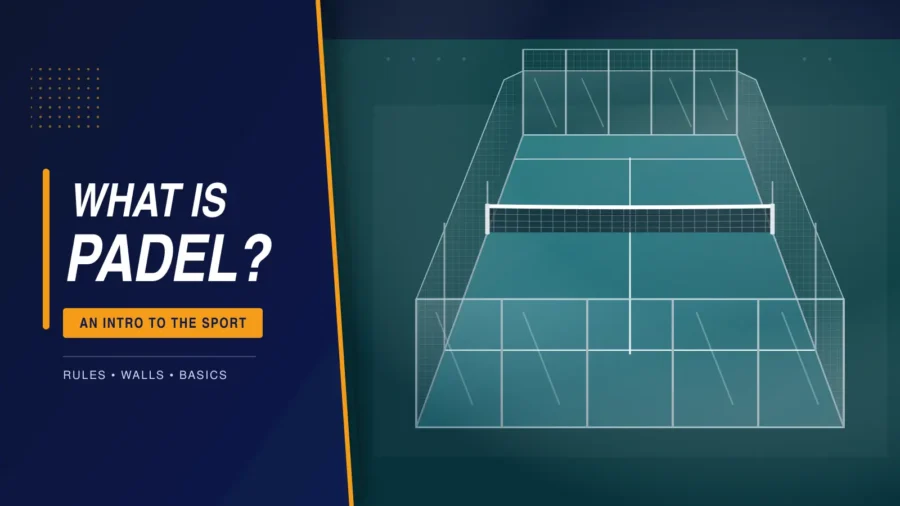
Padel is a doubles racket sport played on a 20m by 10m enclosed court. Players use solid perforated rackets and a pressurized ball, and the surrounding glass or solid walls remain part of the rally after a valid bounce. The game combines familiar net-play skills with its own rebound, positioning, and serving rules.
Scoring resembles tennis, but the serve is hit after bouncing the ball and contact must be at or below waist level. Padel is approachable because four players share a compact court, yet controlling the net and reading the back glass give the sport a deep learning curve.
Padel in One Minute
- Standard padel is played by two pairs.
- The court is 20m long and 10m wide, with an enclosure around it.
- Players use a solid racket with holes and a mandatory wrist cord.
- The serve is made diagonally after one bounce.
- The return of serve must bounce, but later rally balls can be volleyed.
- A ball may rebound from a wall or fence after bouncing in the correct court.
- Games use love, 15, 30, and 40, with several approved deuce formats.
- Matches are usually best of three sets.
If you are ready to book a first session, the guide on how to start playing padel turns those basics into a practical plan.
What Does Padel Look Like?
Padel is usually played with four people on a court surrounded by glass and metal fencing. The service boxes and net may look familiar to a tennis player, but there is no baseline serving area in the tennis sense. The server stands behind a padel service line inside the enclosure.
Rallies move between two main positions. A pair at the back defends with the help of the glass, while a pair closer to the net tries to control time and space with volleys and overheads. The lob is crucial because it can push the attacking team away from the net.
The Padel Court
A regulation court measures 20m by 10m internally and is divided into two equal halves by a net. Service boxes sit on each side of the net, and walls and metal fencing complete the enclosure. Modern venues often use transparent glass so spectators can follow the ball.
The surface may be cement, synthetic material, or artificial grass if it produces a regular bounce and meets the applicable requirements. Court pace can still vary with surface, sand, ball condition, temperature, and moisture.
The padel court construction guide covers the official measurements, enclosure, access, safety area, surfaces, foundations, drainage, and lighting in more detail.
Padel Equipment
Padel Racket
A padel racket is solid and perforated rather than strung. Its shorter format and foam core produce a different response from a strung tennis racket.
Rackets vary in shape, balance, mass, face material, and foam response. Beginners usually benefit from choosing a manageable racket with a generous effective hitting area rather than simply buying the hardest or most head-heavy model. The padel racket finder can narrow the options, while the ultimate padel racket buying guide explains how the specifications interact.
Official play requires a safety cord attached to the handle, and the player must wear it around the wrist.
Padel Ball
The ball is a felt-covered rubber sphere similar in appearance to a tennis ball. Official padel balls have their own approved diameter, rebound, and internal-pressure ranges, so a package marked for padel is the simplest choice.
Ball behavior changes as pressure drops and felt wears. Clubs may also use different approved balls for altitude or playing conditions.
Shoes and Other Gear
Wear court shoes that suit the surface and allow controlled changes of direction. Running shoes are designed mainly for forward movement and may not provide the same lateral platform. Check the outsole, lateral support, fit, and the venue’s surface requirements before buying.
Comfortable sports clothing, water, and a few replacement grips are enough for a first session. The beginner padel equipment checklist separates essentials from optional accessories.
Basic Padel Rules
Every point begins with a diagonal serve. After the return, teams alternate contacts until one pair cannot send the ball back legally.
The central idea is that the enclosure becomes playable after the ball has bounced in the correct court. Players may defend after a rebound from their own glass and can deliberately use a solid wall to send a return across the net.
A second bounce, contact with the net, or an invalid wall sequence ends the point. The full padel rules explanation covers the exact fault, let, tie-break, wall-contact, and unusual-contact cases.
How to Serve
A padel serve starts with a bounce behind the service line and a low contact into the diagonal box. The server alternates sides, has two attempts, and the receiver must wait for the ball to land before returning it.
Use the three-step padel serve guide to learn the motion, and consult the rules guide for the exact contact, foot, line, fence, and let requirements.
How the Walls Work
The easiest beginner concept is bounce first, wall second. Learn to leave a suitable deep ball for the back glass, move into position as it rebounds, and strike before the second bounce.
Players can also use their own glass or solid wall to redirect a return across the net. The rules guide explains which contact sequences are legal, while a beginner session should focus on reading one rebound at a time.
Padel Scoring
Traditional padel games use love, 15, 30, 40, and game. Sets commonly run to six games with a two-game margin, with a tie-break at 6-6, and matches are generally best of three sets.
At deuce, current rules allow Advantage, Golden Point, or Star Point formats. The event or club decides which option applies, and approved short sets or match tie-breaks may also be used, so confirm the format before playing.
Essential Padel Shots
Forehand and Backhand
Padel groundstrokes often use compact preparation and a stable contact. A shorter action helps when the ball arrives quickly or comes off the glass close to the body.
Early players should prioritize height, depth, and recovery position. The detailed padel forehand and backhand guide explains preparation and contact for both sides.
Volley
The volley helps a pair hold the net and direct the ball into open space or at the opponents’ feet. A controlled block with a firm wrist is often more dependable than a large swing.
Lob
The lob is both defensive and attacking. A high, deep lob can force the net team to retreat, giving the defending pair time to move forward and contest the better position.
Bandeja and Vibora
The bandeja is a controlled overhead used to keep the net rather than seek an immediate winner. The vibora is generally more aggressive and uses side spin and pace. Exact labels and techniques vary by coaching system, but the tactical choice is the same: use the overhead that fits your balance and court position.
Smash
A smash can finish a point or send the ball out of the enclosure after the bounce. It is not automatically the best response to every lob. If contact is low or the player is moving backward, a controlled overhead is often the safer tactical choice.
Basic Padel Positioning
Partners should usually move forward and backward together. If one stays at the net while the other retreats to the glass, a large diagonal gap appears between them.
When defending, leave enough room for a deep ball to reach the back wall. Standing directly against the glass removes reaction space. When attacking, hold a position close enough to pressure the opponents but far enough from the net to react to a lob.
Communication matters on balls through the middle and on overheads. Call early, especially when one player has a clearer forehand or a better angle.
A Brief History of Padel
Padel began in 1969 at Enrique Corcuera’s home in Acapulco, Mexico. Limited space led to a 20m by 10m enclosed court, creating the foundation of the modern game.
The sport reached Spain and Argentina in the 1970s and expanded internationally in later decades. The International Padel Federation was founded in Madrid in 1991, and the first World Padel Championships followed in 1992. Rules were subsequently unified internationally.
How to Play Your First Padel Match
- Book a beginner court or introductory lesson and ask which scoring format is used.
- Rent a racket before buying one, and wear the wrist cord at all times.
- Spend the warm-up learning how the ball rebounds from the back glass.
- Practice a legal serve and return before starting points.
- Play cooperative rallies first, then add normal scoring.
- Move with your partner and use lobs to change court position.
- Review only one or two recurring errors after the match.
Do not judge the sport by how hard you can hit in the first session. Learning when to leave a ball for the glass is more valuable than trying to avoid every rebound.
Padel FAQ
Is padel the same as paddle tennis?
No. The names are sometimes confused, but padel has its own enclosed court, equipment standards, and international rules.
Is padel always doubles?
Standard FIP padel is played by two pairs. Informal singles and narrower singles courts exist, but they are not the standard 20m by 10m competition format.
Can the ball hit the wall in padel?
Yes, after it has bounced in the correct court. A return sent to the other side must bounce there before touching the opponents’ wall or fence.
Can you volley the serve?
No. The receiver must let the serve bounce inside the correct service box. Later rally balls may be volleyed.
Is the scoring exactly the same as tennis?
The point and set structure is similar, but padel offers multiple deuce formats and approved alternative match formats. Always check which option applies.