
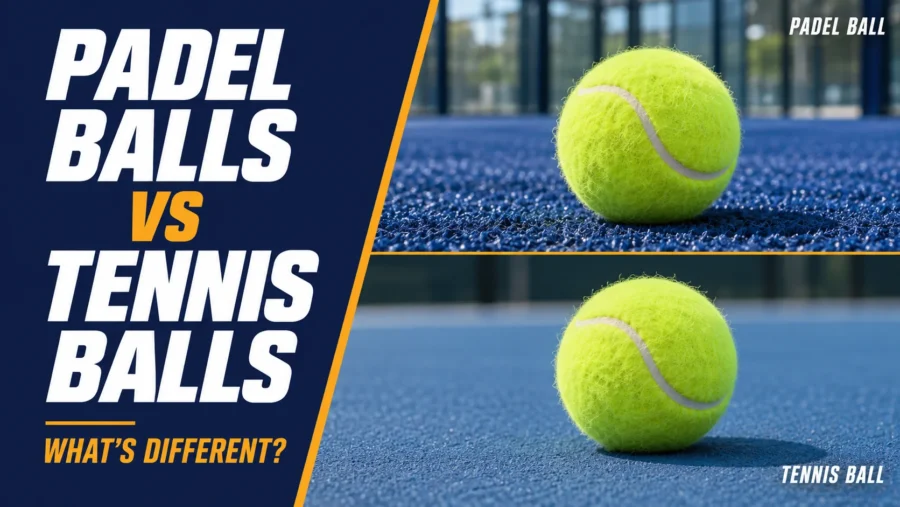
Padel balls and tennis balls look similar, but they are not automatically interchangeable. They are approved for different sports, and their permitted size and rebound ranges differ. The common claim that a padel ball is always smaller, lighter and much less bouncy than a tennis ball is too simple: several of the official ranges overlap.
For normal play, use a ball intended for your sport. To understand why, compare the actual specifications rather than judging two yellow balls by appearance or by squeezing them in your hand.
Padel Balls vs Tennis Balls at a Glance
The table compares the standard padel ball in the 2026 FIP rules with the ITF’s Type 2, medium-speed adult tennis ball. Other tennis categories, including junior and high-altitude balls, have different requirements.
| Specification | Standard padel ball | Type 2 tennis ball |
|---|---|---|
| Diameter | 6.35–6.77cm | 6.54–6.86cm |
| Mass | 56.0–59.4g | 56.0–59.4g |
| Rebound from a 254cm drop | 135–145cm | 135–147cm |
| Governing body for approval | FIP | ITF |
| Intended game | Padel | Tennis |
These are permitted ranges, not the exact measurements of every ball in a can. A product can sit anywhere within the applicable limits and still need to meet the other requirements for approval.
If you are comparing the sports more broadly, the differences between tennis and padel extend to the racket, court and use of walls. The ball is one part of a different playing system.
Are Padel Balls Smaller or Lighter?
The diameter limits allow padel balls to be smaller than Type 2 tennis balls, but do not require every individual padel ball to be smaller than every tennis ball. For example, a hypothetical ball measuring 6.65cm falls inside both size ranges.
The mass ranges are identical. Calling a regulation padel ball a “lighter tennis ball” therefore misrepresents the specifications.
This is also why comparing one used ball from each sport tells you little about the categories. You may be comparing different positions within the permitted ranges, different amounts of wear or a ball that no longer performs as it did when new.
A ruler and kitchen scale are not approval tests. Even a ball that appears to match the size and mass requirements has not demonstrated compliant construction, rebound or other required properties.
Pressure: Why a Simple PSI Comparison Is Misleading
Internal pressure matters, but it is not the only source of a ball’s bounce. The rubber shell deforms and recovers during impact, and its construction affects that response alongside the gas inside it.
The FIP’s English 2026 rulebook expresses its pressure requirement as 4.6–5.2kg per 2.54cm². That wording should not be casually rewritten as a precise psi range without resolving the intended pressure unit. It also does not establish a fixed pressure difference between every padel and tennis product.
The ITF permits both pressurized and pressureless Type 2 tennis balls. That alone makes a universal statement such as “tennis balls have a particular higher pressure” unreliable without identifying the construction being compared.
Three distinctions help when reading a manufacturer’s specification:
- Internal ball pressure concerns the gas within the rubber core.
- Can pressure concerns the environment surrounding the balls before the container is opened.
- Gauge and absolute pressure use different reference points, so figures using them cannot be compared directly without conversion.
A storage-container setting is not automatically the pressure inside the ball. Likewise, the hiss when opening a can does not reveal a ball’s rebound height, approval status or suitability for the other sport.
Is a Soft Tennis Ball a Padel Ball?
No. Pressure loss does not turn a tennis product into an approved padel product. Wear can also affect the felt and rubber, so an old tennis ball is an uncontrolled substitute rather than a reliable way to reproduce a new padel ball.
For a first lesson, ask whether the venue supplies balls. The beginner padel equipment checklist helps you separate the items you need immediately from optional purchases.
What the Rebound Test Actually Measures
A drop test measures how high a ball rises after falling onto a defined hard surface. It does not reproduce every impact in a rally: a sliced approach, topspin forehand and hard overhead reach the court at different speeds, angles and rotations.
The overlap in the table means the rules do not support a claim that every padel ball must bounce lower than every Type 2 tennis ball in this test. They also do not establish a fixed percentage by which one sport’s ball is slower.
ITF ball research treats flight and high-speed impacts as separate subjects. Drag and spin influence the trajectory through the air, while deformation and the impact conditions influence the bounce. A single rebound-height figure cannot describe all of those effects.
Can You Compare Balls at Home?
A controlled side-by-side drop can help identify an obviously flat or inconsistent ball. Use the same hard surface, release height and conditions, and compare balls of similar age without pushing them downward.
Treat the result as a practical check, not certification. Laboratory testing controls factors that a casual test does not, and different floors can produce misleading comparisons.
For playing practice, consistency within the set matters more than proving that one ball rebounds a fraction higher. Mixing a fresh can with heavily used balls makes it harder to judge your timing and shot quality.
Can You Use Tennis Balls for Padel?
For official padel competition, the ball must have FIP approval. A tennis label or ITF approval does not supply that approval by itself.
For an informal hit, players can physically rally with a tennis ball, but should not assume that it gives representative padel practice. A ball whose response differs from the one you normally use can change the timing of a defensive rebound or the judgment of an attacking shot.
Use the venue’s normal padel ball when learning. That allows the coach to assess technique and positioning without first accounting for unfamiliar equipment. The padel rules guide explains the wall and bounce sequences that the ball needs to support.
Can You Use Padel Balls for Tennis?
The same distinction works in the other direction. A padel ball is not automatically approved for a tennis competition simply because its measurements could overlap with a tennis category.
It may be usable for an improvised social rally, but that does not make it the best tool for learning a tennis serve, practicing returns or preparing for a match with a specified ball. Use the ball you will actually face when transfer to competition is the goal.
For beginners who need a slower tennis ball, choose an appropriate red, orange or green tennis stage with a coach. Those are deliberate development categories rather than substitutes selected because another sport’s ball happens to feel softer.
Altitude and Temperature Change the Context
The 2026 FIP rules permit an alternative ball above 1,000m, with a rebound greater than 121.92cm and less than 135cm. The ITF’s dedicated high-altitude category applies above 1,219m and specifies a 122–135cm rebound.
The thresholds differ. Do not assume a ball labeled for high-altitude tennis is therefore the correct padel ball for the same venue. Follow the applicable sport, event and product guidance.
Conditions also affect comparisons. ITF testing documentation notes that heat can change the rubber’s response and increase bounce, while moisture uptake can increase felt mass. Comparing a cold ball from a bag with one that has warmed on court is not a clean test of their intended specifications.
Let the venue and conditions inform your choice within the correct sport. A tennis ball guide organized by court surface can help with tennis selection; for padel, confirm the club’s regular ball before buying a case.
How to Avoid Buying the Wrong Ball
Read the full product name and the sport printed on the packaging. Check whether you are buying a standard adult ball, a junior stage, a pressureless practice product or a version intended for altitude.
For competition, confirm the specified model and required approval. For regular social play, buy one can of the correct type first and compare its consistency in your usual conditions before committing to a bulk order.
The useful distinction is the ball’s verified intended use and response. Similar color, overlapping dimensions and a familiar bounce are not enough to make tennis and padel balls equivalent.