
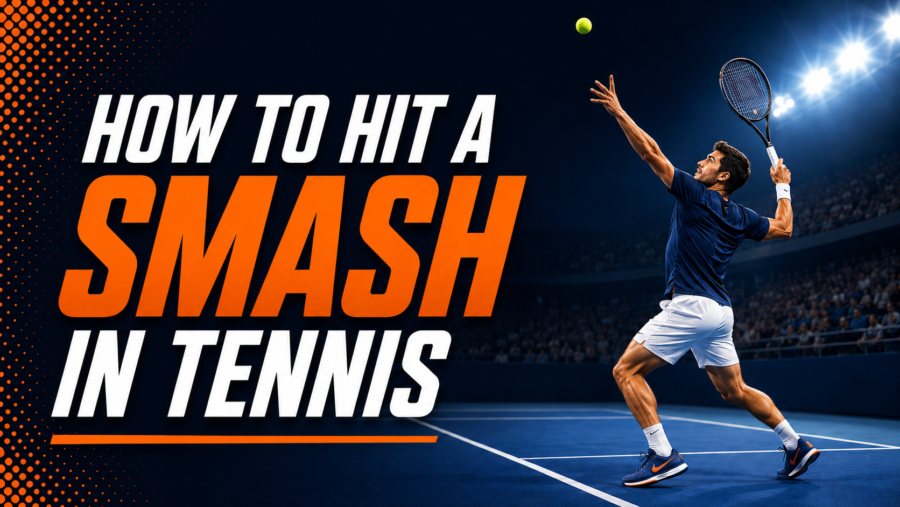
The smash is one of the most effective finishing shots in tennis. It is usually played when an opponent sends a weak lob high into the air, giving you the opportunity to strike the ball overhead and end the point.
Although the motion is similar to the tennis serve, the smash presents a different challenge because you must react to a moving ball, adjust your position, and time contact while already involved in the rally. Many players rush the shot, stand directly underneath the ball, or try to hit with maximum power, causing an apparently easy opportunity to end in the net or beyond the baseline.
A reliable smash depends on early recognition, efficient footwork, a Continental grip, high contact, and a controlled follow-through.
Use the Continental Grip
The correct grip for the tennis smash is the Continental grip. This is the same grip used for serves, volleys, overheads, and slice shots.
Hold the racket as though you were shaking hands with it or using it like a hammer. The Continental grip allows the racket to approach the ball on edge before the forearm rotates naturally into contact.
Beginners often switch to a forehand grip because it makes the racket face point directly toward the ball. This may feel easier, but it limits wrist and forearm movement, reduces control, and encourages players to push the ball rather than swing smoothly through it.
Keep your grip relaxed during preparation. Squeezing the handle too tightly slows down the racket and can make the movement feel stiff.
Recognize the Lob Early
The first step is identifying the lob as soon as it leaves your opponent’s racket. Look at the height, speed, spin, and direction of the ball before deciding whether to move forward, backward, or sideways.
Turn your body immediately instead of running backward while facing the net. Moving straight backward can cause you to lose balance and increases the risk of falling.
Use crossover steps to move behind the ball while keeping your body sideways. Small adjustment steps can then help you create the correct spacing before contact.
Whenever possible, position yourself slightly behind the ball. It is much easier to move forward into the smash than to reach backward when the ball travels over your head.
Prepare Sideways to the Net
The preparation for the smash is similar to the trophy position used during the serve. Right-handed players should turn so the left shoulder faces the net, while left-handed players turn the opposite way.
Raise the non-dominant arm and point toward the ball. This helps you track its movement, maintain balance, and judge the correct contact position.
At the same time, bring the racket behind your head with the hitting elbow raised. Avoid taking an oversized backswing because the incoming ball may drop faster than expected.
Keep your knees slightly bent and your weight balanced. Your preparation should remain relaxed so you can adjust if the ball moves because of wind or spin.
Move Into the Correct Position
Good positioning is more important than raw power. Ideally, the ball should remain slightly in front of your hitting shoulder rather than directly above or behind your head.
If you stand too far forward, the ball may pass behind you and force an awkward contact. If you stand too far back, you may contact it too far in front and pull the smash into the net.
Continue moving your feet until just before the swing. Players often stop too early and then reach for the ball with the upper body, reducing both balance and control.
When moving backward for a deep lob, use a crossover step and keep watching the ball. For a very high ball, you may have enough time to let it bounce and play a groundstroke instead of forcing a difficult overhead.
Contact the Ball High
The ideal contact point is high, slightly in front of the body, and close to full arm extension. Reach upward toward the ball rather than waiting for it to drop to shoulder height.
A high contact point gives you a better angle into the court and allows you to direct the ball with greater control. Contacting the ball too low often leads to the net because the available angle becomes smaller.
Keep your head up and continue watching the contact area. Looking toward the target too early can cause your shoulders to drop and change the racket path.
The racket should accelerate upward before moving forward through the ball. Allow the forearm to rotate naturally so the strings meet the back of the ball cleanly.
Do Not Aim Straight Down
One of the most common mistakes is attempting to hit the smash directly downward. This creates very little margin over the net and often sends the ball into it.
Instead, aim deep into the opponent’s court. The height of the contact point will naturally create a downward angle without requiring you to force the racket toward the ground.
You can direct the smash toward the open court, behind the opponent, or toward their weaker side. Placement is usually more important than maximum speed.
Complete the Follow-Through
After contact, allow the racket to continue forward and across the body. A right-handed player normally finishes toward the left side, while a left-handed player finishes toward the right.
Do not stop the racket immediately after striking the ball. A complete follow-through creates smoother acceleration and allows the body to decelerate safely.
Land in a balanced position and prepare for the next shot. Even a strong smash may be returned, particularly if it is hit directly toward the opponent.
Common Smash Mistakes
Players often miss smashes because they prepare too late, run backward while facing the net, or allow the ball to move behind their body. Using a forehand grip, contacting the ball too low, and trying to hit too hard are also common problems.
Another mistake is standing directly underneath the ball. Move behind it whenever possible so you can transfer your weight forward through contact.
Focus on positioning and clean contact before adding power. A controlled smash directed into open space is more effective than a powerful shot with a low chance of landing inside the court.
Final Thoughts
The tennis smash should be a dependable finishing shot, but it requires more than simply swinging hard at a high ball. Recognize the lob early, turn sideways, move behind the ball, and prepare with a Continental grip.
Point toward the ball with your non-dominant hand, make contact high and slightly in front, and allow the racket to follow through across your body. With good positioning and controlled placement, the smash can become one of the safest ways to finish a point.