
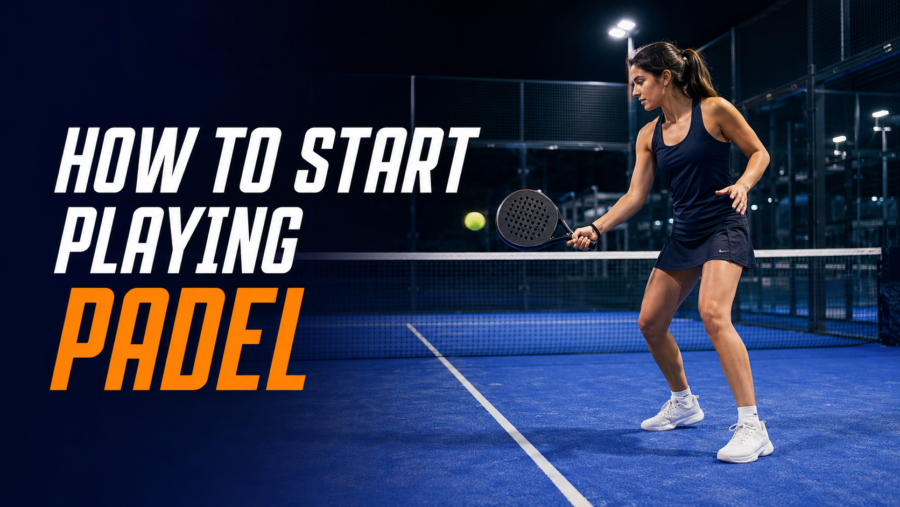
Padel is one of the easiest racket sports to begin playing, but learning the correct fundamentals early will make the game far more enjoyable. You do not need years of technical training or expensive equipment to get started. A suitable racket, a court, three other players and a basic understanding of the rules are enough for your first match.
The sport combines elements of tennis and squash, but it has its own techniques, tactics and movement patterns. The walls remain part of the court, most matches are played in doubles and players rely heavily on positioning rather than power. This guide explains everything you need to know about how to start playing padel.
What Is Padel?
Padel is a racket sport normally played by four players on an enclosed court measuring 20m long and 10m wide. A net divides the court, while glass and metal walls surround the playing area. The ball can rebound from the walls after bouncing, allowing rallies to continue in situations that would end a point in tennis.
Players use solid, stringless padel rackets and balls that resemble tennis balls. The scoring system is also similar to tennis, with points counted as 15, 30, 40 and game. Matches are usually played as the best of three sets, although some clubs use shorter formats or golden-point scoring.
Find a Padel Court and Other Beginners
The easiest way to start is to contact a local padel club. Many clubs offer racket rental, beginner sessions, social matches and systems that help players find partners at a similar level.
Padel is usually played in doubles, so you will need three other players. If you do not already know people who play, ask the club about beginner groups, social leagues or open matches. Playing with other beginners removes pressure and allows everyone to learn together.
For your first few sessions, focus on enjoying the rallies rather than keeping a competitive score. You will learn more by keeping the ball in play than by trying to finish every point immediately.
Get the Essential Padel Equipment
You only need a few items to start playing. These include a padel racket, padel balls, suitable court shoes and comfortable sports clothing. Most clubs allow beginners to rent a racket, which is sensible before purchasing one.
A beginner racket should normally have a round shape, low or medium balance and a large sweet spot. Softer materials can provide additional comfort and make it easier to generate depth without swinging aggressively. Avoid choosing a hard, head-heavy diamond racket simply because it offers more power.
The Ultimate Padel Racket Buying Guide explains the different shapes, balances, materials and core types. You can also use choosing a padel racket based on your level to find characteristics that match a beginner’s needs.
Padel balls look similar to tennis balls, but they are designed specifically for the sport. Wear shoes with sufficient lateral support and grip, as padel involves frequent changes of direction. Always place the racket’s safety strap around your wrist before playing. The complete beginner equipment checklist for padel covers everything worth bringing to the court.
Learn the Basic Padel Rules
The objective is to hit the ball over the net and into the opponent’s court. The opposing team loses the point if the ball bounces twice, hits the net without crossing or lands outside the permitted playing area.
During a rally, the ball must first bounce inside the opponent’s court before touching one of their walls. After the ball bounces on your side, it may rebound from the glass or fence and remain playable. You must return it before it bounces on the ground for a second time.
Volleys are allowed during normal rallies, but the receiving team must allow the serve to bounce. Players can also hit the ball out of the court when the facility permits outside play, although beginners do not need to worry about this advanced rule immediately.
Learn How to Serve in Padel
The padel serve is performed underarm. Stand behind the service line, bounce the ball and strike it at or below waist height. The serve must travel diagonally into the opposite service box.
The ball is allowed to hit the glass after bouncing in the correct service box. However, a serve that bounces and then touches the metal fence is a fault. As in tennis, the server receives a second attempt after missing the first serve.
Beginners should prioritize accuracy and placement instead of speed. Use a compact motion and aim deep toward the glass or closer to the center line. Serve in Padel in 3 Simple Steps provides a more detailed breakdown of the correct technique.
Start With the Essential Padel Shots
You do not need to learn every advanced shot before playing matches. Begin with the forehand, backhand, serve, volley and lob. These five shots are enough to construct points and understand the basic flow of the game.
Padel groundstrokes use shorter backswings than tennis groundstrokes. The court is smaller, and the ball often reaches you quickly after rebounding from the glass. Keep the racket prepared in front of the body and focus on controlled contact.
The volley is used when your team controls the net. Keep the racket head up, use a compact blocking action and direct the ball into open space. Avoid taking a large swing because this reduces reaction time and control.
The lob is one of the most important shots in padel. A good lob pushes the opponents away from the net and gives your team time to move forward. Beginners often underestimate the lob because it does not look aggressive, but it is essential for changing court position. The fundamentals of both groundstrokes are covered in padel forehand and backhand technique.
Understand Basic Court Positioning
Positioning is one of the biggest differences between padel and other racket sports. Teams generally want to control the net because volleys and overheads create more attacking opportunities. However, rushing forward after a weak shot leaves space behind you and allows opponents to pass or lob.
When defending, both partners should normally remain near the back of the court. When attacking, both players should move forward together. Avoid having one player at the net while the other remains at the back, as this creates large gaps.
Move as a team and maintain a similar distance from the net. If your partner moves toward one side, adjust toward the middle to protect the available space. Communication is especially important when the ball travels between both players.
The area between the baseline and net is often called the transition zone. Do not remain there unnecessarily. Move through it when approaching or retreating, but establish a clear attacking or defensive position whenever possible.
Learn to Use the Glass
Many beginners initially treat the walls as obstacles. In reality, the glass gives you additional time and can make difficult defensive balls easier to return.
When a deep ball passes you, allow it to bounce and rebound from the back glass. Move behind its expected path, turn your shoulders and prepare a compact swing. Trying to hit every ball before it reaches the wall often leads to rushed contact.
Begin by practicing gentle feeds toward the back glass. Watch how the ball’s speed, spin and angle affect the rebound. With experience, you will recognize when to play the ball before the wall and when to let it travel behind you.
Consider Taking Beginner Lessons
A coach can help you learn the correct grip, compact swing, wall positioning and basic team movement. Even a small number of lessons can prevent habits that become difficult to correct later.
Group lessons are usually affordable and provide opportunities to meet other beginners. Private lessons offer more individual feedback and can address a specific technical problem more quickly. Group Lessons vs Private Coaching: A Comparison can help you decide which format suits your goals and budget.
Formal coaching is useful but not essential for enjoying the sport. Players wondering whether they can progress independently can read Can You Improve Without a Padel Coach? before choosing how much instruction they need.
Common Beginner Mistakes
The most common mistake is trying to hit every ball hard. Padel rewards control, placement and patience, so reducing pace often produces better results. Power becomes more useful once you can recognize the correct ball to attack.
Another mistake is using large tennis-style backswings. Keep the racket closer to the body and prepare early. Compact movements are easier to control and provide more time against fast shots.
Beginners also tend to avoid the back glass, remain in the transition zone or move independently from their partner. Learning to defend with the walls and move as a team will improve results faster than learning advanced smashes.
Finally, do not attempt a winner from every position. Reset the rally when defending, use the lob to recover the net and wait for a genuinely attackable ball.
How Often Should Beginners Play Padel?
Playing once per week is enough to become familiar with the sport, but twice per week usually produces faster improvement. One session can focus on technique or drills, while the other can involve match play.
Regular short sessions are more valuable than playing for several hours once every few weeks. Repetition helps you understand rebounds, positioning and shot selection. Allow time between sessions if your shoulder, elbow or knees feel unusually sore.
Final Thoughts
Starting padel does not require advanced technique or expensive equipment. Rent a beginner-friendly racket, learn the basic rules and begin with controlled serves, compact groundstrokes, volleys and lobs. Focus on keeping the ball in play and moving together with your partner.
The walls and team positioning may feel unfamiliar during the first few matches, but they quickly become part of the game. Play regularly, stay patient and avoid relying only on power. As your control and understanding improve, padel becomes faster, more tactical and increasingly enjoyable.