
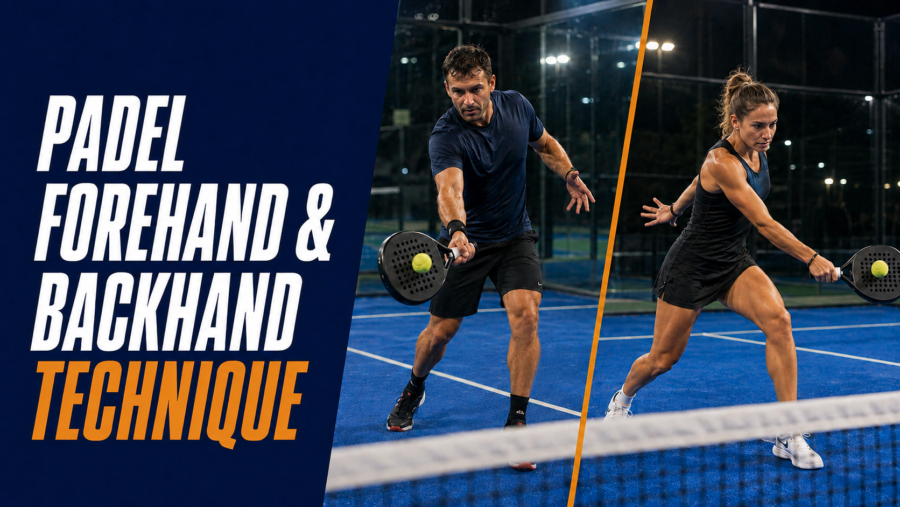
The forehand and backhand in padel are compact groundstrokes built around early preparation, good spacing and contact in front of the body. Start from a balanced ready position, turn the shoulders as soon as you read the ball and guide the racket through a controlled forward swing.
Large tennis-style backswings and extreme topspin are rarely necessary. Control, placement and recovery are usually more useful than maximum speed. Complete beginners can develop these strokes alongside the fundamentals of how to start playing padel.
What Are Padel Forehands and Backhands?
A forehand is played on the dominant side of your body, while a backhand is played on the opposite side. For a right-handed player, the forehand is normally on the right and the backhand on the left. Reverse this for a left-handed player.
This guide covers groundstrokes played after the bounce, usually from the back or middle of the court. A shot struck before the bounce uses a different volley technique.
How to Hit a Padel Forehand or Backhand in 3 Simple Steps
Step 1: Read the Ball and Prepare Early
Begin with your knees slightly bent, weight toward the front of your feet and the racket supported in front. A continental or hammer grip is the simplest starting point because it works on both sides without a large adjustment. It is a practical foundation rather than a mandatory position for every ball.
Make a split-step as the opponent strikes. Once you recognize the ball’s direction, turn your shoulders and prepare the racket before the ball bounces. The takeback should be early but compact rather than a large loop behind your body.
For a forehand, turn the dominant shoulder behind the ball. For a backhand, turn the non-dominant shoulder toward the ball and use your free hand on the racket throat to guide the preparation.
Use adjustment steps to create space from the ball. A neutral, side-on stance helps weight transfer when there is time, but open and semi-open stances are valid when you are rushed.
Step 2: Move Into Position and Contact in Front
Set your feet before swinging. When possible, transfer weight from the rear leg toward the front as your hips and shoulders unwind. Let the legs and torso support the stroke instead of generating all the pace with the arm.
Contact slightly in front with enough space to extend comfortably. Hip or waist height is a useful practice contact, not a fixed requirement. The correct height depends on the bounce and your court position.
For a right-handed forehand, contact is in front and to the right. Stepping through the left leg can support weight transfer. On a one-handed backhand, contact is on the left and the right foot commonly moves forward.
The opposite-foot step is a useful pattern rather than a rule. If the ball arrives quickly, prioritize balance, spacing and clean contact instead of forcing a particular stance.
A one-handed backhand offers reach, while a two-handed backhand may provide extra stability. Use the version that allows consistent contact without crowding the body.
Step 3: Swing Through, Choose an Intention and Recover
For a basic flat groundstroke, swing mostly forward through the ball with a stable wrist and racket face. Continue smoothly toward the target instead of stopping at contact or forcing the racket to finish over a particular shoulder.
Match the follow-through to the shot. A controlled drive needs a compact finish, while an attacking ball may allow more extension. Avoid wrapping the racket around the body unnecessarily.
Choose your intention from the quality of the ball you receive:
- Low or defensive ball: Use height, depth and a safe target to stay in the rally.
- Neutral ball: Keep the trajectory controlled and direct it through the middle or away from an opponent’s preferred side.
- Comfortable ball: Add direction or controlled pace without sacrificing balance.
Return the racket to the ready position immediately after the finish. Recover according to the shot you played and move with your partner so the pair does not leave an unnecessary gap through the middle.
Forehand vs Backhand Technique
| Detail | Forehand | Backhand |
|---|---|---|
| Preparation | Dominant shoulder turns behind the ball | Non-dominant shoulder turns toward the ball |
| Hands | Usually one hand | One or two hands |
| Contact | In front on the dominant side | In front on the non-dominant side |
| Typical forward foot | Opposite foot when time allows | Dominant-side foot on a one-handed shot |
| Free hand | Helps with spacing and balance | Guides the racket during one-handed preparation |
Both strokes require early preparation, suitable spacing, clean contact and balanced recovery. Neither side is automatically more attacking or defensive.
Should You Hit Flat, With Slice or Topspin?
A flat stroke is the most useful foundation. Its short preparation and forward path make it easier to control on low or pressured balls.
Slice is most practical from a comfortable ball around waist height or higher. Begin slightly above it with a mildly open face, but continue forward rather than chopping steeply downward.
Topspin has a smaller role than in tennis, but it is not incorrect. A compact low-to-high action can make a comfortable ball dip toward net players. Avoid a large loop when cramped near the glass.
Playing Before or After the Glass
A shorter ball can often be struck before it reaches the back glass. A deep or fast ball may become easier after the rebound because the wall slows it and sends it forward again.
Move back and slightly to the side so the rebound has space to leave the glass. Running directly to the impact point can crowd you. A high, attackable rebound may call for a bajada instead.
After one court bounce, contact with your glass or fence does not end the rally, but the ball must be returned before its second court bounce. Your return must then bounce in the opponents’ court before reaching their glass or fence.
Where Should You Aim?
Crosscourt gives you more court and often more margin over the net. The middle can reduce the opponents’ angles and create uncertainty about who should play the next ball.
When the opponents are at the net, a controlled shot toward their feet can be more effective than raw speed. A soft chiquita can make them volley upward, while a well-placed lob can move them away from the net entirely.
When the opponents are defending deep, use placement and sensible depth. Hitting maximum pace directly toward the back glass can give them a comfortable rebound instead of creating pressure.
Common Forehand and Backhand Mistakes
- Preparing only after the ball has bounced.
- Using a large tennis-style backswing.
- Standing too close to the ball or reaching too far for it.
- Treating one stance or contact height as mandatory.
- Swinging only with the arm instead of rotating the body.
- Contacting beside or behind the body.
- Trying to create heavy topspin on every forehand.
- Chopping steeply for slice instead of swinging through the ball.
- Overhitting from a defensive position.
- Watching the shot rather than recovering with the partner.
A Simple Forehand and Backhand Drill
Have a partner feed alternating balls to your forehand and backhand. Split-step before every feed, prepare before the bounce and direct controlled flat shots toward a deep central target.
Once the contact is consistent, alternate between crosscourt and middle targets. Finish by mixing shorter balls with deep feeds that rebound from the back glass. Count only shots that combine the correct decision with contact in front and a balanced recovery.
Read, contact and recover. Prepare before the bounce, create enough space to meet the ball in front and return to a balanced position after every shot. Once those three actions are dependable, changes of pace, spin and direction become much easier.