
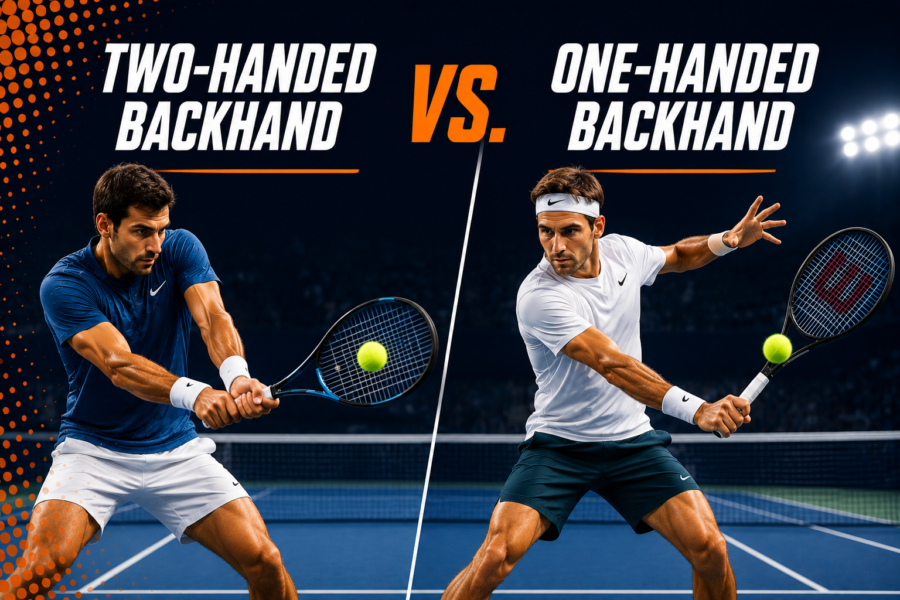
Choosing between a one-handed and two-handed backhand is one of the most important technical decisions a tennis player can make. Both strokes can become effective weapons, but they provide different levels of stability, reach, control, power, and variety.
The two-handed backhand is more common in modern tennis because it is generally easier to control against fast serves, heavy topspin, and powerful groundstrokes. The one-handed backhand remains a strong option for players who value reach, slice, net play, and greater freedom through the swing.
Neither backhand is automatically better for every player. The right choice depends on your strength, timing, coordination, footwork, and preferred style of play.
For a complete backhand fix check out The Tennis Backhand Fix.
What Is a Two-Handed Backhand?
A two-handed backhand is hit with both hands remaining on the racket throughout the stroke. For a right-handed player, the right hand sits at the bottom of the handle and the left hand is placed directly above it. Left-handed players use the opposite arrangement.
The dominant hand normally uses a Continental grip, while the non-dominant hand uses an Eastern or Semi-Western forehand grip. The upper hand contributes much of the acceleration and racket control, while the lower hand guides and stabilizes the stroke.
Because both hands support the racket, the two-handed backhand is compact, stable, and effective when reacting to pace. It is usually the easier choice for players learning how to hit a backhand in tennis.
What Is a One-Handed Backhand?
A one-handed backhand is hit using only the dominant hand during the forward swing. The non-dominant hand supports the throat of the racket during preparation before releasing it as the racket begins moving toward the ball.
Most players use an Eastern backhand grip. The stroke requires an early shoulder turn, accurate footwork, full arm extension, and contact farther in front of the body than a two-handed backhand.
The one-handed backhand provides greater reach and creates a natural transition into a slice backhand, volley, or drop shot. However, it usually requires more strength, better timing, and more precise positioning.
Two-Handed Backhand Advantages and Disadvantages
| Advantages | Disadvantages |
|---|---|
| Greater stability against powerful shots | Less reach on wide balls |
| Easier for beginners and juniors | Requires quick footwork for spacing |
| Compact preparation for returns | Can feel restricted when stretched |
| Better control on high balls | Less natural transition to slice |
| More forgiving when contact is late | May provide less shot variety |
| Requires less dominant-arm strength | Both hands can limit extension |
The biggest advantage of the two-handed backhand is stability. Both hands support the racket, making it easier to absorb a powerful serve or redirect a heavy groundstroke without the frame twisting at contact.
Its compact preparation is especially useful on the return of serve. Players can shorten the backswing and use the opponent’s pace instead of needing a large forward swing. The upper hand also provides extra support when contacting the ball around shoulder height.
The two-handed backhand is generally more forgiving when preparation is slightly late. Although good timing is still important, both hands can help stabilize the racket and make small adjustments near contact.
Its main weakness is limited reach. Players must move closer to the ball and create enough space for both arms. When pulled far outside the court, they may need to release the upper hand and use a defensive slice.
One-Handed Backhand Advantages and Disadvantages
| Advantages | Disadvantages |
|---|---|
| Greater reach on wide and low balls | Requires precise timing and spacing |
| Natural transition to slices and volleys | More difficult against high topspin |
| Full extension can create strong acceleration | Less stable against powerful serves |
| Offers excellent shot variety | Requires more arm strength |
| Suits attacking and all-court players | Contact must be farther in front |
| Can produce sharp angles and heavy spin | Usually takes longer to learn |
The one-handed backhand allows the hitting arm to extend fully, giving the player greater reach on wide and low balls. This can be particularly useful when defending outside the court or moving forward to take the ball early.
It also connects naturally with slices, volleys, and drop shots. Players already control the racket with one hand, allowing them to change between topspin, slice, and touch shots without making a major adjustment.
The longer swing can generate excellent racket-head speed, power, and topspin when contact is clean. However, the margin for error is smaller. The player must prepare early, create enough space, and contact the ball well in front of the body.
High-bouncing balls are one of the biggest challenges. One-handed players may need to take the ball early, move backward and allow it to drop, or use a defensive slice. The stroke can also feel less stable when returning a powerful serve.
Which Backhand Is Easier to Learn?
The two-handed backhand is easier for most beginners. The extra hand stabilizes the racket, reduces the amount of strength required, and makes it easier to control the swing path. Players can usually develop rally consistency more quickly and feel more comfortable when the ball arrives with pace.
The one-handed backhand normally takes longer to develop. It requires earlier preparation, better spacing, and enough strength to control the racket with one arm. Younger juniors may struggle with it until they become physically stronger.
However, some players naturally feel more comfortable swinging with one hand. A coach should consider the player’s coordination, strength, movement, contact point, and ability to repeat the stroke before recommending either version.
Which Backhand Is Better for Returning Serve?
The two-handed backhand is generally better for returning serve. Its compact preparation allows players to react quickly, absorb pace, and redirect the ball with control. Both hands also keep the racket stable when contact is slightly off-center.
A one-handed return can still be effective, but it requires earlier recognition and cleaner timing. Against powerful first serves, many one-handed players use a short block or chip return instead of attempting a full topspin swing.
On slower second serves, the one-handed player has more time to step forward, extend through the ball, and attack. The difference between the two strokes becomes most noticeable against fast first serves directed toward the backhand side.
Which Backhand Handles High Balls Better?
The two-handed backhand normally handles high balls more comfortably. The upper hand provides support and leverage, allowing players to control contact around shoulder height without losing as much stability.
High topspin is one of the biggest weaknesses of the one-handed backhand. The player may need to take the ball early, move farther behind the baseline, or use a slice. Good footwork and early preparation are essential for preventing the ball from rising outside the ideal contact zone.
Which Backhand Produces More Power?
Both backhands can generate significant power. The two-handed version produces reliable pace because both arms contribute to the stroke and stabilize the racket. Most recreational players find it easier to create consistent depth and power with two hands.
The one-handed backhand has a longer swing and allows full arm extension, which can produce impressive racket-head speed. When timed correctly, it can create explosive power and penetration. However, it is much less forgiving when contact is late or too close to the body.
Which Backhand Produces More Topspin?
Both backhands can generate heavy topspin. The two-handed backhand makes it easier to control the racket face and maintain a consistent low-to-high swing, particularly when dealing with higher balls.
The one-handed backhand can produce excellent topspin because of its longer swing path and greater racket-head acceleration. However, the player must contact the ball early and create enough space for the arm to extend.
Grip, racket path, acceleration, and contact quality influence spin more than the number of hands used.
Which Backhand Suits Your Playing Style?
The two-handed backhand usually suits baseline players who value consistency, return quality, and stability under pressure. It is ideal for players who regularly face fast serves, heavy topspin, and powerful groundstrokes.
The one-handed backhand may suit attacking or all-court players who use slices, volleys, angles, and changes of pace. It works best for players with early preparation, good timing, efficient footwork, and enough strength to control the racket with one arm.
| Choose a Two-Handed Backhand If You… | Choose a One-Handed Backhand If You… |
|---|---|
| Want greater stability | Want greater reach |
| Struggle against powerful shots | Prefer an all-court game |
| Want a compact return | Use slices and volleys regularly |
| Find high balls difficult | Prepare early consistently |
| Are a beginner or developing junior | Have sufficient arm strength |
| Prefer baseline consistency | Feel more natural using one hand |
Final Thoughts
The two-handed backhand is the better choice for most beginners and modern baseline players. It provides greater stability, handles high balls more effectively, and performs particularly well when returning fast serves. It is also more forgiving when timing and positioning are not perfect.
The one-handed backhand offers greater reach, variety, and freedom through the swing. It can suit attacking players with good strength, timing, and footwork, but it is more demanding against high topspin and powerful serves.
Neither backhand is universally superior. The best option is the one that feels natural, remains reliable under pressure, and supports your overall style of play.