
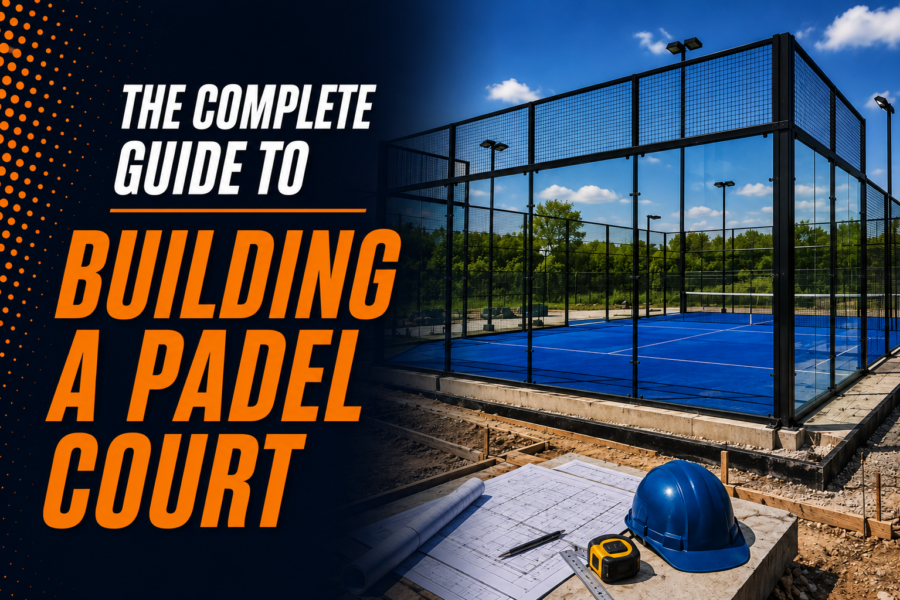
If you’ve ever stepped onto a padel court, you’ve probably noticed that it looks deceptively simple. Four glass walls, metal fencing, artificial turf, and a net don’t seem particularly complicated. In reality, however, every padel court is a precision-engineered sports facility where even small construction errors can affect the way the game is played.
Unlike many other racket sports, the walls are an active part of the game, which means every panel of glass, every section of fencing, and every surface beneath your feet must meet strict standards. The foundation needs to remain perfectly level, the drainage system must prevent standing water, the artificial turf has to provide consistent ball bounce, and the steel structure must withstand years of weather and constant impacts.
Building a padel court is therefore much more than assembling glass panels and laying synthetic grass. It involves careful planning, engineering, and compliance with the official standards established by the International Padel Federation (FIP). Whether the court is being installed at a sports club, hotel, private residence, or commercial facility, every stage of construction contributes to the quality, durability, and safety of the finished product.
In this guide, we’ll explain exactly how padel courts are built, from the official dimensions and essential components to the complete construction process.
What Makes a Padel Court Unique?
At first glance, a padel court might look like a smaller version of a tennis court, but the similarities end there. The enclosed design completely changes the way the game is played and is one of the main reasons padel has become one of the fastest-growing sports in the world.
The biggest difference is that the surrounding walls aren’t simply barriers, they’re part of the game. After the ball bounces on your side of the court, it can rebound off the glass walls and remain in play, creating longer rallies and introducing tactical possibilities that don’t exist in tennis.
Another defining feature is the court’s compact size. At 20 meters long and 10 meters wide, a padel court is considerably smaller than a tennis court. This smaller playing area places greater emphasis on positioning, teamwork, reflexes, and shot selection rather than outright power.
The playing surface is also different. Instead of hard courts or clay, most modern padel courts use high-quality artificial turf filled with silica sand. This combination provides consistent ball bounce, excellent traction, and controlled sliding while reducing wear on the surface.
The court itself is surrounded by a galvanized steel structure that supports tempered glass panels and welded mesh fencing. The glass provides the rebounds used during rallies, while the mesh encloses the remainder of the court without obstructing visibility for spectators.
Together, these elements create a playing environment unlike any other racket sport. The result is a fast-paced game where strategy, teamwork, and intelligent use of the walls are just as important as technical ability.
Padel vs Tennis Courts
| Feature | Padel Court | Tennis Court |
|---|---|---|
| Court Size | 20 × 10 m | 23.77 × 10.97 m (doubles) |
| Walls | Glass walls are part of play | No walls |
| Surface | Artificial turf | Hard, clay or grass |
| Typical Format | Doubles | Singles & doubles |
| Court Design | Fully enclosed | Open court |
Official Padel Court Dimensions
One of the reasons padel has grown so quickly around the world is that every official court follows the same standardized measurements. Whether you play in Spain, Sweden, Argentina, Australia, or the United States, the dimensions remain virtually identical.
According to the International Padel Federation (FIP), every regulation doubles court measures 20 meters long and 10 meters wide, giving a total playing area of 200 square meters. The court is divided into two equal halves by a net positioned exactly in the center.
The service lines are positioned 6.95 meters from the net, creating the service boxes used during every point. Each service box is further divided by a central service line, while all court markings have a width of 5 centimeters for consistency.
The net itself measures 88 centimeters high at the center and rises slightly to 92 centimeters at the posts. This subtle height difference is similar to tennis and helps maintain consistent ball trajectories during play.
Perhaps the most distinctive dimensions involve the walls. The back walls consist of 3 meters of tempered glass with an additional 1 meter of metal mesh above, giving a total height of 4 meters. The side walls gradually transition from glass near the back of the court to metal fencing closer to the net, creating the familiar enclosed playing area.
Indoor facilities must also provide adequate vertical clearance. The FIP specifies a minimum unobstructed height of 6 meters, while 8 meters is recommended for newly constructed facilities to accommodate higher lobs and professional-level play.
Official Padel Court Measurements
| Component | Official Measurement |
|---|---|
| Court Length | 20 m |
| Court Width | 10 m |
| Total Playing Area | 200 m² |
| Net Height (Centre) | 88 cm |
| Net Height (Posts) | 92 cm |
| Service Line Distance | 6.95 m from the net |
| Court Line Width | 5 cm |
| Back Wall Height | 4 m (3 m glass + 1 m mesh) |
| Minimum Free Height | 6 m (8 m recommended for new courts) |
These measurements may seem highly specific, but every one of them has been carefully designed to create consistent ball bounce, predictable rebounds, and fair playing conditions across every official padel court in the world.
The Main Components of a Padel Court
Although a finished padel court appears relatively simple, it’s actually made up of several carefully engineered components that work together to provide durability, safety, and consistent playing conditions.
Everything starts beneath the surface.
Foundation
The foundation is arguably the most important part of the entire construction process. It supports the weight of the steel structure, glass panels, lighting system, and playing surface while ensuring the court remains perfectly level for many years.
Most courts are built on reinforced concrete or porous concrete foundations with carefully designed drainage systems to prevent standing water after rainfall. Even minor imperfections in the foundation can affect ball bounce or lead to structural issues later on.
Steel Structure
The steel frame forms the skeleton of the court.
Manufacturers typically use galvanized steel protected with powder coating to resist corrosion and withstand years of exposure to rain, sun, and changing temperatures. This structure supports the glass walls, fencing, lighting columns, and entrance gates while maintaining the court’s overall stability.
Tempered Glass Walls
The glass walls are what make padel unique.
Constructed from high-strength tempered safety glass, they allow the ball to rebound consistently while providing excellent visibility for both players and spectators. High-quality glass is manufactured to extremely tight tolerances to ensure reliable ball behavior and maximum safety during play.
Metal Mesh Fencing
The sections above and beside the glass walls use welded steel mesh fencing. These panels keep the ball inside the playing area while allowing airflow and visibility. The mesh is carefully designed so the ball interacts consistently with the fence during rallies.
Artificial Turf
Nearly every modern padel court uses artificial turf rather than concrete or acrylic surfaces.
The turf provides consistent traction, improves player comfort, reduces joint impact, and creates predictable ball bounce. Different turf systems are available depending on the desired playing speed, but all aim to balance grip, durability, and performance.
Silica Sand
After the turf is installed, silica sand is brushed into the fibers.
This sand keeps the grass upright, stabilizes the surface, improves traction, and contributes to consistent ball bounce. Without the correct amount of sand infill, the playing characteristics of the court can change significantly.
Net System
Although it appears simple, the net must meet precise height requirements and maintain proper tension across the entire width of the court. A correctly installed net ensures fair play and consistent performance.
LED Lighting
Modern padel courts almost always use LED floodlights mounted on tall lighting columns positioned around the court.
These systems provide uniform illumination while minimizing shadows and glare, allowing players to comfortably play during the evening without affecting visibility. LED technology also reduces energy consumption and maintenance costs compared to older lighting systems.
The Anatomy of a Padel Court
| Component | Purpose |
|---|---|
| Foundation | Supports the entire structure and ensures a level playing surface |
| Steel Frame | Holds the court together and supports glass, fencing, and lighting |
| Tempered Glass | Allows controlled rebounds and excellent visibility |
| Mesh Fencing | Keeps the ball in play while allowing airflow |
| Artificial Turf | Provides grip, comfort, and consistent ball bounce |
| Silica Sand | Stabilizes the turf and improves playing characteristics |
| Net | Divides the court into two equal halves |
| LED Lighting | Enables safe play during low-light conditions |
Step 1 – Site Planning and Preparation
Every successful padel court begins long before the first piece of steel or glass arrives on site. Careful planning ensures the finished court is safe, durable, and able to provide consistent playing conditions for many years.
The first step is selecting a suitable location. The site should have enough space not only for the court itself but also for walkways, player access, spectator areas, maintenance equipment, and, if required, surrounding fencing or landscaping. Builders also consider how players will move around the court and whether there’s enough room for future expansion.
Ground conditions are equally important. Before construction begins, the soil is evaluated to determine whether it can support the weight of the completed structure. Soft or unstable ground may require additional excavation or reinforcement before work can continue.
For outdoor courts, drainage is one of the most critical considerations. Rainwater must be able to flow away from the playing surface quickly to prevent puddles, erosion, or damage to the foundation. Proper drainage planning significantly extends the lifespan of the court while reducing future maintenance costs.
Builders also think about environmental factors such as sunlight, prevailing wind direction, and nearby trees. Positioning the court to minimize glare from the sun can improve playing conditions, while avoiding overhanging trees reduces the amount of leaves and debris that accumulate on the artificial turf.
Before Construction Begins
| Planning Factor | Why It Matters |
|---|---|
| Ground stability | Supports the court safely |
| Drainage | Prevents water accumulation |
| Court orientation | Reduces sun glare and wind impact |
| Available space | Allows safe access around the court |
| Utilities | Required for lighting and maintenance |
| Local regulations | Ensures the project complies with planning requirements |
Pro Tip: A poorly chosen location can lead to drainage problems, uneven settling, and higher maintenance costs, even if the court itself is built perfectly.
Step 2 – Building the Foundation
The foundation is often described as the most important part of a padel court because every other component depends on it.
If the base isn’t perfectly level, players may experience inconsistent ball bounce, water may collect on the surface, and excessive stress can eventually affect the steel structure and glass panels. Spending extra time and money on a high-quality foundation almost always pays off in the long run.
Construction usually begins with excavation. Contractors remove the existing soil before installing layers of compacted aggregate that create a stable base. Depending on the project, this is followed by either a reinforced concrete slab or a porous concrete system designed to improve drainage.
Throughout the process, builders continuously check levels using laser equipment. Modern padel courts are built to extremely tight tolerances because even slight variations in height can affect how the ball behaves during play.
Drainage systems are installed beneath or around the foundation to carry water away efficiently. Outdoor courts rely heavily on these systems to remain playable after rainfall and to protect the foundation from long-term water damage.
Once the foundation has cured and passed inspection, it provides a perfectly stable platform for the rest of the construction process.
Foundation Construction Process
- Excavate the site.
- Install and compact the sub-base.
- Construct the drainage system.
- Pour the concrete foundation.
- Check levels and surface tolerances.
- Allow the foundation to cure before installation begins.
Step 3 – Installing the Steel Structure
With the foundation complete, construction moves above ground.
The steel frame forms the structural backbone of the entire court, supporting the glass walls, mesh fencing, lighting system, and entrance gates. Every component must be installed with precision to ensure the finished court remains stable under daily use and varying weather conditions.
Most manufacturers use galvanized steel because it offers excellent resistance to corrosion. The steel is typically finished with a powder-coated surface that provides additional protection while improving the court’s appearance.
Installation begins by securing the structural columns to the concrete foundation using heavy-duty anchor bolts. Horizontal beams and support members are then assembled according to the manufacturer’s specifications, gradually forming the complete perimeter of the court.
During this stage, builders constantly measure alignment, spacing, and vertical accuracy. Even small installation errors can affect how the glass panels fit later in the project.
Why Steel Quality Matters
High-quality galvanized steel provides:
- Excellent structural strength.
- Resistance to rust and corrosion.
- Long service life.
- Greater stability during strong winds.
- Lower maintenance requirements.
A properly installed steel structure allows the court to remain rigid while safely supporting thousands of games over many years.
Step 4 – Installing the Glass Walls and Mesh Panels
Once the steel frame has been assembled, the court begins to take its recognizable shape.
Large tempered glass panels are carefully lifted into position and secured within the steel structure using specialized mounting systems designed to absorb vibrations while protecting the glass from unnecessary stress.
Tempered safety glass is significantly stronger than ordinary glass and is manufactured specifically for sports facilities. It provides predictable ball rebounds while remaining highly resistant to impact during play.
The mesh panels are then installed around the remaining sections of the court. These steel panels keep the ball in play while allowing airflow and maintaining excellent visibility for players and spectators.
Modern courts generally fall into two categories.
Traditional courts include steel posts between each glass panel, while panoramic courts reduce the number of visible supports to improve spectator viewing and television coverage. Both designs meet official standards but offer slightly different aesthetics.
Glass vs Mesh
| Component | Purpose |
|---|---|
| Tempered Glass | Provides predictable rebounds and visibility |
| Steel Mesh | Keeps the ball inside the court while allowing airflow |
Precision during this stage is essential. Correct spacing and alignment ensure consistent ball rebounds and help prevent unnecessary stress on the glass over time.
Step 5 – Installing the Artificial Turf
With the court structure complete, attention turns to the playing surface.
Artificial turf has become the standard for modern padel courts because it offers excellent durability, reliable traction, and consistent ball bounce throughout the year. Unlike natural grass, it requires relatively little maintenance while remaining playable in a wide range of weather conditions.
Large rolls of turf are carefully positioned across the foundation before being trimmed and joined using specialized adhesives and seam tape. The goal is to create a perfectly smooth surface where the joins are almost impossible to detect.
After installation, silica sand is brushed deep into the turf fibers. This sand performs several important functions. It helps keep the fibers upright, improves player grip, contributes to consistent ball bounce, and protects the surface from excessive wear.
The amount of sand is carefully controlled because too little or too much can significantly change how the court plays.
The Playing Surface
| Component | Function |
|---|---|
| Artificial Turf | Grip, comfort, and durability |
| Silica Sand | Stability, traction, and ball bounce |
A properly installed surface allows players to move confidently while delivering the predictable playing characteristics expected on a professional-quality padel court.
Step 6 – Installing Lighting
Many padel matches take place during the evening, making high-quality lighting an essential part of modern court construction.
Today’s courts almost exclusively use LED floodlights because they provide bright, even illumination while consuming far less electricity than traditional lighting systems. LEDs also have longer lifespans and require significantly less maintenance.
Lighting columns are positioned around the court to eliminate dark spots and reduce shadows. Builders carefully angle each fixture to ensure players can comfortably track high lobs without excessive glare.
Indoor facilities often require fewer lighting columns because the fixtures can be integrated into the building’s roof structure, while outdoor courts rely on tall perimeter-mounted poles.
Good Lighting Should Provide
- Uniform illumination across the court.
- Minimal glare.
- Reduced shadows.
- Excellent visibility for players and spectators.
- Energy-efficient operation.
Proper lighting allows the court to be used safely throughout the day and well into the evening.
Step 7 – Final Inspection and Testing
Before the court is ready for play, every component undergoes a thorough inspection.
Builders carefully check the steel structure, glass panels, mesh fencing, playing surface, net system, and lighting installation to ensure everything meets the required specifications.
The artificial turf is brushed one final time to distribute the silica sand evenly across the surface, while the net height is measured to confirm it complies with official regulations.
Outdoor courts are also tested for drainage by confirming that water flows away efficiently without collecting on the playing surface.
Finally, the court is inspected for safety. Every bolt, fixing, gate, and glass panel is examined before the facility is handed over for use.
Final Quality Checklist
| Inspection Item | Purpose |
|---|---|
| Foundation level | Ensures consistent ball bounce |
| Steel structure | Confirms stability and alignment |
| Glass panels | Checks secure installation |
| Mesh fencing | Verifies correct positioning |
| Artificial turf | Ensures smooth, even surface |
| Sand distribution | Provides consistent playing characteristics |
| Net height | Meets official regulations |
| Lighting | Confirms uniform illumination |
| Drainage | Prevents standing water |
Once these final checks have been completed, the court is ready for its very first match.
How Long Does It Take to Build a Padel Court?
The time required to build a padel court depends on factors such as site conditions, weather, local permits, and whether the court is being installed indoors or outdoors. However, once all planning and approvals have been completed, the physical construction process is surprisingly efficient.
The first stage involves preparing the site, excavating the ground, and building the foundation. This is usually the most time-consuming part of the project because the concrete must be allowed to cure properly before construction can continue. Rushing this stage can compromise the stability and longevity of the entire court.
Once the foundation is ready, the installation of the steel structure, glass panels, artificial turf, and lighting can often be completed within a few days by an experienced installation team.
If the project includes multiple courts, additional facilities, or custom features such as spectator seating or clubhouses, the overall timeline naturally increases.
Typical Construction Timeline
| Stage | Estimated Time |
|---|---|
| Site preparation | 2–5 days |
| Foundation and curing | 2–4 weeks |
| Steel structure installation | 2–4 days |
| Glass and mesh installation | 1–3 days |
| Artificial turf installation | 1–2 days |
| Lighting installation | 1–2 days |
| Final inspection | 1 day |
For most single-court projects, the complete process typically takes four to six weeks, assuming planning permission and materials are already in place.
How Much Does It Cost to Build a Padel Court?
There isn’t a single price for building a padel court because every project is different. Costs vary depending on the country, the quality of materials, site conditions, labour rates, and whether the court is built indoors or outdoors.
The largest expenses are usually the steel structure, tempered glass, foundation, artificial turf, and lighting system. Ground preparation can also significantly affect the budget, particularly if excavation, drainage improvements, or retaining walls are required.
Premium panoramic courts generally cost more than traditional designs because they use larger glass panels and fewer visible support columns. Additional features such as custom branding, spectator seating, fencing, scoreboards, or canopies also increase the total investment.
Instead of focusing only on the initial construction cost, it’s important to consider the long-term value of the court. Higher-quality materials typically require less maintenance, last longer, and provide a better playing experience, making them a worthwhile investment over time.
Factors That Affect Construction Costs
| Factor | Impact on Cost |
|---|---|
| Ground preparation | High |
| Foundation type | High |
| Steel structure quality | High |
| Tempered glass | High |
| Artificial turf | Medium to High |
| Lighting system | Medium |
| Indoor or outdoor installation | Medium |
| Labour costs | Varies by location |
| Number of courts | Economies of scale may reduce cost per court |
Although it may be tempting to reduce costs by choosing lower-quality materials, doing so often results in higher maintenance expenses and a shorter lifespan for the court.
Common Mistakes During Padel Court Construction
Building a padel court is a significant investment, and avoiding common mistakes can save thousands in future repairs while ensuring the court performs as intended.
One of the most frequent problems is poor drainage. Even a perfectly constructed court can become unusable if rainwater cannot drain efficiently. Water that remains beneath or around the foundation may eventually cause settlement, uneven surfaces, or damage to the playing area.
Another mistake is compromising on material quality. Inferior steel may corrode more quickly, while low-quality artificial turf can wear out prematurely and affect ball bounce. Likewise, tempered glass should always meet the required safety standards, as it experiences constant impacts during play.
Incorrect installation is equally problematic. Misaligned glass panels, uneven turf seams, or an improperly tensioned net may seem like minor issues, but they can affect both gameplay and safety.
Lighting is another area that’s often overlooked. Poorly positioned floodlights create shadows and glare, making evening matches uncomfortable for players.
Finally, some projects fail to consider future maintenance. Choosing materials that are difficult to clean or replacing components that aren’t widely available can increase long-term operating costs.
Mistakes to Avoid
| Mistake | Potential Consequences |
|---|---|
| Poor drainage | Standing water and foundation damage |
| Uneven foundation | Inconsistent ball bounce |
| Low-quality materials | Reduced lifespan and higher maintenance |
| Incorrect glass installation | Safety and rebound issues |
| Poor lighting design | Reduced visibility during play |
| Ignoring maintenance | Faster surface deterioration |
Investing in experienced contractors and quality materials usually results in a safer, longer-lasting court with lower maintenance costs over its lifetime.
How to Maintain a Padel Court
Building the court is only the beginning. Regular maintenance keeps the surface performing consistently, extends its lifespan, and provides a better experience for players.
Artificial turf should be brushed regularly to keep the fibres upright and evenly distribute the silica sand. Over time, foot traffic causes the sand to move, which can affect grip and ball bounce if it’s not redistributed.
The glass panels should also be cleaned frequently. Dust, fingerprints, rain marks, and algae can reduce visibility while affecting the professional appearance of the facility.
Routine inspections are equally important. Bolts, steel connections, fencing, lighting fixtures, and net systems should all be checked periodically to ensure everything remains secure and in good condition.
Outdoor courts require additional attention after storms or periods of heavy leaf fall. Removing debris promptly prevents drainage systems from becoming blocked and helps preserve the artificial turf.
Regular Maintenance Schedule
| Maintenance Task | Recommended Frequency |
|---|---|
| Brush the artificial turf | Weekly |
| Redistribute silica sand | Monthly or as needed |
| Clean glass panels | Every 2–4 weeks |
| Inspect the steel structure | Every 3–6 months |
| Check net tension | Monthly |
| Inspect lighting | Every 6–12 months |
| Clean drainage channels | Regularly, especially after heavy rain |
A well-maintained padel court not only lasts longer but also provides safer, more consistent playing conditions throughout the year.
Final Thoughts
Although a padel court may appear relatively simple, every component is carefully designed and engineered to create a safe, durable, and enjoyable playing environment. From the foundation hidden beneath the surface to the tempered glass, steel structure, artificial turf, and lighting system, each element plays an important role in how the court performs.
Successful construction is about much more than following the correct dimensions. Proper planning, quality materials, precise installation, and ongoing maintenance all contribute to a court that delivers consistent ball bounce, reliable durability, and an excellent playing experience for years to come.
Whether you’re building a single court at home, expanding a sports club, or investing in a commercial padel facility, understanding how padel courts are built allows you to make informed decisions at every stage of the project. A well-constructed court isn’t simply an investment in infrastructure, it’s an investment in the future of one of the world’s fastest-growing sports.
FAQ
How big is a standard padel court?
An official doubles padel court measures 20 metres long by 10 metres wide, providing a total playing area of 200 square metres.
What surface is used on a padel court?
Most modern padel courts use artificial turf filled with silica sand. This combination provides consistent ball bounce, excellent grip, and long-term durability.
Can a padel court be built indoors or outdoors?
Yes. Padel courts can be installed both indoors and outdoors. Outdoor courts require additional drainage and weather-resistant materials, while indoor courts benefit from greater protection from the elements.
How long does a padel court last?
With quality materials and proper maintenance, a padel court’s steel structure and glass can last for decades. The artificial turf typically needs replacing after several years, depending on usage and maintenance.
Does a padel court require planning permission?
This depends on local regulations. In many areas, commercial developments and outdoor sports facilities require planning approval, while requirements for private residential installations vary by country and municipality.
Can an existing tennis court be converted into a padel court?
Yes. Many clubs convert underused tennis courts into multiple padel courts because the sport requires much less space. However, the existing surface, drainage, and foundation must be evaluated before construction begins.