
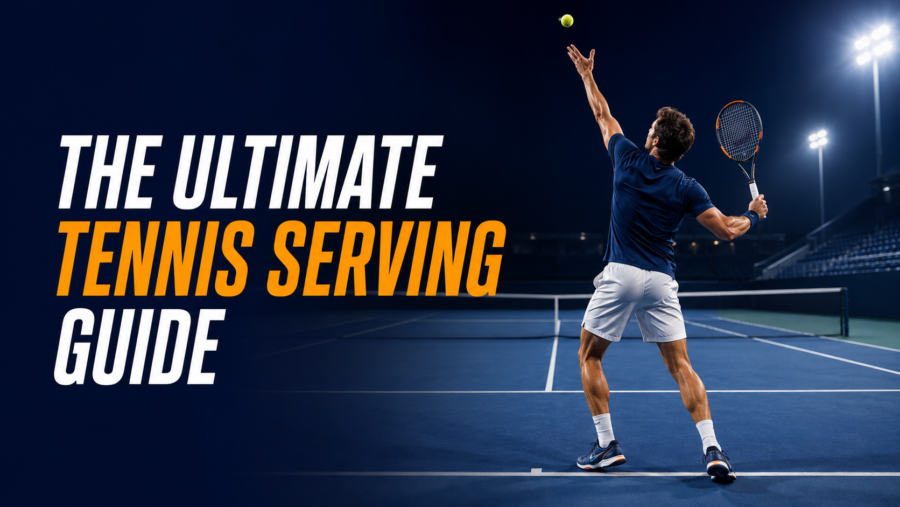
An effective tennis serve combines a legal starting position, a repeatable toss, a coordinated upward swing, useful spin, intentional placement, and a balanced recovery. Speed matters, but a serve that starts the point on favorable terms is more valuable than a faster serve that rarely lands in.
This guide is the main technique-and-tactics hub. It explains how the parts connect, then points to focused guides for detailed serving rules, forearm rotation, individual spin serves, speed development, and troubleshooting.
Tennis Serve Guide at a Glance
| Serve element | Main goal | Practical checkpoint |
|---|---|---|
| Grip | Allow the racket edge to lead and the strings to rotate toward contact | Use a Continental grip rather than a forehand grip |
| Stance | Create a balanced base for the motion | Begin stable, with the body positioned side-on or partly side-on |
| Toss | Put the ball in a hittable window | Release without flicking the wrist and avoid chasing a poor toss |
| Loading phase | Store and organize force through the legs and trunk | Bend and coil only as far as balance and timing allow |
| Upward swing | Accelerate the whole chain toward contact | Reach up rather than collapsing or pulling down early |
| Racket orientation | Produce the chosen pace and spin | Let the edge approach before the forearm and racket rotate |
| Contact | Strike at the highest comfortable reach | Keep the hitting arm extended without forcing a locked joint |
| Follow-through | Decelerate and return to play | Land under control and recover for the next shot |
| Tactics | Make the return predictable or uncomfortable | Combine location, spin, pace, and the next-ball plan |
The exact appearance differs between players. A technically sound serve does not need to copy one professional’s stance, toss height, knee bend, or finish.
Tennis Serving Rules in Brief
The server begins a standard game from behind the baseline on the right side of the center mark, then alternates sides after each point. The ball is normally released by hand and struck before it bounces into the diagonally opposite service court; the rules permit a player with the use of only one arm to use the racket for the release. The server normally has a first and second attempt; two consecutive faults lose the point.
The feet must satisfy the current foot-fault rule from the start of the service motion until the ball is struck. Service lets, the order of servers, doubles partner order, interruptions, and approved alternative formats are covered in the complete tennis serving rules guide.
For practice, the essential habits are simple:
- start from the correct side
- stand behind the baseline within the permitted lateral area
- serve diagonally into the correct box
- do not strike a toss you cannot control in practice
- keep track of whether the attempt is a first or second serve
Tournament regulations can add timing procedures and format variations, but they do not change the basic need for a legal, repeatable motion.
The Best Grip for a Tennis Serve
The Continental grip is the standard starting point because it allows the racket to approach on edge, rotate through the hitting area, and create flat, slice, or topspin-based serves without a complete grip change.
To find it, hold the racket as if using its edge like a hammer. On a conventional eight-bevel handle, a right-handed player commonly places the base knuckle of the index finger and heel pad around bevel two. A left-handed player uses the mirror position. Handle shapes vary, so the functional checkpoint is more useful than memorizing one photograph.
The hand should be secure without squeezing continuously. Excess tension can make the motion harder to sequence and can encourage the player to steer the racket face.
A forehand grip may make a beginner’s first contact feel easier because the strings face the court sooner. It also tends to limit edge-led acceleration and spin development. Transition gradually with short serves and relaxed swings rather than forcing full speed immediately.
Platform Stance or Pinpoint Stance?
Both major stances can support a strong serve. The better choice is the one that preserves balance, timing, and an upward drive.
Platform stance
In a platform stance, the feet remain separated during the loading phase. This provides a stable base and can simplify timing because the back foot does not have to move before the upward swing.
It can suit beginners, players who lose balance, and servers who value a repeatable start. A wide stance is not automatically better; the player still needs enough freedom to coil and drive upward.
Pinpoint stance
In a pinpoint stance, the back foot moves toward the front foot before the upward drive. This can create a compact launch position but adds a moving part that must be coordinated with the toss and racket preparation.
The back foot must not cross into an illegal position. It should also arrive without pushing the player sideways or causing the hips to open too early.
How to choose
Test both at controlled speed. Keep the stance that produces the most consistent toss-contact relationship and the most stable landing. Do not switch simply because a favorite professional uses the other option.
Starting Position and Pre-Serve Routine
Choose a position that matches the target and next-ball plan. In singles, many players serve from near the center mark because it reduces the distance to recover. Moving wider can improve an angle, but it also opens different return lanes.
In doubles, the server may adjust according to the partner’s net position, planned poach, and preferred first shot. The serving position remains subject to the foot-fault boundaries.
A short routine helps organize attention. It might include checking the score, selecting the target, taking one breath, bouncing the ball a consistent number of times, and beginning only when ready. The routine should prepare the decision, not delay play.
How to Hit a Tennis Serve Step by Step
The serve is one continuous action. The stages below are checkpoints for learning, not instructions to pause at each position. The step-by-step guide to how to serve in tennis provides a closer lesson for players building the motion from the beginning.
1. Set the grip, stance, and target
Choose the serve before beginning. Set the Continental grip, establish a balanced stance behind the baseline, and look at a target within the correct service box.
Avoid deciding between wide, body, and center during the toss. A late decision often changes the swing or racket face.
2. Start the hands smoothly
Begin with the arms and body free of unnecessary tension. The tossing arm and racket arm do not have to move at identical speed, but their timing should allow the ball to rise while the racket prepares without rushing.
Some players use a compact take-back; others use a larger loop. The shape matters less than arriving in a balanced loaded position on time.
3. Release a repeatable toss
Hold the ball lightly and release it from the fingers without an aggressive wrist flick. The arm can continue upward after release to support balance and shoulder alignment.
A useful toss is not simply “high.” It gives the server time to complete the motion while remaining close enough to the body’s natural contact path. Tosses that drift force last-second corrections.
4. Coil and load within control
As the racket prepares, allow the trunk and shoulders to turn while the legs load. The amount of knee bend is individual. More bend is not helpful if it disrupts the toss, delays the swing, or prevents an effective upward drive.
Keep the body organized around the intended contact rather than leaning dramatically for appearance.
5. Let the racket organize behind the body
The racket moves into an upward acceleration path as the lower body and trunk begin to uncoil. The familiar “racket drop” is part of that continuous sequence, not a pose to pull into with the hand.
Forcing the racket down can break rhythm and add tension. Focus on a smooth change of direction and an upward throw-like action.
6. Drive upward and lead with the edge
Push against the court and transfer the motion through the trunk, shoulder, arm, and racket. Research describes the serve as a linked whole-body action rather than an isolated arm swing.
The racket edge approaches the ball before the strings rotate toward the intended contact. This edge-led path is one reason the Continental grip is central to serve development.
7. Rotate the forearm and racket through contact
The forearm rotates as part of the service action, while internal shoulder rotation and other joint motions also contribute substantially to racket-head speed. “Snap the wrist” is therefore an incomplete and potentially misleading cue.
The tennis grips guide explains why the continental grip supports this movement. In the full serve, the priority is coordinated acceleration, not aggressively twisting one joint in isolation.
8. Contact at a high, comfortable reach
Meet the ball with the hitting arm extended at the highest comfortable point that the player can repeat. The exact location changes with serve type, anatomy, toss, and intended trajectory.
Do not force the body to remain perfectly still. Effective contact occurs during an upward and forward sequence, but the player should not fall uncontrollably into the court.
9. Follow through and recover
Allow the racket and body to decelerate naturally. The back leg may swing through to help balance, and the player should finish ready to react rather than admiring the serve.
Recovery direction depends on location. A wide serve can pull the return crosscourt, while a serve down the center can create a different first-ball pattern. Move according to the expected reply.
How to Build a Consistent Ball Toss
The toss is consistent when its useful contact window is predictable, not when every ball reaches an identical centimeter in space. The player still needs enough tolerance to strike normal variation.
Use these checkpoints:
- hold the ball without squeezing it into the palm
- release from the fingers with a quiet wrist
- keep the tossing arm moving on a repeatable path
- allow the eyes and head to track the ball without losing posture
- catch poor practice tosses instead of training emergency swings
Toss location by serve type
| Serve intention | General toss tendency | Main caution |
|---|---|---|
| Flatter serve | In front and within comfortable reach | Too far forward can pull the body down before contact |
| Slice serve | Similar to the normal contact area, with a path that supports sideward brushing | Exaggerating the toss far right or left can reveal the serve and disrupt balance |
| Kick serve | A contact path that permits upward and across-the-ball acceleration | Tossing too far behind can force back arching and unstable contact |
| Topspin-slice serve | Between a more direct and a more upward spin path | Do not chase a label at the expense of a repeatable toss |
These are tendencies, not fixed coordinates. The ideal toss must work with the player’s height, handedness, stance, mobility, and swing.
A simple toss check
Stand in the normal service position and make the full tossing action without swinging. Let the ball drop rather than catching it at the top. Mark the landing area and repeat ten times.
The drill reveals drift, but the landing spot is not the contact point. A served ball is struck before it returns to the court, while the body may also move during the motion.
Types of Tennis Serve
| Serve type | Main ball behavior | Common tactical use | Main learning challenge |
|---|---|---|---|
| Flat or flatter serve | Less spin and a more direct path | First-serve pace through a target | Smaller margin over the net and into the box |
| Slice serve | Curves laterally and can skid after the bounce | Pulling a returner wide or jamming the body | Creating useful spin without opening the racket face and floating the ball |
| Kick serve | Topspin-dominant flight and a higher, more active bounce | Second-serve margin and moving the returner vertically or laterally | Maintaining upward acceleration and a safe toss-contact relationship |
| Topspin-slice serve | Blends upward and sideward rotation | A versatile second serve and varied first serve | Controlling the blend rather than producing an undefined slow ball |
| Underarm serve | Struck below the normal overhead contact | A legal tactical surprise when the receiver stands far back | Disguise, placement, and accepting the tactical risk |
Flat serve
No high-level serve is literally spin-free. “Flat” describes a more direct, pace-oriented ball with less curve than a spin serve.
Use it selectively when the target and score justify the smaller margin. Placement and disguise often matter as much as maximum speed.
Slice serve
A slice serve uses sideward rotation to curve through the air and change the returner’s contact. From a right-hander on the deuce side, a wide slice commonly moves away from a right-handed receiver; other combinations produce different geometry.
The dedicated slice serve guide covers the contact path and progressions without overloading this hub.
Kick serve
A kick serve uses a more upward racket path and topspin-based rotation to create net clearance and an active bounce. It can move the returner above a comfortable strike zone, but only if the server maintains speed through the spin action.
See the kick serve guide for the full technique. Beginners can first develop a reliable topspin-slice second serve rather than forcing an extreme bounce immediately.
Topspin-slice serve
Many practical second serves combine topspin and slice. This blend can offer more net clearance than a flatter serve and a less demanding toss-contact relationship than an exaggerated kick.
The name matters less than the result: enough spin and height to create margin, with enough pace and location to avoid giving the receiver an easy attack.
Underarm serve
An underarm serve is legal when performed within the serving rules. It can punish a receiver who stands unusually far behind the baseline, but a poorly placed attempt may start the point defensively.
Use it as an intentional tactic, not a substitute for developing an overhead second serve.
First Serve vs Second Serve
A first serve can accept more risk because a second attempt remains. That does not mean the first serve should be a maximum-speed swing to a tiny target.
A second serve needs sufficient net clearance, spin, and a repeatable target. Slowing the racket dramatically often removes the rotation and shape that create safety. The player can reduce target risk while preserving a committed swing.
| Situation | First-serve priority | Second-serve priority |
|---|---|---|
| Neutral score | Create an advantage without donating too many faults | Start the point with a dependable pattern |
| Under pressure | Use the highest-confidence combination of target and shape | Commit to a practiced spin and generous target |
| Receiver far back | Mix body, angle, and occasional shorter location | Use shape and placement rather than only more pace |
| Receiver attacking | Jam the body, vary direction, or change speed | Avoid a predictable soft ball to one strike zone |
Track first-serve percentage, double faults, return quality, and the next shot. A serve percentage alone cannot show whether the ball created an advantage.
Tennis Serve Placement
The three broad targets are wide, body, and down the center. Their exact geometry changes between the deuce and advantage courts and according to the server’s handedness.
Wide serve
A wide serve moves the receiver away from the center and can open the opposite side for the next shot. It also creates a sharper return angle if the receiver reaches it well.
Body serve
A body serve targets the receiver’s movement space rather than a line. It can make a full swing difficult, especially when mixed with serves that pull in both directions.
Aim with enough margin that a small error does not become an easy serve into the receiver’s preferred contact zone.
Serve down the center
A center or T serve travels through the middle channel. It often reduces the returner’s angle and can set up a predictable first ball.
The name “T” refers to the service-line and center-service-line intersection, but the highest-percentage target is normally an area rather than the painted junction itself.
Serving From the Deuce and Ad Courts
On the deuce court, a right-handed server’s slice naturally supports the wide angle, while a left-hander can use it toward the center. On the advantage court, those relationships reverse.
Do not let the natural curve make the pattern predictable. Develop at least two credible locations from each side and choose a target based on the receiver’s position, handedness, return preference, and the next shot you want.
The same target can produce different outcomes against different opponents. A body serve to a compact returner may be ineffective, while a wide serve to a fast receiver may open too much court.
Serve Plus One Patterns
The serve is not finished when the ball lands in. “Serve plus one” means connecting the serve to the server’s first groundstroke or volley.
A simple planning sequence is:
- Choose a serve location and shape.
- Predict the most likely return direction or quality.
- Recover to a position that covers the realistic replies.
- Use the next shot to the open court, behind the receiver, or into a high-percentage pattern.
For example, a wide serve may create space on the opposite side, but only if the server recovers and the return does not create a sharper angle first. A body serve can produce a shorter central reply that invites an inside-out forehand.
Serving in Singles and Doubles
Singles
Singles rewards a combination of location and recovery. Serving wider can open the court, but the server must cover the return angle. Center serves reduce angle and can make the first groundstroke easier to organize.
Change patterns before the receiver becomes comfortable. Variation does not require a completely new motion; similar preparation with different spin and location is more useful.
Doubles
Doubles adds a net partner and planned team movement. Before serving, agree on whether the partner will stay, poach, or fake, and how the server will cover the next ball.
Body and center serves can restrict return angles, while wide serves can create a larger lane. The best choice depends on the receiver, partner, formation, and score rather than a universal doubles rule.
How to Improve Serve Accuracy
Accuracy improves when the target is large enough to reward correct execution. Divide the service box into wide, body, and center zones instead of aiming at a line.
Use a scoring drill:
- place three safe target areas in the box
- serve ten balls to one area
- award two points for the target, one for the correct third of the box, and zero for a fault
- record the score before changing target
Repeat with first-serve and second-serve intentions. A successful second-serve session should demand consecutive makes so one good ball cannot hide several double-fault patterns.
How to Serve Faster Without Losing the Serve
Serve speed comes from coordinated force production, racket-head speed, efficient contact, and an appropriate ball trajectory. It is not created by squeezing harder or snapping only the wrist.
Before chasing a higher number, confirm that the player can:
- use a suitable grip
- toss into a repeatable contact window
- accelerate upward without losing balance
- contact at a useful reach
- maintain direction and a playable first-serve percentage
The focused guide to serving faster in tennis covers speed development and measurement. Add speed in stages and track target success, not radar alone.
Common Tennis Serve Mistakes
Using a forehand grip
This exposes the strings early and can prevent edge-led acceleration and effective spin. Rebuild from short-court serves with a Continental grip.
Chasing an inconsistent toss
Repeatedly hitting poor tosses trains compensations. Catch the ball in practice and restart when it leaves the planned window.
Forcing the racket drop
Pulling the racket down into a pose can interrupt the chain. Let it emerge from a smooth change of direction as the body drives upward.
Serving only with the arm
The legs and trunk do not need exaggerated movement, but the serve should connect the body rather than isolate the shoulder and arm.
Slowing the second serve too much
A tentative swing often removes the spin and clearance needed for margin. Use a larger target and committed spin instead.
Falling away or failing to recover
A serve can land in while leaving the player off balance. Finish under control and move according to the likely return.
For a focused diagnostic page, see the four common tennis serve mistakes. Change one cause at a time rather than applying several cues to every serve.
Tennis Serve Drills
Toss-window drill
Place a visual marker where the ball should land if an unhit toss drops. Make ten full tossing actions and count how many land in the practical area. Adjust release direction, not just height.
Service-line progression
Begin closer to the net with a Continental grip and a relaxed edge-led action. Move back only when the ball clears the net and reaches the intended box without steering.
Three-zone placement
Serve to wide, body, and center areas in a planned sequence. The goal is to change location without visibly changing the early motion.
Second-serve streak
Choose a generous target and count consecutive successful spin serves. Restart after a fault. This introduces pressure without requiring maximum pace.
Serve plus one
Serve to a target, recover, and hit the next ball to a planned area. Use a partner, ball machine, or controlled feed so the server practices the full opening pattern.
For a more individualized framework, the guide to improving your tennis serve connects observation, practice priorities, and progress tracking.
A 30-Minute Serve Practice Session
| Time | Focus | Goal |
|---|---|---|
| 5 minutes | Dynamic preparation and easy throwing actions | Raise readiness without beginning at maximum intensity |
| 5 minutes | Tosses and half-speed service-line serves | Establish grip, release, and rhythm |
| 8 minutes | First serves to two target zones | Combine location with controlled pace |
| 6 minutes | Second-serve streaks | Build repeatable spin and margin |
| 4 minutes | Serve plus one patterns | Connect the serve to recovery and the next ball |
| 2 minutes | Pressure sequence | Finish with a small scored challenge |
The number of serves should match the player’s age, training history, and current tolerance. Stop if pain or a sudden loss of normal motion appears. A coach or qualified health professional should assess persistent symptoms rather than using more repetitions as the solution.
How Equipment Affects the Serve
Racket length, mass, balance, swingweight, head size, strings, and tension can all change timing and response. A higher swingweight may provide more effective mass at contact but can also reduce the acceleration a player can produce.
Strings and tension affect launch, feel, and control, but they cannot replace technique. Change only one equipment variable at a time and stay within the manufacturer’s instructions for the exact frame.
Do not copy a professional setup solely because the player serves well. Professional frames are often customized, and the athlete’s strength, timing, and preparation differ from those of a recreational player.
Frequently Asked Questions
What is the best serve for a beginner?
A beginner should first build a legal overhead serve with a Continental grip, repeatable toss, and generous target. A controlled topspin-slice action is a practical route toward a dependable second serve.
Should you jump when serving?
The feet may leave the court as a result of the upward drive, provided the serve remains legal. A player does not need to force a jump; balance and contact matter more than visible height.
How high should the ball toss be?
High enough to complete the motion without rushing, but not so high that the ball drops a long distance and becomes difficult to time. The useful measure is a repeatable contact window, not one universal height.
Should you snap your wrist on a tennis serve?
“Snap” oversimplifies the action. Forearm rotation, internal shoulder rotation, elbow extension, trunk movement, and other components contribute to racket speed. Forcing an isolated wrist action is not the same as a coordinated serve.
Why does the serve keep going into the net?
Common causes include a toss that is too low or misplaced, contact below the intended reach, insufficient upward trajectory, and a racket face or swing path that sends the ball down too early. Identify which variable changes on the missed serves before choosing a fix.
Why does the serve keep going long?
The toss may be behind the preferred contact, the racket face may be too open, or the serve may lack the intended spin and trajectory. Use a larger target and compare video from the side rather than simply slowing the swing.
Where should a second serve be aimed?
Use a generous area away from the lines, then vary body and backhand-oriented locations as reliability improves. The best target depends on the receiver and the server’s most dependable spin.
Is serve speed or placement more important?
Neither works alone. At most levels, a repeatable serve with useful placement and variation creates more value than occasional maximum speed. Pace becomes more effective when it can be directed and backed by a next-ball plan.
A complete serve is a coordinated start to the point. Build the grip, toss, upward action, spin, and recovery first, then use placement and serve-plus-one patterns to turn reliable technique into a match advantage.