
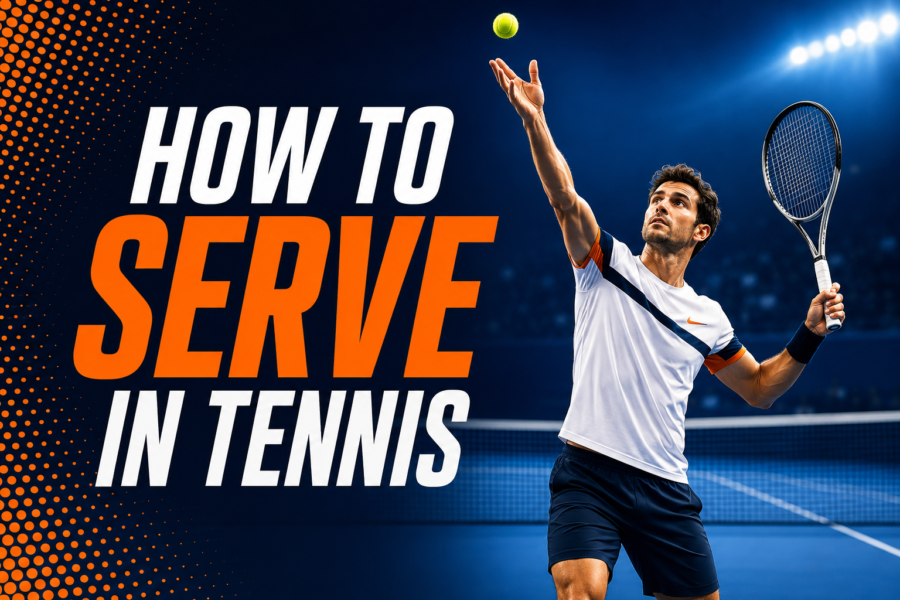
The serve is one of the most important shots in tennis because every point begins with it. Unlike every other stroke, the server controls when the point starts, where the ball is directed, and what type of spin or speed is used. A reliable serve can create immediate pressure, produce weak returns, and give you control of the point from the first shot.
The serve is also one of the most technically demanding strokes to learn. It requires the legs, torso, shoulder, arm, and racket to work together in the correct sequence. Beginners often struggle because they focus only on hitting the ball hard instead of developing a smooth and repeatable motion.
Learning how to serve in tennis becomes easier when the stroke is divided into clear stages. The most important parts are the grip, stance, preparation, ball toss, trophy position, racket drop, contact point, pronation, and follow-through.
For a complete serve fix check out The Tennis Serve Fix.
Use the Continental Grip
The correct grip for most tennis serves is the continental grip. It is used for flat, slice, and kick serves because it allows the racket to approach the ball on edge and accelerate naturally through contact.
To find the continental grip, hold the racket as though you are shaking hands with it or using it as a hammer. For a right-handed player, the base knuckle of the index finger should rest on bevel two. Left-handed players use the mirrored position.
Many beginners use a forehand grip because it makes it easier to place the strings directly behind the ball. Although this may feel more comfortable initially, it limits spin, racket-head speed, disguise, and long-term development. It can also encourage an inefficient pushing motion.
The continental grip may feel unusual at first, but it is essential for building a complete and technically sound serve.
Choose the Correct Serving Stance
Begin behind the baseline with your body turned sideways toward the net. A right-handed player places the left foot closer to the baseline and the right foot behind it. A left-handed player uses the opposite arrangement.
The front foot should point diagonally toward the right net post for a right-handed player, while the back foot remains roughly parallel to the baseline. Keep your knees relaxed and distribute your weight comfortably between both feet.
There are two common serving stances:
| Serving stance | Description |
|---|---|
| Platform stance | The feet remain separated throughout the loading phase |
| Pinpoint stance | The back foot moves closer to the front foot before the upward swing |
The platform stance usually provides more balance and is often easier for beginners. The pinpoint stance can create greater upward drive, but it requires more coordination. Neither option is automatically better, so choose the stance that allows you to remain balanced and repeat the motion consistently.
Begin With a Relaxed Preparation
Hold the racket and ball comfortably in front of your body before beginning the motion. Keep your shoulders relaxed and avoid squeezing the racket handle tightly.
As the hands separate, the tossing arm rises while the racket arm moves into the backswing. The shoulders should begin turning so that your upper body remains sideways to the net.
A smooth rhythm is more important than speed during this stage. Rushing the preparation often causes an inconsistent toss, poor balance, and unnecessary tension in the serving arm.
Beginners can start with a shortened motion if the full serve feels too complicated. However, the long-term goal should be a continuous movement rather than stopping the racket behind the head before swinging.
Develop a Consistent Ball Toss
The ball toss is one of the most important parts of the serve. Even an excellent swing becomes difficult to repeat when the toss changes position from one attempt to the next.
Hold the ball lightly with the fingertips rather than squeezing it into the palm. Raise the tossing arm from the shoulder and release the ball smoothly. Avoid flicking the wrist or bending the elbow excessively.
For a basic flat serve, the ball should be tossed slightly in front of the body and a little toward the hitting-arm side. A right-handed player generally places it slightly to the right of the head, while a left-handed player uses the opposite position.
The toss should allow you to reach upward at full extension and move slightly into the court. Tossing too far behind the body can reduce power and place stress on the shoulder. Tossing too far forward may cause you to fall into the court before making contact.
The toss should also be high enough to complete the motion without rushing. However, an extremely high toss gives the wind more time to affect the ball and may disrupt your timing.
Move Into the Trophy Position
As the tossing arm reaches upward, the body moves into what is known as the trophy position. This is the loaded position immediately before the racket accelerates toward the ball.
In a balanced trophy position:
- The tossing arm extends upward
- The racket elbow is raised
- The shoulders are tilted
- The knees are bent
- The upper body remains turned
- The front shoulder sits higher than the back shoulder
The trophy position should occur naturally as part of the serving motion. Avoid forcing the racket into a fixed pose or pausing for too long.
The shoulder tilt is especially important. It helps create an upward swing and prevents the serve from becoming a purely forward pushing motion.
Use the Legs and Body
A powerful serve does not come only from the arm. The legs begin the upward movement, followed by the hips, torso, shoulder, arm, and racket.
Bend the knees during the loading phase, but do not squat excessively. Push upward against the court as the tossing arm begins to lower and the racket accelerates toward the ball.
The body should move upward before rotating forward. Players who rotate too early often pull away from the ball and lose control of the contact point.
The serve works as a connected kinetic chain. When each part of the body contributes in sequence, the racket can move quickly without requiring excessive muscular effort from the arm.
Allow the Racket to Drop
As the body begins driving upward, the racket head drops behind the back. This position creates the distance needed to accelerate toward contact.
The racket drop should happen naturally through relaxation, shoulder movement, and elbow position. Trying to force the racket as far down the back as possible can create tension and disrupt the motion.
From the racket drop, the racket begins travelling upward on edge. This edge-first movement is one of the main reasons the continental grip is necessary.
Keep the arm relaxed during the upward swing. Tension slows the racket down and can make the serve feel forced.
Reach Up to the Contact Point
The ideal contact point is high, slightly in front of the body, and close to full arm extension. You should feel as though you are reaching upward to hit the ball rather than waiting for it to drop toward you.
A high contact point creates a better angle over the net and into the service box. It also helps you generate more speed and spin while maintaining control.
Keep your head up and continue watching the contact area. Looking toward the target too early can cause the shoulders to drop and the racket path to change.
The body should remain extended through contact. Collapsing the elbow or allowing the ball to fall too low reduces power and makes the serve less consistent.
Understand Pronation
One of the most misunderstood parts of the serve is pronation. Pronation is the natural rotation of the forearm that turns the racket from an edge-first position into contact and then continues after the ball has been struck.
It is not an aggressive wrist snap. The wrist remains relaxed while the forearm and shoulder rotate naturally through the swing.
Without pronation, players often brush the side of the ball unintentionally or push the serve with an open racket face. Correct pronation allows the racket strings to face the ball at contact while preserving racket-head speed.
A useful drill is to begin close to the net and practise serving with a relaxed throwing motion. Focus on approaching the ball with the racket edge before allowing the strings to rotate through contact.
Follow Through Across the Body
After contact, the racket continues forward and across the body. A right-handed player usually finishes with the racket near the left side, while a left-handed player finishes toward the right.
The follow-through should happen naturally rather than being forced into a specific position. Stopping the racket suddenly after contact reduces speed and can place unnecessary stress on the shoulder and elbow.
The back leg may move forward as the body enters the court. Land in a balanced position and prepare for the return immediately.
A complete follow-through helps the body decelerate safely and keeps the entire service motion smooth.
Recover After the Serve
The point begins as soon as the serve is struck. Do not remain inside the service motion or watch the ball for too long.
Land under control, bring the racket back in front of the body, and perform a split step as the returner makes contact. Your recovery position should depend on the location of the serve and the likely return.
You do not always need to move directly back to the center mark. For example, after serving wide, you may recover slightly toward that side because the returner has different available angles. Good recovery positioning helps you prepare for the next shot and use the advantage created by the serve.
Types of Tennis Serves
Once the basic motion becomes consistent, you can begin learning different types of serves.
Flat Serve
The flat serve uses minimal spin and directs more racket speed through the ball. It is normally the fastest serve but provides a smaller margin for error.
Slice Serve
The slice serve creates sidespin by brushing across the outside of the ball. It curves through the air and moves sideways after the bounce, making it effective for pulling opponents away from the court.
Kick Serve
The kick serve uses heavy topspin and sidespin to make the ball dip into the service box and bounce higher. It is commonly used as a second serve because the spin creates additional net clearance and control.
The basic serving motion should remain similar for all three serves. Changing the racket path, contact area, and toss slightly allows you to create different types of spin while maintaining disguise.
Common Serving Mistakes
Using the wrong grip is one of the most common problems. A forehand grip limits racket acceleration and makes it difficult to develop slice or kick.
An inconsistent ball toss is another major issue. Practise the toss separately until you can place the ball in approximately the same location repeatedly.
Other frequent mistakes include facing the net too early, gripping the racket too tightly, contacting the ball too low, opening the racket face, relying only on the arm, and slowing down before contact.
Players also make the mistake of trying to serve at maximum power before developing control. A smooth serve hit at 60% effort is more useful than an uncontrolled serve hit as hard as possible.
Read also 4 Common Serve Mistakes in Tennis.
How to Practise the Tennis Serve
Begin by practising the continental grip and throwing motion without a ball. Shadow swings can help you understand the racket path without worrying about the result.
Next, practise the ball toss separately. Place a racket on the ground in front of your lead foot and try to make the tossed ball land on the strings without moving your feet.
You can then serve from the service line using a shortened motion. Focus on reaching upward, pronating naturally, and directing the ball into the correct service box.
Gradually move back toward the baseline as your control improves. Practise serving to three main locations: wide, into the body, and down the T.
Use targets rather than simply counting how many serves land in. This develops accuracy and teaches you to begin points with a tactical purpose.
Final Thoughts
Learning how to serve in tennis requires patience because the stroke combines several movements into one continuous action. The continental grip, sideways stance, consistent ball toss, trophy position, racket drop, high contact point, pronation, and relaxed follow-through all contribute to an effective serve.
Do not focus only on power. Begin by developing balance, rhythm, control, and a repeatable motion. Once the technique becomes reliable, racket-head speed and serve variety can be added gradually.
A consistent serve gives you confidence at the beginning of every point. With regular practice, it can develop from a difficult beginner stroke into one of the strongest weapons in your game.