
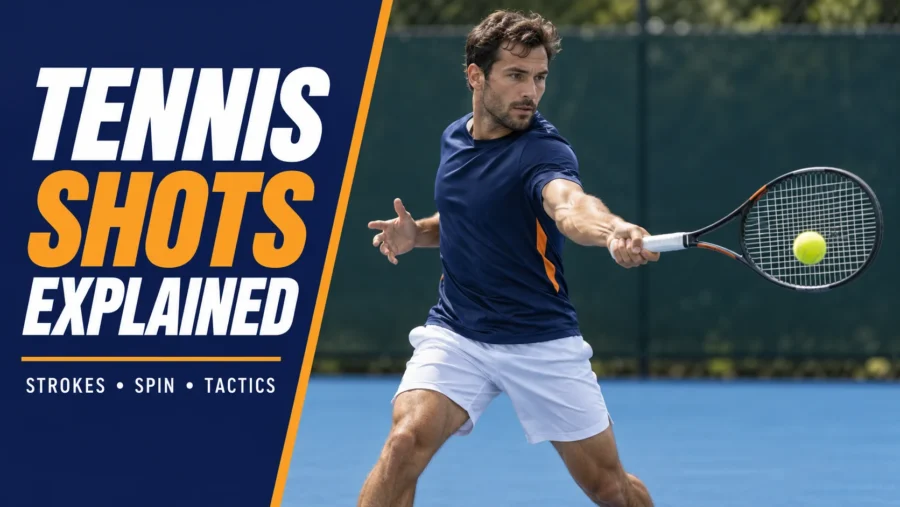
Tennis shots fall into a few practical families: serves start the point, returns answer the serve, groundstrokes are hit after a bounce, volleys are usually struck before the ball bounces, and specialty shots solve tactical problems. A stroke describes the hitting action, while a shot often describes the ball you intend to produce. Players use the terms loosely, so the context matters more than a rigid label.
This guide is a quick-reference map rather than a lesson on every technique. Use it to identify a shot, understand its purpose and decide which skill deserves focused practice next.
Tennis shots at a glance
| Shot or stroke | When it is hit | Main purpose |
|---|---|---|
| Serve | To begin a point | Start with placement, spin or pace |
| Return | Immediately after the serve | Neutralize or attack the server |
| Forehand groundstroke | After one bounce, dominant side | Build or finish from the baseline |
| Backhand groundstroke | After one bounce, non-dominant side | Rally, redirect or attack |
| Volley | Before the ball bounces | Take time away near the net |
| Half-volley | Just after a very short bounce | Handle a low ball near the net |
| Overhead or smash | Above the head | Attack a lob or high ball |
| Lob | High over an opponent | Defend, reset or pass a net player |
| Drop shot | Soft and short | Bring an opponent forward |
| Passing shot | Past a player at the net | Win or pressure from the baseline |
The same swing can create different outcomes. For example, a forehand may be flat, topspin-heavy, sliced, driven crosscourt or shaped into a lob.
Serve
The serve is the only stroke that begins entirely under the hitter’s control. The player tosses the ball and strikes it before it lands, from behind the baseline and into the diagonally opposite service box.
Common versions include the flat serve, slice serve and kick serve. A flat serve prioritizes direct pace, a slice serve curves sideways and stays relatively low, and a kick serve uses heavy topspin to jump higher after the bounce. Placement and reliability usually matter more than maximum speed, especially on a second serve.
The complete tennis serving guide covers grip, stance, toss and swing sequence in more detail.
Return of serve
The return is the first shot played by the receiver. It can resemble a shortened groundstroke, a compact block or, against a slower serve, a fuller attacking swing.
Good returns depend on an early split step, a quick unit turn and a target that suits the situation. Deep through the middle is often a safer neutralizing choice, while a crosscourt angle can move the server immediately. The return-of-serve guide explains positioning and preparation.
Forehand groundstroke
A groundstroke is a forehand or backhand hit after the ball bounces. The forehand is played on the dominant side for most players and is commonly used to dictate rallies with pace, spin and direction.
A player can hit a forehand crosscourt, down the line, inside-out or inside-in. Those labels describe direction and court position, not entirely different strokes. The detailed forehand technique guide breaks down preparation, contact and follow-through.
Backhand groundstroke
The backhand is a groundstroke played on the non-dominant side. It may be hit with one hand or two hands, and both versions can be effective at every level.
Two-handed backhands often provide a stable contact through both arms, while one-handed backhands offer reach and an easy transition to slice. Neither is automatically better. Body size, strength, timing and coaching all affect the choice, as explained in the backhand technique guide.
Volley
A volley is normally struck before the ball bounces. Players use volleys near the net to take time away, close open space and finish points, although a volley can technically be played from farther back.
The basic forehand and backhand volleys use a compact movement rather than a large groundstroke swing. The racket face, contact point and balance control direction. A drop volley is a deliberately soft version intended to land short, while a punch volley is firmer and deeper.
Half-volley
A half-volley is hit immediately after the ball bounces, often while it is still very low. It is not a true volley because the ball has touched the court, but it is usually played with a short, stable action similar to a volley.
This is frequently a recovery shot when a player is moving forward and cannot reach the ball in the air. Keeping the head still, bending through the legs and simplifying the target are more useful than trying to generate extra pace.
Overhead and smash
An overhead is an above-the-head shot used against a lob or another high ball. “Smash” usually describes the attacking version intended to finish the point, although the two terms are often used interchangeably.
The player should turn sideways, track the ball with adjustment steps and contact it at a comfortable reach. A high ball is not automatically easy, particularly when it drifts behind the hitter. The tennis smash technique guide covers positioning and safer contact choices.
Lob
A lob sends the ball high over an opponent, usually one positioned near the net. An offensive topspin lob can dip inside the baseline after clearing the opponent, while a high defensive lob buys recovery time.
Depth is usually more important than height alone. A short lob invites an overhead, but a deep lob can force the opponent to retreat or play a difficult ball over the shoulder. Learn when to choose each version in the tennis lob guide.
Drop shot
A drop shot is struck softly so the ball lands short and stays difficult to reach. It works best when the opponent is deep, off balance or expecting a stronger drive.
Disguise, control and court position matter more than simply slowing the swing. Attempting a drop shot from well behind the baseline gives the ball farther to travel and gives the opponent more time. The drop-shot technique guide explains setup, contact and tactical timing.
Approach shot
An approach shot is played while moving toward the net or with the intention of following the ball forward. It is commonly hit deep to a corner, low with slice or behind an opponent who is already moving.
An approach does not need to be a winner. Its job is to create a weaker reply and place the hitter in a sound net position. The next volley is part of the pattern, so recovery and the split step should be planned before the ball is struck.
Passing shot
A passing shot travels past an opponent at the net. It may go down the line, crosscourt or sharply at an angle, and it can be hit from either wing.
The first pass does not always need to win the point. A firm, dipping ball at the volleyer’s feet can force a weak first volley and create an easier second pass. When the opponent covers one side early, a lob is another passing option.
Topspin, slice and flat shots
Topspin makes the ball rotate forward. It helps a forceful shot dip into the court and often produces a higher bounce. Slice creates backspin, typically travels lower and can change the rhythm of a rally.
A flat shot has less topspin and follows a more direct path. “Flat” does not mean zero rotation, and “slice” does not mean a defensive shot in every situation. The guide to topspin and slice in tennis explains how each ball behaves.
Other useful shot names
Several terms describe a situation or intention rather than a unique swing:
- Crosscourt shot: travels diagonally across the court.
- Down-the-line shot: travels roughly parallel to the sideline.
- Inside-out forehand: a forehand hit from the backhand side toward the opponent’s crosscourt side.
- Inside-in forehand: a forehand hit from the backhand side down the line.
- Dink or touch shot: an informal term for a very soft ball, more common in doubles or at the net.
- Tweener: a low-percentage shot played between the legs, usually while chasing a lob.
- Moonball: a high, deep groundstroke with substantial net clearance.
- Chip: a short, blocked slice, often used on returns or approaches.
Which shots should beginners learn first?
Start with a reliable forehand, backhand, serve and return because they appear in almost every point. Add basic volleys and overheads so moving forward does not feel unfamiliar. Specialty shots become more useful after a player can control direction and depth on routine balls.
Grip affects what feels natural and which racket-face angles are available. Learn the major grip positions alongside the core strokes so the names connect to practical racket-face control.
Practice a small number of repeatable patterns rather than every shot at once. A crosscourt groundstroke, a deep middle return and a controlled serve target build a foundation that makes lobs, drop shots and passing shots easier to use with purpose. Add movement drills gradually, then place the strokes inside point patterns so technique and decision-making develop together.
Frequently asked questions
What is the difference between a shot and a stroke in tennis?
A stroke is generally the physical hitting action, such as a forehand or volley. A shot often refers to the intended result, such as a lob, passing shot or crosscourt ball. In everyday tennis language, the terms overlap and are not governed as strict rulebook categories.
Is a serve a stroke?
Yes. A serve is a stroke used to start a point, and it can also be described as a shot. It has its own rules because the server controls the toss and must deliver the ball into the correct service box.
Is a volley allowed to bounce?
No. A standard volley is struck before the ball bounces. A ball played immediately after a short bounce is a half-volley.
What are the four basic tennis strokes?
Many beginner programs group the forehand, backhand, serve and volley as four basic strokes. The return and overhead are also essential, so that list should be treated as a teaching shortcut rather than a complete taxonomy.