
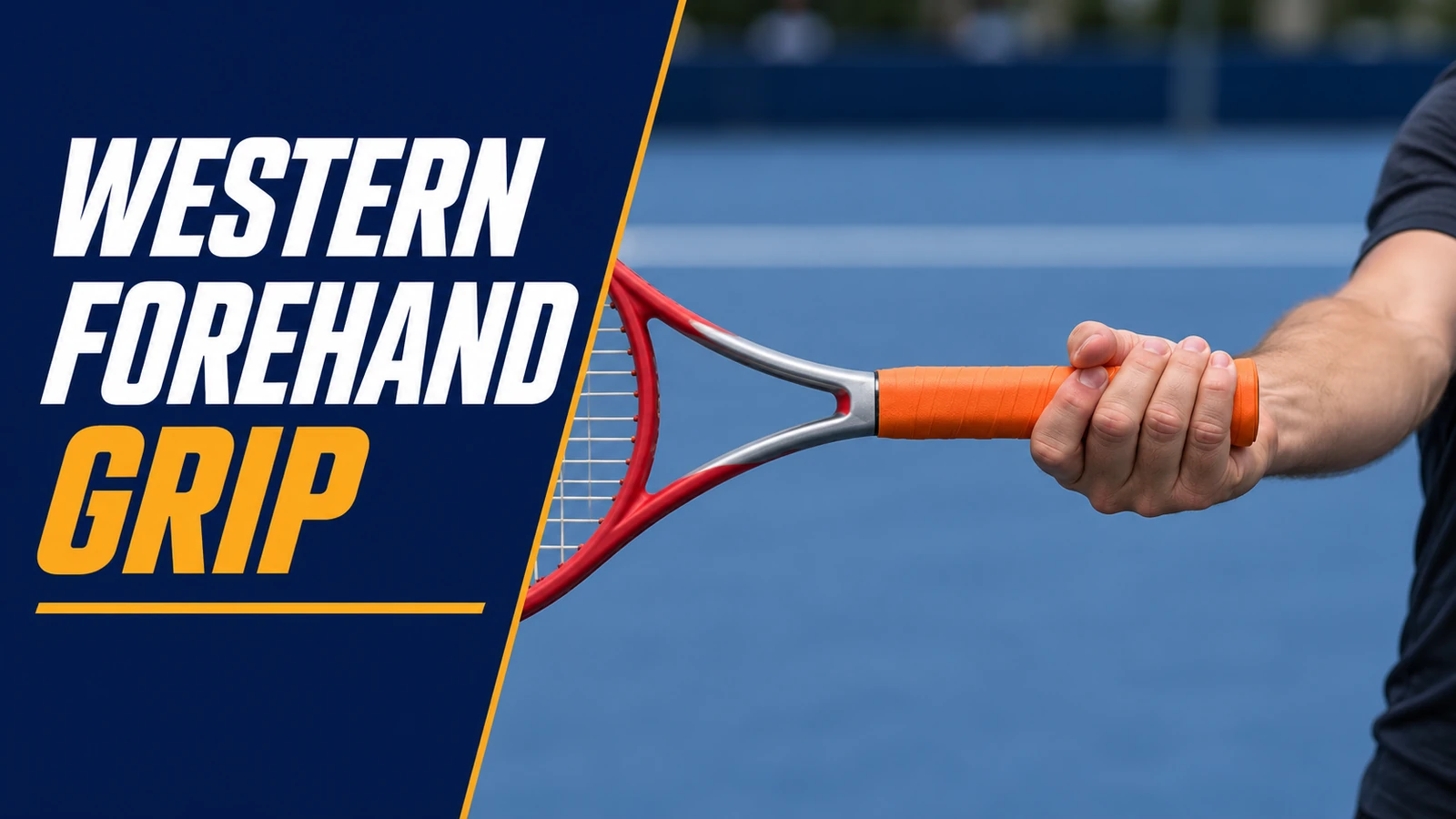
The full Western forehand grip places the base knuckle of the index finger and the heel of the hand around the bottom bevel of the racket handle. It can suit a player who prefers high contact and heavy topspin, but it demands good spacing and makes low, skidding balls more awkward.
Changing to Western is therefore a technique decision, not a shortcut to more spin. The grip has to work with your contact point, swing path, movement and ability to change grips for the next shot.
Find the Full Western Grip
Hold the racket on edge and look from the butt cap toward the head. In the fixed numbering used here, the top flat surface is bevel 1; the remaining bevels run clockwise. The bottom flat surface is bevel 5.
Place the base knuckle of the index finger and the heel pad of the palm around bevel 5. Keep the hand near the butt cap, with the little finger secure above its flare. Allow a comfortable space beside the index finger instead of squeezing all the fingers into a rigid fist.
Some diagrams reverse the counting direction for left-handers. Check the viewing direction and numbering before comparing instructions. The complete tennis grip guide provides the other grip references.
Check the Palm, Not Only One Knuckle
Moving the index knuckle while leaving the heel pad in its old position can create a different grip from the one you intended. Look at both contact areas, then make a slow shadow swing and inspect the stringbed near the expected ball contact.
The strings must be able to meet the ball with a controlled face. If you need to force the wrist into an uncomfortable position just to present the racket, stop and reassess the grip and spacing with a coach.
What Changes in the Swing?
Western places more of the hand under the handle than Eastern or Semi-Western. For the same arm and wrist arrangement, the racket face tends to be more closed. A successful swing coordinates that relationship with an upward and forward racket path.
The grip itself does not generate topspin. Spin depends on the motion of the strings relative to the ball, including racket speed, swing direction and face orientation. Simply closing the face and swinging upward can produce a netted ball or a thin, weak contact.
You still need forward travel through the hitting zone. A ball that spins heavily but lands short gives the opponent time to attack; depth and trajectory matter alongside the visible bounce.
Prepare With the Body and Create Space
Begin the unit turn when you recognize the forehand. Use the non-hitting hand to support the racket during preparation, and move the feet so the hitting arm has room.
Western does not require one compulsory stance. A semi-open or open stance may fit a lateral baseline ball, while a more neutral stance may suit a comfortable shorter ball. The incoming shot and available time should decide, rather than the grip label alone.
The broader forehand technique guide explains the movement sequence. For Western, pay particular attention to whether the ball gets too close to the body before the racket starts forward.
Find a Contact Zone You Can Repeat
Aim for contact in front of the body and sufficiently to the hitting side to avoid crowding. There is no universal distance in centimeters because reach, stance, arm structure and ball height differ.
Many full Western players feel most comfortable with medium-to-high contact. “High” does not mean reaching above the head or lifting the shoulder to chase every bounce. Move so the ball enters a range in which you can keep balance and direct the face.
| Incoming ball | Useful adjustment | What to avoid |
|---|---|---|
| Comfortable waist-to-chest-height ball | Establish spacing, then swing upward and forward through a large target | Brushing almost vertically and leaving the ball short |
| High, deep topspin ball | Move early to take it in a manageable zone, either earlier or after creating more space | Waiting until it crowds the shoulder |
| Low, skidding slice | Lower through the legs, shorten the preparation and allow more net margin | Trying to scoop the ball with a sudden wrist movement |
| Short ball inside the court | Move forward and control the trajectory for the shorter available court | Reusing the same high, deep rally shape without adjustment |
| Wide defensive ball | Prioritize reach, height and recovery over maximum acceleration | Insisting on a perfect attacking swing while stretched |
Taking the ball earlier requires timing; retreating requires space and gives up court position. Practice both responses to a high ball rather than treating either as the universal solution.
Manage Low Balls Without Forcing the Wrist
Low contact is the main practical test of a full Western grip. The racket must approach from an appropriate height despite the grip’s closed-face tendency, and there may be little space below a ball that skids near the court.
Prepare early, bend comfortably through the hips and knees, and leave enough lateral room for the racket. Use a compact swing with a generous target instead of demanding a sharp angle from a difficult contact.
You can also choose a different shot when you have time to set the appropriate grip. A controlled slice or defensive block may be more useful than forcing a full topspin swing from an extreme stretch. Establish that option in practice rather than making an unplanned grip change during contact.
If low balls repeatedly force awkward compensations, a less extreme forehand grip may suit your game better. The goal is a usable range of shots, not loyalty to one bevel.
Use High Contact Without Overhitting
Western can make a high rally ball feel more manageable, especially when the player can maintain space and an upward swing. That advantage is most useful when it produces depth, a difficult bounce or an angle the opponent has to defend.
On a high ball well behind the baseline, use height and depth to regain position. On a shorter high ball, you may drive more directly through the court, but the face and swing still need enough control to keep the shot inside the baseline.
Do not pull the head away early to watch the result. Track the ball into your contact area, complete a balanced swing and begin recovery. The three-step tennis footwork cycle is especially useful when a preferred high contact tempts you to stop adjusting your feet.
Advantages and Tradeoffs
| Potential advantage | What must support it | Practical cost |
|---|---|---|
| Heavy topspin with useful net clearance | Clean contact, racket speed and a coordinated upward path | Spin without depth can be easy to attack |
| Comfortable handling of higher rally balls | Early reading and enough space beside the body | Low, fast balls require more adjustment |
| Dipping angles and higher-bouncing patterns | Good directional control | Sharp angles can expose more court on the reply |
| Confidence accelerating through a rally ball | Repeatable face orientation | A more specialized contact range may reduce versatility |
Western is not automatically more powerful, safer for the arm or superior on every surface. A player’s overall technique and comfort matter more than the grip’s name.
Compared with Semi-Western, full Western is a more extreme position with a greater low-ball compromise. Compared with Eastern, it generally requires a larger adjustment for neutral-grip shots such as volleys. If you are deciding between the less extreme options, the Eastern and Semi-Western comparison covers their broader tradeoffs.
Learn the Grip in Four Stages
1. Find the Face Without a Ball
Make 10 slow shadow swings from a balanced position. Pause near the expected contact zone to check that the racket face can meet an imaginary ball without a forced wrist position.
Reset the hand after every two swings so you practice finding the grip, not merely holding it. Use a mirror or a short side-view recording if you cannot see where the palm sits.
2. Use Comfortable Drop Feeds
Start around the service line and use slow drop-fed forehands into a large crosscourt target. Hit three sets of eight balls, pausing between sets to check the grip and contact spacing.
Count balls that clear the net, land in the intended half and come from a balanced contact. Aim for six of eight before moving farther back. If contact is consistently thin or framed, slow down and make the ball placement more predictable.
3. Add Height and Movement Separately
Ask a partner to feed eight comfortable medium balls, then eight slightly higher balls, then eight lower ones. Keep the target broad and use the adjustment appropriate to each height.
Once the height changes are manageable, add a small lateral movement. Do not increase speed, width and bounce variation together; otherwise it becomes difficult to identify what caused the error.
Record which height produces a reliable deep ball and which repeatedly forces a weak contact. That comparison helps determine whether the grip fits your real match environment.
4. Rehearse the Next Grip
Begin in Western, play a controlled forehand and recover with the non-hitting hand supporting the racket. Change to Continental before a gentle volley feed, then reset for another forehand.
Complete two sets of eight forehand-to-volley sequences. The aim is an organized grip change during preparation, not a fast rotation while the racket is already moving toward the ball.
This exercise matters even for baseline players. A grip that produces a good forehand but leaves you unable to organize the next shot needs more transition practice.
Diagnose the Ball Flight Before Changing Everything
| Repeated problem | First checks | Useful practice response |
|---|---|---|
| Ball goes into the net | Face too closed, cramped contact, racket not reaching the intended path | Slower feeds with more space and a higher target |
| Ball spins but lands short | Too much upward action relative to forward travel | Large deeper target at moderate speed |
| Ball flies long | Face too open at contact, late adjustment or poorly matched trajectory | Reduce pace and inspect the actual contact on video |
| Frequent frame hits | Late preparation, inconsistent spacing or overly steep path | Predictable drop feeds before adding movement |
| Low balls feel impossible | Late reading and insufficient lowering, or a grip unsuited to that contact | Separate low-ball practice and review the grip choice |
| Forehand works but volleys fail | Grip change is late or incomplete | Slow forehand-to-Continental sequences |
These are starting checks, not diagnoses from ball flight alone. More than one cause can produce the same miss.
Try Western in structured practice before rebuilding your match forehand around it. Keep it if it improves the balls you face most often while leaving you a workable answer to low shots and grip transitions. If those costs remain greater than the benefit, a milder position is a valid technical choice.