
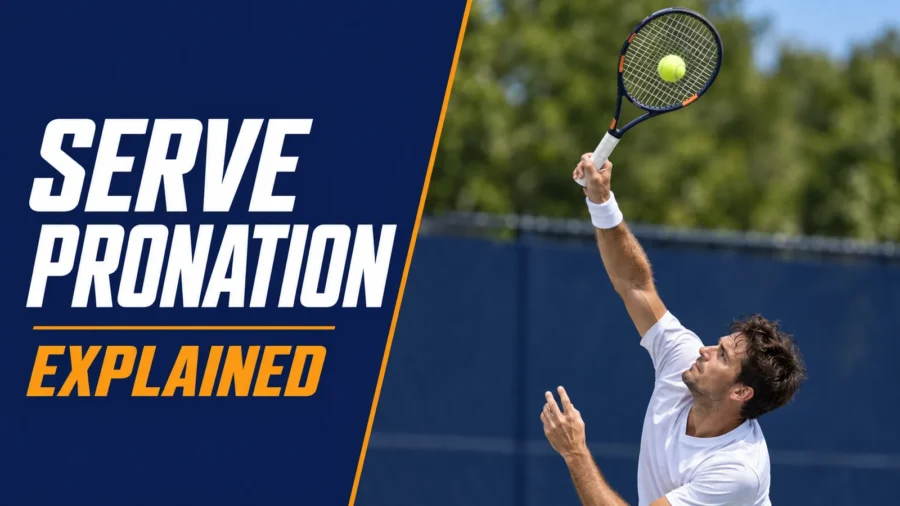
Pronation in a tennis serve is the inward rotation of the forearm that helps turn the racket from an edge-leading position toward the ball and then onward through the follow-through. Anatomically, the radius rotates around the ulna during pronation.
The coaching term is often used too broadly. The visible rotation of the racket is not created by the forearm alone. Internal rotation at the shoulder, elbow extension, forearm rotation and the movement of the rest of the body combine in a fast sequence. Pronation is therefore part of an efficient service motion, not a deliberate wrist snap added at the last moment.
Serve Pronation at a Glance
| Question | Direct answer |
|---|---|
| What rotates? | The forearm pronates as the radius rotates around the ulna |
| Is shoulder rotation the same movement? | No. Internal shoulder rotation turns the upper arm at the shoulder joint |
| Is pronation a wrist snap? | No. The wrist is not the joint that produces forearm pronation |
| When does it happen? | Rotation develops during the upward swing, around contact and into the follow-through |
| Which grip supports it? | The continental grip is the standard starting point for most serves |
| Should it be forced? | No. It should emerge from a coordinated, relaxed sequence |
This page isolates the rotation mechanic. Players who need stance, toss, loading, contact and follow-through in one sequence should start with How to Serve in Tennis.
What Pronation Actually Means
Pronation and supination are anatomical movements of the forearm. With the elbow bent and the palm initially facing upward, pronation turns the palm downward. During that movement, the radius crosses over the ulna.
Supination is the opposite rotation. It returns the forearm toward a palm-up position, with the radius and ulna more nearly parallel.
The arm is raised and moving rapidly during a serve, so the motion does not look as simple as turning a stationary palm over. The same forearm rotation changes the orientation of the hand and racket while other joints are moving at the same time.
Pronation Is Not Internal Shoulder Rotation
Internal shoulder rotation turns the upper arm within the shoulder joint. Forearm pronation turns the radius around the ulna at the radioulnar joints. They are distinct movements even though both can contribute to the racket’s rapid rotation.
This distinction corrects a common oversimplification. When a coach says “pronate,” the visible action being described may include substantial internal shoulder rotation as well as true forearm pronation.
Pronation Is Not a Wrist Snap
The wrist can flex, extend and deviate, but it does not pronate the forearm. Trying to flick the wrist sharply at the ball can disrupt the racket path, open the face too early and make contact less predictable.
The wrist is not rigid during a high-level serve, either. It moves within the full kinetic chain, but that is different from consciously forcing an isolated last-second snap.
Why Pronation Matters in the Serve
An efficient serve often approaches the upward swing with the racket edge leading. The arm and racket then rotate so the stringbed can meet the ball with the intended face angle and swing direction.
That rotation serves several purposes:
- It helps orient the stringbed for contact without requiring a forehand-style grip.
- It lets the player accelerate along a continuous path rather than pushing the racket face toward the ball.
- It supports the changing racket-face and swing-path relationship used for flatter and more spin-oriented serves.
- It allows the arm to continue rotating through the follow-through instead of stopping abruptly at contact.
Pronation should not be treated as the sole source of serve speed. Biomechanical research identifies a sequence involving the legs, trunk, shoulder, elbow, forearm and hand. Studies also differ in their estimates of individual joint contributions because measuring rapid three-dimensional motion close to impact is difficult.
The practical conclusion is stronger than any one percentage: the serve is a linked motion. How to Serve Faster in Tennis covers whole-sequence speed development rather than assigning power to one joint.
Where Pronation Fits in the Service Motion
Before the Upward Swing
The continental grip allows the racket to move into a position where its edge can lead upward. During the loading and racket-drop phases, the shoulder, upper arm and forearm organize for the acceleration that follows.
There is no need to hold the forearm in an exaggerated fixed position. Excess tension in the hand and forearm can make the sequence harder to coordinate.
During Upward Acceleration
As the racket accelerates, elbow extension and internal rotation of the upper arm combine with forearm rotation. The racket changes orientation quickly, but it is still traveling on an upward and forward path rather than simply spinning in place.
This is why still images can be misleading. A photograph freezes one moment and cannot show which joint created the position or how the racket arrived there.
Around Contact
At contact, the racket face must match the intended serve direction and spin. Rotation cannot be so early that the strings face the ball throughout the upward swing, nor so late that the edge reaches the ball first.
Players should not try to stop pronation exactly at contact. The motion develops through a brief period around impact, and its timing varies with the serve type, swing path and individual technique.
After Contact
Forearm and upper-arm rotation continue as the racket travels into the follow-through. The strings may turn visibly outward after impact, which is why post-contact video often makes pronation easy to notice.
The follow-through is evidence of an ongoing motion, not a position to force. Deliberately twisting to create a particular finishing photograph can add tension without improving the contact that already occurred.
The Role of the Continental Grip
The continental grip places the hand so the racket can travel edge-first and rotate naturally during the upward swing. It is also the standard foundation for volleys and overheads.
A forehand-style or “frying pan” grip tends to present the strings toward the ball too early. That can encourage a pushing action and reduce the need for the coordinated edge-to-face rotation this article describes.
To check the basic orientation, hold the racket so the thin edge is visible rather than the full stringbed. The USTA uses simple edge-tapping exercises to help players become familiar with this grip.
Changing the grip may initially reduce serve pace or consistency because the contact pattern is unfamiliar. Begin at low speed and rebuild control before trying full-power serves. The broader grip families are explained in Tennis Grips Explained: How to Hold the Racket.
How Pronation Changes by Serve Type
Pronation and upper-arm rotation are not exclusive to a flat serve. The amount, timing and visible appearance change because each serve uses a different racket path and face relationship.
| Serve type | Main intention | How to interpret the rotation |
|---|---|---|
| Flat serve | More direct pace with relatively little spin | Rotation helps bring the face into a more direct contact orientation while the racket travels up and through |
| Slice serve | Sidespin with a path that works more across the ball | Rotation still occurs, but the swing direction and face angle preserve the brushing component |
| Kick serve | Upward and across contact for heavy topspin and sidespin | Rotation remains part of the chain, but forcing the face to turn forward too early can reduce the upward brushing path |
The table does not prescribe an exact angle. Serve mechanics vary between players, and ball toss, trunk position and contact location also affect the result. How to Hit a Kick Serve in Tennis owns the complete kick-serve path and progression.
Comfort and Safety
Pronation is a normal forearm movement, but a tennis serve places the entire upper limb under high-speed load. More rotation is not automatically better, and forcing the range can irritate the wrist, forearm, elbow or shoulder.
Practice new mechanics below maximum effort and keep the movement smooth. Stop if a drill causes sharp pain, persistent discomfort, weakness or altered sensation. A qualified tennis coach can help with coordination, while a healthcare professional should assess ongoing pain or a suspected injury.
No drill can guarantee injury prevention. Workload, previous injury, strength, mobility, technique and recovery all affect how a player tolerates serving.
Safe Drills for Learning Serve Pronation
These drills are intended to clarify the movement at low speed. They are not a substitute for the complete serve sequence or for individual coaching.
1. Feel Forearm Rotation Without a Racket
Bend the elbow comfortably and hold the forearm in front of the body. Turn the palm upward, then slowly turn it downward while keeping the upper arm relatively quiet.
This identifies supination and pronation anatomically. It is not meant to reproduce the full serve, where the shoulder and arm also move.
2. Find the Racket Edge
Use a continental grip and hold the racket near the throat to reduce leverage. Make a slow, compact upward motion with the edge leading, then allow the stringbed to turn through the imagined contact area.
Keep the movement smooth and pain-free. Do not wrench the forearm to make the strings finish in an extreme position.
3. Shadow the Edge-to-Face Sequence
Without a ball, rehearse a relaxed service swing at low speed. Notice the edge rising first and the stringbed arriving later rather than facing the target for the entire swing.
Film from behind and from the side if possible. Slow-motion video can show whether the face opens early, but it cannot diagnose every joint movement from a single camera angle.
4. Use an Abbreviated Serve
Stand in a comfortable serving position and begin with the racket already raised instead of using a full takeback. Serve gently from inside the baseline or near the service line, prioritizing clean contact and a continuous finish.
Increase distance and effort only after the movement remains coordinated. The goal is not to hit hard from a shortened court.
5. Add the Full Motion Gradually
Blend the learned rotation back into the normal toss and loading sequence. Alternate controlled serves with shadow swings so the edge-to-face pattern remains connected to the whole body.
For a broader progression, including toss and rhythm work, use How to Improve Your Tennis Serve. This page should remain focused on the rotation component.
Common Pronation Mistakes
| Mistake | Why it causes trouble | Better cue |
|---|---|---|
| Using a forehand grip | The strings face forward early and encourage a push | Begin with a continental grip and let the edge lead |
| Trying to snap the wrist | It isolates the wrong joint and can disturb the racket path | Think of smooth arm rotation through contact |
| Rotating too early | The face opens before the upward path reaches the ball | Keep the edge moving upward longer |
| Waiting to twist after contact | The face may not be organized when it matters | Let rotation develop before, through and after contact |
| Squeezing the handle | Excess tension can interrupt the sequence | Hold securely without a rigid forearm |
| Isolating the forearm | The serve loses support from the rest of the kinetic chain | Coordinate legs, trunk, shoulder, elbow and forearm |
| Forcing an extreme finish | The player copies a photograph rather than the motion | Allow a balanced follow-through to emerge |
Some apparent pronation problems begin elsewhere. An unsuitable toss, late preparation or forehand grip can force the arm to compensate. 4 Common Serve Mistakes in Tennis helps separate those larger faults from the rotation itself.
How to Check Your Pronation on Video
Record several controlled serves from behind the baseline and from the side, with enough distance to keep the entire body and racket in frame. Review the motion at normal speed first, then in slow motion.
Look for a sequence rather than a frozen pose:
- The racket does not climb with the full stringbed facing the target from the start.
- The edge leads during at least part of the upward motion.
- The face turns into the intended contact orientation without a visible last-second wrist flick.
- Rotation continues into a balanced follow-through.
- The motion remains coordinated when viewed at normal speed.
A two-dimensional video cannot reliably separate every degree of shoulder rotation, forearm pronation and wrist movement. Use it to identify obvious timing patterns, not to calculate joint mechanics.
Final Takeaway
Tennis serve pronation is the forearm’s inward rotation, not a wrist snap. It helps change racket orientation around contact, but the visible action also includes substantial movement at the shoulder and elbow.
Learn it with a continental grip, low-speed edge-to-face drills and a relaxed follow-through. The aim is a coordinated rotation within the full service chain, not the largest possible twist or a forced finishing position.
Frequently Asked Questions
Do you have to pronate on a tennis serve?
Forearm rotation is a normal component of an efficient service action, but it works with internal shoulder rotation and the rest of the kinetic chain. A player should not try to bolt an isolated twist onto an otherwise disconnected swing.
When should pronation happen?
It develops during the upward acceleration, around contact and into the follow-through. The exact timing differs with the serve type and the player’s motion, so “pronate only after contact” and “snap at contact” are both misleading cues.
Is pronation caused by the wrist?
No. Anatomical pronation occurs at the forearm as the radius rotates around the ulna. The wrist can move during the serve, but it is not the joint responsible for forearm pronation.
Does a slice serve use pronation?
Yes, forearm and upper-arm rotation can remain part of a slice-serve motion. The across-ball swing path and racket-face orientation preserve the sidespin component, so the action should not be copied from a flat serve as one identical pose.
Why can the racket hit the ball with the edge?
The rotation may be late, the grip may be unfamiliar or the toss and contact point may not match the swing. Slow the motion, shorten the swing and rebuild the edge-to-face sequence before adding speed.
Why can the racket face open too early?
A forehand-style grip, early forearm rotation or a pushing action can present the strings too soon. Confirm the continental grip and rehearse a relaxed edge-leading upward swing.
Can pronation make a serve faster?
Efficient arm rotation can support racket speed, but pronation alone does not create a fast serve. Speed comes from the coordinated sequence and an effective contact, which are covered in The Ultimate Tennis Serving Guide.