
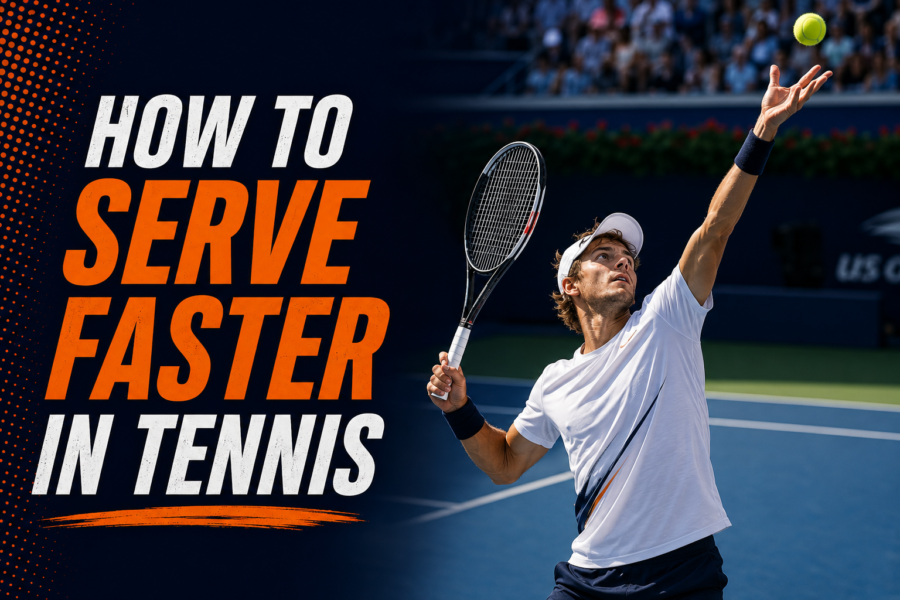
A faster tennis serve comes from increasing racket-head speed while directing that speed through a stable contact point. The most reliable path is not swinging the arm harder; it is improving the sequence from the ground through the legs, trunk, shoulder, arm, and racket, then training that sequence progressively.
Placement and first-serve percentage still matter. A serve that gains 10mph but rarely lands in or leaves you off balance may be less effective than a slower serve that starts the point on your terms.
What Actually Creates Serve Speed?
The serve is a whole-body movement. Force begins against the court and is transferred through a coordinated kinetic chain, with each segment contributing at the right time rather than every body part firing at once.
The general sequence is:
- Stable stance and controlled loading.
- Leg drive and upward movement.
- Hip and trunk rotation.
- Shoulder-over-shoulder action and racket drop.
- Rapid upward swing with internal shoulder rotation and forearm pronation.
- Contact at full comfortable reach.
- Balanced landing and deceleration.
Not every powerful server uses the same stance, knee bend or backswing. The goal is an efficient sequence that fits your mobility, strength and timing, not a perfect copy of one professional.
For a complete breakdown of grips, stances, tosses and serve types, start with the ultimate tennis serving guide. This article focuses specifically on adding speed.
Use the Continental Grip
The continental grip allows the racket to travel upward with its edge leading before the strings turn toward the ball. That movement supports pronation, spin and racket-head speed.
A forehand grip often makes the strings face the target too early. Beginners can guide the ball into the box that way, but the grip limits the throwing action and encourages a stiff push.
Hold the racket firmly enough that it stays stable without squeezing throughout the motion. Excess tension in the hand and forearm can restrict acceleration and make timing harder.
Build a Repeatable Toss
A fast swing cannot compensate for a toss that forces you to reach sideways, lean backward or wait under the ball. The toss must place the ball where your upward swing can reach it at full comfortable extension.
For a right-handed flat serve, a useful starting point is slightly into the court and a little to the right of the head. Left-handed players reverse the direction. The exact position depends on stance, height, spin and individual technique.
Release the ball smoothly from the fingers rather than flicking the wrist. A toss does not need to be extremely high; it needs enough height for you to complete the loading phase without rushing.
Toss Check
Place a marker roughly one racket length inside the baseline. Make ten tosses without swinging and let each ball fall.
The test is not whether every ball lands on one coin-sized spot. Look for a compact area that lets you reach up and move forward without chasing the toss.
Load Without Collapsing
Knee flexion and trunk rotation help store and transfer energy, but more bend is not automatically better. A deep position that you cannot reverse quickly may slow the motion or disturb the toss.
Keep pressure balanced through the feet and maintain enough trunk control that the chest does not collapse. As the tossing arm rises, the shoulders can tilt and the torso can coil relative to the hips.
The platform and pinpoint stances can both produce elite pace. Choose the stance that lets you load, drive upward and land consistently rather than changing only because another player appears more explosive.
Drive Up Before Reaching Forward
Powerful servers push against the court and reach upward to contact. The motion also carries the body forward, but chasing the ball horizontally too early can pull the contact point down and send the serve into the net.
Think of lifting the hitting side toward the ball. The legs extend, the trunk uncoils and the racket accelerates as one connected sequence.
The back leg may kick behind the body after contact to help counterbalance forward momentum. Do not force a decorative leg position; it should emerge from a balanced drive and landing.
Let the Racket Drop Happen Naturally
The racket head moves behind the back as the body drives upward. This position is often called the racket drop, but forcing the racket down with the arm can create tension and poor sequencing.
A relaxed elbow and shoulder allow the racket to lag as the upper arm changes direction. The drop is part of a continuous throwing action, not a pose to hold.
If your motion stops in the trophy position, simplify the backswing and practice a continuous rhythm. Speed depends on how smoothly segments accelerate in sequence.
Lead With the Edge and Pronate
As the racket travels toward the ball, its edge initially leads upward. The forearm then pronates and the shoulder rotates internally so the strings meet the ball and continue turning through the follow-through.
Pronation is not a last-second wrist snap. Forcing the wrist forward can reduce control and add stress without producing an efficient swing.
If this action still feels unfamiliar, the guide to common tennis serve mistakes explains the grip and swing-path problems that often interrupt it.
Contact at Full Comfortable Reach
A high contact point improves the angle into the service box and gives the racket more time to accelerate. Reach fully without locking the entire body or stretching so far that balance disappears.
For a flat first serve, contact is normally slightly in front. A kick serve uses a different toss and swing path, so do not force every serve through one identical contact point.
Keep the head relatively stable through contact. Looking down early often pulls the shoulders and racket path away from the ball.
Do Not Remove All Spin
A flat serve is fast, but it still needs enough rotation and a suitable trajectory to clear the net and land. Trying to strike a perfectly spin-free ball can make the serve unreliable.
Slice lets you move the returner off court or into the body, while topspin increases net clearance and changes the bounce. An effective first serve blends speed with the type of spin the target requires.
The slice serve guide and kick serve guide explain those paths separately.
Seven Drills to Increase Serve Speed
Warm up before high-intensity serving and stop if you feel sharp or increasing pain. These drills develop sequence and intent, but none guarantees more speed.
1. Shadow Serve With a Pause Check
Make a slow serve without a ball and pause briefly at three points: loaded position, contact reach and balanced landing. Use the pauses to check alignment, then repeat the motion continuously without stopping.
Perform two sets of five slow repetitions. The aim is awareness, not fatigue.
2. Ball Throw Over the Net
Stand in a serving position and throw a tennis ball overhand into the opposite service box. Allow the legs and trunk to contribute while the throwing arm stays loose.
Start at moderate intensity. If you cannot throw comfortably, address that limitation before trying to create a faster racket motion.
3. Half-Serve From a Short Backswing
Begin with the racket near a comfortable trophy position and serve at 50 to 70 percent effort. A shorter action removes some moving parts and helps you feel the upward edge-led swing.
Hit three sets of six balls, alternating targets. Increase the motion only when contact remains clean.
4. Serve From the Service Line
Move forward to the service line and hit controlled serves into the opposite box. The shorter distance encourages spin and a relaxed upward action instead of brute force.
Work back toward the baseline in stages while keeping the same rhythm. Do not hit full speed from the short position.
5. Three-Speed Serves
Hit one serve at roughly 60 percent, one at 75 percent and one at 90 percent. Repeat the sequence while aiming at the same large target.
The contrast teaches you what changes as effort rises. If the 90-percent swing becomes tense, return to the fastest level you can coordinate.
6. Target Plus Radar Drill
Divide the service box into a large target zone and measure speed only on balls that land in it. Record the median of several successful serves rather than celebrating one outlier.
This prevents radar training from rewarding misses. A phone app can provide rough feedback, but numbers from different devices are not directly comparable to tournament radar.
7. Serve Plus One
Serve to a chosen location, recover and play a planned first groundstroke. The drill links pace to match value and exposes serves that leave you falling away or slow to recover.
Use the return-of-serve guide to understand the patterns your opponent may use against each target.
Strength and Power Training for a Faster Serve
Gym work can increase the physical capacity behind the motion, but it cannot replace technical timing. Build general strength before adding high-speed throws or complex lifts.
A balanced program may include:
- Split squats or squats for lower-body strength.
- Hip hinges for posterior-chain strength.
- Calf raises and landing drills for ankle capacity.
- Rows and pull variations for upper-back strength.
- Pressing variations appropriate to shoulder tolerance.
- Anti-rotation and rotational trunk exercises.
- Medicine-ball throws after a suitable base is established.
- Rotator-cuff and scapular endurance work selected for the player.
Exercise choice, load and range should match your training age and health. A qualified coach or clinician can adapt the program if you have pain, previous injury or limited overhead mobility.
A Two-Day Serve-Speed Practice Plan
Leave enough recovery between high-intensity sessions. Match play and other overhead training also count toward total load.
Session A: Technique and Targets
- Dynamic whole-body warm-up: 8–10 minutes.
- Shadow serves: 2 × 5.
- Ball throws: 2 × 6 per side at moderate effort.
- Half-serves: 3 × 6.
- Full serves to two targets: 4 × 5.
- Serve plus one: 10 points.
Session B: Controlled Speed
- Dynamic whole-body warm-up: 8–10 minutes.
- Short-court progression: 12–18 serves.
- Three-speed sequences: 5 rounds.
- Target plus radar: 3 × 6 successful serves.
- Spin serves at lower intensity: 2 × 6 each direction.
- Easy cooldown and training notes.
The numbers are examples, not a universal prescription. A junior, returning player or athlete who already serves heavily in matches may need much less volume.
How to Measure Progress
Track more than maximum speed. Useful measures include:
- Median speed of successful first serves.
- Percentage landing in a defined target.
- First-serve percentage during practice sets.
- Aces and unreturned serves.
- Double faults after a high-speed first serve.
- Quality of the first shot after the return.
- Pain, stiffness and recovery the next day.
Test under similar conditions with the same balls and device. Temperature, altitude, ball wear and measurement position can all change the reading.
The records in the fastest tennis serves ever are interesting benchmarks, but they are not appropriate goals for most players.
Common Mistakes That Limit Serve Speed
Squeezing the Racket
Constant grip tension can restrict the free acceleration of the arm and racket. Use enough pressure for control, then allow the hand and forearm to remain responsive.
Chasing a Bigger Knee Bend
The legs contribute only if their drive is timed with the rest of the motion. An exaggerated bend can make the toss inconsistent and leave the player late.
Tossing Too Far Forward
A forward toss can support court penetration, but too much forces the player to chase the ball and lose upward reach. Move it only as far as you can contact in balance.
Forcing the Wrist
The wrist participates in a high-speed chain, but consciously snapping it is not a reliable shortcut. Improve the edge-led swing, shoulder rotation and pronation instead.
Serving Only at Maximum Effort
All-out repetitions can hide technical errors and raise fatigue quickly. Use varied intensities and finish before coordination deteriorates.
Ignoring Placement
A body serve at 100mph may be more disruptive than a predictable 110mph serve through the middle. Measure how the return changes, not only the display.
Serve Speed and Injury Risk
Serving places substantial repeated load on the shoulder, elbow, wrist, trunk and lower body. Research links injury risk with several factors, including strength, range of motion and weekly tennis volume, but no single technique cue can guarantee prevention.
Increase high-intensity volume gradually and avoid testing maximum speed when the arm is fatigued. Persistent pain, loss of strength, night pain or symptoms that worsen across sessions deserve assessment by a qualified healthcare professional.
A proper warm-up can prepare you to serve, but it does not make an excessive workload safe. Do not use painkillers or technical compensations simply to keep serving through symptoms.
How Fast Should Your Serve Be?
There is no required number for recreational tennis. A useful speed is one you can direct, repeat and support with a dependable second serve.
Compare yourself with a consistent personal baseline rather than a professional peak. The average serve-speed guide provides context across playing levels.
Faster Serve FAQ
Can strength training make my serve faster?
It can improve force and power capacity, especially when combined with sound technique and suitable throwing or serving practice. More strength does not automatically become racket speed unless the movement remains coordinated.
Should I jump higher when I serve?
The feet may leave the court as a result of leg drive, but height in the air is not the goal. A well-timed upward push and balanced landing matter more than an exaggerated jump.
Does a heavier racket create a faster serve?
A heavier racket may deliver more momentum if you can accelerate it with the same timing. If the added mass slows the swing or makes repeated serving tiring, ball speed and control may decrease.
Is a flat serve always the fastest?
It normally produces the highest radar reading because more of the swing is directed through the ball. Slice and kick serves trade some linear speed for spin, shape and margin.
How often should I practice serving?
Frequency depends on age, training history, match schedule and total volume. Short, high-quality sessions with recovery are usually more useful than occasional sessions of hundreds of fatigued serves.