
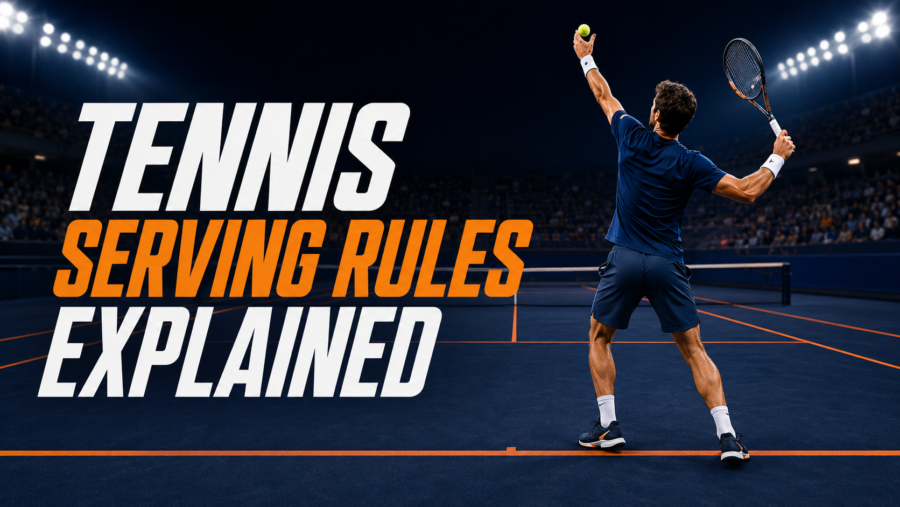
A legal tennis serve starts with the server at rest behind the baseline, between the imaginary extensions of the center mark and the correct sideline. The server releases the ball and strikes it before it touches the ground, sending it over the net into the diagonally opposite service box.
Each point normally allows a first serve and, after one fault, a second serve. A second consecutive fault loses the point. This guide follows the 2026 Rules of Tennis and focuses on legality, faults, lets and serving order rather than technique.
Tennis Serving Rules at a Glance
| Situation | Ruling |
|---|---|
| Server starts the game | From the right half of the court |
| Service direction | Diagonally into the opposite service box |
| Ball touches a service-box line | In |
| First serve misses | Fault; server receives a second serve |
| Second serve misses | Double fault; receiver wins the point |
| Good serve touches net, strap or band first | Service let; replay that serve |
| Server touches baseline during service motion | Foot fault |
| Server catches an abandoned toss | No fault |
| Receiver attempts a return | Receiver is considered ready |
| Good serve hits receiver before bouncing | Server wins the point unless it is a service let |
The broader point, game and set framework appears in Tennis Rules Explained: The Ultimate Guide. The sections below isolate the service rules that decide how each point begins.
Where the Server Must Stand
Immediately before starting the service motion, the server must be at rest with both feet behind the baseline. Both feet must also be within the imaginary extensions of the center mark and the relevant sideline.
The relevant sideline changes by format:
- In singles, it is the singles sideline.
- In doubles, it is the doubles sideline.
A singles server cannot stand in the doubles alley. A doubles server may stand behind the part of the baseline between the singles and doubles sidelines, provided the server remains inside the imaginary extension of the doubles sideline.
The server starts every standard game from the right half of the court, commonly called the deuce side. After each point, the server alternates between the right and left halves.
How the Ball Must Be Served
The server releases the ball by hand in any direction and hits it with the racket before it touches the ground. A player able to use only one arm may use the racket to release the ball.
The rules do not require an overarm motion. An underarm serve is legal if the player follows the same position, release, foot-fault and destination rules. The ball cannot bounce before an ordinary able-bodied serve is struck.
The service motion is completed when the racket hits or misses the ball. If the player tosses the ball but decides not to attempt a hit, the player may catch it with a hand or racket or allow it to bounce without receiving a fault.
This page does not teach grip, toss height, loading or swing mechanics. Players looking for that instruction should continue to How To Serve In Tennis.
Which Service Box Is Correct?
The serve must travel over the net and land in the service court diagonally opposite the server. A serve from the right half goes into the receiver’s right service court from the receiver’s perspective, which is diagonally across the net.
Court lines are part of the court they bound. A serve touching the service line or center service line is in, unless another event such as a service let applies.
The receiver may stand anywhere on the receiver’s side of the net, inside or outside the court lines. The receiving position does not change the service box the server must target.
First Serves, Second Serves and Double Faults
If the first service is a fault, the server serves again without delay from behind the same half of the court. The exception is when the first serve came from the wrong half; once corrected, the next serve comes from the half required by the score.
Two consecutive service faults lose the point. This is the double fault commonly shown in match statistics.
A service let does not use up that serve. If a first serve is a let, the server repeats a first serve. If a second serve is a let, the server repeats the second serve because the previous fault is not canceled.
The point-game-set scoring structure is explained separately in How The Scoring System Works In Tennis?.
What Counts as a Service Fault?
Under the 2026 rules, the service is a fault when any of the following occurs:
- The server breaks the service-position, serving or foot-fault rules.
- The server tries to hit the tossed ball and misses it.
- The served ball touches a permanent fixture, singles stick or net post before hitting the ground.
- The served ball touches the server, the server’s partner or anything either person is wearing or carrying.
- The serve does not land in the correct service box, unless a let requires it to be replayed.
Trying to hit the ball is the key distinction on an abandoned toss. Catching or allowing the toss to bounce is not a fault when no attempt to strike it is made.
Foot-Fault Rules
During the service motion, the server may not:
- Change position by walking or running, although slight foot movements are permitted.
- Touch the baseline or the court with either foot.
- Touch the area outside the imaginary extension of the relevant sideline with either foot.
- Touch the imaginary extension of the center mark with either foot.
The restriction lasts through the service motion. A foot may not start legally and then touch the baseline before contact.
One or both feet may be off the ground when the ball is struck. Jumping upward is not itself a foot fault, provided the server met the position rules and did not touch a prohibited area during the motion.
These details are among the lesser-known applications collected in 14 Secret Tennis Rules Most Players Don’t Know.
Service Lets
A service is a let in either of these situations:
- The served ball touches the net, strap or band and is otherwise good.
- The ball is served when the receiver is not ready.
A let also applies when the serve touches the net, strap or band and then touches the receiver, the receiver’s partner or something either person wears or carries before the ball reaches the ground.
Only that service is replayed. A previous fault remains in place, which is why a let on second serve does not restore a first serve.
The official rules also recognize an approved No-Let alternative. If the sanctioning body announces that procedure, a serve touching the net, strap or band can remain in play. Players should check the event format instead of assuming standard let rules apply everywhere.
When the Receiver Is Ready
The server must not serve until the receiver is ready. The receiver must, in turn, play to the server’s reasonable pace and become ready within a reasonable time.
If the receiver attempts to return the serve, the receiver is treated as ready. A player cannot swing at the ball and then claim unreadiness after seeing the result.
When it is demonstrated that the receiver was not ready, the service cannot be called a fault. It is replayed as a service let.
What If the Serve Hits the Receiver?
If a served ball hits the receiver or, in doubles, the receiver’s partner before touching the ground, the server wins the point. It does not matter that the ball appeared likely to land outside the service box.
The exception is a service let. If the ball first touches the net, strap or band and then hits the receiver or partner before bouncing, the serve is replayed.
This is why a receiver should allow a clearly long or wide serve to bounce rather than catching it or blocking it with the body.
Serving Order in Singles
The player who serves the first game becomes the receiver for the next game. The players then alternate service games until the set ends.
The choice of first server, first receiver or starting end is determined by a toss before the warm-up. The toss winner makes one permitted choice, and the opponent makes the remaining choice.
At the start of a new set, the normal alternating order continues from the previous set. The player or team that received in the final game of the previous set serves the first game of the next one, subject to the match’s established order.
Serving and Receiving Order in Doubles
In doubles, the team serving the first game of a set decides which partner serves that game. The opposing team selects its first server for the second game.
The first server’s partner serves the third game, and the second server’s partner serves the fourth. That four-player rotation continues until the end of the set.
| Game in rotation | Server |
|---|---|
| 1 | Team A, chosen first server |
| 2 | Team B, chosen first server |
| 3 | Team A, other partner |
| 4 | Team B, other partner |
| 5 | Rotation returns to the first server |
The receiving team also chooses which partner receives the first point of its first receiving game. The partners alternate receiving points for the rest of that game and retain that receiving order for the set.
After the return is made, either partner may hit the next ball. The server’s partner and receiver’s partner may stand anywhere on their own side of the net, inside or outside the court, provided they do not hinder an opponent.
Serving in a Tie-Break
The player or team whose turn it is serves the first point from the right half. The opponent serves the next two points, after which each player or team serves two consecutive points in alternating turns.
In doubles, the established service rotation within each team continues. The server still alternates between the right and left halves after every point.
Tie-break formats, end changes and match tie-break variations belong to the dedicated How Tennis Tie-Breaks Work? guide. The key service rule here is one point for the opening server, followed by two-point service turns.
What Happens When the Wrong Player or Side Serves?
Points already completed normally stand when a serving-order error is discovered. The correction depends on the error.
Serving From the Wrong Half
Correct the side as soon as the error is discovered and continue from the half required by the score. A fault served before discovery stands.
Serving Out of Turn in a Standard Game
The player originally due to serve takes over as soon as the error is discovered. If the entire game finished before discovery, the altered order remains in place.
A fault served by the opponents before discovery does not stand. In doubles, however, a fault served by the wrong partner of the same team does stand.
Serving Out of Turn in a Tie-Break
If the error is discovered after an even number of points, correct the order immediately. If discovered after an odd number, the altered order remains.
The same fault distinction applies: an opponent’s fault before discovery does not stand, while a fault by the wrong partner of the same doubles team does.
Wheelchair Tennis Service Adaptations
Wheelchair tennis follows the main Rules of Tennis with defined exceptions. Immediately before serving, the wheelchair server must be stationary and is then allowed one push before striking the ball.
Throughout the delivery, no wheel may touch an area other than the legal space behind the baseline and inside the imaginary extensions of the center mark and sideline.
If conventional service methods are physically impossible for a quad player, the player or another person may drop the ball and allow it to bounce before it is struck. The same method must then be used for the entire match.
The two-bounce rule applies during wheelchair points: the wheelchair player must return the ball before a third bounce, and the second bounce may be inside or outside the court boundaries. That adaptation does not remove the service-position rules above.
Service Fault or Code Violation?
A fault is a failed attempt under the service rules. A time violation, audible obscenity, ball abuse or other conduct issue is handled under tournament procedures and codes, not recorded as an ordinary service fault.
The Rules of Tennis allow a maximum of 25 seconds between points, although event procedures govern timing and enforcement. Tennis Code Violations Explained: Warnings, Fines and Defaults covers that separate disciplinary process.
Final Summary
A legal serve begins from the correct half behind the baseline, stays within the center-mark and sideline extensions, and lands diagonally in the opposite service box. The server alternates sides after every point and normally receives two attempts.
The most common disputes are resolved by separating faults from lets: a missed box, attempted miss or foot fault uses an attempt, while an otherwise good net-cord serve or a serve delivered to an unready receiver is replayed. Singles and doubles use the same delivery rules, but doubles adds a fixed four-player service rotation for each set.
Frequently Asked Questions
Can you serve underarm in tennis?
Yes. The rules require legal position, release, contact before the bounce and delivery into the correct service box, but they do not require an overarm swing.
Can you bounce the toss and then serve it?
Not in an ordinary able-bodied serve. The ball must be struck before it touches the ground. A defined quad wheelchair adaptation may permit a dropped ball to bounce.
Is stepping on the baseline a foot fault?
Yes. Touching the baseline or the court with either foot during the service motion is a foot fault.
Is a serve on the service line in?
Yes. A ball touching a line is treated as touching the court bounded by that line.
Does a net-cord serve always get replayed?
Under standard rules, it is replayed only if it is otherwise good or meets another service-let condition. A serve that touches the net and then lands outside the correct box is a fault. An announced No-Let format changes the procedure.
Do you get another first serve after a second-serve let?
No. The second serve is replayed. A service let does not cancel the first fault.
Can doubles partners change serving order during a set?
No. The rotation chosen at the start of the set continues through that set. A new order can be selected for the next set.