
A tennis grip is the position of your hand around the racket handle. It is not the same as grip size, and there is no single hand position that works best for every shot.
Most players change grips several times during a point. The Continental grip is the standard starting point for serves, volleys, overheads and slices. Eastern, Semi-Western and Western are forehand grips with different contact-height and spin trade-offs. Backhands use either a one-handed backhand grip or a two-hand combination.
This guide explains how to find each grip using the racket handle’s eight bevels, including the correct mirrored positions for left-handed players.
Tennis Grips at a Glance
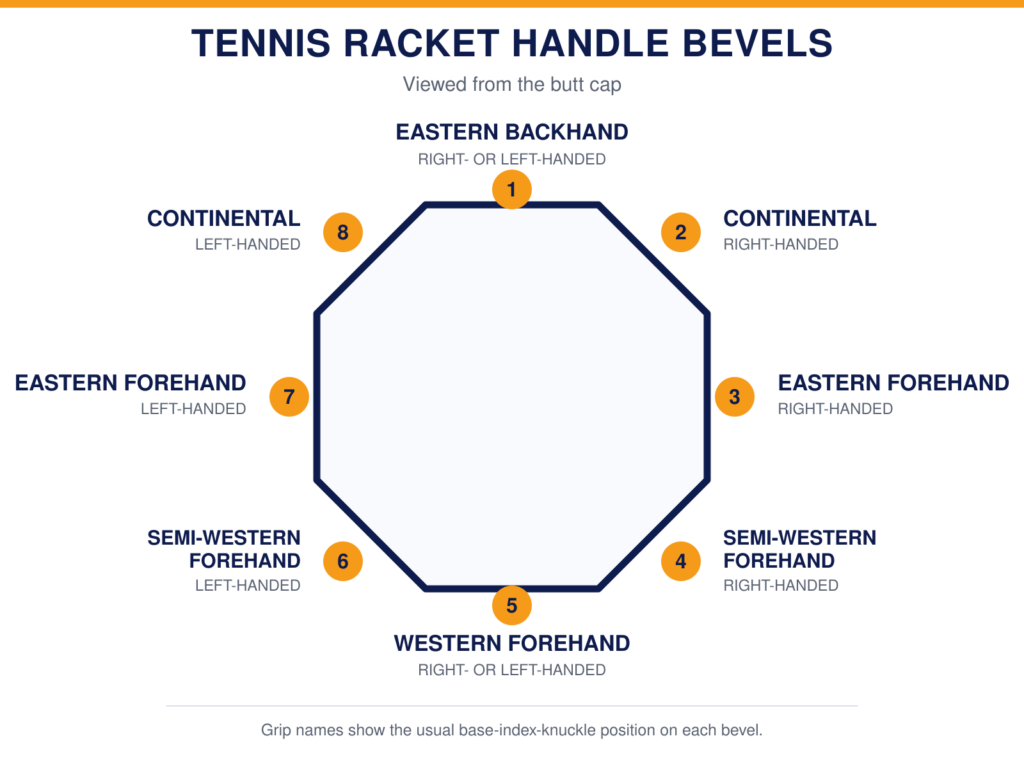
The bevel numbers below use one fixed orientation: look at the butt cap with the racket head pointing away from you and the strings vertical. Bevel 1 is the top flat surface, and the numbers continue clockwise.
| Shot or grip | Right-handed position | Left-handed position | Best suited to | Main trade-off |
|---|---|---|---|---|
| Continental | Bevel 2 | Bevel 8 | Serves, volleys, overheads, backhand slice and touch shots | Not well suited to a modern topspin forehand |
| Eastern forehand | Bevel 3 | Bevel 7 | Direct forehand drives, lower-to-medium contact and all-court play | Less natural on very high balls than more closed grips |
| Semi-Western forehand | Bevel 4 | Bevel 6 | Topspin forehands and medium-to-high contact | Low, skidding balls require more adjustment |
| Western forehand | Bevel 5 | Bevel 5 | Heavy topspin and high contact | Difficult on low balls and a long change to Continental |
| Eastern backhand | Bevel 1 | Bevel 1 | One-handed topspin or drive backhand | High balls demand early preparation and precise spacing |
| Semi-Western backhand | Bevel 8 | Bevel 2 | Advanced one-handed backhand with more topspin | Low balls and slices are more difficult |
| Two-handed backhand | Bottom hand near Continental; top hand in an Eastern-to-Semi-Western forehand position | Mirrored combination | Stable drives and returns | Less reach than a one-handed stroke |
These positions are reference points, not rigid laws. Many players use a modified grip with the index knuckle or heel pad close to the edge between two bevels.
How the Eight Bevels Work
A tennis racket handle is octagonal. Its eight flat and angled surfaces are called bevels, and they provide a repeatable way to describe hand position.
To identify them:
- Hold the racket in front of you with its head pointing away and the strings vertical.
- Look directly at the butt cap.
- Treat the top flat surface as bevel 1.
- Count clockwise through bevels 2 to 8.
Use the base knuckle of your index finger as the main landmark. The heel pad, the fleshy area at the base of your palm, should normally support the same general position. If the knuckle is on one bevel while the heel pad has rotated much farther around the handle, you have created a modified grip and may get a different racket-face angle than expected.
Why Some Left-Handed Grip Charts Use Different Numbers
This guide keeps the physical bevel numbers fixed and mirrors the hand position. That is why a right-handed Continental grip is on bevel 2 and a left-handed Continental is on bevel 8.
Some coaching diagrams reverse the counting direction for left-handers. In those diagrams, both players may be told to use “bevel 2,” even though their hands occupy mirrored physical positions. The instructions can both be correct; the numbering systems are different. The fixed map in this article matches the right- and left-handed positions described in HEAD’s grip guide.
How to Hold a Tennis Racket Correctly
Finding the correct bevel is only part of the grip. Hand height, finger spacing and pressure also affect control.
Place the Hand Near the Butt Cap
For most strokes, the little finger should sit just above the butt-cap flare. Holding much higher shortens the effective racket and can restrict the swing. Letting part of the hand hang below the handle can reduce security.
The upper hand of a two-handed backhand should sit directly above the lower hand. Keep the hands together without overlapping them or leaving a large gap.
Separate the Index Finger Slightly
Allow a small space between the index finger and the middle finger, creating a gentle trigger shape. The fingers should remain comfortable rather than being forced into an exaggerated position.
Use Controlled, Variable Grip Pressure
Hold firmly enough that the racket remains secure, but do not squeeze at maximum effort throughout the swing. Excess tension can slow grip changes and reduce touch. Pressure naturally increases when the racket must be stabilized, such as on a fast return or firm volley, and relaxes again between shots.
The aim is not one permanent pressure number. It is a secure racket with a hand and forearm that can still move freely.
Continental Grip
For a right-handed Continental grip, place the base index knuckle and heel pad around bevel 2. A left-handed player mirrors the position on bevel 8.
The Continental is also called the hammer grip or chopper grip because the racket is held as if its edge were the head of a hammer. “Handshake grip” is better reserved for the Eastern forehand.
What Is the Continental Grip Used For?
Continental is the standard grip for:
- Flat, slice and kick serves
- Forehand and backhand volleys
- Overheads
- Backhand slices and chips
- Drop shots
- Low defensive pickups
- Some blocked returns
USTA coaching guidance recommends Continental for the serve, overhead and both volleys. At the net, using the same basic grip on both sides allows a player to react without rotating through several bevels.
Continental also supports the edge-leading positions and forearm rotation used in an effective service motion. Players learning the serve should establish this grip before chasing more pace or spin. The complete sequence is covered in how to serve in tennis.
Continental Grip Limitations
Continental is not the normal choice for a modern topspin forehand. Its comparatively open racket-face relationship makes it harder to swing aggressively upward while keeping the ball down.
It is also too broad to say that Continental is “the backhand grip.” It is widely used for a backhand slice, but a one-handed topspin backhand normally uses Eastern backhand, while a two-handed backhand combines two positions.
Avoid the Frying-Pan Serve Grip
A common beginner error is serving with a forehand grip so the strings face upward like a frying pan. It may make gentle serves feel easier initially, but it restricts the edge-first path and spin options available from Continental. The USTA’s Continental-grip lesson uses the racket edge as a simple learning cue.
Eastern Forehand Grip
Place the right-handed base index knuckle and heel pad around bevel 3. A left-handed player uses the mirrored position on bevel 7.
The Eastern forehand is the true “shake hands with the racket” position. The palm sits more directly behind the handle than it does in Continental, helping the player present a relatively neutral stringbed at contact.
Eastern Forehand Strengths
Eastern works well for:
- Lower-to-medium-height balls
- Direct drives and flatter attacking shots
- Moderate-topspin rally balls
- Returns and approach shots
- All-court players who move forward regularly
- Beginners learning a clear contact point
It is wrong to describe Eastern as a flat-only grip. Topspin still comes from the racket’s upward path, speed and face orientation through contact. Eastern simply provides less built-in face closure than Semi-Western or Western.
For the complete movement beyond hand position, read the guide to forehand technique in tennis.
Eastern Forehand Trade-Offs
High, heavy balls can be more demanding because the player must create enough upward action without opening the racket face. A player who regularly contacts the ball around shoulder height may find a more closed grip easier to manage.
Eastern also requires a change to Continental for serves, overheads and most volleys. That is normal; learning efficient grip changes is more useful than trying to use one grip for every shot.
Semi-Western Forehand Grip
For a right-handed Semi-Western forehand, place the base index knuckle and heel pad around bevel 4. A left-handed player uses bevel 6.
This position rotates the hand farther under the handle and creates a more closed racket-face relationship than Eastern. It pairs naturally with an upward swing and a contact point in front of the body.
Semi-Western Strengths
Semi-Western offers a useful balance of topspin and versatility. It can help a player accelerate confidently while using spin and net clearance to create margin over the net.
It is particularly comfortable on medium-to-high contact and is common among baseline players. It can still produce a penetrating, lower trajectory when the swing, contact and racket-face angle are adjusted correctly.
Semi-Western Trade-Offs
Low, fast and skidding balls are less natural because the closed face must be taken below the ball without scooping or excessive wrist manipulation. Good knee bend, spacing and early preparation become important.
The change from Semi-Western to Continental is also larger than the change from Eastern, which matters when moving quickly from the baseline to the net.
If these are the two positions you are considering, the dedicated Eastern vs Semi-Western forehand grip comparison goes into more detail without treating either as universally better.
Western Forehand Grip
The Western forehand places the base index knuckle and heel pad around the bottom bevel, bevel 5. Because bevel 5 sits opposite bevel 1, it is the same fixed reference for right- and left-handed players.
Western is a legitimate advanced grip, not an incorrect or unusable one. It creates the most closed racket-face relationship among the standard forehand grips and normally works with high contact and a steep upward swing.
Western Grip Strengths
Western can support:
- Heavy topspin
- High net clearance
- High-bouncing balls
- Short angles that dip into the court
- Baseline patterns built around depth and a jumping bounce
The grip can allow an experienced player to swing quickly while using spin to bring the ball down. The grip itself does not create spin; racket-head speed, swing path and clean contact remain essential.
Western Grip Trade-Offs
Low and skidding balls are the main challenge. The player needs enough time, leg bend and space to lower the racket and reach an appropriate contact point.
Western also requires the largest change to reach Continental for a serve or volley. It may be unnecessarily specialized for a new player who is still learning spacing and basic racket-face control, but it should not be dismissed for a player whose technique and preferred contact height suit it.
Backhand Grips
“Backhand grip” does not describe one universal position. The correct setup depends on whether the player hits with one hand or two and whether the shot is a topspin drive, slice, volley or defensive block.
Eastern Backhand Grip for a One-Handed Backhand
The Eastern backhand is the standard reference for a one-handed topspin or drive backhand. Place the base index knuckle and heel pad around bevel 1. Because bevel 1 is the top surface, the fixed number is the same for right- and left-handed players.
This position puts the hand behind the handle from the backhand side and helps support a stable stringbed at contact. The ball is normally struck clearly in front of the body with the hitting arm extended.
Eastern Backhand Strengths and Trade-Offs
Eastern backhand can produce a penetrating drive and meaningful topspin. It is a versatile starting point for a one-handed player and sits only one bevel away from Continental on either side of the handle.
Its main challenges are high balls, late preparation and poor spacing. The player must turn early, create room for the swing and contact the ball in front. A one-handed slice normally changes to Continental rather than forcing the Eastern position to perform every backhand task.
The full one- and two-handed stroke structures are covered in backhand grip and technique.
Semi-Western Backhand Grip
The name for this advanced one-handed position varies between coaching systems. In the fixed map used here, Semi-Western backhand means bevel 8 for a right-handed player and bevel 2 for a left-handed player. Some coaches call the same general position an extreme Eastern backhand.
It closes the racket face more than Eastern backhand and can make higher contact and heavy topspin easier for a player with suitable timing and strength. The trade-off is that low balls become more difficult, contact must be farther forward and a larger change is needed for slices and volleys.
It is an option, not the default grip every one-handed player should learn.
Continental Grip for a Backhand Slice
A one-handed backhand slice is commonly played with Continental. The neutral position helps the player set a slightly open racket face and move through the ball with control.
Do not confuse the slice with a one-handed topspin drive. Although both are hit with one hand, their racket path, contact and usual grip are different.
Two-Handed Backhand Grip
A two-handed backhand uses two grips rather than one. A common teaching setup is:
For a right-handed player:
- Bottom, dominant right hand: Continental on bevel 2, sometimes shifted slightly toward Eastern backhand
- Top, non-dominant left hand: a left-handed Eastern-to-Semi-Western forehand position on bevel 7 to 6
For a left-handed player:
- Bottom, dominant left hand: Continental on bevel 8, sometimes shifted slightly toward Eastern backhand
- Top, non-dominant right hand: a right-handed Eastern-to-Semi-Western forehand position on bevel 3 to 4
Keep the hands close together, with the non-dominant hand immediately above the dominant hand. Both hands coordinate the stroke. The upper, non-dominant hand often contributes substantially to acceleration and racket-face control, but the balance between the hands varies by player.
This combination is a reliable starting point, not a rule without exceptions. An ITF Coaching Review analysis documented multiple grip combinations among high-level two-handed backhands.
Two hands add stability and can help on returns and higher balls, but they reduce reach. Players stretched wide often release the upper hand and use a one-handed Continental slice. If you are choosing a stroke, compare the practical differences between a one-handed and two-handed backhand.
How to Change Grips During a Point
Grip changes should happen during preparation, before the forward swing begins.
Support the racket throat with the non-dominant hand in the ready position. As you recognize the incoming ball, relax the hitting hand slightly and use the non-dominant hand to rotate the racket into the required position during the unit turn. Then secure the grip before the racket accelerates forward.
There is no mandatory baseline ready-position grip. Some players wait in their forehand grip, while others use a more neutral hand position. What matters is that the non-dominant hand helps organize the racket early.
At the net, staying in Continental minimizes unnecessary movement because the same basic grip works for forehand and backhand volleys.
Simple Grip-Change Drill
Try this without a ball:
- Begin in a balanced ready position with the non-dominant hand on the racket throat.
- Turn to Eastern or Semi-Western forehand, make a slow shadow swing and recover.
- Turn to your one- or two-handed backhand setup, make a slow shadow swing and recover.
- Change to Continental and rehearse a serve, volley or slice position.
- Repeat the sequence slowly until you can find each grip without looking at the handle.
Accuracy matters more than speed. Once the changes are reliable, add movement and gentle feeds.
Which Forehand Grip Should You Choose?
| If you prefer… | Useful starting option | Why |
| Direct drives and lower contact | Eastern | Relatively neutral face and straightforward extension |
| A balance of topspin and versatility | Semi-Western | Comfortable for many modern rally heights |
| Heavy topspin and high contact | Western | Supports a steep upward path and closed face |
| Touch, slice or emergency defense | Continental | Adaptable face, but not a normal topspin-forehand grip |
No grip is automatically best. As Tennis Australia explains, grips are not one-size-fits-all. The choice should work with the player’s contact height, swing, physical comfort, tactical style and ability to control the racket face.
A grip also exists on a continuum. A player may sit between Eastern and Semi-Western without needing to force the hand onto the exact center of one bevel.
Which Grips Should a Beginner Learn First?
A practical beginner foundation is:
- Continental for serves, volleys, overheads and backhand slices
- Eastern or a mild Semi-Western for the forehand
- Eastern backhand for a one-handed topspin backhand
- Continental bottom hand with an Eastern-to-Semi-Western top hand for a two-handed backhand
Eastern forehand is often accessible because it presents a clear contact point and handles lower balls well. Semi-Western can also be an effective starting grip when the player naturally uses more upward swing and regularly receives medium-to-high balls.
The best decision is the one that lets the beginner contact the ball in front, control its height and change comfortably to the other grips the game requires.
Grip Type, Grip Size, Replacement Grip and Overgrip
These terms describe different things:
- Grip type is the hand position used for a shot: Continental, Eastern, Semi-Western or Western.
- Grip size is the circumference of the handle, commonly labeled L0 to L5 or measured in inches.
- Replacement grip is the thicker base wrap installed directly on the handle.
- Overgrip is a thin outer wrap placed over the replacement grip for surface feel, moisture management and protection.
An L2 or 4 1/4in handle can be held with any stroke grip. Changing handle size does not turn an Eastern grip into a Semi-Western grip.
If you are choosing handle circumference, use the tennis grip size calculator. If the surface is worn or slippery, follow the guide to change your tennis overgrip.
Common Tennis Grip Mistakes
Using One Grip for Every Shot
No standard grip performs every tennis task equally well. Learn the required changes rather than asking one hand position to cover every forehand, backhand, serve and volley.
Confusing Eastern Forehand With Eastern Backhand
They share the Eastern name but occupy different bevels. Under the fixed map, Eastern forehand is bevel 3 for a right hand and bevel 7 for a left hand. Eastern backhand is bevel 1 for either hand.
Calling Eastern Forehand the Frying-Pan Grip
Eastern forehand is a valid groundstroke grip. “Frying-pan grip” usually describes the strings-facing-up forehand-style hold that causes problems on a serve.
Moving Only the Index Knuckle
The heel pad must support the intended position. Twisting one finger while leaving the rest of the palm in the old grip can produce an unstable hybrid.
Holding Too Tightly
Continuous maximum pressure makes grip changes and touch more difficult. Secure the racket when required, then release unnecessary tension between shots.
Changing the Grip Too Late
Do not wait until the racket starts forward. Use the non-dominant hand to set the grip during the unit turn.
Copying a Professional’s Grip Without Its Contact Point
Professional grips are often modified positions between textbook labels. Their hand placement also works with years of footwork, spacing and swing development. Copying a bevel without understanding the associated contact height is unlikely to reproduce the same shot.
Final Thoughts
Tennis grips are tools for controlling the racket face across different shots and contact heights. Continental forms the foundation for serves and net play. Eastern and Semi-Western cover the widest range of forehands, Western offers a more specialized heavy-topspin option, and backhands require either a dedicated one-handed position or a coordinated two-hand combination.
Learn the bevel references, but judge the result on court. The right grip should help you create a repeatable racket face, contact the ball in a suitable position and change smoothly to the next shot.
Frequently Asked Questions
What is the most versatile tennis grip?
Continental is the most versatile for serves, volleys, overheads, slices, drop shots and defensive pickups. It is not normally the best choice for a modern topspin forehand or one-handed topspin backhand.
What is the best forehand grip for a beginner?
Eastern and a mild Semi-Western are both practical starting points. Eastern offers a direct contact reference and handles lower balls well; Semi-Western provides more natural support for topspin and medium-to-high contact.
What grip should I use for a tennis serve?
Continental is the standard grip for flat, slice and kick serves. Advanced players may make small adjustments, but Continental is the clearest foundation for learning a complete service motion.
Can I hit topspin with an Eastern forehand grip?
Yes. Topspin depends on racket-head speed, an upward swing path and racket-face orientation through contact. Semi-Western and Western make a more closed face easier to maintain on steeper upward swings, but Eastern is not limited to flat shots.
Is the Western forehand grip wrong?
No. Western is an advanced grip that can produce heavy topspin and handle high contact well. Its main limitations are low balls, flatter trajectories and the larger change required to reach Continental.
What grip should I use for a one-handed backhand?
Eastern backhand on bevel 1 is the standard starting position for a one-handed topspin or drive backhand. Continental is more common for a dedicated backhand slice.
What grips are used for a two-handed backhand?
The dominant bottom hand commonly sits near Continental. The non-dominant top hand commonly uses its Eastern-to-Semi-Western forehand position. Exact combinations vary, so both hands should work together without fighting over the racket-face angle.
Do left-handed players use different tennis grips?
Left-handed players use the same grip families but mirror their physical positions around the handle. Under the fixed clockwise numbering in this guide, Continental is bevel 8, Eastern forehand bevel 7, Semi-Western forehand bevel 6 and Western bevel 5 for a left hand.
How tight should I hold a tennis racket?
Hold securely enough to control the frame without squeezing at maximum effort throughout the swing. Grip pressure changes with the shot and usually firms around contact before relaxing again.