
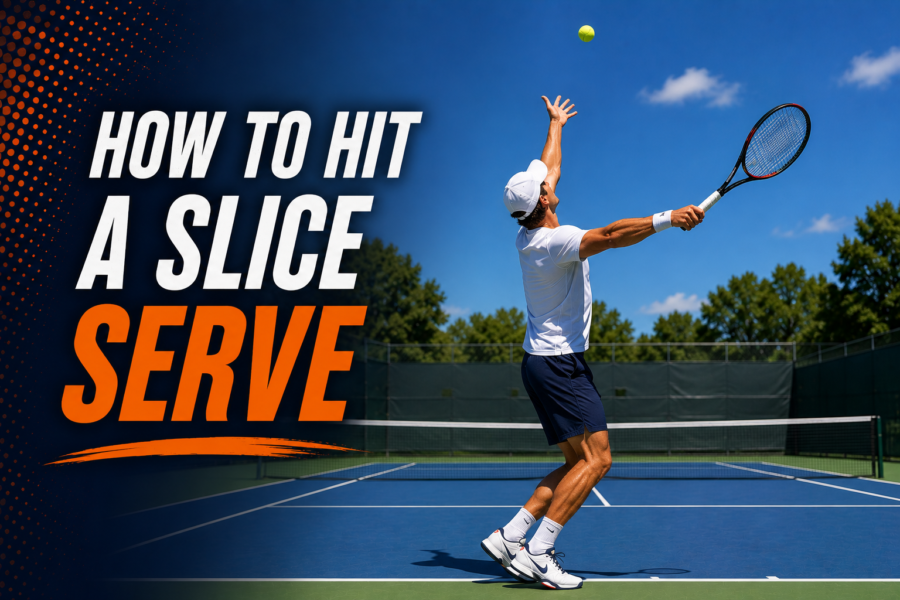
The slice serve is a tennis serve that uses sidespin to make the ball curve through the air and move sideways after it bounces. It is usually slower than a flat serve, but its movement makes it difficult for opponents to predict, reach, and return cleanly.
For right-handed players, the slice serve curves from right to left. It can pull an opponent wide when served from the deuce court and can also move away from a right-handed returner when directed down the T from the ad court. Left-handed players create the opposite movement, which can be especially effective because opponents face left-handed serves less frequently.
A strong slice serve is not created by simply cutting around the side of the ball. It requires the correct grip, a controlled toss, upward racket acceleration, contact on the outside of the ball, and a relaxed follow-through.
For a complete serve fix check out The Tennis Serve Fix.
Slice Serve Grip
The continental grip is the correct grip for the slice serve. It is also commonly used for the flat serve, kick serve, volleys, overheads, and slices.
To find the continental grip, hold the racket as though you were shaking hands with it or holding a hammer. The base knuckle of your index finger should rest on bevel two for a right-handed player, with the positioning mirrored for a left-handed player.
This grip allows the racket to approach the ball on edge before the strings open naturally into contact. It also gives the forearm enough freedom to rotate through the serve while creating spin.
Using a forehand grip makes it difficult to generate proper slice because the racket face opens too early. It may feel easier at first, but it usually limits spin, disguise, control, and long-term serve development.
Starting Position
Begin in a balanced serving stance behind the baseline. Right-handed players normally place the left foot closer to the baseline and the right foot behind it. Left-handed players use the opposite arrangement.
Your front foot should point diagonally toward the net post, while the back foot remains roughly parallel to the baseline. Keep your knees relaxed, hold the racket comfortably, and avoid squeezing the handle tightly.
The starting position for a slice serve does not need to look different from your regular serve. Keeping the same setup helps disguise your intention and makes it more difficult for the returner to anticipate the serve.
Ball Toss
The toss for a slice serve is usually placed slightly farther to the side than the toss for a flat serve. A right-handed player may release the ball slightly to the right, while a left-handed player may release it slightly to the left.
The movement should be subtle. Tossing the ball too far sideways can pull your body off balance, reduce upward extension, and make the direction of the serve obvious.
The ball should still be high enough and slightly inside the court so you can reach upward and make contact at full extension. A low toss forces the player to rush, while a toss that drifts behind the head makes it difficult to create clean sidespin.
Advanced players often use almost the same toss for several serve types. This improves disguise and allows them to change between flat, slice, and kick serves without revealing the target too early.
Loading the Body
The slice serve should use the entire body rather than relying only on the arm. As the tossing arm rises, turn the shoulders so the upper body becomes coiled. Bend the knees comfortably and allow the racket to move into the trophy position.
In the trophy position, the tossing arm should extend upward, the racket elbow should be raised, and the shoulders should be tilted. The front shoulder sits higher than the back shoulder before the upward swing begins.
From this loaded position, push against the court with the legs and rotate the hips and shoulders toward the ball. The racket should accelerate upward rather than immediately moving sideways around the ball.
Racket Drop
As the body begins moving upward, the racket head drops behind the back. This creates the distance needed to accelerate toward contact.
Keep the arm and wrist relaxed during the racket drop. Trying to force the racket into position often creates tension and interrupts the natural throwing motion of the serve.
The racket should then travel upward on edge. This is sometimes described as leading with the edge of the racket before the forearm rotates and the strings meet the ball.
A relaxed racket drop and upward swing are essential for generating both spin and speed. Without upward acceleration, the serve often becomes a weak sideways push rather than a penetrating slice.
Slice Serve Contact Point
The contact point for a slice serve should be high, in front of the body, and slightly to the side. Right-handed players contact the outside-right portion of the ball, while left-handed players contact the outside-left portion.
If the ball is imagined as a clock face, a right-handed player generally brushes around the 2 to 3 o’clock area. A left-handed player uses the mirrored contact area around 9 to 10 o’clock.
Do not attempt to wrap the racket completely around the side of the ball. The racket still needs to travel upward and forward through contact. The sideways brushing action adds spin, while the forward movement gives the serve enough pace and depth.
The arm should be close to full extension at contact. Reaching high increases the margin over the net and helps create a more effective serving angle.
How to Create Sidespin
Sidespin is created by brushing across the outside of the ball while the racket is accelerating upward and forward. The racket path should move diagonally across the ball rather than striking directly through its center.
A common mistake is trying to create spin only with the wrist. The wrist should remain relaxed, but it should not be deliberately snapped sideways. Most of the racket speed comes from the legs, shoulder rotation, forearm rotation, and the throwing action of the arm.
The racket face should not be excessively open. An open racket face often sends the ball long or produces a floating serve without enough control.
The goal is to combine spin with penetration. A useful slice serve should curve in the air, land with reasonable depth, and move sideways after the bounce.
Pronation on the Slice Serve
Pronation still occurs on a slice serve. It is the natural rotation of the forearm that allows the racket to move from an edge-first position into contact and then continue across the body.
Some beginners avoid pronation because they believe the slice serve requires holding the racket face at an angle throughout the swing. This creates a weak chopping motion and limits racket-head speed.
Allow the forearm to rotate naturally while directing the racket across the outside of the ball. The exact amount of pronation may feel different from a flat serve, but it should not be completely removed.
Slice Serve Follow-Through
After contact, allow the racket to continue forward and across the body. For a right-handed player, the racket commonly finishes near the left side of the body. A left-handed player finishes toward the right side.
Do not stop the racket immediately after brushing the ball. A restricted follow-through reduces speed, places unnecessary stress on the arm, and makes the serve less consistent.
The back leg may move forward into the court as the body completes its rotation. Finish in a balanced position so you can recover quickly and prepare for the return.
The follow-through may feel slightly more across the body than on a flat serve, but the overall service motion should remain smooth and relaxed.
Where to Aim the Slice Serve
The slice serve is especially effective when used to create angles. From the deuce court, a right-handed player can serve wide and pull the returner away from the court. This creates open space for the next shot.
From the ad court, the same player can use slice down the T. The ball curves toward the center service line and may continue moving away from a right-handed opponent’s backhand after the bounce.
Left-handed players reverse these patterns. A left-handed slice serve from the ad court can pull a right-handed returner wide, while a slice down the T from the deuce court can move away from the returner’s backhand.
The body serve is another useful option. Sidespin can make the ball move toward the returner after the bounce, restricting their swing and forcing a late adjustment.
How to Practise the Slice Serve
Begin close to the service line and practise brushing the outside of the ball using a compact motion. Focus on creating visible sideways movement rather than serving with maximum speed.
Next, move halfway between the service line and baseline. Use the full continental grip and gradually add shoulder rotation, racket drop, and upward extension.
Once the spin becomes consistent, practise from the baseline. Place targets near the wide corner, down the T, and toward the returner’s body.
A useful drill is to place a cone near the outside edge of the service box and attempt to curve the ball toward it. Do not judge the serve only by where it lands. Pay attention to how far it moves through the air and after the bounce.
Practise using the same starting position and similar toss for both the slice and flat serve. This will improve disguise and make the serve more effective during matches.
Also read: Common Slice Serve Mistakes.
When to Use the Slice Serve
The slice serve is useful as both a first and second serve. As a first serve, it can create a sharp angle and force the opponent outside the court. As a second serve, additional spin can provide more control than a flat serve.
It is particularly effective against opponents who stand close to the center mark or struggle to return wide serves. It can also be used against players with limited movement or uncomfortable backhand returns.
Avoid using the same placement repeatedly. Even a strong slice serve becomes predictable when the opponent knows where it is going. Mix it with flat serves, body serves, and kick serves to create uncertainty.
Final Thoughts
The slice serve is an effective way to add variety, movement, and tactical pressure to your service games. It curves through the air, moves sideways after the bounce, and can open space for the next shot.
To hit it correctly, use a continental grip, place the toss slightly to the side, accelerate the racket upward, and brush across the outside of the ball. Maintain natural forearm rotation and allow the racket to complete a relaxed follow-through across the body.
Focus on spin and placement before trying to add maximum speed. Once the technique becomes reliable, the slice serve can become one of the most useful tools in your tennis serving technique.