
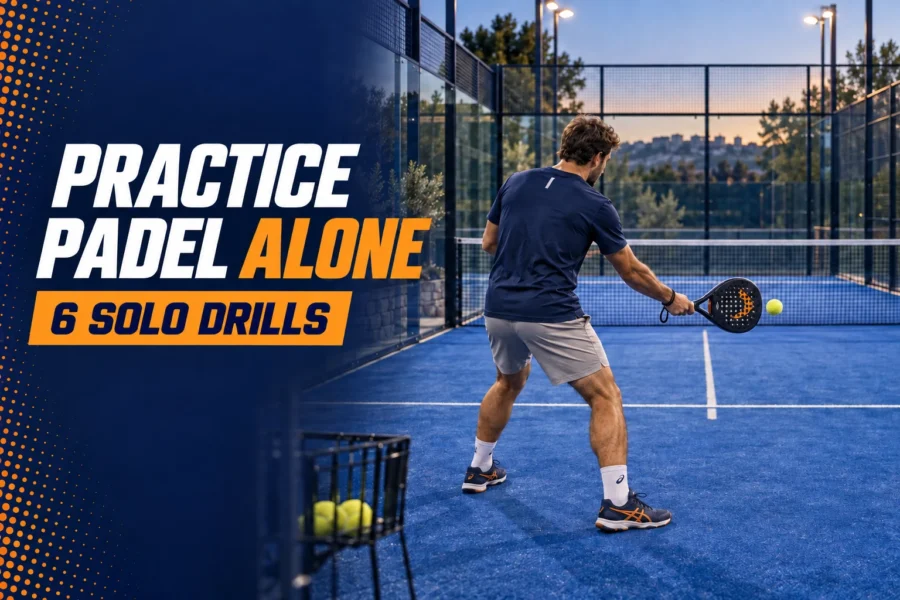
You can practice padel alone by working on serve placement, self-fed groundstrokes, back-glass returns, lobs, controlled wall volleys and footwork. A court, a racket and a few balls are enough to build a useful session without a partner or ball machine.
The key is to give each exercise a specific target. These six solo drills let you measure placement, control and movement, although you will still need other players to practice reading opponents, returning serves and coordinating with a partner.
What You Need for Solo Padel Practice
For the hitting drills below, use a padel court with enough uninterrupted space to practice safely. Bring the following:
- Your padel racket, with its wrist strap secured.
- Several padel balls with reasonably similar bounce.
- Flat court markers, if the venue permits them.
- A phone or notebook to record your scores.
Court lines can replace markers when you are starting out. Keep spare balls and equipment outside your movement area, and collect loose balls before they interfere with your next repetition.
Begin with several minutes of easy movement, controlled changes of direction and relaxed shadow swings. Start hitting gently, then adjust the difficulty according to how comfortably you can control the ball.
6 Solo Padel Drills You Can Do Without a Partner
1. Serve Placement Practice
The serve is particularly suitable for solo practice because you control the starting position, bounce and contact. Begin with a generous target inside the diagonal service box, leaving a clear margin from its edges.
- Choose a target toward the center of the receiving box or toward its side wall.
- Start behind the service line in the correct half of the court. Bounce the ball within your serving area and strike it at or below waist height, keeping at least one foot on the ground.
- Hit 10 serves from the right side, then 10 from the left, collecting balls in smaller batches if necessary.
- Record both the number of legal serves and the number landing in your chosen target.
Keep your feet clear of the service line and the imaginary extension of the center line until contact. Remember that a serve which lands in the correct box but touches the metal fence before its second bounce is a fault.
Progression: Once you can reliably hit a broad target, alternate between a central target and a wider one. Change the placement before adding more pace.
Your score measures serving accuracy, not how difficult the ball would be for an opponent to return. If your bounce or contact point varies between attempts, review the fundamentals of serving in padel before making the target smaller.
2. Self-Fed Forehand and Backhand Targets
This drill gives you time to organize your contact point and direct the ball deliberately. Start in the back of the court and choose a broad landing area across the net, such as the central part of the space beyond the opposite service line.
- Release the ball beside and slightly ahead of your body, allowing one bounce.
- Adjust your feet and hit a controlled forehand toward the target.
- Recover to a balanced ready position before setting up the next ball.
- Complete 10 forehands, then repeat with 10 backhands.
Use a compact preparation and enough net clearance to give yourself a comfortable margin. The aim is a repeatable shot that lands where intended, rather than maximum speed.
Progression: Keep the same target but vary your starting position slightly. Once contact remains comfortable, alternate between forehands and backhands instead of completing each side in a separate batch.
A self-feed provides much less information to read than an opponent’s shot. Use this exercise to refine your padel forehand and backhand technique, then check whether the same control holds up against incoming pace and spin.
3. Self-Fed Back-Glass Returns
This exercise helps you practice moving with a rebound and allowing space between your body and the ball. The feed should reproduce the final part of an incoming shot: floor first, then back glass, then your racket.
Start a few steps in front of the rear glass, slightly outside the intended path of the ball. Position yourself side-on so you can watch the rebound and turn toward the net without spinning around blindly.
- With your free hand, gently feed the ball downward toward the floor just in front of the back glass.
- Let it bounce once on the floor and then rebound from the glass.
- Adjust your feet as the ball comes away from the wall.
- Return it over the net before it bounces on the floor again, then reset.
If creating a manageable feed is difficult, begin by catching the rebound before another bounce. Once the feed is consistent, add your racket and aim for a large central target across the net.
Try two sets of eight controlled returns, working on both sides where comfortable. Count a successful repetition only when you use the correct bounce sequence, make balanced contact and land the return inside the opposite court.
Progression: Change the feed gently to create slightly shorter or longer rebounds. Avoid adding complicated corner rebounds until you can handle the single back-glass bounce consistently.
The glass does not give you an additional floor bounce. Under the basic rules of padel, you must return the incoming ball before its second bounce on the ground.
4. Self-Fed Lobs to a Deep Target
Solo lob practice is useful for learning to control your landing depth. It cannot tell you whether a particular lob would clear an opponent’s reach, so treat the target score as one part of the shot.
Choose a broad landing zone beyond the opposite service line, with a comfortable margin from the back glass. If you are indoors, account for the available ceiling height before attempting a higher trajectory.
- Start in the rear part of your court and drop-feed a ball beside and slightly ahead of you.
- After one bounce, lift the ball over the net with a controlled upward swing.
- Watch where its first bounce lands.
- Repeat for 10 attempts, then practice from the other side.
Record how many balls land in the deep target, how many finish short and how many hit the opposite glass before bouncing. This separates a depth problem from a general lack of consistency.
Progression: Once the drop-feed feels comfortable, use the back-glass feed from the previous drill and play a lob from the rebound. Keep the feed gentle enough that you can prepare without rushing.
Avoid turning the exercise into a contest to hit the highest possible ball. Effective padel lob technique requires a suitable combination of height, depth and control for the situation.
5. Gentle Wall Volleys
Wall volleys can help you practice compact racket preparation and controlled contact. This is a coordination exercise with an artificial rebound, rather than a simulation of a normal padel rally.
Face a clear section of rear glass, starting around 2m away and adjusting the distance to your control. Leave enough space for your swing and use gentle shots, since a harder hit returns to you more quickly.
- Start with a soft feed against the glass at a comfortable height.
- Meet the rebound before it touches the floor.
- Volley it gently back toward the same area of glass.
- Continue for a short sequence, then stop and reset.
During the sequence, the ball travels from racket to glass to racket, without a floor bounce. Begin with forehand volleys, then try backhand volleys before alternating between them.
Aim initially for five controlled contacts in a row. Build toward 10 while keeping the same compact action, rather than increasing the pace to extend the sequence.
Progression: Alternate forehand and backhand contacts while keeping your body balanced. If the ball becomes too fast or moves beyond comfortable reach, let it go and restart instead of chasing it toward the glass.
Use a smooth wall surface, not the metal fence, for predictable rebounds. Keep the main cues from your padel volley technique: prepare early, limit the backswing and return the racket to a ready position.
6. Shadow Footwork and Recovery
Shadow practice lets you rehearse how your feet, body and racket work together without managing a ball. It is particularly useful for noticing whether you recover after a stroke or remain stuck in your finishing position.
Choose a clear area of court and work at a pace that allows you to stay balanced. Begin with a simple lateral pattern.
- Start in a ready position with your racket in front.
- Make a small split step, then take controlled adjustment steps toward an imaginary forehand.
- Perform a relaxed shadow stroke and recover to your starting position.
- Repeat toward the backhand side.
Complete two short rounds of approximately 20–30 seconds, resting between them. Keep the movement compact enough that every repetition finishes under control.
Progression: Add an overhead variation. Turn sideways, move back with controlled steps, rehearse your overhead preparation and recover forward after the shadow stroke.
Avoid running straight backward while facing the net. If you are practicing the movement for a padel bandeja, keep the shadow swing relaxed and focus on organizing your position before the imagined contact.
Without an opponent, you cannot properly test anticipation or time your split step to a real strike. Use this drill to rehearse the movement pattern, then connect it to visual cues when you return to live play.
A Simple 30-Minute Solo Padel Session
You do not need to complete all six drills every time. Choose one main weakness and give it enough attention to compare your first attempts with your final ones.
| Time | Activity | Main focus |
|---|---|---|
| 0–5 minutes | Easy movement, shadow swings and gentle hitting | Prepare gradually and check the court is clear |
| 5–12 minutes | Serve placement from both sides | Record legal serves and target hits |
| 12–20 minutes | Groundstroke, back-glass or lob practice | Work on one specific weakness |
| 20–25 minutes | Gentle wall volleys or shadow footwork | Maintain controlled contact or balanced recovery |
| 25–30 minutes | Repeat a short target test, record results and collect balls | Compare performance under the same conditions |
Allow time for ball collection and brief rests within each block. If you have only a few balls, complete fewer repetitions rather than rushing between scattered balls.
For a beginner, serve placement and self-fed groundstrokes are straightforward starting points. Add the back-glass drill once you can create a predictable feed, and introduce continuous wall volleys only at a speed you can manage.
How to Make Solo Practice More Useful
Change One Variable at a Time
Keep your starting position, target and approximate pace consistent while learning a drill. If you change all three together, it becomes difficult to tell what caused a better or worse result.
When the exercise becomes comfortable, change one feature. You might narrow the target, vary the feed or add a recovery movement after the shot.
Track Placement and Control Separately
A ball can reach the target even when you are off balance or late to contact. Alongside your target score, note whether the movement felt repeatable and whether you recovered into a useful position.
Record a short clip occasionally, with the phone securely positioned outside your movement area and according to the venue’s filming rules. When improving your padel without a coach, footage can help you notice repeated habits, although interpreting the cause of an error may still require feedback.
Test the Skill Against Another Player
Solo practice removes the uncertainty created by an opponent. A self-fed lob, controlled wall volley or accurate serve is therefore a useful practice result, but it does not prove that the shot will work under pressure.
In your next session with another player, test the skill you practiced alone. Ask for manageable feeds first, then introduce less predictable balls or normal points, and use the errors that appear to choose the focus of your next solo session.