
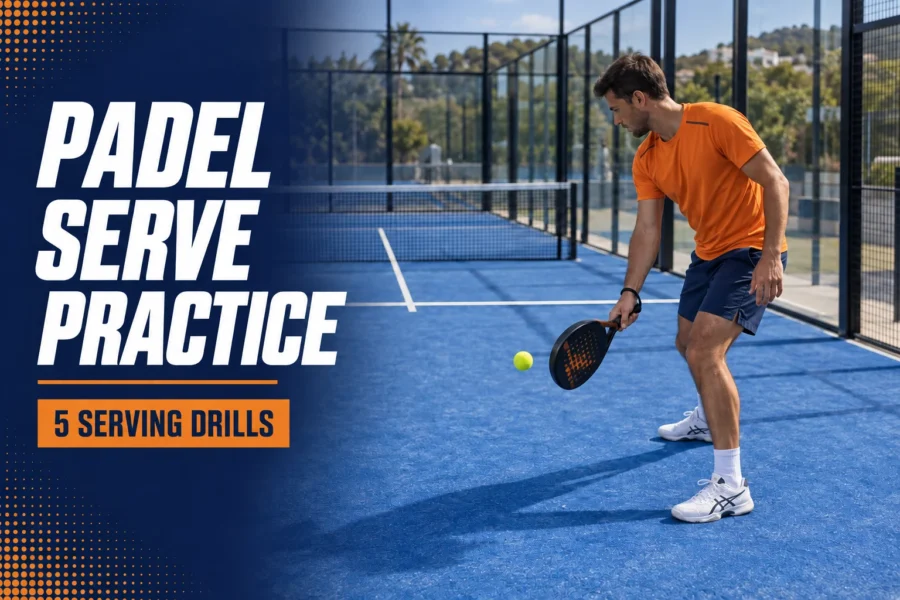
To practice your padel serve, start with a repeatable motion and a generous target, then add changes of direction, second serves and a live returner. Track whether the serve is legal, whether it reaches your intended area and what happens on the next shot.
These five drills build a structured serving session. You can do the first four alone on a court; the fifth needs another player to test how your serve works against a return.
Set Up Your Serve Practice
Bring several padel balls with a similar bounce, your racket and a way to record results. Use court lines or permitted flat markers to identify broad target areas, and keep loose balls clear of your movement path.
Begin with easy movement, relaxed shadow swings and gentle serves. Secure your racket’s wrist strap before hitting.
If your setup or contact is uncertain, review how to serve in padel before adding scoring. The repetition counts below are adjustable starting points, not standards you must reach.
Count Only Legal Serves
Apply the same rules during practice that you would use in a match:
- Start behind the service line on the correct side. Keep your feet clear of that line, the imaginary center-line extension and the receiving area in front of you until contact.
- Bounce the ball within your serving area. It must not cross the service line or imaginary center-line extension before you strike it.
- Contact the ball at or below waist level, with at least one foot on the ground.
- Land the serve in the diagonally opposite service box. Boundary lines count as good.
- After a correct bounce, glass contact is allowed. Contact with the metal fence before the second floor bounce makes the serve a fault.
Watch what happens after the first bounce, particularly when practicing wide serves. A ball landing on your target can still become a fault.
The basic rules of padel explain service lets, faults and scoring in more detail.
5 Padel Serve Practice Drills
1. Establish Your Starting Score
This drill gives you a result to compare with later sessions.
Choose a generous area inside the diagonal service box, leaving space between the target and the boundaries. Serve at a comfortable pace that lets you repeat the motion without reaching or losing balance.
- Choose your target before preparing.
- Serve 10 balls from the right side, resetting your stance and release each time.
- Repeat from the left side.
- Record legal serves separately for each side.
For missed serves, note the main fault: net, outside the box, fence contact or an issue with your serving position or contact height. Keep the tally simple enough to use between attempts.
What to change: If one side is less reliable, repeat a short set there with the same target and pace. Check your setup and ball release before trying several swing changes at once.
2. Change Targets Between Serves
Repeatedly hitting one area is useful, but match play requires choosing a placement and executing it after a reset.
Identify two broad landing zones in each receiving box: one toward the center line and another toward the side glass. Keep both comfortably inside the boundaries.
- Start from the right serving side and name your target before hitting.
- Make one serve attempt, then change serving sides.
- Choose the next target before beginning your motion.
- Complete 10 attempts, giving each serving side five turns.
Record two totals: legal serves and legal serves that landed in the chosen zone. A ball that lands safely in the other zone counts toward the first total only.
Progression: Have another player call the target before you prepare. Keep the target fixed once your service motion begins.
A landing zone in the middle of the box is not automatically a body serve. Whether the ball crowds a receiver depends on where they stand and move.
3. Practice First and Second Serves
This exercise connects your first-serve choice with what happens when it misses.
Play 10 simulated points without a returner. Begin on the right and alternate serving sides after each simulated point.
- Choose a first-serve target and make your attempt.
- If it is legal, record it and move to the next point.
- If it is a fault, reset and hit a second serve from the same side.
- Record a double fault if the second attempt also fails.
Use a dependable target for the second serve. Keep a smooth motion rather than trying to guide the ball with a hesitant push.
Replay genuine service lets without scoring them as successes or faults. A let on a second serve repeats the second serve only.
What to record: Keep first serves in, second serves in and double faults separate. For example, seven successful first serves plus two successful second serves from three attempts means you started nine of the 10 points and made one double fault.
Progression: Play another short round in which every attempt is treated as a second serve. This gives you a simple one-chance task without requiring a deliberately risky first serve.
4. Compare Placement at Two Speeds
A faster serve is useful only if you can control it and manage the return it produces.
Choose one broad target and use the same serving side for both parts of the comparison.
- Hit five serves at your usual controlled pace.
- Hit five slightly firmer serves toward the same target.
- Record legal serves and target hits for each group.
- Repeat from the other serving side.
Keep your release and preparation as similar as practical. Avoid adding a new spin action at the same time, because you will struggle to identify which change affected the result.
What to watch: Does the firmer serve repeatedly go long, catch the fence or pull you off balance? If so, return to the pace at which you can place it more reliably.
With a returner, also check whether the extra speed creates a more difficult return or leaves you less time to prepare. A small practice sample gives you something to investigate, rather than proving that one speed is always better.
5. Serve and Assess the Return
This drill tests the purpose of your serve: starting a point you can continue effectively.
One player serves while the other receives diagonally opposite. Begin with manageable returns toward the server, then introduce more choice.
- The server chooses a target and uses normal first and second attempts.
- The receiver lets the serve bounce before returning it.
- The server moves forward after serving, prepares around the receiver’s contact and plays one controlled next shot.
- Stop the sequence and record the outcome.
- Alternate serving sides after each point attempt, then swap roles after 10 points.
Include double faults in the serving tally. If the receiver misses a legal serve, record the serve result but leave the next-shot result blank.
Track three things separately:
- Was the serve legal?
- Did it reach the intended target?
- When a playable return arrived, did the server control the next shot?
Use a small split step around the receiver’s contact and react from the position you have reached. These padel footwork drills develop the approach and readiness needed for that transition.
Progression: Let the receiver choose between a low return and a lob. The server should respond to the actual ball, which may require a volley, a groundstroke or retreating to defend.
If placement is reliable but the first volley regularly breaks down, work on that contact separately with these padel volley drills.
Choose the Drills Your Serve Needs
You do not need to complete every drill in each session. Use your results to choose the next task.
| What happens in practice | Where to focus |
|---|---|
| Routine serves regularly miss | Drill 1 with a broad target and comfortable pace |
| Serves land in, but placement is inconsistent | Drill 2 |
| A missed first serve often becomes a double fault | Drill 3 |
| Adding pace reduces control | Drill 4 |
| The serve lands well, but the return catches you unprepared | Drill 5 |
For a short solo session, establish your starting score, work on one problem and repeat a comparable set at the end. Keep the target size and pace similar when comparing results.
When another player is available, finish by testing your serve against returns. These padel drills for two players provide options for extending the session into longer exchanges.
Can You Practice Your Padel Serve at Home?
At home, you can rehearse your setup and a gentle release, bounce and catch without striking the ball. Use a clear space and remember that different flooring and balls change the bounce.
The exercises in this guide to padel training at home include simple preparation work. Use a court to check actual serve placement, net clearance and what happens after the ball reaches the receiving box.