
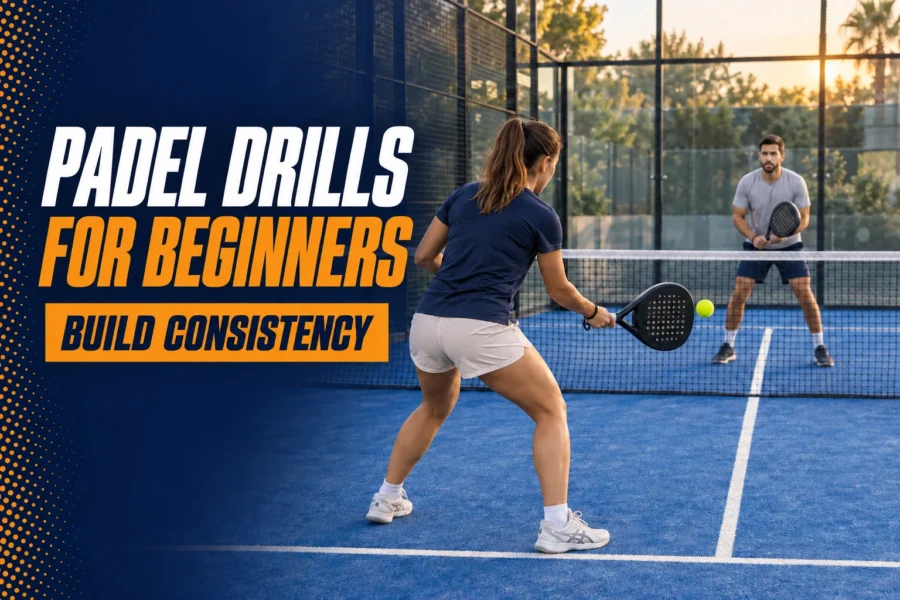
Start with cooperative rallies, predictable feeds and large targets. Useful padel drills for beginners give you time to prepare, make balanced contact and recover before the next ball, then gradually introduce the movement and decisions needed in a match.
The seven drills below progress from simple exchanges to back-glass returns, volleys, lobs and practice points. Most need only two players, while the final exercise adds the communication and shared court coverage of doubles.
Before You Start
You need a padel court, a partner, your rackets and several balls. Secure your wrist straps, keep spare balls outside your movement area and begin with a few minutes of easy movement and gentle hitting.
Agree on the purpose of each exercise before feeding the first ball. During cooperative drills, both players should help create a manageable next shot, with enough margin over the net and away from the walls.
The suggested repetition counts are starting points. Reduce the target or simplify the feed when an exercise repeatedly breaks down, and increase the challenge when you can maintain control.
If you do not have a partner, use these solo padel practice drills for exercises designed around self-feeding and individual practice.
1. Short-Court Cooperative Rallies
This drill introduces controlled contact without the distance of a full-court exchange. It also gives you a manageable way to practice preparing your racket before the ball arrives.
Stand opposite each other, several steps from the net and inside the service boxes. Use one straight half of the court so neither player needs to cover too much ground.
- Begin with a gentle underarm feed.
- Let the ball bounce once before each shot.
- Send it back toward your partner at a comfortable pace.
- Count each successful return after the opening feed, aiming initially for six in a row.
For this exercise, try to land each ball inside the opposite service box. Use small adjustment steps and a compact swing rather than reaching from a fixed position.
Make it easier: Shorten the distance slightly and reset after each successful exchange. If you cannot produce a manageable feed, practice feeding and catching before adding continuous hitting.
Progression: Move a little farther back while keeping the same controlled exchange. Avoid stepping back so far that you immediately need a much bigger swing.
Keep the contact point comfortably in front of your body. The same preparation principles apply to your padel forehand and backhand technique, even when the rally becomes longer.
2. Rear-Court Rally Ladder
The rally ladder adds distance while keeping both players focused on continuity. Its purpose is to make several controlled shots in succession, including the recovery between them.
Choose a straight half-width lane running across the net. Both players start toward the back of their respective halves, with enough room to adjust to the bounce.
- Start a rally with an easy feed.
- Work together to complete four successful returns after the feed.
- Begin a new rally with a target of six, then another with a target of eight.
- If a rally ends early, repeat that target before moving up.
Aim toward a generous area around your partner rather than the edges of the lane. Give the ball enough height to clear the net comfortably, while controlling its depth so your partner can continue.
Make it easier: Move forward slightly or begin with a target of two returns. You can also use separate forehand and backhand rounds if changing sides makes the exercise too difficult.
Progression: Keep the same pace but vary the placement enough to require a few adjustment steps. Add movement before trying to hit harder.
Do not judge the session only by your longest rally. Notice whether you can repeatedly reach the lower targets without losing balance or rushing the swing.
3. Back-Glass Catch and Return
Learning to read the back-glass rebound gives you another way to keep a point alive. Begin with a predictable hand feed so you can concentrate on the bounce sequence and your position.
Both players stand on the same side of the net. The feeder should be several steps closer to the net and diagonally clear of the receiver’s swing and rebound path.
- The feeder gently throws the ball toward the floor just in front of the rear glass.
- The ball bounces on the floor, hits the glass and comes back into the court.
- The receiver adjusts their feet and catches it before another floor bounce.
- Once that feels comfortable, replace the catch with a gentle racket return that the feeder can catch.
Work with one ball at a time. Start with eight manageable feeds to one side, then change sides and swap roles.
The sequence is floor, glass, then catch or racket contact. Catching is a learning exercise; when playing a normal shot, the rules of padel require you to return the ball before its second floor bounce.
Make it easier: Adjust the feed so the rebound comes away from the glass at a comfortable height. If it dies close to the wall or sends you scrambling, reset rather than forcing the attempt.
Progression: Keep the same hand feed, but return the rebound over the net toward a large central target. The feeder remains clear of your swing while you practice turning the rebound into a controlled shot.
4. Controlled Volleys to a Target
This drill separates volley placement from the pressure of a fast exchange. You have time to prepare the racket, meet the ball in front and control where it lands.
The volleyer stands a few steps from the net. The feeder works from the rear of the opposite half, with a broad landing target placed away from their body and any spare-ball basket.
- Feed gently to the volleyer’s forehand at a comfortable height.
- The volleyer meets the ball before it bounces and directs it toward the target.
- Reset the racket in front of the body after each volley.
- Complete eight feeds, then repeat on the backhand and swap roles.
Count balls landing in the target, but also notice whether you finish balanced and ready for another shot. A successful ball hit with a rushed, reaching action is a reason to adjust the setup before increasing difficulty.
Make it easier: Use the same feed repeatedly and enlarge the landing zone. Keep the pace low enough that the volleyer can prepare without a large backswing.
Progression: Alternate forehand and backhand feeds in a known pattern. Later, let the feeder choose the side while keeping the speed manageable.
Focus on the compact preparation and controlled contact described in padel volley technique. Fast volley-to-volley exchanges can wait until you can handle these simpler feeds.
5. Lobs Over a Passive Net Player
A partner gives you a useful reference when practicing lob height, while a landing target helps you judge depth. For this drill, the player near the net deliberately leaves the lob alone so both of you can observe its flight.
The hitter starts in the rear court. The feeder stands near the opposite net position and sends an easy ball that the hitter can play after one bounce.
- Feed to the same comfortable area for the first few attempts.
- The hitter gets balanced and lifts a lob over the net player.
- The net player stays clear and watches where the ball lands.
- Complete eight attempts, then swap roles.
Choose a broad target beyond the opposite service line, leaving a margin from the rear glass. Record whether each lob lands short, reaches the target or hits the glass before bouncing.
Make it easier: Use a slower, more predictable feed and a larger target. Concentrate on a controlled upward swing before trying to disguise the shot.
Progression: Alternate feeds between the forehand and backhand. Once that is manageable, introduce a little movement before contact.
The feeder should not backpedal underneath the lob or attempt an overhead catch. This exercise helps you assess height and depth, but beating an active opponent requires further practice with padel lob technique and shot selection.
6. Serve, Return and Third Ball
A reliable point opening involves more than getting the serve into the box. This drill connects the serve, the receiver’s return and the server’s next shot into one controlled sequence.
Start in the normal diagonal serving and receiving positions. Initially, the server can remain back after serving so both players have a simpler exchange.
- Serve at a comfortable pace into the correct diagonal service box.
- The receiver allows the serve to bounce and returns it toward a generous target around the server.
- The server plays one further controlled shot back into the opposite court.
- Stop, reset and repeat, changing serving side and swapping roles regularly.
Count a complete sequence only when all three shots are legal and land in court. Start with five attempts in each serving role and record how often you complete the sequence.
Use a legal service bounce within your serving area, contact the ball at or below waist height and keep at least one foot on the ground at contact. If the opening shot is inconsistent, revisit the basics of serving in padel.
Make it easier: Reduce the pace and use broad central targets. Practice serve and return alone before adding the third shot.
Progression: Let the server move forward after serving and play the next ball from the position they reach. Once the opening sequence is comfortable, continue the rally instead of stopping after three shots.
7. Four-Player Cooperative-Start Points
This exercise introduces doubles decisions without making every opening ball competitive. It gives beginners time to establish the rally before trying to win it.
Arrange two players on each side, initially toward the rear court. Begin with a gentle feed and agree that the first four shots after the feed will be cooperative.
- Send the opening shots toward manageable areas for the opposing pair.
- Count four successful shots after the feed.
- After the fourth shot lands in, continue playing the point competitively.
- Award one point to the winning pair and begin again with a new feed.
If someone misses during the cooperative phase, restart without awarding a point. Reduce the opening target to two shots if four prevents you from reaching the competitive phase.
Call for balls between you and your partner, and leave each other enough room to swing. Recover with awareness of the space your partner is covering, using the basic positioning principles for new padel players as a starting point.
Progression: Begin with a legal serve instead of a feed, agreeing in advance whether the serve counts toward your cooperative total. Later, remove the cooperative requirement and see whether the same controlled decisions carry into normal points.
The opening condition is a practice rule. Once competition begins, you can attack a suitable ball, but you still need to choose a shot you can execute from your position.
A 40-Minute Beginner Padel Practice Session
You do not need to complete every drill in one visit. Combine a rally exercise, one specific skill and a point-opening or doubles exercise so the session includes both repetition and decisions.
| Time | Activity | Focus |
|---|---|---|
| 0–5 minutes | Easy movement and gentle hitting | Prepare gradually and establish a comfortable pace |
| 5–10 minutes | Short-court cooperative rallies | Clean contact and manageable feeds |
| 10–18 minutes | Rear-court rally ladder | Repeatable depth, recovery and continuity |
| 18–26 minutes | Back-glass, volley or lob drill | One specific skill, with both players taking turns |
| 26–34 minutes | Serve, return and third ball | Keep the opening sequence under control |
| 34–40 minutes | Four-player practice points, or continued cooperative rallies with two players | Apply the skill with more decisions |
Include short rests and ball collection within each block. If setup takes longer or you need more recovery, reduce the number of repetitions rather than rushing through them.
Change the skill block between sessions. For example, work on the glass during one visit, then volleys during the next, while keeping the rally ladder as a familiar comparison.
How to Progress Without Losing Consistency
Keep the Feed Manageable
The feeder has an active role in making practice useful. Send balls that let your partner work on the intended skill, and reset a clearly unsuitable feed rather than counting it as an ordinary miss.
As control improves, vary the feed gradually. Add a little movement, a different height or a change of direction before combining all three.
Increase One Challenge at a Time
Smaller targets, longer rallies, less predictable feeds and faster shots all make a drill harder. Choose one change so you can see whether the current skill holds up.
If the rally repeatedly breaks down immediately, return to the previous version. Aim for an exercise that produces enough successful repetitions to practice the movement, while still exposing the error you want to improve.
Measure More Than Your Best Rally
Record a simple result, such as completed three-shot sequences out of five attempts or controlled glass returns out of eight feeds. Repeat the same setup in a later session so the comparison means something.
Also note the most common reason a sequence ended: a ball in the net, excessive depth, late preparation or poor recovery. Use that pattern to choose the next drill, then check whether the improvement appears when you play normal points.