
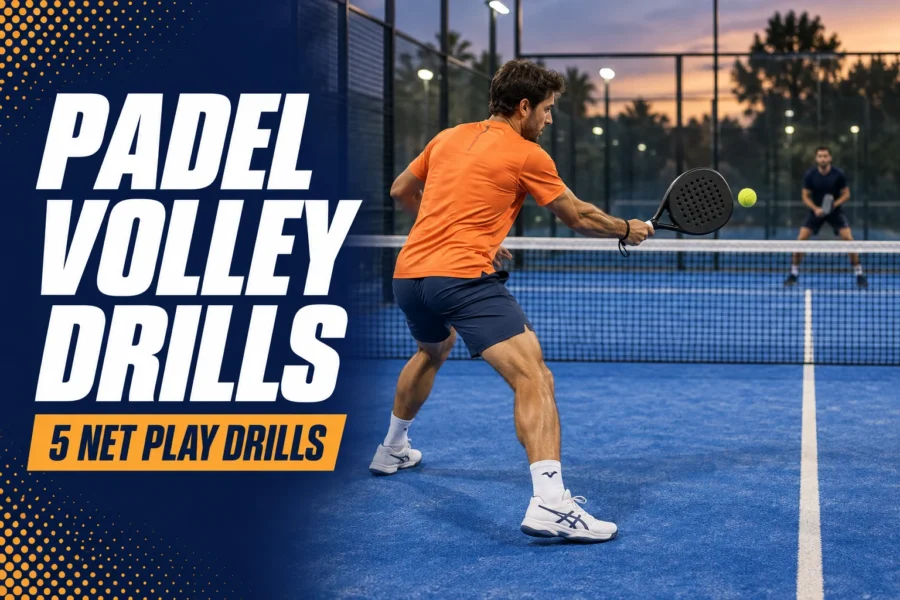
To improve your padel volleys, practice placing the ball, recovering for the next shot and choosing a controlled response to different feeds. Start with predictable balls, then add direction changes, low volleys and situations where you approach or defend the net with a partner.
These five padel volley drills build that progression. The first four need two players, while the final exercise uses four players to connect volley practice with doubles points.
Set Up Your Volley Practice
Begin with easy movement and gentle hitting. Keep spare balls outside the movement area, use your racket’s wrist strap and start with feeds that both players can control.
Choose a net position that gives you room to react and adjust. Your position will change with the ball and your partner, so there is no single distance from the net that suits every exercise or point.
Before increasing the difficulty, check the basics in padel volley technique: compact preparation, comfortable contact in front and a return to ready after each shot. Use the repetition targets below as starting points, with breaks and easier feeds when needed.
| Drill | Players | Main focus |
|---|---|---|
| First-bounce targets | 2 | Placement and depth |
| Two volleys with a direction change | 2 | Control between consecutive shots |
| Low volley or comfortable volley | 2 | Net clearance and shot selection |
| Serve and control the first volley | 2 | Approaching without rushing contact |
| Three volleys, then play the point | 4 | Partner coverage and live decisions |
1. First-Bounce Target Volleys
This drill makes placement easy to assess because each volley is allowed to land before the next feed.
Setup: One player starts at the net. The feeder stands toward the opposite rear court, clear of a broad target area just beyond the service line.
- Agree on the target, leaving a generous margin from the back and side glass.
- The feeder sends a manageable ball to the volleyer’s forehand.
- The volleyer aims the first bounce into the target, then returns to ready.
- Let the ball land and reset before feeding again.
Try ten feeds on one wing, then repeat on the backhand. Record how many volleys land in court and how many reach the chosen target.
Make it easier: Enlarge the target and keep the feed direction predictable. Work on controlled contact before asking for greater depth.
Make it harder: Alternate the wing while keeping the same target. Later, change the target between sets so you practice directing the ball deliberately.
Depth is useful, but it does not automatically make a volley difficult to defend. A ball hit too hard or too deep can rebound generously off the glass, so also ask your partner which returns would leave them a comfortable next shot.
2. Two Volleys With a Direction Change
This exercise uses one ball throughout. You control the first volley toward your partner, then place the second into a different area.
Setup: The feeder starts in one half of the opposite rear court. The volleyer begins at the net, with a broad target available in the other half.
- The rear player feeds a comfortable ball.
- The net player volleys back toward the feeder.
- The feeder lets that ball bounce and sends another manageable return.
- The net player changes direction with the second volley, aiming into the open half.
- Let the second volley land, then stop and reset.
Complete six sequences before changing roles. The feeder does not chase the final shot, which allows both players to assess its placement.
Practice target: Count sequences in which both volleys reach their intended areas. Pay attention to whether the racket returns to ready between contacts.
Progression: Vary the second feed slightly. If it arrives low or leaves the volleyer rushed, allow another controlled volley toward the feeder instead of requiring a difficult direction change.
That choice matters in a point: the available ball determines whether changing direction is sensible. For longer exchanges that add more movement and uncertainty, use these padel drills for two players.
3. Low Volley or Comfortable Volley
A volley contacted below net height needs enough upward clearance to cross the net. A more comfortable ball may allow a firmer forward push, provided you have time, balance and a suitable contact position.
Setup: The feeder works from across the net, mixing gentle dipping balls with easier feeds that reach the volleyer above net height. Begin with one wing.
- Read the feed and adjust to create room for contact.
- On a low ball, lower comfortably and use a short, controlled action to clear the net.
- On an easier ball, place the volley more firmly toward a broad target.
- Return to ready and reset before the next feed.
Start with the feeder announcing which ball is coming. After several repetitions, remove the announcement while keeping the speed manageable.
Practice target: Record successful low-ball returns separately from the easier volleys. Do not require both types to land at the same depth.
The dipping feed presents a similar problem to a chiquita directed toward the net player’s feet. The immediate task is to manage the low contact and stay prepared for the next ball.
Progression: Mix forehand and backhand feeds. A higher ball that arrives quickly or crowds your body may still need a compact block, so height alone should not trigger an attacking swing.
4. Serve and Control the First Volley
The first volley after a serve is often played while you are still moving forward. This drill separates the approach from the temptation to rush or overhit that contact.
Setup: One player serves and the other receives diagonally opposite. Choose a broad first-volley target away from the returner’s body.
- Begin with a controlled legal serve, using your normal padel serving technique.
- Move forward while the ball travels.
- The returner lets the serve bounce, then sends a manageable return toward the approaching player.
- The server shortens the approach steps and makes a small split step around the returner’s contact.
- Play one controlled volley, let it land and reset.
Complete five valid serve-and-return sequences from each serving side before swapping roles. If the serve or return misses, restart without treating it as a volley error.
Practice target: Count first volleys that land in court while you remain balanced enough to prepare for another shot. Note target hits separately.
You do not need to reach a fixed net position before the returner hits. Become ready to react wherever the approach has taken you, using the movement principles in these padel footwork drills.
Progression: Ask the returner to vary between a comfortable ball and a slightly dipping return. If the ball requires a groundstroke, play it and reset rather than forcing a stretched volley.
The receiver must let the serve bounce. After the return, the server may volley the next ball.
5. Three Volleys, Then Play the Point
This four-player drill gives the net pair a short cooperative sequence before everyone begins competing for the point.
Setup: One pair starts at the net and the other in defensive positions toward the back. Use one ball and begin with manageable feeds to both net players.
- A rear player starts with a gentle feed.
- The net pair works together to complete three controlled volleys, counting their combined total.
- During this introductory sequence, the rear pair lets each volley bounce and returns gently without lobbing.
- Once the third volley makes a legal first bounce, the rally becomes competitive.
- Play out the point with normal movement and shot choices.
If the introductory sequence breaks down, restart without awarding a point. Once the sequence is completed, the winning pair earns one point for the resulting rally.
Swap net and rear roles after four starts, including attempts that ended during the cooperative stage. This keeps both pairs involved even if completing the sequence is difficult.
What to watch: Use clear calls for central balls and adjust your coverage as a pair. Good communication with your padel partner is particularly useful when either player could take the next volley.
Progression: Add a broad depth target during the cooperative stage, provided the feeds remain comfortable. Finish with normal doubles points so you also practice choosing when to volley, retreat or let a ball bounce without a required volley count.
Choose a Focus for Your Session
You do not need to complete all five drills every time. Choose exercises that address the part of volleying that currently breaks down.
- Missing straightforward volleys: Start with Drill 1 and a generous target.
- Losing control when the next ball arrives: Use Drill 2 and check the return to ready.
- Putting low balls into the net: Spend more time on Drill 3.
- Rushing after the serve: Use Drill 4 with cooperative returns.
- Struggling to work with your partner at the net: Use Drill 5, then play normal points.
Keep the feeds similar for a short set so the results are comparable. When the exercise becomes manageable, change one feature, such as direction, height or the target, before increasing the pace.
Can You Practice Padel Volleys Alone?
You can rehearse compact preparation and the return to ready without a partner. These exercises for practicing padel at home include shadow volleys and simple racket-control work.
A suitable practice wall also allows gentle volley exchanges, provided there is enough clear space and the surface is intended for ball practice. Keep the pace low enough to control the rebound.
Solo work can help you rehearse the action, but it does not reproduce an opponent choosing where and how to hit. Return to partner feeds to check whether your preparation, placement and shot selection hold up when the next ball is less predictable.