
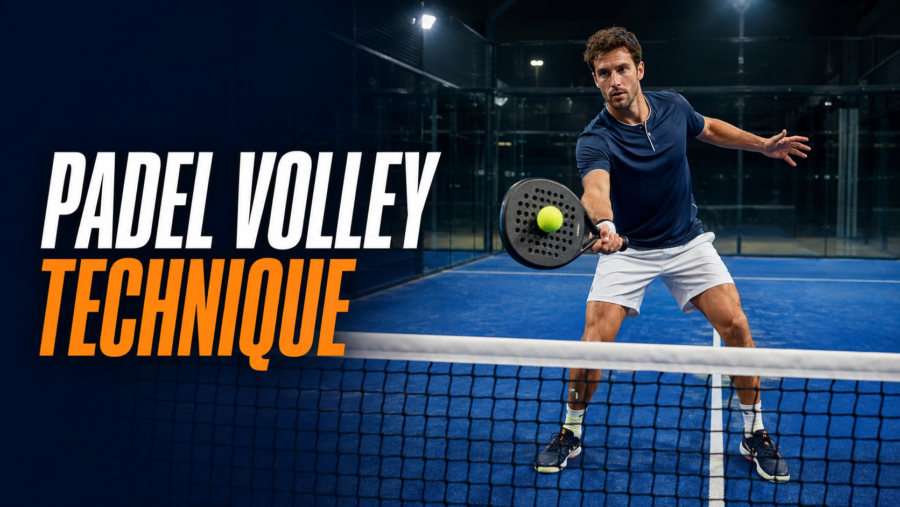
A reliable padel volley starts with the racket in front, a split-step as the opponent strikes, a small shoulder turn and contact ahead of the body. The movement is a compact block or guided punch, not a full groundstroke swing.
Volleys are normally played from an attacking position near the net, but they do not always need to win the point. A controlled volley can keep your pair at the net, move the defenders into a weaker position and create an easier ball to attack next.
What Is a Volley in Padel?
A volley is a shot struck before the ball bounces. It is different from a half-volley, which is played immediately after the ball has touched the court.
During a rally, you may volley the ball after it crosses the net. The returner cannot volley a serve, however, because the serve must bounce in the correct service box first. Good serve technique often gives the serving pair an opportunity to move forward and play the first volley.
How to Hit a Padel Volley in 3 Simple Steps
Step 1: Prepare and Split-Step
Use a continental grip, also known as a hammer grip, as your starting point. It allows you to move between forehand and backhand volleys without a major grip change. It is the most practical default rather than a rule that every player must follow in every situation.
Hold the racket head up and in front of your chest, with your elbows relaxed. Your non-dominant hand can support the throat of the racket until you know which side the ball is approaching. Keep your knees slightly bent and your weight toward the front of your feet.
Make a small split-step and try to land as the opponent strikes the ball. This puts both feet under you and makes the first movement quicker in either direction.
Avoid standing directly against the net. The ideal position changes with the opponents, the quality of your previous shot and the likelihood of a lob. Leave enough room to step forward for a volley while still being able to turn and retreat for a ball played over your head.
Step 2: Turn and Meet the Ball in Front
Turn your shoulders with a small unit turn while keeping the racket ahead of your body. Unlike the longer swings used for forehand and backhand technique, a volley does not need the racket to travel behind your torso.
For a right-handed forehand volley, turn slightly to the right and step diagonally forward with the left foot when there is time. For a backhand volley, turn the left shoulder toward the ball, support the racket with the left hand during preparation and normally step with the right foot. Reverse these patterns if you are left-handed.
The opposite-foot step helps transfer weight, but it is not mandatory on every ball. A fast body shot may allow only a split-step, a small adjustment and a compact block.
Contact the ball in front of your body and near the center of the racket. Keep the wrist stable and guide the racket forward. When the incoming ball is fast, use its pace and make very little swing. When it is slower and comfortably above net height, you can use a slightly firmer forward action.
For a low volley, bend through the knees and allow the racket face to open enough to clear the net. Do not try to chop aggressively downward from a contact point below net height.
Step 3: Choose a Target and Recover
Let the height and speed of the ball determine how aggressively you play:
- Above net height: Apply pressure with controlled depth, an angle or the open space.
- Around net height: Prioritize placement toward the opponents’ feet or the middle.
- Below net height: Use more net clearance and controlled pace instead of forcing a winner.
A slow, low chiquita toward your feet requires patience. Keep the response low if possible, but accept that a neutral ball is often the correct result from a difficult contact.
Finish briefly in the direction of your target, then return the racket to the ready position. Do not let the follow-through wrap far across your body. Recover with another split-step before the opponents make contact.
Both players should shift laterally and move forward or backward together. Learning to move effectively with your partner protects the middle and prevents one player from leaving a large gap. If a good lob moves over you, turn and retreat rather than backpedalling. When you can reach it in balance, choose an appropriate overhead such as a bandeja.
Forehand Volley vs Backhand Volley
| Detail | Forehand volley | Backhand volley |
|---|---|---|
| Shoulder turn | Dominant shoulder moves slightly back | Non-dominant shoulder turns toward the ball |
| Step when time allows | Opposite foot | Opposite foot |
| Free hand | Supports balance | Supports the racket during preparation, then releases for balance |
| Contact | In front and slightly to the racket side | In front of the body with the hitting arm stable |
The two sides share the same fundamentals: compact preparation, contact in front, a stable wrist and a short finish. Do not turn the backhand volley into a large two-handed groundstroke.
Where Should You Aim a Padel Volley?
The opponents’ feet are a strong target, especially when they are moving forward or recovering. The middle can reduce their available angles and create uncertainty about who should play the next ball.
When both opponents are defending deep, use a controlled volley toward a corner so the ball remains low near the back glass. A short angle can be effective when you contact a comfortable ball above the net and the defenders are well behind the baseline, but it is risky when you are stretched or hitting upward.
The ball must bounce in the opponents’ court before it reaches their glass or fence. A volley sent directly into their wall or fence without a court bounce loses the point.
Should a Padel Volley Be Flat or Sliced?
Both options have a purpose. A firmer flat volley can pressure an opponent moving forward or exploit an open space. Light slice can keep the bounce lower and help create a difficult ball near the back of the court.
Do not chase maximum spin. A steep, wristy chopping motion makes the racket face harder to control. Direction, height and pace usually matter more than producing heavy slice.
Common Padel Volley Mistakes
- Letting the racket drop near the hip between shots.
- Taking a large backswing behind the body.
- Contacting the ball beside or behind the hip.
- Swinging hard at a fast incoming ball instead of blocking it.
- Trying to attack every volley, including balls below net height.
- Using the wrist to manufacture excessive slice.
- Standing flat-footed or crowding the net.
- Watching the shot instead of resetting the racket and recovering.
- Moving independently from the partner and opening the middle.
A Simple Volley Practice Drill
Have a partner feed alternating forehand and backhand volleys while you start in the ready position. Split-step before each feed and call either “block” or “attack” based on the ball’s speed and height.
Direct fast feeds toward a deep central target with a compact block. Step into slower balls and alternate between the middle and corners. Count only volleys made with contact in front, a short finish and an immediate recovery to the ready position.
Prepare, meet and recover. Keep the racket in front, contact the ball ahead of your body and reset immediately beside your partner. Once those three actions become reliable, placement and controlled variation become much easier.