
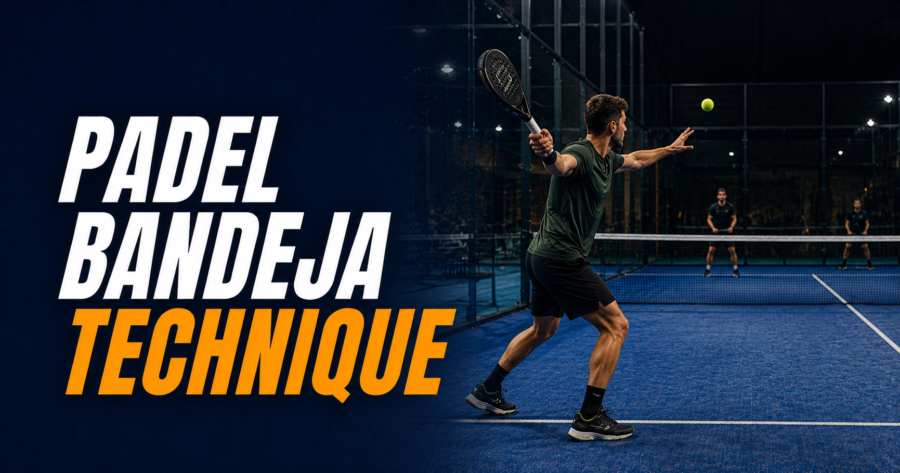
The bandeja is a controlled overhead used to handle a lob without giving up the net. Instead of trying to end the point with maximum power, the player sends the ball deep with controlled pace and slice, then recovers forward before the opponents can take over the attacking position.
Although it is sometimes called a defensive smash, that description can be misleading. The bandeja is played in response to defensive pressure from a lob, but its main purpose is to preserve an attacking court position.
A successful bandeja keeps the opponents deep, produces a low or uncomfortable reply and gives you enough time to return to the net. Placement, movement and recovery are more important than hitting a winner.
What Is a Bandeja?
“Bandeja” is the Spanish word for “tray.” The name comes from the historically open, tray-like position of the racket during the preparation and swing.
Modern techniques vary, so the name should not be interpreted too literally. The shot is best understood as a controlled overhead positioned between a high forehand volley and a smash.
The racket begins above the intended contact point and moves forward with a controlled high-to-low component. A slightly open face creates slice, helping the ball travel deep and remain lower after the bounce or wall rebound.
What Is the Purpose of the Bandeja?
The main purpose is to return a reachable lob while preserving or recovering the net. It is normally a point-building shot rather than an attempted winner.
A good bandeja can:
- Prevent the opponents from taking the net immediately.
- Keep the defending pair near the back glass.
- Produce a low reply that is difficult to attack.
- Give the hitter time to recover forward.
- Create a weaker ball for the next volley.
- Reduce the risk of an uncontrolled smash rebounding back to the opponents.
The shot should be judged partly by what happens afterward. A bandeja that lands deep and allows your pair to re-establish the net has succeeded, even if the opponents return it.
When to Hit a Bandeja
Against a Reachable but Deep Lob
The bandeja is most useful when an opponent plays a lob that forces you backward but remains reachable with a balanced overhead.
The ball is often too deep or uncomfortable for a reliable finishing smash. Instead of forcing power from a poor position, the bandeja allows you to return the ball safely and move forward again.
When a Smash Would Be Too Risky
A hard smash from too far back may land deep, rebound strongly from the back glass and return toward the defenders at a comfortable height. That can turn your attacking shot into an opportunity for them.
The bandeja uses less pace and a lower trajectory. This helps you control the rebound and maintain pressure without relying on a direct winner.
When You Need Time to Recover the Net
Because the shot is played with controlled pace and depth, it can give you enough time to reverse your backward movement and recover forward.
This does not mean the bandeja should be hit slowly. It needs sufficient pace to prevent the opponents from stepping forward and attacking, but not so much that you lose placement or recovery time.
When the Opponents Are Defending Deep
A sliced bandeja directed toward the corner, middle or feet can keep both opponents behind the service line. The defenders may be forced to contact the ball low or wait for an awkward wall rebound.
If they begin moving forward before you strike, adjust the target. A ball toward the body or feet may be more effective than automatically aiming for the glass.
When Not to Hit a Bandeja
The bandeja is not the correct response to every high ball. Shot selection depends on the depth and direction of the lob, your balance and the opponents’ positions.
Choose another option when:
- The lob is short enough for a confident finishing smash.
- You are balanced close to the net and can attack with a more aggressive vibora.
- The ball travels over the non-racket shoulder and makes the normal swing awkward.
- The lob passes behind you or forces contact behind the body.
- You cannot create enough space between yourself and the ball.
- Your partner is out of position and cannot cover the court.
- Wind, sun or lighting makes an aggressive overhead unnecessarily risky.
If the lob is too deep for a balanced overhead, allow it to bounce and use the back glass. Forcing a bandeja while falling backward usually produces a short, floating ball.
Bandeja vs Vibora vs Smash
These overheads respond to different situations, although the boundaries between them are not always rigid.
| Shot | Best opportunity | Main purpose | Typical action |
|---|---|---|---|
| Bandeja | Reachable but deeper or less comfortable lob | Preserve or recover the net | Controlled pace, slightly open face and slice |
| Vibora | More manageable attacking lob while balanced | Apply greater pressure | Faster lateral swing with stronger sidespin |
| Flat smash | Short, high ball contacted well in front | Finish the point or create an unreachable rebound | Higher contact and more direct acceleration |
| Gancho | Ball crossing the non-racket shoulder or central overhead area | Maintain coverage without forcing an awkward swing | Higher, more over-the-head hooking action |
| Bounce and glass | Lob too deep for a safe overhead | Recover the rally from the back | Allow the ball to bounce and play after the wall |
Court position alone does not determine the correct shot. Handedness, ball direction, contact height, balance and the opponents’ movement all affect the decision.
When uncertain, choose the option you can execute while balanced. A controlled overhead that maintains the net is generally more useful than a forced winner attempt.
How to Hit a Bandeja Step by Step
1. Recognize the Lob Early
Watch the opponent’s preparation and racket face. As soon as you identify the lob, begin turning and moving rather than waiting for the ball to reach its highest point.
Early recognition gives you time to get behind the ball. Late recognition usually leaves the contact above or behind the head, making both placement and recovery more difficult.
2. Turn Sideways
Rotate your shoulders and hips so your chest faces toward the side of the court. This position creates space for the racket and allows the torso to contribute to the swing.
Avoid retreating while square to the net. Backpedalling from a forward-facing position reduces balance and can become dangerous if your feet cross unexpectedly.
3. Move Behind the Ball
Use larger crossover or side steps when you need to cover distance, then smaller adjustment steps as the ball descends. Your objective is to move behind the projected contact point.
Do not run directly underneath the ball. Leave enough space so the contact can occur in front and toward the racket side.
4. Use a Continental Grip
The continental grip is the standard starting grip for the bandeja. It allows you to maintain a slightly open racket face and create slice without making a large grip change during the rally.
Small individual variations are possible, but the grip should provide control on both the overhead and the following volley. An extreme grip can make the racket face difficult to stabilize.
5. Prepare the Racket High
Raise the racket beside and behind the head with the hitting elbow high and separated from the torso. The racket head should begin above the expected contact point.
The preparation should remain compact. A large smash-style backswing adds unnecessary movement and makes timing more difficult.
6. Use the Non-Dominant Arm for Tracking
Raise the non-dominant arm to help judge the ball’s descent and maintain body alignment. Some players point directly toward the ball, while others use a less pronounced tracking position.
The exact arm position is not universal. Its purpose is to improve balance, spacing and awareness of the incoming ball.
7. Establish a Stable Base
Complete the main backward movement before beginning the forward swing. Keep the knees flexed and the feet far enough apart to support balance.
Small final adjustments are normal, but avoid swinging while still running backward. A stable base allows you to transfer weight forward through contact.
8. Contact Around Head Height
A typical bandeja is contacted around forehead, eye or head height, slightly in front and toward the racket side. It is not normally struck at the highest possible point like a finishing smash.
The exact height changes with the incoming ball and the player’s technique. The essential requirement is a comfortable contact in front rather than a rigid measurement.
9. Keep the Racket Face Slightly Open
A moderately open face helps lift the ball safely over the net while producing slice. The face must remain stable through contact.
Opening it too far can make the ball float or travel long. Closing it excessively can send the shot into the net or remove the margin needed from a deeper court position.
10. Swing Forward With a High-to-Low Component
Begin above the contact point and move forward with a controlled downward element. The swing should travel through the ball rather than chopping steeply underneath it.
Shoulder rotation, arm extension and weight transfer should work together. Avoid trying to create all the spin with an abrupt wrist flick.
11. Transfer Weight Forward
Move the body through the shot so your momentum begins carrying you back toward the net. Leaning backward at contact usually sends the ball short or high.
The forward transfer also helps you achieve greater depth without swinging at maximum speed.
12. Follow Through and Recover
Continue the racket forward and naturally across the body. There is no single required finish position, provided you remain balanced and control the intended direction.
Begin recovering as the ball travels. Re-establish your ready position and split-step before the opponent makes contact.
How Much Spin Should a Bandeja Have?
Slice or underspin is characteristic of the bandeja, often with a small amount of sidespin created by the lateral swing. Heavy spin is not required.
Direction, depth and speed should come first. A slightly open racket face and a swing beginning above the contact point can create enough slice without forcing the action.
Trying to produce excessive spin may lead to a steep chopping motion. This often makes the ball float, land short or lose the forward penetration needed to keep the opponents deep.
A successful bandeja does not always “die” after reaching the glass. The rebound depends on the ball’s speed, spin, bounce angle, court surface and the wall it reaches.
How Hard Should You Hit the Bandeja?
Use controlled medium pace rather than maximum power. The ball should travel quickly enough to prevent an easy attack but slowly enough for you to control the target and recover the net.
Hitting harder does not automatically produce a better bandeja. Excessive pace may reduce accuracy and create a larger rebound from the back glass.
The correct speed also depends on the opponents. If they are staying deep, a controlled corner ball may be sufficient. If they are moving forward, a firmer shot toward their feet or body may be necessary.
Where to Aim the Bandeja
Deep Crosscourt Corner
The crosscourt corner is a common target because the diagonal provides more court length and can bring both the side and back glass into play.
A deep ball into this area forces the defender to manage the bounce, spin and wall sequence. It also gives the hitter more time to recover forward.
Crosscourt is not automatically the correct choice. If the opponent has anticipated the target or handles the corner well, change the direction.
Through the Middle
The middle offers a large target and reduces the angles available on the opponents’ next shot. It may also create uncertainty over which player should take the ball.
Aim deep enough to keep both defenders behind the service line. A short central ball can invite an aggressive groundstroke or allow them to move forward.
Toward the Feet or Body
When the opponents step forward, direct the bandeja toward their feet, playing hip or body. This can force a cramped contact and make an accurate counter-lob difficult.
The body target provides more margin than a narrow corner. It is useful when you need reliability rather than a demanding angle.
Down the Line
A down-the-line bandeja can surprise an opponent who has moved toward the middle. It may also keep the ball away from the stronger defender.
The available court is shorter than on the diagonal, so depth control becomes more difficult. Use it selectively rather than as the default direction.
Near the Side Glass
A ball that bounces before reaching the side glass can create a difficult low rebound. The first bounce must land legally inside the opponents’ court before the ball touches the glass or fence.
Do not aim directly into the enclosure on the fly. Use a sufficiently large court target and allow the bounce to carry the ball toward the wall.
Preventing an Attackable Wall Rebound
A bandeja that rebounds high and slowly from the back glass can provide the defender with an attacking opportunity. If the ball sits up, they may be able to step forward and play a bajada.
To reduce this risk:
- Use slice without opening the racket face excessively.
- Avoid sending a fast, flat ball directly toward the back glass.
- Target the corner or side-glass area when the angle is available.
- Keep the first bounce deep enough to prevent the opponent from moving forward.
- Adjust the pace to the court and ball conditions.
No target guarantees a harmless rebound. Watch how each opponent handles the walls and adjust during the match.
What to Do After Hitting the Bandeja
Start recovering forward when the shot’s quality allows it. The goal is to re-establish the net before the opponents can take advantage of the space you left while retreating.
Do not sprint blindly. Stop and split-step before the opponent contacts the ball so you can react to a low drive, lob or shot toward your feet.
If your bandeja lands short or floats, hold a position from which you can defend. Continuing forward behind an attackable ball can leave you exposed.
Once you recover, reliable volley technique becomes important because the bandeja is often intended to create a manageable next ball rather than finish the point immediately.
Moving With Your Partner
When one player moves backward for a bandeja, the partner should normally shift toward the middle to cover the temporary gap. This movement must happen early enough to protect the open court without crowding the hitter.
After the bandeja, both players should recover their attacking formation together. If the hitter moves forward while the partner remains deep or too central, the opponents can exploit the gap between them.
Calling the lob, identifying who will take it and rebuilding the net formation are important parts of working effectively with your partner.
Bandeja Technique From Different Court Sides
The basic principles remain the same on both sides: recognize the lob early, turn, move behind the ball, contact in front and recover.
However, the incoming trajectory changes according to court side and handedness. A ball arriving on the racket side may allow a more natural lateral swing, while a ball crossing the body may require a higher contact or a different overhead.
Do not force the same contact point from every position. Adjust the target and shot choice according to the space available around your body.
Common Bandeja Mistakes
Recognizing the Lob Too Late
Late recognition leaves insufficient time to turn and move behind the ball. Watch the opponent’s preparation and begin retreating early.
Backpedalling While Facing the Net
Moving backward while square reduces stability and prevents proper shoulder rotation. Turn sideways and use controlled crossover or side steps.
Running Underneath the Ball
Standing directly beneath the ball creates a crowded contact and makes the swing travel upward. Move farther behind it so you can contact in front.
Contacting Behind the Head
A late contact reduces control and keeps your momentum moving backward. Improve the initial movement and create the contact point in front.
Contacting Too High
Trying to strike at the highest possible point turns the movement into a smash and can create a higher rebound. Allow the ball to descend to a comfortable head-height contact.
Dropping the Elbow
A collapsed preparation makes it difficult to begin the swing above the ball. Keep the elbow high and away from the torso.
Using an Oversized Backswing
A large swing adds speed but reduces timing and control. Keep the preparation compact and prioritize placement.
Opening the Racket Face Too Much
An excessively open face sends the ball upward or long. Use only enough opening to provide clearance and controlled slice.
Chopping Steeply
A steep downward action produces spin without sufficient depth. Swing forward through the ball with only a controlled high-to-low component.
Hitting Too Hard
Maximum pace can create errors and an attackable wall rebound. Reduce the speed until you can consistently control the depth and target.
Leaning Backward
Falling away from the ball sends the shot short and prevents recovery. Establish a stable base and transfer the weight forward.
Watching the Shot
Standing still after contact allows the opponents to take the net. Recover immediately while remaining ready to stop and split-step.
Drills to Improve the Bandeja
Shadow Movement Drill
Start in your normal net position. Turn sideways, move backward, set the feet, simulate head-height contact and recover forward.
Finish every repetition with a split step. This trains the complete movement pattern rather than only the swing.
Large-Target Feeding Drill
Have a partner feed comfortable lobs while you aim for a broad crosscourt or middle target. Score the ball according to depth and direction before judging spin.
Begin at controlled speed. Reduce the target size only after you can move, contact and recover consistently.
Low-Rebound Drill
Place a defender near the back court and ask them to report the height of the ball after the bounce or wall rebound.
Experiment with pace, slice and target. The objective is to produce a ball that remains below a comfortable attacking contact without sacrificing depth.
Bandeja-Plus-One Drill
Play the bandeja, recover forward and then handle a deliberately blocked return with a volley. Continue the rally rather than ending the drill after the overhead.
This reinforces the bandeja as a setup shot and connects it with the next contact.
Overhead Decision Drill
Ask the feeder to vary the height, depth and direction of each lob. Call the correct response before playing it:
- Bandeja for a reachable but deeper lob.
- Vibora for a more attackable lob.
- Smash for a short, high ball.
- Gancho for a ball crossing the non-racket shoulder.
- Bounce for a lob that passes beyond a balanced overhead position.
The drill develops recognition and prevents the habit of forcing the same shot against every lob.
Pair-Recovery Drill
Practise with both players at the net. When one player retreats for the bandeja, the partner shifts toward the middle and then both rebuild their formation after the shot.
Add live replies once the movement becomes coordinated. Judge the drill by the pair’s final positioning as well as the bandeja itself.
Frequently Asked Questions
Is the Bandeja a Defensive Shot?
It is a controlled overhead played in response to a lob, but its purpose is usually to preserve an attacking net position. It can therefore be defensive in execution while serving an attacking tactical objective.
What Grip Is Used for the Bandeja?
The continental grip is the standard starting grip. It supports a slightly open racket face, controlled slice and a smooth transition to the next volley.
At What Height Should You Contact the Ball?
Contact is usually around forehead, eye or head height, slightly in front and toward the racket side. The exact height depends on the incoming ball and the player’s position.
Should the Bandeja Have Heavy Slice?
No. A modest amount of slice can help keep the ball low, but depth, direction and controlled speed are more important than producing extreme spin.
Should You Always Aim Crosscourt?
No. Crosscourt provides more court length and useful wall angles, but the middle, body and down-the-line areas can all be effective according to the opponents’ positions.
Should You Always Return to the Net?
Recover forward when the shot prevents an immediate attack. If the bandeja lands short or floats, stop in a position from which you can defend instead of charging blindly.
Can Beginners Learn the Bandeja?
Yes, but they should begin with movement, balance and controlled contact rather than spin or power. Learning to recognize when the ball should be allowed to bounce is just as important as learning the swing.