
Affiliate disclosure: This page contains affiliate links. If you make a purchase through one of these links, Tennis Overload may earn a commission at no additional cost to you.
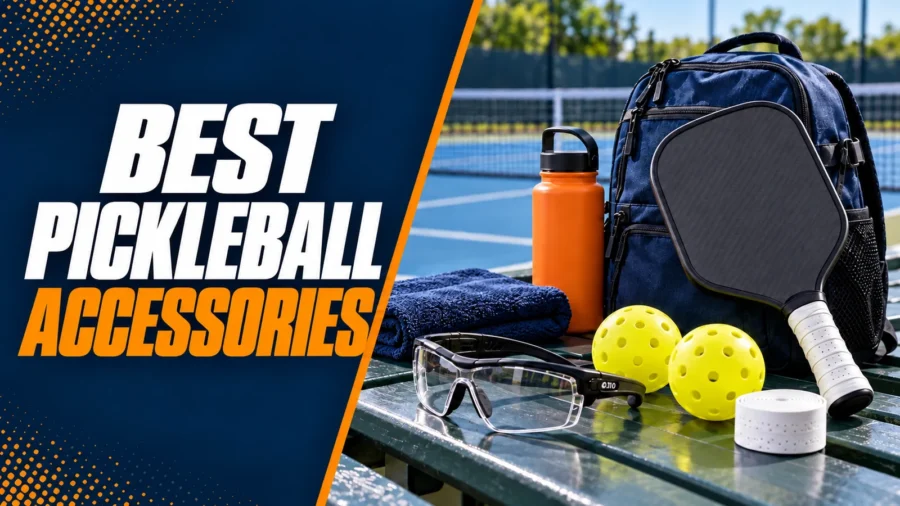
The most useful pickleball accessories in 2026 are impact-rated protective eyewear, the correct indoor or outdoor balls, a spare overgrip, edge tape and a compact court bag. Court shoes, hydration and sun protection matter more than novelty training gadgets, while a portable net is worthwhile only for players who regularly convert shared spaces into a court.
Buy accessories to solve a specific problem. A new player does not need a paddle cover, eraser, lead tape, rebound net and electronic sensor on day one, and some aftermarket changes can make a tournament paddle non-compliant if they go beyond the alterations allowed by current rules.
Best Pickleball Accessories at a Glance
| Accessory | Priority | Best for | Main caution |
|---|---|---|---|
| Protective eyewear | Essential | Every playing level | Choose impact-rated sport eyewear, not fashion glasses |
| Court shoes | Essential | Safe lateral movement | Fit and surface matter more than style |
| Indoor or outdoor balls | Essential | Venue-specific play | Tournament players should check approval and event model |
| Overgrip | High | Sweat control and grip sizing | Too many layers can round the handle bevels |
| Edge tape | Useful | Guarding the paddle edge | Added weight changes balance slightly |
| Paddle cleaner or eraser | Surface dependent | Raw carbon faces | Some cleaners can damage coatings or graphics |
| Pickleball bag | Useful | Organized transport | Oversized bags encourage unnecessary gear |
| Water bottle and towel | High | Warm venues and long sessions | Hydration needs vary by player and conditions |
| Portable net | Situational | Temporary courts | Check regulation height and tension |
| Court marking kit | Situational | Shared gym or driveway play | Use only where the owner permits markings |
1. Impact-Rated Protective Eyewear
Protective eyewear is the first accessory to add because close-range exchanges can send the ball toward the face with little reaction time. USA Pickleball highly recommends proper eye protection for all players, although recreational and tournament requirements can vary.
Look for clear impact markings from a recognized standard and a secure sport fit. Lenses should provide an unobstructed field of view, resist fogging and stay in place during quick changes of direction. Ordinary sunglasses may reduce glare but are not automatically designed for impact.
Prescription players can use certified protective frames with prescription inserts or lenses. Ask an optician or qualified sports-eyewear supplier which standard and lens material fit your needs.
2. Court Shoes
Running shoes are built mainly for forward motion, while pickleball requires repeated lateral shuffles, stops and pivots. A proper court shoe provides a wider, more stable platform and an outsole designed for multidirectional traction.
Choose fit before brand. The toes need room to spread, the heel should remain secure and the midfoot should feel supported without numbness. A durable hard-court outsole is the normal choice for outdoor acrylic, while indoor venues may have their own footwear rules.
Court shoes do not guarantee injury prevention, but they are a more appropriate tool for the movement demands of the game. Let them dry between sessions and use the material-safe methods in this guide to cleaning and maintaining tennis shoes.
3. The Correct Pickleball Balls
Keep balls that match the venue. Indoor balls customarily use larger holes and often feel softer, while outdoor balls generally use smaller holes and a firmer construction to cope with wind and rougher courts.
USA Pickleball rules permit approved balls across indoor or outdoor play, but tournament organizers select the event ball. Competitive players should verify that exact model and practice with it before the event.
Replace cracked, badly warped or inconsistent balls. Cold temperatures can make plastic more brittle, while heat can soften it and alter the shape, so avoid storing balls in a vehicle for long periods.
4. Spare Overgrips
An overgrip improves sweat absorption, traction and comfort without requiring a full replacement grip installation. Keep one or two spares in a sealed bag so they remain clean and dry.
Wrap with even overlap and consistent tension. Too many layers increase handle size, soften the bevels and may make grip changes less precise. If the handle is already too large, use a thinner grip rather than forcing another layer over it.
Change the overgrip when it becomes smooth, saturated or begins moving under the hand. Players who sweat heavily will need more frequent replacement than occasional indoor players.
5. Edge Guard Tape
Edge tape protects the guard from scrapes when a low ball brings the paddle close to the court. It is particularly useful for players who practice outdoors or frequently reach for dinks near their feet.
Apply only enough tape to cover the vulnerable area. Extra material adds weight around the perimeter and can make the paddle feel more head-heavy, even when the change is small on a scale.
Current USA Pickleball rules allow edge guard tape within specified placement limits, but tournament players should review the latest paddle-alteration section. Tape should never extend onto the face in a way that changes playing characteristics.
6. Paddle Eraser or Surface-Safe Cleaning Cloth
A purpose-made rubber eraser can lift ball residue from some raw carbon-fiber faces. It is not a universal paddle cleaner. Painted, coated, fiberglass and graphic surfaces may require a different method, and aggressive rubbing can alter appearance or finish.
Check the manufacturer’s care instructions for the exact model. When no eraser is recommended, a clean, slightly damp microfiber cloth followed by thorough drying is often the safer starting point.
Do not use household solvents, abrasive pads or sandpaper. Intentionally changing surface roughness can damage the paddle and may create an equipment-compliance issue.
7. A Practical Pickleball Bag
A dedicated bag keeps paddle faces away from keys, bottles and dirty shoes. Most players need space for two paddles, several balls, eyewear, a bottle, a towel and small personal items rather than a full tournament duffle.
Padded paddle sleeves and a ventilated shoe compartment are useful, but thermal lining cannot protect equipment left for hours in a hot car. Bring paddles indoors after playing and open damp compartments to dry.
A sling is enough for quick open play, while a two-strap backpack distributes a heavier load more comfortably. Buy the size that matches a normal session, not the maximum amount of gear you might carry once a year.
For model-specific storage options, the guide to the best pickleball bags and backpacks compares slings, everyday backpacks and tournament bags.
8. Water Bottle, Towel and Sun Protection
A leak-resistant bottle and small towel are simple accessories that get used every session. Outdoor players should also carry broad-spectrum sunscreen, a hat or visor and, where appropriate, electrolyte support.
Fluid needs depend on heat, humidity, session length, body size, health and sweat rate. Drink regularly and respond to thirst, but players with medical conditions or specific fluid restrictions should follow professional advice rather than generic targets.
Stop playing and seek help for concerning symptoms such as confusion, fainting, chest pain or severe weakness. Accessories support preparation, but they do not make extreme conditions safe.
9. Portable Pickleball Net
A portable net is worthwhile when you regularly play in a gym, driveway or multi-use court without a permanent system. The net should span the court correctly, remain stable and allow adjustment to the regulation 36in height at the sidelines and 34in at the center.
Compare total packed weight, setup time, frame replacement parts and the quality of the center support. A sagging recreational net changes passing-shot height and can create misleading habits.
If most local courts already provide nets, spend the money on court fees, lessons or replacement shoes instead. Ownership creates storage and transport work that occasional players may not need.
10. Court Marking Kit
Temporary lines make it possible to lay out a pickleball court on an approved shared surface. Weighted markers and removable tape are easier to store than painted lines, but they must remain flat so they do not become a trip hazard.
Always ask the facility or property owner before applying tape or chalk. Adhesive can mark wood, coatings and painted sports floors, and a full court needs adequate run-off beyond the 20ft by 44ft playing lines.
The dimensions and non-volley zones make more sense after reading how to play pickleball. Measure carefully rather than estimating from a badminton or tennis layout.
Useful Accessories for Competitive Players
Backup Paddle
A backup should be legal for the event and familiar enough to use immediately if the main paddle breaks. It does not need to be identical, but a similar weight, shape and grip size reduces adjustment.
Players still choosing their primary and backup can compare the best pickleball paddles for every level. Confirm the current approved-equipment list before sanctioned competition because certification status can change.
Small First-Aid Kit
Adhesive bandages, blister dressings and basic personal supplies can handle minor problems, but they are not a substitute for venue emergency procedures. Carry prescribed medication according to medical advice and know how to contact staff.
Match Notebook or Simple Phone Notes
A Pickleball match journal can record serve targets, unforced-error patterns and post-match observations without adding another training gadget. Keep notes short and actionable, such as “return through the middle” or “reset when stretched.”
Accessories That Are Optional, Not Essential
Weighted Tape
Weighted tape can increase stability, power or swing feel depending on placement. It can also slow the hand, change balance and aggravate discomfort if added without a clear purpose.
USA Pickleball permits weighted tape within its alteration rules, but a modified paddle must remain compliant. Add small, symmetrical amounts and stop if control or comfort deteriorates.
Paddle Covers
A cover protects the face inside an unstructured bag and is useful for travel. It adds little value when the bag already has individual padded compartments and the paddle is stored carefully.
Ball Retrievers
Pickup tubes and rolling collectors help coaches, clubs and players with limited mobility manage a large basket. A casual doubles group using three balls normally does not need one.
Training Targets
Flat targets or cones can add purpose to serves and dinks. Place them where they will not create a dangerous obstacle and prioritize repeatable decisions over trying to hit tiny targets on every ball.
Make Sure Accessories Follow the Rules
Tournament paddle alterations are limited. Current rules allow certain changes such as grip wrap, edge guard tape, weighted tape, approved OEM systems and identification markings, but they prohibit features that create excessive spin or otherwise make the paddle non-compliant.
Read the current rules of pickleball before modifying a competition paddle. Do not assume an accessory is legal because a retailer sells it.
Balls, nets and court dimensions also have defined requirements. These standards are one reason pickleball equipment should not be selected entirely by analogy with tennis, even though the differences between tennis and pickleball include several shared court-sport principles.
Players crossing over from padel should also note that the paddle, ball and enclosed-court systems are fundamentally different, as explained in padel versus pickleball.
A Sensible Buying Order for Beginners
- Start with an approved, comfortable paddle and the correct balls.
- Add court shoes and impact-rated eyewear.
- Buy a spare overgrip, bottle and small bag.
- Add edge tape or a paddle-specific cleaner only if needed.
- Buy a net and markers only when you have a regular temporary venue.
This order keeps the budget focused on playing rather than collecting equipment. Learn the rules, take a few sessions and let recurring needs determine the next purchase.
Final Verdict
Protective eyewear, proper court shoes and the correct balls provide more practical value than any novelty accessory. A spare overgrip, edge tape and surface-safe cleaning method help maintain the equipment you already own, while a sensible bag keeps it organized.
A portable net and marking kit can unlock more places to play, but they are situational purchases. The best accessory is one that solves a real court problem without compromising fit, safety or equipment compliance.