
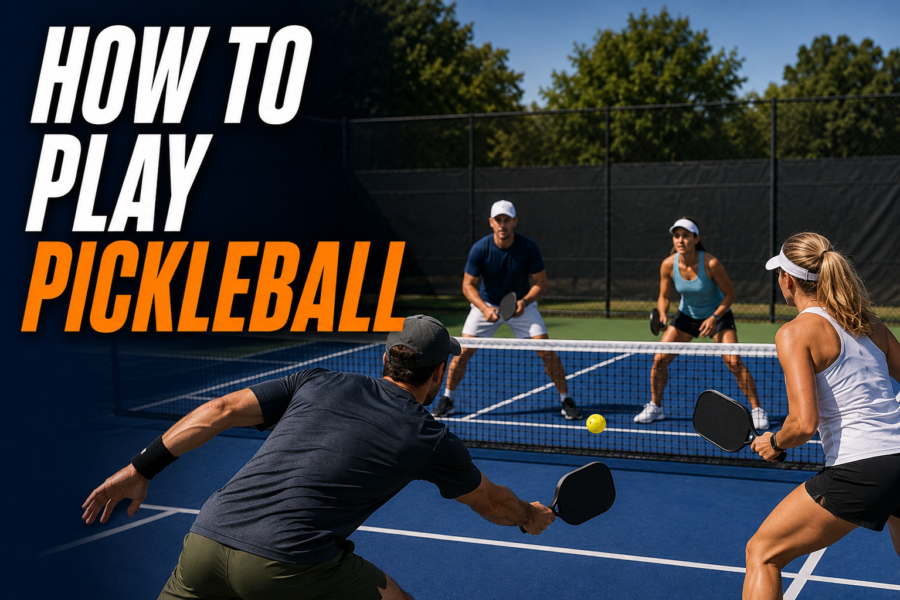
Pickleball is played by serving a perforated plastic ball diagonally, letting the serve and return bounce, and then using groundstrokes or volleys to win the rally. The fastest way to learn is to begin with doubles, use traditional side-out scoring, and focus on legal serves, controlled returns, and movement toward the non-volley-zone line.
This beginner guide follows the 2026 USA Pickleball rules but concentrates on what to do during a first game. For exact rule interpretations, scoring variants, and unusual situations, use the complete pickleball rules guide.
Pickleball Quick Start
| Step | What to do | Beginner priority |
|---|---|---|
| 1 | Start behind the baseline and serve diagonally | Put the ball in play rather than chasing speed |
| 2 | Let the serve bounce | The receiver cannot volley the serve |
| 3 | Let the return bounce | The serving team cannot volley the return |
| 4 | Move forward when the ball allows | Approach under control rather than running through contact |
| 5 | Rally from the non-volley-zone line | Use compact volleys and soft dinks |
| 6 | Call the score before each serve | Confirm the server, side, and score |
| 7 | Play to the agreed target | A common recreational game is to 11, win by 2 |
Those seven steps are enough to start a simplified game. The sections below explain how each part fits together.
What You Need to Play
A basic pickleball setup requires:
- a pickleball paddle for each player
- an indoor or outdoor pickleball suited to the court
- a court and net
- court shoes with suitable lateral support and traction
- comfortable sports clothing
Pickleball paddles are solid rather than strung. Beginners generally benefit more from manageable weight, a predictable response, and a comfortable grip than from a highly specialized power or spin design. The guide to the best pickleball paddles for every level provides the dedicated product-selection detail.
Check that the court is dry, clear of loose balls, and free from obvious trip hazards before playing. Warm up progressively and leave enough space between active courts when the venue allows it.
Learn the Court Before the First Rally
A standard pickleball court is 20ft wide and 44ft long for both singles and doubles. The net is 36in high at the sidelines and 34in at the center.
The non-volley zone extends 7ft from the net on each side. Its boundary line is part of the zone. Players usually call this area the kitchen.
| Court area | Why it matters |
|---|---|
| Baseline | The server begins behind it |
| Right and left service courts | The serve travels diagonally into one of these courts |
| Centerline | Separates the service courts |
| Non-volley zone | Players cannot volley while touching this area or its line |
| Sidelines and baseline | Define whether most rally balls are in or out |
The court is smaller than a tennis court, but successful doubles play is not simply miniature tennis. The two-bounce rule and non-volley zone change where players stand and how they construct a rally. The tennis vs pickleball comparison explains those wider differences.
Set Up a Beginner Doubles Game
Doubles is an accessible starting format because each player covers less space. Put two players on each side and choose service, receive, or end by any fair method.
Use traditional side-out scoring for the first game unless everyone has agreed to another format. A common recreational target is 11 points, win by 2.
At the start of a game:
- The first server begins in the right service area.
- The score is called as 0-0-2 under traditional doubles scoring.
- The server sends the ball diagonally into the opposite service court.
- Only one player on the starting team serves in the opening service sequence.
- When that team loses the rally, service moves to the other team.
The third number identifies whether the team is on its first or second server. Calling 0-0-2 at the start is a bookkeeping convention that accounts for the opening team having only one server before the first side out.
How to Serve in Pickleball
Stand behind the baseline between the imaginary extensions of the centerline and sideline. At least one foot must remain on the playing surface or ground behind the baseline when the ball is struck, and neither foot may touch the court, baseline, or area outside those extensions at contact.
Aim diagonally across the court. The serve must clear the non-volley zone and land in the correct service court. A serve that touches the net and then lands legally remains in play.
USA Pickleball permits two serving methods:
Volley serve
Strike the ball before it bounces. The paddle arm must move in an upward arc at contact, contact must not be above the waist, and the paddle head must not be above the highest part of the wrist.
Drop serve
Release the ball from a natural, unaided height and strike it after it bounces. Do not throw or propel it to create the bounce. The volley-serve arc, waist, and paddle-head requirements do not apply to a legal drop serve.
For either method, use a visible release and do not manipulate the ball to add spin before contact. Spin may be produced when the paddle strikes the ball.
For a first game, the drop serve can simplify the motion. Use a compact swing and aim well inside the service box rather than near a line.
Apply the Two-Bounce Rule
The two-bounce rule controls the first three shots:
- The served ball must bounce in the receiver’s court.
- The return must bounce in the serving team’s court.
- After those two required bounces, either side may volley or play the ball after one bounce.
The rule applies to the teams, not to one named player. In doubles, either partner may play the third shot after the return has bounced.
A frequent beginner error is serving and immediately running so close to the net that the return lands at the player’s feet. Stay behind the baseline long enough to play the required bounce, then move forward behind a controlled shot.
Move From the Baseline to the Non-Volley-Zone Line
The non-volley-zone line is usually the strongest doubles position once the two required bounces are complete. From there, players can take balls earlier and leave less open court in front of them.
Do not sprint forward regardless of ball quality. A high, slow return may allow both serving partners to advance quickly. A deep return may require a controlled third shot and one or more transition volleys before the team reaches the line.
Use this movement sequence:
- Split or settle as the opponent contacts the ball.
- Hit while balanced.
- Advance only while the ball’s height and direction permit it.
- Stop again before the next opponent contact.
- Arrive at the line together with a doubles partner when possible.
Moving as a pair reduces gaps. If one partner advances while the other stays deep, opponents can attack the space between them.
Understand the Kitchen During Play
The kitchen rule does not prohibit entering the non-volley zone. It prohibits volleying while touching the zone or its boundary line.
You may step into the kitchen to play a ball after it bounces. After hitting it, recover when there is time so the next ball cannot force an awkward volley while you remain inside.
Momentum also matters. If a player volleys from outside the zone and the follow-through carries that player, the paddle, clothing, or anything being carried into the zone, the result is a fault. This remains true even if the ball has already become dead.
Learn Four Basic Shots
Serve and return
Use margin over the net and away from the lines. A deep return often gives the receiving team more time to approach the non-volley-zone line.
Groundstroke
A groundstroke is hit after the ball bounces. Keep the swing controlled and recover toward a useful court position rather than admiring the shot.
Volley
A volley is struck before the ball bounces. Near the net, a compact block is usually easier to control than a large backswing.
Dink
A dink is a soft shot intended to bounce in the opponent’s non-volley zone. Its purpose is to keep the ball low and make an immediate attack more difficult, not simply to make the ball travel slowly.
Follow One Rally From Start to Finish
This example uses traditional side-out scoring in doubles.
- Team A’s server calls 0-0-2 and serves from the right.
- Team B lets the serve bounce and returns it deep.
- Team A lets that return bounce, satisfying the two-bounce rule.
- Team A plays a controlled third shot and begins moving forward.
- Team B, already near the non-volley-zone line, volleys the ball back.
- Both teams exchange lower shots until Team B sends one into the net.
- Team A wins the rally and scores because it was serving.
- The same server moves to the left and calls 1-0-2 before serving again.
If Team A had lost the rally, no point would have been added under side-out scoring. Because Team A began the game as server 2, service would have passed to Team B.
Keep Score Without Getting Lost
Traditional doubles scores contain three numbers:
- the serving team’s score
- the receiving team’s score
- the serving number, 1 or 2
For example, 6-4-1 means the serving team leads 6-4 and is using its first server. When that server loses a rally, the partner becomes server 2. If server 2 loses a rally, a side out transfers service to the opponents.
Singles uses two numbers because there is no second server. The server begins on the right when the server’s score is even and on the left when it is odd.
USA Pickleball also recognizes rally scoring as a provisional tournament option in specified 2026 circumstances. That does not make it the automatic format for a recreational game. Confirm the scoring system before playing and use the detailed rules page for the current tournament restrictions.
Beginner Doubles Strategy
Return deep and advance
The receiving team may approach immediately after the return because it has already allowed the serve to bounce. A deeper return creates more time to move.
Give the third shot a purpose
A soft third shot can create time to advance. A driven third shot can pressure a weak or high return, but a hard shot without enough margin often produces an early error.
Keep attackable balls low
When all four players are near the non-volley-zone line, height matters. A ball that sits well above net level is easier to attack than a low ball that must be lifted.
Protect the middle together
Partners should communicate about balls between them. Move laterally as a pair rather than leaving one player to cover both the middle and the sideline.
Choose consistency before power
Beginners usually gain more from one additional controlled ball than from attempting a low-percentage winner. Placement and recovery create the chance to attack a genuinely high ball.
Common Beginner Mistakes
| Mistake | Why it causes trouble | Better response |
|---|---|---|
| Volleying the serve or return | Breaks the two-bounce rule | Say “bounce, bounce” during early rallies |
| Rushing forward after serving | The return must still bounce | Hold behind the baseline until the return lands |
| Standing permanently in the kitchen | Removes the option to volley | Recover behind the line after playing a bounced ball |
| Using a large volley backswing | Reduces reaction time and control | Use a short block near the net |
| Hitting every ball hard | Raises the error rate | Build the rally until a higher ball appears |
| Advancing alone in doubles | Opens a gap between partners | Move forward and sideways as a pair |
| Forgetting the server number | Creates scoring disputes | Call the full score before every serve |
A Simple First Practice
| Time | Activity | Goal |
|---|---|---|
| 5 minutes | Easy cooperative groundstrokes | Find the bounce and paddle contact |
| 5 minutes | Crosscourt serves and returns | Build a legal, repeatable start |
| 5 minutes | Dinks from both non-volley-zone lines | Control height and direction |
| 5 minutes | One player volleys while one feeds | Learn compact preparation |
| 10 minutes | Half-speed game with score calls | Connect rules, movement, and scoring |
This is an example session, not a required training dose. Take additional rest and adjust the pace to the players, conditions, and available court time.
How to Improve After the First Game
Track one controllable goal at a time. A new player might aim to make eight of ten serves, return most balls deep enough to advance, or reach the non-volley-zone line without rushing through contact.
Do not change paddles to solve every technique problem. First check contact point, balance, swing size, and shot choice. If equipment is genuinely limiting grip comfort or control, compare verified specifications rather than choosing by promotional power claims alone.
If the sport itself is still unfamiliar, the pickleball beginner overview provides the short definition and background. This page deliberately keeps history brief so the playing sequence remains clear.
Final Checklist Before Playing
- agree on singles or doubles
- confirm side-out or rally scoring
- choose the game target and win-by-two requirement
- identify the first server and starting side
- call the score before every serve
- allow the serve and return to bounce
- respect the non-volley-zone rule
- stop play if a genuine court hazard enters the playing area
The first goal is not advanced shot-making. A legal serve, two controlled bounces, balanced movement, and clear score calls are enough to turn practice into a real pickleball game.
Frequently Asked Questions
Is singles played differently from doubles?
The court and core rally rules are the same, but singles has one server per side and a two-number score. One player covers the whole court, so positioning and recovery demands are different.
Can a beginner step into the kitchen?
Yes. A player may enter the non-volley zone to play a ball that has bounced. The restriction applies to volleying and the momentum created by a volley.
Does the return of serve have to be crosscourt?
No. The serve must travel diagonally into the correct service court, but the return may be directed anywhere inside the opponents’ court.
Can a serve touch the net?
Yes. If it touches the net and then lands in the correct service court beyond the non-volley zone, play continues.
Do beginners have to use rally scoring in 2026?
No. Traditional side-out scoring remains the normal starting format. Rally scoring is a provisional option for certain USA Pickleball tournament formats, so players should use the format announced for their event or agreed before recreational play.
Is pickleball easier than tennis or padel?
The basic rally and serve can be learned quickly, but the sports test different movement, positioning, and shot-selection skills. A player’s background and mobility affect which game feels easier.