
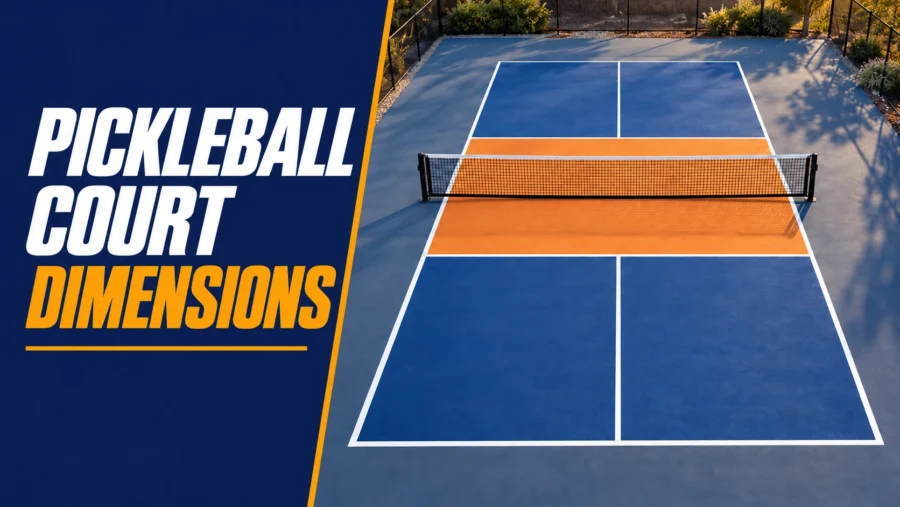
The official pickleball court is 20ft wide and 44ft long, and that size is used for both singles and doubles. Each non-volley zone extends 7ft from the net, the net measures 36in high at the sidelines and 34in at the center, and every court needs extra clear space around the painted lines for safe movement.
The marked court and the total playing surface are different measurements. The tables below distinguish the court lines, service areas, net and surrounding clearances, including which measurements include the lines themselves.
Official Pickleball Court Dimensions at a Glance
The measurements below follow the 2026 USA Pickleball rules. They apply to permanent courts, temporary taped courts and tournament courts unless a facility uses additional run-off space.
| Court feature | Official measurement |
|---|---|
| Marked court | 20ft × 44ft |
| Half-court from net to baseline | 22ft |
| Non-volley zone depth | 7ft on each side of the net |
| Service area depth | 15ft from the non-volley zone line to the baseline |
| Approximate service court size | 10ft × 15ft |
| Line width | 2in |
| Net height at sidelines | 36in |
| Net height at center | 34in |
| Net post spacing | 22ft |
| Minimum net length | 21ft 9in |
| Minimum playing surface | 30ft × 60ft |
| Preferred new or tournament surface | 34ft × 64ft |
| Stadium playing surface | 50ft × 80ft |
The 20ft × 44ft rectangle is the actual court. The larger playing-surface figures include the out-of-bounds area players use to stop, recover and chase wide or deep shots.
How a Pickleball Court Is Divided
The net divides the court into two equal halves measuring 20ft × 22ft. On each half, a non-volley zone line sits 7ft from the net, leaving 15ft between that line and the baseline.
A centerline divides the space behind the non-volley zone into left and right service courts. The centerline does not continue through the non-volley zone.
Baselines
The baselines run parallel to the net at the two ends of the court. A server must make contact with the ball while positioned behind the baseline and within the imaginary extensions of the centerline and sideline.
The baseline is part of the court. A rally ball touching any part of it is in.
Sidelines
The sidelines form the 44ft-long outer edges of the court. Unlike tennis, the same sidelines are used in singles and doubles, so the playable width always remains 20ft.
This is one reason singles pickleball can feel physically demanding despite the smaller court. One player must cover the full doubles width.
Non-Volley Zone
The non-volley zone, usually called the kitchen, is a 7ft × 20ft area on each side of the net. Its boundary line belongs to the zone, so touching that line while volleying is a fault.
Players may enter the kitchen to hit a ball after it bounces. The restriction is about volleys, not simply standing in the area. The full conditions, including momentum faults, are covered in the rules of pickleball.
Service Courts
Each half contains a right service court and a left service court behind the kitchen line. A serve travels diagonally into the opposite service court and must clear the non-volley zone line.
The centerline, sideline and baseline count as in on a serve. The non-volley zone line is the exception: a serve touching that line is short and therefore a fault.
How Pickleball Court Lines Are Measured
Official court dimensions are measured to the outside edge of the perimeter and non-volley zone lines. Court lines are 2in wide and should be a single, clearly contrasting color.
The 20ft × 44ft dimensions therefore include the perimeter lines. The diagonal between opposite outside corners is approximately 48ft 4in.
Pickleball Net Dimensions
A regulation net is at least 21ft 9in long and at least 30in from its bottom edge to its top. The posts sit 22ft apart and outside the 20ft sidelines, and the posts should be no more than 3in in diameter.
The top of the net must be 36in high at each sideline and 34in at the center. A center strap can hold a permanent net at the correct middle height.
A tennis net is 36in high at its center, 2in higher than the center of a regulation pickleball net.
How Much Total Space Does a Pickleball Court Need?
The smallest official playing surface is 30ft × 60ft. That leaves 5ft beyond each sideline and 8ft beyond each baseline, which can feel tight when players chase lobs or angled shots.
For new construction and tournament play, 34ft × 64ft is the better target. It provides 7ft of side clearance and 10ft beyond each baseline. A stadium court may use a 50ft × 80ft area to accommodate officials, broadcast equipment and more generous run-off space.
| Layout | Side clearance | Baseline clearance | Best suited to |
|---|---|---|---|
| 30ft × 60ft | 5ft per side | 8ft per end | Minimum recreational installation |
| 34ft × 64ft | 7ft per side | 10ft per end | New builds and tournament play |
| 50ft × 80ft | 15ft per side | 18ft per end | Stadium and showcase courts |
Clearance should remain free of benches, fences, bags and loose equipment. More space is particularly valuable around baselines because the two-bounce rule often keeps players deeper during the opening shots of a rally.
Pickleball Court Size Compared With Tennis
The marked tennis doubles court is 78ft long and 36ft wide, compared with pickleball’s 44ft × 20ft rectangle. Both sports need clear space beyond those boundaries, so the line dimensions alone do not determine a shared facility’s capacity.
For shared-court layouts and setup, follow the guide to adding pickleball lines to a tennis court. It explains conversion measurements, marking methods and net adjustments.
Indoor and Outdoor Court Sizes
The official dimensions do not change indoors. A regulation indoor court is still 20ft × 44ft with the same kitchen and net measurements.
The difference is usually the surface and surrounding space. Gym floors may be smooth and fast, while outdoor courts normally use textured acrylic over asphalt or concrete. Indoor venues must also account for walls, basketball supports, curtains and other obstacles outside the lines.
If you are deciding where to begin, the equipment and first-rally sequence in how to play pickleball explains how the court is used during a point. Players comparing sports can also see how the layout differs in padel vs pickleball.
Common Pickleball Court Measurement Mistakes
The most frequent mistake is treating 20ft × 44ft as the total space requirement. Those are only the painted boundaries, and a court squeezed into that exact footprint gives players nowhere to decelerate.
Other common errors include measuring to the inside of the lines, extending the centerline through the kitchen, setting the net to 36in at the center and drawing separate singles sidelines. Pickleball uses one 20ft-wide court for both formats.
Pickleball Court Dimensions FAQ
Is a pickleball court the same size for singles and doubles?
Yes. Singles and doubles both use a 20ft × 44ft court. Singles does not use narrower sidelines.
How big is the kitchen in pickleball?
Each non-volley zone is 7ft deep and 20ft wide, including its boundary lines. Together, the two zones occupy a 14ft-long strip centered on the net.
How far is the baseline from the kitchen line?
The distance is 15ft. This space is split by the centerline into two service courts that are approximately 10ft wide and 15ft deep.
Can a badminton court be used for pickleball?
The doubles badminton court shares the same 20ft × 44ft outer dimensions, which makes it a useful base. You still need pickleball-specific non-volley zone lines and a net set to pickleball height.
What is the smallest safe area for a pickleball court?
The official minimum playing surface is 30ft × 60ft. A 34ft × 64ft area is preferred for new construction and tournament play because it provides more run-off room.