
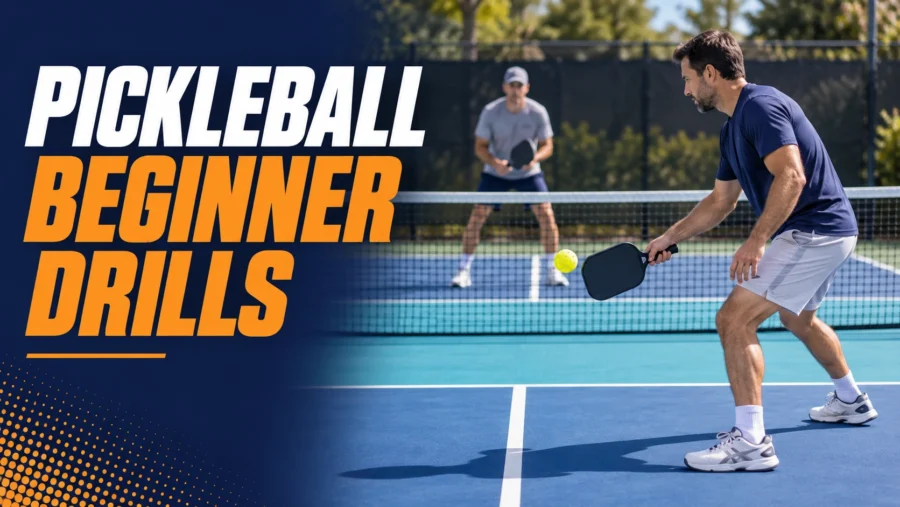
The best pickleball drills for beginners make one skill easier to repeat, then test it in a realistic rally. Start with controlled contact, serve and return accuracy, and balanced movement before adding faster volleys or difficult third-shot drops.
You do not need to complete every drill in one session. Choose two that address the mistakes you make most often, use the scoring targets below, and finish with a short game that requires those skills.
Set Up a Practice You Can Measure
Bring a paddle, several suitable pickleballs and a few flat markers. Keep spare balls outside the playing area, and pause to collect them before they become a movement hazard. Shoes should provide a secure fit and lateral support for the court surface.
For most drills, work in sets of 10 attempts. Count successful decisions as well as successful shots: a low ball played softly toward a sensible target is a better learning attempt than a lucky winner struck while falling backward.
The targets below are starting benchmarks, not official skill ratings. If fewer than half your attempts succeed, shorten the distance, slow the feed or enlarge the target. Progress when you can repeat the goal in two sets without rushing.
If serving order, the kitchen or the two-bounce rule is still unclear, learn the basic sequence in how to play pickleball before scoring practice games.
Drill 1: Drop, Hit and Recover
Purpose: Find a repeatable contact point on both groundstroke sides.
Stand near the service-court center with a partner on the opposite side of the net. Your partner waits outside the target lane and collects or catches the ball after its bounce. Drop the ball from a comfortable height, let it bounce, and send it gently into the opposite service court.
Use a short preparation, turn your shoulders and contact the ball with room between it and your body. After the shot, return the paddle to a ready position instead of watching the finish indefinitely.
- Dose: Two sets of 10 forehands and two sets of 10 backhands.
- Goal: Seven of 10 balls clear the net and land in the chosen service court.
- Easier version: Move closer to the net and reduce the swing.
- Progression: Have your partner hand-feed from a safe position, alternating slightly left and right so you must adjust your feet.
A common error is dropping the ball too close to the shoes and then folding the arm into the body. Place the drop far enough away to create a comfortable swing, while keeping it within easy reach. Do not try to solve cramped contact by flicking the wrist at the last moment.
Drill 2: Cooperative Kitchen Dinks
Purpose: Control height and distance on a slow ball.
Both players start just behind their kitchen lines. Begin with an easy underhand feed and let each ball bounce before returning it. Aim for the middle of the opposite kitchen, using enough height to cross the net without producing a ball that sits up comfortably for an attack.
Count the team’s consecutive successful shots. Restart the count after a miss, but identify whether the error came from height, distance or poor spacing before starting again.
- Dose: Three rounds of two minutes.
- Goal: Build a rally of six controlled dinks, then eight.
- Easier version: Allow a catch and re-feed between shots to establish the contact.
- Progression: Play crosscourt and alternate between a middle target and a slightly wider target.
You may enter the kitchen to play a bounced ball. The restriction concerns volleying and the associated momentum, so avoid treating the line as a barrier you can never cross. The complete pickleball rules explain the distinction.
Move your feet to create space. Reaching farther on every shot while the feet stay fixed usually ends with an uncontrolled paddle face.
Drill 3: Serve to a Large Deep Target
Purpose: Start points reliably without aiming for the lines.
Place flat markers to identify the rear half of the diagonal service court. Keep the target comfortably inside the sideline, centerline and baseline. Use a legal serve you can repeat; a simple drop serve is a useful option while learning.
Serve five balls from the right and five from the left. Record two numbers: how many serves were legal, and how many legal serves reached the deep target.
- Dose: Two sets of 10 serves, with a short collection break between sets.
- Goal: Eight legal serves, including five in the target.
- Easier version: Count any legal service-box landing.
- Progression: Choose the target before each serve, alternating deep middle and deep toward the receiver’s less comfortable side.
If depth causes frequent long serves, move the target farther inside the baseline and reduce effort slightly. A repeatable in-bounds serve provides more useful practice than occasional maximum-speed successes.
The kitchen line is out on a serve. Do not confuse a short serve that clips that line with a valid short target.
Drill 4: Return, Advance and Settle
Purpose: Connect a deep return with controlled movement toward the kitchen.
One player serves normally. The receiver aims into the rear half of the server’s court, then moves forward. The server allows the return to bounce and sends the third shot back at a manageable pace.
The receiver should settle into a balanced ready action around the server’s contact, wherever they have reached. If still in transition, play the next ball from there instead of continuing to run through the shot.
- Dose: Ten return sequences each, then switch roles.
- Goal: Six sequences with a legal return, forward progress and balanced next contact.
- Easier version: The server uses a gentle feed to start the rally.
- Progression: Vary serve depth and make the receiver decide how far they can advance before setting their feet.
Do not score arrival at the kitchen as the only success. A player who returns well and makes a controlled transition shot has learned more than one who reaches the line but is still running when the ball arrives.
Drill 5: Compact Volley Rally
Purpose: Learn a controlled reply to a ball that arrives before bouncing.
Start just behind the kitchen lines with both players balanced. Feed gently above net height and exchange compact volleys toward each other’s central hitting area. Keep the pace low enough that neither player needs to protect the face or make an uncontrolled swing.
Let an awkward low feed bounce and restart. This is a control exercise, so forcing every ball out of the air defeats the purpose.
- Dose: Four rounds of 30 seconds, with a short pause between rounds.
- Goal: Five consecutive controlled volleys with the paddle recovering after each shot.
- Easier version: One player feeds from farther back while the other volleys to a large target.
- Progression: Alternate gentle forehand and backhand feeds without increasing speed.
Use a short action and a stable face. A large backswing makes the next contact harder to organize. Also check that your feet and momentum stay clear of the kitchen when volleying; winning the exchange does not make a foot fault legal.
Drill 6: Build a Drop From Short to Long
Purpose: Develop the distance control needed for a third-shot drop.
One player stands near the kitchen line to feed and observe. The other begins halfway between the baseline and kitchen line and receives a gentle bounced ball. Play a soft arc that lands in the opposite kitchen, ideally leaving the observer with a low contact rather than an easy downward volley.
Begin close enough that you can lift the ball comfortably. Move back a small step after a successful set rather than starting every attempt from the baseline.
- Dose: Three sets of 10 balls from the current distance.
- Goal: Six drops land in the kitchen or produce a clearly low contact for the observer.
- Easier version: Drop-feed yourself or start closer to the kitchen.
- Progression: Move back toward the baseline, then have the feeder alternate slightly shorter and deeper balls.
A drop that lands in the kitchen after traveling very high may still have been attackable before bouncing. Ask your partner about the available volley, not only where the ball landed.
Keep the swing smooth. Slowing the paddle abruptly before contact often leaves the ball in the net, while scooping with a sudden open face can make it float.
Drill 7: Reset and Take One Step Forward
Purpose: Stop, control a difficult ball and advance behind a useful reply.
The feeder stands behind the opposite kitchen line. The learner starts in the transition area and receives a gentle ball around knee height after the bounce. The learner sends it softly toward the kitchen, then advances only if the reply would make the feeder contact low.
The feeder catches or stops the ball after assessing the result, so the learner can reset without a rushed chain of feeds. Increase realism after the control is repeatable.
- Dose: Two sets of 10 feeds each.
- Goal: Six controlled resets, each followed by an appropriate move or hold.
- Easier version: Use slower feeds and start closer to the kitchen.
- Progression: Play three live shots, with the learner moving between contacts but settling before each reply.
Keep grip pressure secure without squeezing continuously. If the ball rebounds too fast, check the face angle and swing size before making the grip excessively loose.
Drill 8: Serve, Return and Third Shot
Purpose: Join separate skills into the opening of a real point.
Play only the first three shots, then stop and score the sequence. The server serves, the receiver returns and advances, and the server allows the ball to bounce before playing the third shot.
Award one practice point for each of these outcomes: a legal serve, a return into the rear half and a third shot chosen appropriately for the incoming ball. For the third shot, a controlled drop is reasonable from a deep, low return; a balanced drive can be reasonable from a shorter, higher return.
- Dose: Five sequences with each player serving.
- Goal: Score at least two of the three practice points in seven sequences out of 10.
- Easier version: Use gentle serves and cooperative returns.
- Progression: Play the rally out after the third shot, while keeping the opening-sequence score separate from who wins.
These are drill points, not standard pickleball scoring. Separating them helps prevent a lucky final result from hiding a poor earlier decision.
A 30-Minute Beginner Practice
| Time | Activity | What to record |
|---|---|---|
| 0–4 minutes | Comfortable movement and drop-hit contacts | Which side needs more spacing work |
| 4–9 minutes | Cooperative dinks | Best controlled rally count |
| 9–15 minutes | Serve targets, alternating turns | Legal serves and deep-target hits |
| 15–21 minutes | Return, advance and settle | Balanced three-shot sequences |
| 21–26 minutes | Drop or reset drill | Successful low-contact outcomes |
| 26–30 minutes | Opening-sequence game | Good decisions as well as rallies won |
Include ball collection within each block. If only one court is available, take turns feeding rather than leaving loose balls behind an active player.
A predictable paddle response makes these exercises easier to assess. The guide to pickleball paddles for different playing levels explains what to look for, but changing equipment after every difficult session makes it harder to identify a technical pattern.
Keep a three-number record after practice: serve percentage, best dink rally and controlled return sequences. Repeat the same drills next time before making them harder. A small, repeatable improvement is a better reason to progress than one unusually good rally.