
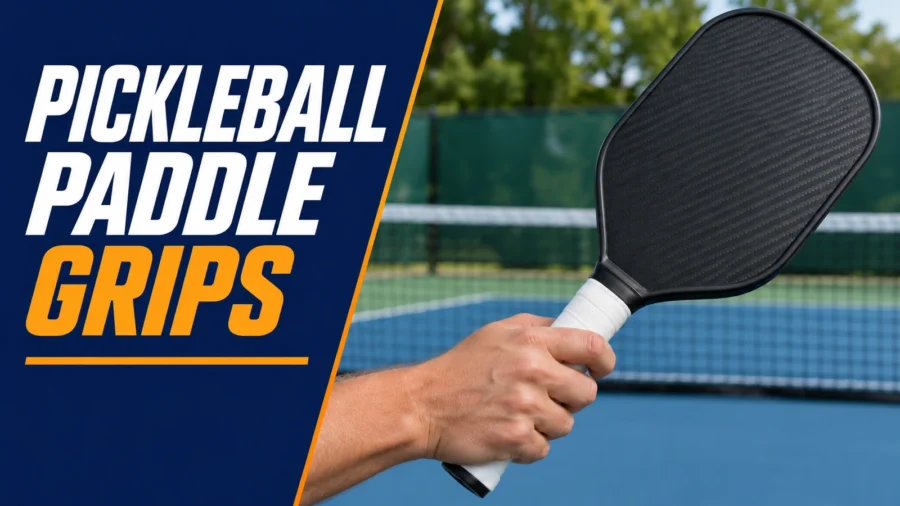
The best way for a beginner to hold a pickleball paddle is with a relaxed continental grip, similar to shaking hands with the handle. It keeps the paddle in a neutral position, makes forehand-to-backhand changes quick and works for serves, dinks, volleys, blocks and resets without a major grip change.
Eastern and western-style grips can add advantages on particular forehands, but they also make the opposite side or soft game more difficult. Start neutral, learn to control grip pressure and only rotate the hand when a specific shot gives you a reason.
How to Hold a Pickleball Paddle Step by Step
- Hold the paddle face upright with your non-dominant hand.
- Place your dominant hand on the face, then slide it down toward the handle as if shaking hands with the paddle.
- Wrap your fingers around the handle without burying it deep in the palm.
- Keep the index finger slightly separated from the other fingers for control.
- Form a relaxed V between the thumb and index finger along the top edge of the handle.
- Hold at roughly 3 out of 10 pressure for neutral rallies, then firm up briefly when a harder shot requires stability.
The exact hand position varies with handle shape and bevels. Some paddles have a clear octagonal grip, while others feel rounder. The important result is a square, controllable face on both forehands and backhands.
If you are learning the sport from the beginning, combine this grip with the sequence in how to play pickleball rather than trying to master specialized grips first.
The Continental Grip
The continental grip is the most versatile pickleball grip and is commonly taught to beginners. It is widely used because the paddle can move between forehand and backhand volleys without a large hand adjustment.
To find it, use the handshake method. On a clearly beveled handle, the base knuckle of the index finger sits near the second bevel for a right-handed player. Left-handed players use the mirrored position.
Advantages
- Fast transitions between forehand and backhand
- Neutral paddle face for blocks and resets
- Useful for dinks, volleys, overheads and serves
- Less need to change grips during quick exchanges
Limitations
- Less natural topspin on an aggressive forehand than a more rotated grip
- Some players initially feel stronger on the backhand than the forehand
- A late contact point can leave the forehand face open
The continental grip is still the best home base because pickleball exchanges near the kitchen happen too quickly for a large grip change on every ball.
The Eastern Forehand Grip
From continental, rotate the hand slightly behind the handle so the palm sits more naturally behind a forehand. On a beveled handle, the index knuckle moves toward the third bevel for a right-handed player.
The eastern grip can make forehand drives and serves feel more direct. It closes the face slightly and supports a low-to-high swing for controlled topspin.
Its weakness appears on backhands and reaction volleys. If you leave the hand in a strong eastern forehand position, the backhand face may open and require a late wrist correction. Players who use this grip should learn either a small, early change or a two-handed backhand.
Best for
- Forehand drives from the baseline
- Players whose game is built around a forehand third shot
- Serves that use a controlled upward swing
Be careful when
- Defending fast balls at the body
- Blocking on the backhand side
- Dinking in a rapid forehand-backhand exchange
The Western and Semi-Western Grip
A western-style grip rotates farther under the handle, closing the forehand face and making a steep upward swing more natural. Some advanced players use a mild semi-western version for heavy forehand topspin.
Extreme rotation is less practical in pickleball than in baseline tennis. The smaller court produces quick body attacks, compact volleys and frequent backhands, so a grip that strongly favors the forehand can create a major defensive weakness.
Use it as a specialized option rather than the default. If the paddle face points sharply toward the ground in the ready position, you may be rotating farther than your current technique can support.
Best for
- Advanced forehand topspin drives
- Players who change grips early and consistently
- Specific baseline or speed-up patterns
Main drawbacks
- Awkward backhand blocks without a grip change
- Harder neutral dinks and resets
- Greater timing demand in fast exchanges
The Two-Handed Backhand Grip
A two-handed backhand uses the dominant hand as the base and adds the non-dominant hand above it. For a right-handed player, the right hand often stays near continental while the left hand supplies leverage and face control.
This setup can add stability on drives, counters and some backhand dinks. It also reduces reach, especially with a short handle, and requires enough space for both hands.
Do not force the second hand onto a handle that is too short. Paddle shape and handle length influence whether the grip feels natural, which is one reason the best pickleball paddles for every level should be compared by fit as well as face material.
Grip Pressure Matters as Much as Grip Style
Many control problems come from squeezing rather than hand placement. A tight grip makes the paddle rebound more rigidly, reduces touch and can tire the forearm.
Use a pressure scale from 1 to 10:
- 2–3: Dinks, drops, resets and soft blocks
- 4–5: Neutral volleys and controlled drives
- 6–7: Briefly at contact for a hard counter or overhead
- 8–10: Usually unnecessary and difficult to sustain
Pressure should change during the point. Keep the hand relaxed in the ready position, firm it for stability at contact and release tension immediately afterward.
USA Pickleball’s instruction on resets emphasizes a loose grip and compact motion because excessive pressure sends the ball away too firmly. The same principle applies to defensive volleys near the non-volley zone.
Where Should Your Hand Sit on the Handle?
Most players should place the dominant hand close to the bottom of the handle without hanging the little finger off the butt cap. This preserves reach and leaves room for a second hand on longer handles.
Choking up can improve control and shorten the lever for fast hand battles. Holding very low can add reach and leverage but may make the paddle feel less stable. Test one position at a time instead of sliding randomly during every rally.
The handle should fill the fingers enough that you can hold it securely without crushing it. An overgrip can change circumference, tack and moisture management, but too many layers can round off the bevels.
Ready Position After You Set the Grip
A good grip is less useful if the paddle starts below the waist. In neutral play, keep the paddle in front of the chest, elbows slightly forward and the tip generally up.
At the kitchen, bias the face slightly toward the most likely contact while staying able to cover both sides. Against an opponent who favors a forehand speed-up, a small backhand bias may protect the body, but do not lock the wrist into one position.
Grip and ready position should support the rules rather than distract from them. The guide to pickleball rules explains the serve, two-bounce requirement and non-volley zone.
Should You Change Grips During a Rally?
Small changes are normal for experienced players, especially between a baseline forehand and a two-handed backhand. Large changes are risky during fast exchanges because the ball can arrive before the hand settles.
Use continental as the recovery grip. If you rotate for a forehand drive, return toward neutral as the opponent contacts the next ball. Practice the change deliberately so it does not depend on looking at the handle.
At the kitchen, minimize changes. A neutral grip and adaptable paddle angle usually cover more situations than committing to an extreme forehand position.
Common Pickleball Grip Mistakes
Holding the Paddle Like a Frying Pan
If the palm sits fully under the handle and the paddle face points upward, the grip encourages pop-ups and makes backhands difficult. Rotate toward a handshake position.
Squeezing at Maximum Pressure
Constant tension reduces touch and slows hand changes. Relax between contacts and use only enough pressure to keep the paddle stable.
Putting the Thumb Straight Up the Back
A thumb extended high along the handle can limit range of motion. Keep it wrapped comfortably unless a specialized two-handed or backhand technique calls for a brief adjustment.
Copying a Tennis Forehand Grip Everywhere
A semi-western tennis grip may feel powerful on a drive but leave the backhand exposed at the kitchen. Pickleball’s shorter reaction time rewards a more neutral default.
Ignoring Handle Size
A grip that is too large can make changes slow, while a very small handle may encourage squeezing. Adjust with a replacement grip or overgrip in small steps.
Three Drills to Find the Right Grip
1. Forehand-Backhand Wall Blocks
Stand close enough to a practice wall for compact rebounds. Alternate forehand and backhand blocks with a continental grip. Complete sets of 20 without changing the grip or swinging.
2. Grip-Pressure Dinks
Hit five dinks at pressure 2, five at pressure 4 and five at pressure 6. Notice how the ball leaves the face. The goal is to learn a usable range, not prove that the loosest grip is always correct.
3. Drive and Recover
Hit a forehand drive with a mild eastern grip, then return to continental before your partner feeds a backhand volley. Begin slowly and increase pace only when the change happens without looking.
Players coming from tennis should also read the tennis vs pickleball comparison because similar grip names do not produce identical decisions on the smaller court.
Are Grip Adjustments Legal?
USA Pickleball rules allow replacement grip wrap and changes to grip size through inserts, provided the paddle remains compliant with equipment rules. Non-mechanical devices that change grip size or stabilize the hand are addressed by the rulebook.
Tournament players should use a paddle on the approved list and avoid modifications to the face. A legal overgrip does not make an otherwise non-compliant paddle legal.
Final Takeaway
Use a relaxed continental grip as the default way to hold a pickleball paddle. It gives beginners the simplest path between forehands, backhands and soft shots. Add a mild eastern grip for selected forehand drives or a two-handed backhand when those choices solve a real problem, then recover to neutral before the next fast exchange.