
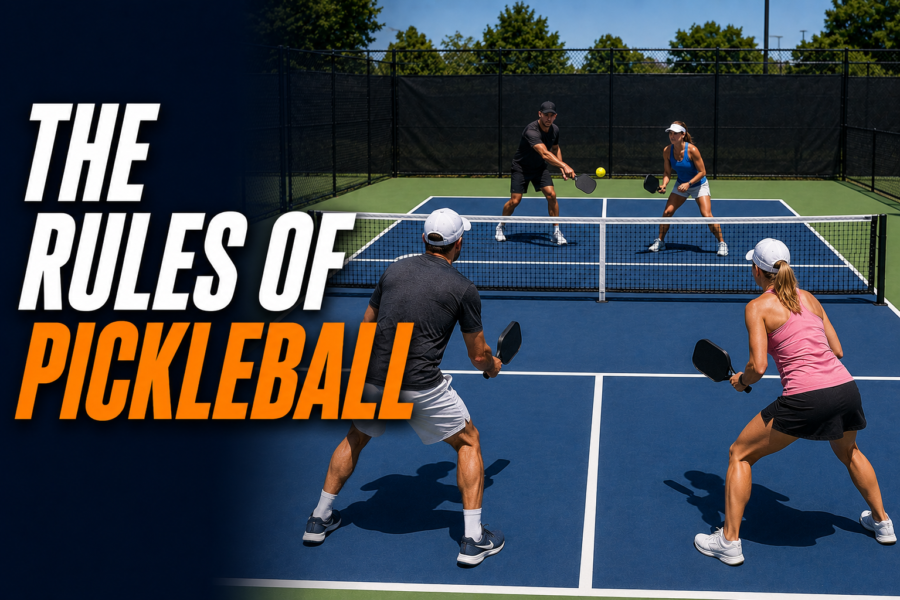
Pickleball rules determine how the serve starts, when the ball must bounce, where players may volley, who scores, and what ends a rally. Under traditional side-out scoring, only the serving player or team scores. USA Pickleball also permits provisional rally scoring in specified 2026 tournament situations, but that option is not a universal replacement for recreational side-out scoring.
This guide is based on the 2026 USA Pickleball Official Rulebook and change document. Other sanctioning bodies, tours, leagues, and local organizers may publish different formats, so an event’s stated rules control its competition.
Pickleball Rules at a Glance
| Rule | 2026 USA Pickleball position |
|---|---|
| Court | 20ft by 44ft for singles and doubles |
| Serve | Diagonal, one attempt, using a legal volley serve or drop serve |
| Serve landing | Must clear the non-volley zone and land in the correct service court |
| Two-bounce rule | The serve and return must each bounce before either team may volley |
| Non-volley zone | No volley while touching the zone or its boundary line |
| Traditional scoring | Only the serving side scores |
| Common game target | 11 points, win by 2 |
| Rally scoring | Provisional tournament option in specified formats; every rally produces a point |
| Line calls | A ball touching a line is in, except a serve touching the non-volley-zone line is short |
| Net-touching serve | Remains live if it otherwise lands legally |
Beginners who need the playing sequence rather than the full rule framework should start with the guide to how to play pickleball.
Court, Net, and Lines
A regulation court is 20ft wide and 44ft long. The dimensions are the same for singles and doubles. The net is 36in high at the sidelines and 34in at the center.
The non-volley zone extends 7ft from each side of the net. Its boundary lines are part of the zone.
The service courts sit behind the non-volley zone and are divided by the centerline. On a serve, the non-volley-zone line is out because the ball has not cleared the zone. The centerline, sideline, and baseline of the correct service court are in.
For a rally ball after the serve, a ball that touches any court boundary line is in. A ball must land completely outside the line to be called out.
Equipment Rules
Players use an approved paddle and ball in sanctioned competition. The USA Pickleball Equipment Standards Manual operates alongside the rulebook, and tournament equipment may be inspected against the current approved lists.
Recreational players should still use equipment intended for pickleball and follow venue restrictions. Equipment approval, paddle modifications, and ball selection can change, so tournament entrants should check the applicable event information rather than assuming every retail paddle remains eligible. The guide to the best pickleball paddles for every level explains the main buying considerations for recreational play.
How a Game Begins
Any fair method may determine the first choice of service, receive, side, or deferral. The chosen server begins from the right service area unless a rule-based score adjustment changes the correct position.
The score must be called before the serve. In traditional doubles scoring, it contains the serving team’s score, receiving team’s score, and server number. In singles, it contains the two players’ scores.
Pickleball Serving Rules
Only one serve attempt is permitted unless a rule requires a replay. The server must use the correct court and serve diagonally to the correct receiver.
Service-foot position
When the paddle contacts the ball:
- neither foot may touch the court or baseline
- at least one foot must be on the playing surface or ground behind the baseline
- the feet may not touch outside the imaginary extensions of the sideline and centerline
Ball release and spin
The release must be visible to the referee and receiver, or to the receiver in an unofficiated match. The server may not manipulate the ball with the hand, body, or paddle to add spin before it is struck, although natural rotation may occur.
The paddle may impart spin at contact. In 2026, the rulebook expressly clarifies that the restriction concerns manipulation before contact, not spin created by the paddle strike.
Volley serve
A volley serve is struck before the ball bounces. At contact:
- the serving arm must move in an upward arc
- contact cannot be above the waist
- the highest point of the paddle head cannot be above the highest part of the wrist
The ball may be released with one hand or from the paddle as allowed by the rulebook. A player who cannot use one hand may use the paddle to release the ball.
Drop serve
For a drop serve, the ball is released from a natural, unaided height and struck after bouncing. It cannot be thrown, tossed upward, or forced downward to create the bounce.
The upward-arc, waist-contact, and paddle-head restrictions for a volley serve do not apply to a legal drop serve. Service-foot position, visible release, and no pre-contact manipulation still matter.
Where the serve must land
The serve must travel diagonally, clear the opponent’s non-volley zone, and land in the correct service court. It may touch the net on the way.
A net-touching serve is not automatically replayed. If it lands legally, the ball remains live. If it lands on the non-volley-zone line, in the wrong court, or out, it is a fault.
The Two-Bounce Rule
The receiving team must let the serve bounce before returning it. The serving team must then let that return bounce before playing the third shot.
After one bounce has occurred on each side, players may volley or play the ball after a bounce. A team violates the rule if it volleys the serve or volleys the return before the required second bounce.
“Two-bounce rule” refers to one required bounce on each team’s side, not two bounces on the same side. A second bounce before a legal return normally ends the rally.
Non-Volley-Zone Rules
The non-volley zone, or kitchen, restricts volleys rather than all player movement.
A player may:
- enter the zone at any time without volleying
- play a ball that has bounced in the zone
- stand in the zone while the ball is elsewhere, provided the player does not volley
- leave the zone and volley after both feet have established contact outside it
A player commits a fault by volleying while touching the zone or its line. The restriction also includes anything the player is wearing or carrying.
Momentum after a volley
The act of volleying continues until the player’s follow-through momentum ends. A player who volleys from outside the zone and then falls or steps into it because of that momentum commits a fault, even if the returned ball has already become dead.
Contacting a partner or object that is touching the zone can also create a fault when that contact is part of the volleying player’s momentum. Regaining balance outside the zone matters before making contact with it.
Traditional Side-Out Scoring
Traditional side-out scoring awards points only to the serving side. A common recreational game is played to 11 and must be won by 2. Approved tournament games may use targets of 15 or 21, also with a two-point margin.
Doubles score call
The score contains three numbers. For example, 7-5-1 means:
- the serving team has 7
- the receiving team has 5
- the team is using server 1
Both partners normally receive a service turn before a side out. The exception is the team that serves first in a new game: only one partner serves in that opening sequence, so the starting score is called 0-0-2.
When the serving team scores, its players switch right and left service courts and the same server continues. When the first server loses a rally, the partner serves from the partner’s correct position. When the second server loses, service passes to the opponents.
Players do not change their starting positions merely because the receiving team wins a rally. Correct server and receiver positions are tracked through the team’s score and its starting server.
Singles score call
Singles uses two numbers because each side has one player. The server serves from the right when the server’s score is even and from the left when it is odd.
Under side-out scoring, a receiver who wins a rally gains service but not a point. The new server uses the side determined by the new server’s existing score.
Provisional Rally Scoring in 2026
Rally scoring awards a point to the player or team that wins each rally, whether serving or receiving. Under the 2026 rule, the receiving side can also score the game-winning point. The earlier provisional restriction that required the final point to be won on serve no longer applies.
This remains an optional, provisional USA Pickleball tournament format. A tournament director may choose it within the rulebook’s permitted structure, but it is excluded from double-elimination doubles events, 2026 USA Pickleball Golden Ticket events, and the 2026 USA Pickleball National Championships.
Permitted rally-scoring match formats include:
- one game to 11, 15, or 21
- best two of three games to 11, 15, or 21
- best three of five games to 11, 15, or 21
Games still require a two-point winning margin. The rulebook also allows an approved weather-related reduction to 7 points in specified tournament circumstances, with the end change at 4.
Rally scoring changes point allocation and doubles service sequence, so players should not mix its score call with traditional 0-0-2 side-out scoring. Check the event format before warm-up.
| Question | Traditional side-out | 2026 provisional rally scoring |
|---|---|---|
| Who scores after a rally? | Serving side only | Rally winner |
| Can a receiver score game point? | No ordinary point while receiving | Yes |
| Doubles service sequence | Both partners normally serve before side out | Uses the rally-scoring sequence stated by the rulebook |
| Default for a casual game? | Common starting choice | Use only when agreed |
| Universal at sanctioned tournaments? | No single format fits every event | No, optional and restricted |
Singles Rules
Singles uses the full 20ft by 44ft court. The server serves from the right at an even score and the left at an odd score.
The same serve, two-bounce, non-volley-zone, line-call, and fault rules apply. Because there is no partner, singles has no second-server phase under traditional scoring.
Doubles Rules
In doubles, the correct server serves to the correct receiver. Partners may stand anywhere on their own side as long as their positioning does not violate another rule or interfere improperly.
Stacking is legal. The server and receiver must be in their correct positions, but their partners may arrange themselves to reach a preferred formation after the serve.
Under traditional scoring, both partners normally serve before a side out. Players should track the starting server rather than relying only on where everyone happened to finish the previous rally.
Faults That End a Rally
Common faults include:
- serving into the net or outside the correct service court
- committing a service-foot or service-motion violation
- volleying before the required bounce on each side
- volleying while touching the non-volley zone or its line
- allowing the ball to bounce twice before returning it
- hitting the ball out of bounds
- failing to send the ball over the net
- touching the net or net post while the ball is live
- being struck by the live ball before it becomes dead, subject to the applicable rule
- hitting a permanent object before the ball bounces in the opponent’s court
- having both doubles partners hit the ball to make one return
A ball can contact one player’s paddle more than once during a continuous, single-direction stroke. The 2026 wording recognizes that even a rare triple contact can be legal under that condition. Separate strokes or a two-player hit are faults.
Line-Call Rules in Unofficiated Play
Players make calls on their own end of the court. An out call must be made promptly, and the opponent receives the benefit of doubt.
If doubles partners disagree about whether a ball was out, the team’s call is in. Spectators must not be consulted to decide a line call.
A player should call only a ball that can be clearly seen out. If the space between the ball and line cannot be seen, the ball is treated as in.
Replays, Lets, and Hinders
Pickleball has no automatic service let for a serve that clips the net and lands correctly. Play continues.
A rally may be replayed for a valid hinder, such as a stray ball entering the playing area and affecting play, or another situation for which the rulebook prescribes a replay. A player cannot manufacture a replay to escape an ordinary fault.
In an officiated match, the referee determines whether a claimed hinder affected play. In a recreational game, stop promptly when a real safety issue enters the court and resolve the situation cooperatively.
Balls Around or Back Over the Net
A return normally crosses over the net. An around-the-post shot can be legal because it does not need to pass between the net posts or above the net height.
If spin or wind causes a ball to bounce in the opponent’s court and return over the net, a player may reach over the net plane to strike it after the bounce. The player may not touch the net system or the opponents’ court while the ball is live, and cannot strike the ball before it first crosses to that player’s side.
These are edge cases, not beginner technique priorities. The tennis vs pickleball comparison explains why the shared net-and-court appearance does not make the two rule systems interchangeable.
Match and Tournament Formats
Scoring format and competition structure are separate choices.
| Competition structure | What it means |
|---|---|
| Single elimination | One loss removes a player or team from the draw |
| Double elimination | A second loss is normally required for elimination |
| Round robin | Each entry plays the other entries in its group |
| Pool play plus playoff | Group results determine advancement to an elimination stage |
| Team event | Results from multiple lineups or matches contribute to a team outcome |
The tournament director publishes the draw structure, match format, scoring method, ball, court procedures, and any approved modifications. “Round robin” does not automatically mean rally scoring, and “double elimination” does not automatically mean one fixed game target.
Rules for Wheelchair and Adaptive Play
USA Pickleball publishes specific adaptations for wheelchair and adaptive competition. For example, wheelchair players may receive a second bounce and fault on a third, while rear-wheel position controls parts of the non-volley-zone and service rules.
Those adaptations should be checked in the dedicated current rules rather than inferred from standing play. A local accessibility accommodation also should not be mistaken for an unauthorized competitive advantage.
Common Rules Disputes Resolved
A serve clips the net and lands in the correct service court
The ball is live. There is no automatic replay.
A player steps into the kitchen after a groundstroke
Legal. The non-volley-zone restriction applies to volleying.
A volley winner is dead before momentum carries the player into the kitchen
Fault. The momentum rule continues even after the ball becomes dead.
Doubles partners disagree on an out call
The ball is in.
The receiver wins a rally under traditional scoring
The receiver does not earn an ordinary point. Service advances according to singles or doubles side-out rules.
The receiver wins game point under an announced 2026 rally-scoring format
The receiver earns the point and may win the game because every rally can produce the winning point under the 2026 provisional rule.
A ball lands on the service-box sideline
In. The exception is the non-volley-zone line, which makes a serve short.
Final Rules Checklist
- confirm the governing rules and scoring format
- call the complete score before serving
- serve from the correct side to the correct receiver
- let the serve and return bounce
- treat the non-volley-zone line as part of the zone
- make prompt, honest line calls and give opponents the benefit of doubt
- distinguish a net-touching live serve from a true replay
- check event-specific rally scoring and match-format notices
For the sport’s short definition and background, see the pickleball beginner overview. Its origin and growth are separate from the precise rules applied to a 2026 match.
Frequently Asked Questions
Can players switch sides in doubles?
Players switch right and left when the scoring and service rules require it. Partners may also use legal stacking, but the correct server and receiver must still begin in their correct positions.
Can a player touch the kitchen line?
Yes, except while volleying or when volley momentum causes the contact. The line is part of the non-volley zone.
Is an underhand serve the whole service rule?
No. A volley serve has upward-arc, contact-height, paddle-head, release, foot-position, and placement requirements. A drop serve removes the three volley-motion tests but retains the other applicable requirements.
Must every game be played to 11?
No. Eleven is common, but approved formats can use other targets. Players must know the announced target, winning margin, match format, and scoring system.
Is rally scoring now mandatory?
No. USA Pickleball treats it as a provisional tournament option in 2026, with explicit restrictions. Recreational groups may agree on a format before play.
Where can a beginner learn positioning and tactics?
This page owns rules rather than stroke instruction. The beginner playing guide covers serving execution, movement to the non-volley-zone line, basic shots, and a complete example rally.