
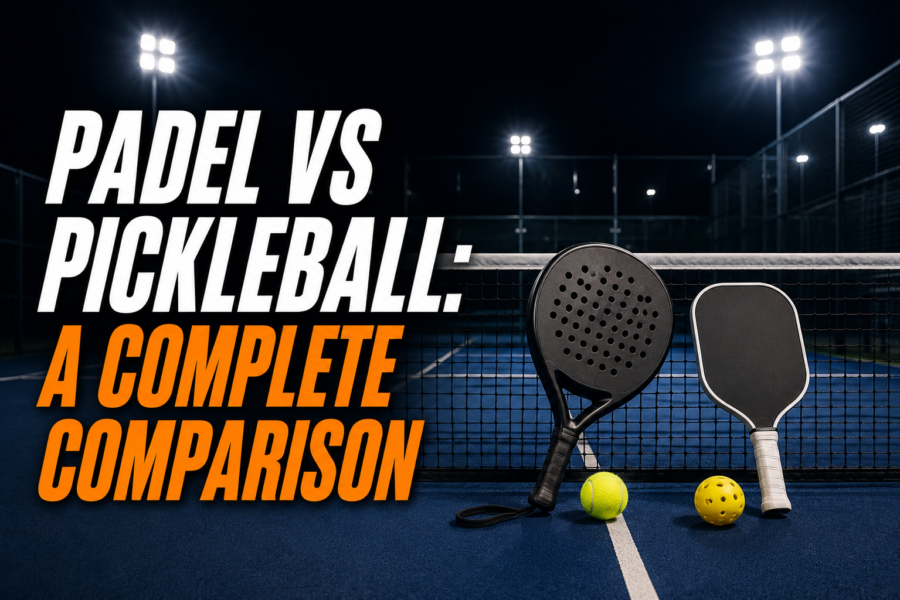
Padel and pickleball are both social racket sports usually played as doubles, but they are not variations of the same game. Padel uses an enclosed 20m by 10m court, a pressurized ball, and walls that remain part of the rally. Pickleball uses a smaller, open court, a perforated plastic ball, and a 7ft non-volley zone on each side of the net.
The fastest way to choose between them is to decide which type of rally appeals to you. Padel rewards movement as a pair, net positioning, and reading rebounds from glass. Pickleball puts more emphasis on the two-bounce rule, non-volley-zone positioning, compact strokes, and control around the kitchen line.
Padel vs Pickleball at a Glance
| Feature | Padel | Pickleball |
|---|---|---|
| Usual format | Doubles | Singles or doubles, with doubles very common |
| Court | 20m by 10m and enclosed | 44ft by 20ft and open |
| Walls | In play after a valid bounce | Not part of play |
| Hitting equipment | Solid perforated racket with wrist cord | Solid paddle |
| Ball | Pressurized rubber ball with felt cover | Lightweight perforated plastic ball |
| Serve | After one bounce, at or below waist level, diagonally | Volley or drop serve, each under its own motion rules, diagonally |
| Return of serve | Must bounce | Must bounce, then the serving side must also let the return bounce |
| Net-area rule | No kitchen | Volleys restricted by the non-volley zone |
| Common scoring | Tennis-style games and sets | Side-out scoring is traditional; approved formats can vary |
Both sports are easy to begin at a social level, but each has rules that punish habits carried over from tennis. The detailed padel rules guide and pickleball rules guide cover those systems separately.
Court Size and Layout
Padel Court
A regulation padel court is 20m long and 10m wide. It is divided by a net and fully enclosed by glass or solid walls and metal fencing. The net is 0.88m high at the center and 0.92m at the ends.
The enclosure is not just a boundary. Once the ball bounces in the correct court, it may rebound from a wall or fence and remain in play. Players can also use their own glass or solid wall to send a return back over the net.
Pickleball Court
A pickleball court is 44ft long and 20ft wide for singles and doubles. The net is 34in high at the center and 36in at the sidelines.
The defining marking is the non-volley zone, commonly called the kitchen, which extends 7ft from the net on each side. A player may stand in the kitchen and play a ball that has bounced, but may not volley while touching the zone or carry momentum into it after a volley.
Pickleball therefore uses less court area than padel and does not require an enclosure. That generally makes it easier to mark on an existing hard court, although a purpose-built layout offers clearer lines and safer surrounding space.
Equipment Differences
Racket vs Paddle
A padel racket has a solid hitting surface with holes, no strings, and a short handle. Under official rules, its total length cannot exceed 45.5cm, and the safety cord attached to the handle must be worn around the wrist.
A pickleball paddle is also solid and unstrung, but its outline is typically longer and more rectangular. Approved paddles must satisfy the relevant size, surface, and material standards. Players should check an event’s approved-equipment requirements rather than assuming every recreational paddle is tournament legal.
Ball
A padel ball looks similar to a tennis ball. It has a rubber core and felt exterior, but its approved size, bounce, and internal-pressure ranges are specific to padel.
A pickleball is hollow plastic with a pattern of holes. Outdoor and indoor models may use different hole arrangements and materials, but an official ball must meet the governing body’s specifications.
Players starting padel can use the beginner padel equipment checklist to avoid buying tennis equipment that only looks similar.
Cost and Court Access
Padel normally depends on a purpose-built enclosed court, so regular players often need to book a commercial club or dedicated venue. The starting equipment is a padel racket, approved balls, suitable court shoes, and any venue fee. Rental rackets can reduce the first-session cost, but ongoing court access may be the larger expense in markets with limited supply.
Pickleball can have a lower entry barrier where public courts, community programs, or temporary lines on an existing hard court are available. A basic paddle and outdoor balls may be enough to begin. Private clubs, premium paddles, dedicated shoes, leagues, and tournament fees can still make it expensive, so it is not universally the cheaper sport.
Prices vary substantially by country, facility, peak booking time, and equipment tier. Compare local court availability and recurring fees before deciding from retail equipment prices alone.
Serving Rules
Padel Serve
The padel server stands behind the service line, bounces the ball, and strikes it at or below waist level with at least one foot on the ground. Before contact, the ball must remain behind the service line and on the correct side of the imaginary center-line extension. The serve travels diagonally into the opposite service box, and the server normally has two attempts.
The receiver must let the serve bounce. If it lands in the correct service box and then touches the metal fence before its second bounce, it is a fault. A correct bounce followed by the glass wall is playable.
Pickleball Serve
Pickleball permits a volley serve and a drop serve, each with its own requirements. The ball is served diagonally beyond the opponent’s non-volley-zone line, and the receiving team must let it bounce before returning.
The serving team must then let that return bounce before playing its next shot. This is the two-bounce rule. After those two required bounces, either side may volley if the non-volley-zone rules are respected.
The beginner how to play pickleball guide explains the serving sequence and court positions in more detail.
Scoring Differences
Padel normally uses the familiar tennis sequence of love, 15, 30, 40, and game. A set is commonly played to six games by two, with a tie-break at 6-6. Current rules list Advantage, Golden Point, and Star Point methods for resolving deuce, so players must confirm which option their match uses.
Traditional pickleball uses side-out scoring, meaning only the serving side can add a point. Games are commonly played to 11 and must be won by two, although tournament and league formats can use other targets or an approved rally-scoring option.
In doubles side-out scoring, the score call identifies the serving team’s score, the receiving team’s score, and whether the first or second server is serving. That rotation is one of the biggest learning differences for a padel player.
How Walls and the Kitchen Change Tactics
Padel rewards a team that can take and hold the net without becoming vulnerable to the lob. When pushed back, players can allow a ball to rebound from the glass and use the extra travel time to build a controlled return. Angles, overheads, and coordinated movement as a pair matter more than trying to end every point with raw pace.
Pickleball often develops around the non-volley-zone line. Players use controlled drops, dinks, speed-ups, and counters while staying alert to kitchen foot faults. Because the plastic ball slows quickly, compact preparation and placement are usually more reliable than long swings.
Neither sport has one universal rally pattern. Court speed, ball condition, player level, weather, and playing style can all change how long or physical a match feels.
Movement and Physical Demands
Padel includes repeated accelerations, turns, overheads, and reactions to rebounds within an enclosed space. The team may move forward and backward together many times in one rally.
Pickleball uses a smaller open court, but it still requires starts, stops, lateral movement, balance, and quick reactions near the net. Singles generally asks one player to cover more space than doubles.
It is inaccurate to declare either sport automatically easier on every body. Match intensity, technique, surface, footwear, conditioning, and previous injuries matter. New players should increase playing time gradually and learn safe movement rather than relying on a sport’s reputation.
Learning Curve
Pickleball can feel immediately familiar because the court is small and the ball travels relatively slowly. The hard parts appear quickly, however: serving rotation, the two-bounce rule, kitchen positioning, and controlling soft shots under pressure.
Padel beginners can often start rallies soon, especially in doubles, but wall rebounds require a new judgment of spacing and timing. Tennis players frequently stand too close to the back glass or swing too fully when a compact response would be better.
The how to start playing padel guide gives a practical route from court booking to a first match.
Padel vs Pickleball for Tennis Players
A tennis background helps with tracking, volleys, overheads, and basic racket control in padel. It can also create problems if the player refuses to let the ball reach the glass or treats the serve as a weapon instead of a point starter.
In pickleball, tennis players often arrive with useful hand-eye coordination but take swings that are too large near the kitchen. They must also stop following the return straight to a volley because the serving side has to respect the second required bounce.
For a separate comparison of tennis and pickleball court rules and technique, see tennis vs pickleball.
Which Sport Should You Choose?
Choose padel if you are attracted to:
- playing almost entirely as a doubles team;
- using rebounds and lobs tactically;
- frequent transitions between the back glass and net; and
- a tennis-like game and set structure.
Choose pickleball if you prefer:
- the option to play singles or doubles;
- a compact court without playable walls;
- kitchen-line exchanges and controlled soft shots; and
- access to courts that can be marked on existing hard surfaces.
Availability may decide the question. Padel needs a dedicated enclosure, while pickleball can be hosted in more types of venues. If both are nearby, one beginner session in each will reveal more than a list of theoretical pros and cons.
Padel vs Pickleball FAQ
Is padel the same as pickleball?
No. They use different courts, balls, serving rules, scoring structures, and rally rules. The playable walls in padel and the non-volley zone in pickleball produce fundamentally different tactics.
Which court is bigger?
A padel court has a larger total playing area at 20m by 10m. A pickleball court is 44ft by 20ft.
Can you play padel with a pickleball paddle?
Not in regulated play. Padel rackets and pickleball paddles follow different equipment standards, and padel also requires a wrist safety cord.
Which is easier for a beginner?
Both can support a beginner rally, but the difficult skills differ. Pickleball requires kitchen control and scoring rotation, while padel requires reading rebounds and moving with a partner.