
You can sustain a rally. The next challenge is choosing a useful shot, moving at the right time and knowing what your partner should cover.
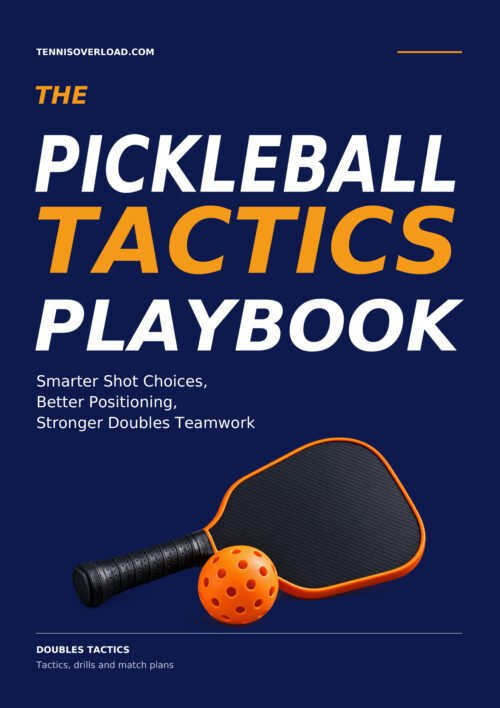
The Pickleball Tactics Playbook is a 264-page digital guide to doubles tactics for recreational and club players. It connects recognisable match situations with clear explanations, original court diagrams and structured practice. You work on the intended shot, the possible replies and the next decision when your plan does not work.
Who this book is for
This book is for beginner-to-intermediate doubles players who know basic scoring and can sustain a rally.
It is especially useful if you play regularly but remain unsure about shot selection, positioning or shared responsibilities. You can use it with a regular partner or with different club partners.
The focus is tactical decision-making. Technique is explained where it helps you understand a choice. Fitness programmes, nutrition, rehabilitation, equipment reviews and detailed stroke rebuilding are outside its scope.
Work on the problems that keep appearing in matches
- Your serve or return leaves your pair unprepared for the next ball.
- You hesitate between a third-shot drop and drive, or commit to the next shot before seeing the reply.
- You move forward into an attack or struggle with low balls at your feet.
- Your dinking has little purpose, or your speed-ups invite a comfortable counter.
- Middle balls cause hesitation, and wide balls or lobs leave your pair disorganised.
- You change plans after every mistake without knowing whether the problem was the decision, execution or coverage.
What you will learn
You will learn to assess contact height, balance, available time and the positions of all four players before choosing a response.
The lessons explain how to:
- Choose between defending, neutralising, building pressure and attacking.
- Select a target for a clear reason and prepare for more than one possible reply.
- Judge when to advance, hold your position or reorganise with your partner.
- Give the non-hitting partner a useful coverage responsibility.
- Observe opponent tendencies, test one adjustment and review its effect.
- Keep decisions and communication manageable at important scores and in changing conditions.
Each match-situation lesson includes what to notice, a useful starting response, reasons to change it, likely opposing options and what to do after an unsuccessful shot.
Exactly what is included
| Included | Count | What it covers |
|---|---|---|
| Foundations | 6 | Reading the ball, target selection, rules, positioning and point construction |
| Match-situation lessons | 24 | Six each on serve and return, transition and defence, kitchen play and attack selection, and teamwork and coverage |
| Adaptation lessons | 4 | Reading opponents, adjusting plans, important points and playing conditions |
| Two-player drills | 4 | Individual decisions practised with one partner |
| Four-player drills | 8 | Tactical choices, partner coverage and realistic opposing options |
| Practice-match formats | 2 | Decisions under score pressure and testing a team plan |
| Complete practice sessions | 8 | Sixty-minute sessions arranged as two consecutive four-week blocks |
| Reusable worksheets | 4 | Pre-match plan, partner agreement, match review and practice notes |
| Original instructional figures | 44 | Court positioning, tactical sequences and practice setups |
| Lesson-to-practice map | 1 | Links between the instruction and relevant activities |
| Glossary | 1 | Explanations of the terminology used |
| Courtside reference | 1 page | A concise reminder of key decisions and rules |
The book also includes a “Start With Your Biggest Problem” finder, recommended reading routes, practical safety guidance, a diagram key, further reading and a rules-edition note.
There are 12 distinct drills. The two practice-match formats and eight complete sessions are counted separately.
How the practice works
Practising with one partner: the four two-player cards each provide a complete 15-minute activity. They isolate decisions involving drops and drives, resets, dinking and responses to pace. Each card explains which doubles responsibilities are absent when only two players are on court.
Practising with four players: the eight four-player drills each run for 20 minutes. They include defined starting positions, feeds or serves, role changes, scoring, stopping conditions and review cues. Manageable opening situations progress to variable decisions and live play within the stated training boundaries.
The two practice-match formats also require four players and each run for 20 minutes. One focuses on important scores; the other helps a pair form, test and adjust a plan.
You will need court access, a paddle for each player, pickleballs and a timer. Individual cards specify court-safe flat tape or markers and any paper or pencil needed. Players supply the feeds and follow the rotations; no additional feeder or scorekeeper is required.
An eight-week structure for four players
Follow one complete 60-minute session each week, starting with the first four-week block and continuing into the second.
| Week | Session |
|---|---|
| 1 | Serve and Return as a Pair |
| 2 | Choose the Third Shot and the Next Ball |
| 3 | Reset and Move Forward Together |
| 4 | Dink With a Purpose and Cover Together |
| 5 | Choose the Attack and Handle the Counter |
| 6 | Cover the Middle and Use Interceptions |
| 7 | Handle Lobs and Important Points |
| 8 | Test and Adjust Your Team Plan |
The first block establishes opening decisions, controlled transition, kitchen play and coverage. The second develops attack selection, responses under pressure and independent team planning.
Read the assigned lessons and activity cards before the session. Each on-court hour includes preparation, a progressive warm-up, two main activities, changeovers, drinks, ball collection and review.
You can repeat a session or take longer than eight weeks.
Format and delivery
- Digital format: downloadable PDF ebook.
- Length: 264 A4 pages.
- Language: English.
- Navigation: clickable contents, bookmarks and internal links.
- Complete book: all practice instructions, worksheets and reader reference material are included in the PDF.
Frequently asked questions
Is this suitable for a complete beginner?
It assumes you already know basic scoring and can sustain a rally. The foundations explain the rules and terminology needed for the tactical lessons.
Can I use it with only one practice partner?
Yes. Four dedicated drills require two players in total. The eight four-player drills, both practice-match formats and all eight complete sessions require four players in total.
Do I have to follow the eight-week sequence?
No. You can use the problem finder to choose a relevant lesson and activity, or follow the complete sequence. Repeat sessions when you need more time with a decision.
Are the worksheets interactive PDF forms?
No. They are reusable worksheet pages with writing space and a short example on each page.
Which rules does the book use?
The book uses the 2026 USA Pickleball Official Rulebook as its baseline, checked on 16 October 2026. Traditional side-out doubles scoring is the default. Other formats and training modifications are identified where used.