
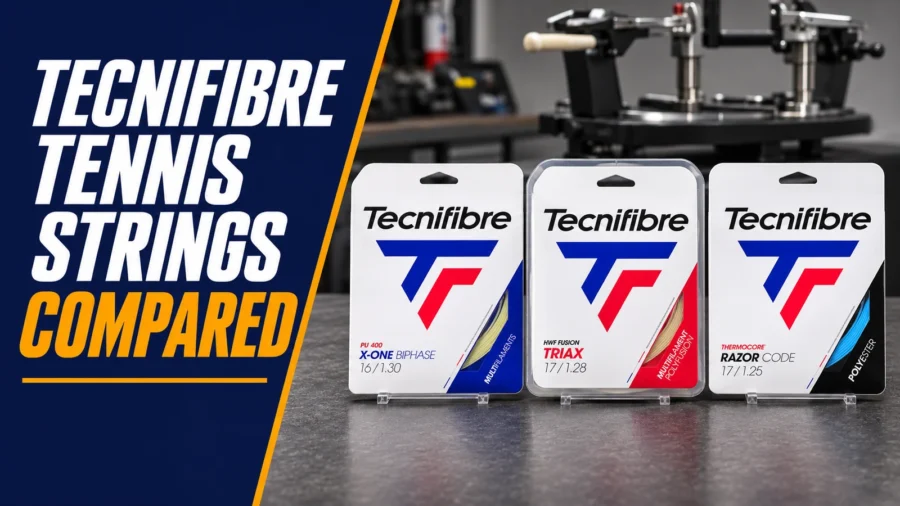
Tecnifibre’s multifilaments are the better starting point for easy power, feel and a more yielding stringbed. Its co-polyesters suit players who generate their own pace and need more restraint or resistance to breakage. Multifeel, X-One Biphase and Triax therefore answer different needs from Razor Code, Razor Soft and Black Code, even though all carry the same brand.
For most recreational players deciding without a reliable baseline, start by comparing Multifeel with X-One Biphase. For an established polyester user, compare Razor Code with Razor Soft, then consider a shaped string if that contact feel suits your topspin game.
These recommendations are based on published specifications and product information, rather than personal playtesting.
Which Tecnifibre string should you shortlist?
| String | Construction | Useful starting point for | Tradeoff to consider |
|---|---|---|---|
| Multifeel | Multifilament with a central core | Club players seeking accessible power and value | Frequent string breakers may find its life too short |
| X-One Biphase | Premium multifilament | Touch, power and a more elastic response | Higher purchase cost and vulnerability to heavy string wear |
| Triax | Multifilament combining polyamide and co-polyester | Multifilament users seeking more control and resistance | A different, firmer-feeling direction from a conventional soft multi |
| Razor Code | Round co-polyester | Fast swings and a firm, controlled response | Too demanding when the player needs the strings to supply depth |
| Razor Soft | Co-polyester with polyurethane additives | Polyester users seeking a less firm alternative | “Soft” remains relative to polyester |
| Razor Spin | Square co-polyester with polyurethane additives | A shaped alternative within the newer Razor range | Changes the contact response as well as the formula |
| Black Code | Pentagonal co-polyester | Players who want a shaped spin-oriented polyester | Not a substitute for multifilament comfort |
Multifeel versus X-One Biphase
Multifeel is the accessible entry point into Tecnifibre’s multifilament range. It combines fine fibers with a larger central core, rather than being a completely uniform bundle. Its practical appeal is straightforward: a player can move away from basic factory strings without immediately choosing an expensive premium installation.
The Multifeel review explains how that construction affects the response. It is worth considering for moderate swings, doubles and players who rarely break strings. Spending more is unnecessary if this gives you the depth and touch you need.
X-One Biphase is the premium choice in this comparison. Its fiber construction, polyurethane impregnation and Biphase treatment are directed toward power and feel. The X-One Biphase review is useful if you already enjoy multifilament and want to compare a more refined option.
Do not choose X-One solely because it sits higher in the range. A player breaking soft strings every few sessions may find the recurring installation cost difficult to justify. A player who needs more trajectory restraint may prefer a different construction rather than a more expensive version of an already powerful setup.
Triax occupies a different space
Triax combines polyamide and co-polyester fibers within a multifilament structure. That is different from stringing polyester in the mains and nylon in the crosses: the mixed construction exists inside the strand itself.
Its role is to offer a bridge for players who like multifilament but want more resistance and control. The Triax review covers that compromise. It is a particularly useful comparison when an ordinary multi feels too lively, but a full monofilament polyester bed feels unnecessarily demanding.
Triax is not identical to Razor Soft. One is a multifilament construction containing co-polyester; the other is a polyester monofilament with additives. The word “hybrid” can hide that important distinction when used loosely in product descriptions.
Razor Code, Razor Soft and Razor Spin
Razor Code is a round co-polyester aimed at experienced players seeking control and resistance. It belongs on the shortlist if you supply pace comfortably and want a predictable response under full swings. The Razor Code review examines that firm, controlled direction.
Razor Soft adds polyurethane to a co-polyester formulation. Tecnifibre positions it around precision with improved comfort. Consider it when polyester already suits your technique but you want to compare a less firm response. The Razor Soft review explains why the name should not be read as equivalent to a soft multifilament.
Razor Spin introduces a square profile alongside co-polyester and polyurethane additives. Its clearest distinction is that shaped contact surface. It is a logical trial for a Razor user who wants a different sensation of bite, but it should not be treated as an automatic upgrade. A smooth string can also produce substantial spin through the way the strings move and return during impact.
Where Black Code fits
Black Code uses a five-sided co-polyester profile and Tecnifibre’s Thermocore manufacturing process. It offers another route to a shaped string without moving into the Razor family.
The practical comparison is between your preferred contact response, launch and ability to repeat a rally ball. The Black Code review discusses those characteristics in more detail. Choose between shaped models by trialling comparable diameters and tensions, rather than assuming four sides, five sides or a newer release must produce the best result.
Make a useful first comparison
Material is the largest decision. The broader guide to tennis string types is a useful reference when deciding whether you actually need polyester.
After that, change one variable at a time. Compare one set before committing to a reel, and keep the same racket and stringer where possible. Record the exact diameter in millimeters because gauge labels are less precise across ranges.
Your string tension must fit both the string and the racket. Avoid carrying an unusually high multifilament tension straight into a polyester installation simply because the previous setup felt comfortable.
Finally, judge value by useful play rather than whether the strings have snapped. A multi may show visible fraying, while an intact polyester can already feel inconsistent. The correct replacement point depends on how the setup plays, not just its appearance.