
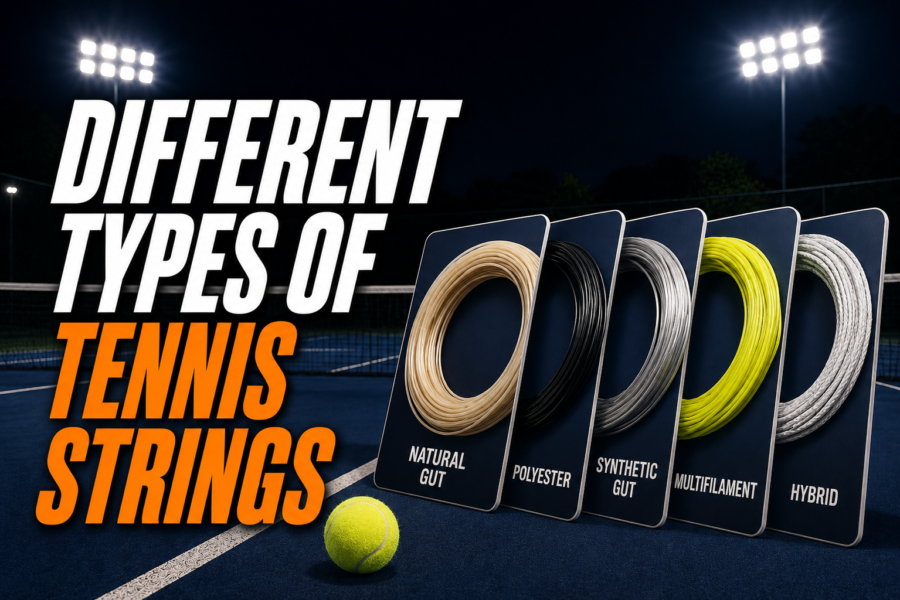
The main types of tennis strings are natural gut, multifilament, synthetic gut and polyester. Hybrid stringing is not a separate material. It combines two strings in the same racket to create a different balance of performance and durability.
Each family has a typical profile, but the label is only a starting point. Construction, formulation, gauge, coating, tension and the racket all influence the finished stringbed. A soft co-poly can still be firm beside natural gut, while a premium multifilament can behave very differently from a basic solid-core nylon.
Tennis String Types at a Glance
| String type | Typical construction | Common strengths | Main limitations | Often suits |
|---|---|---|---|---|
| Natural gut | Twisted natural fibers based on collagen | Elasticity, power, feel and tension stability | High cost, moisture sensitivity and careful installation | Players prioritizing performance and comfort |
| Multifilament | Many small synthetic fibers bonded together | Accessible power, comfort and feel | Fraying and lower break resistance than many monofilaments | Beginners, intermediate players and players wanting a softer response |
| Synthetic gut | Usually a solid nylon core with one or more outer wraps | Balanced performance and value | Does not specialize as strongly as premium categories | Beginners, recreational players and practical all-round setups |
| Polyester or co-polyester | Usually one solid polyester-based filament | Control during fast swings, break resistance and spin-supporting snapback | Low free power, firm response and playability loss before breakage | Developed, fast-swinging players and frequent string breakers |
| Hybrid | Two different strings in mains and crosses | Adjustable balance of response, durability and cost | More variables and uneven wear between materials | Players with a clear reason to combine two string behaviors |
| Aramid | Very stiff, strong fibers, often braided and used in a hybrid | Extreme resistance to breaking | Very firm, low-powered response with limited general appeal | Chronic string breakers with specialist guidance |
These are comparative tendencies, not fixed scores. The exact product and setup can move a string away from the category average.
Material and Construction Are Different Questions
String material describes what the string is made from. Construction describes how that material is arranged.
A monofilament is generally one solid strand. Most polyester and co-polyester tennis strings use this structure, but “monofilament” does not prove that a string is polyester. Some nylon and other polymer strings are also monofilaments.
A multifilament combines many smaller fibers, often with a binding material and protective coating. Natural gut also contains many fibers, but it is a distinct natural material rather than a synthetic multifilament.
Synthetic gut can make the terminology confusing. It is normally nylon and commonly uses a solid central core surrounded by wraps. The name describes a practical synthetic category, not an artificial version of natural gut with the same construction.
Natural Gut Tennis Strings
Natural gut is made from processed animal intestinal material, traditionally bovine serosa in modern tennis products. Its collagen-based fibers are twisted and finished to create the string. It is not made from a synthetic material designed merely to imitate gut.
Typical Strengths
Natural gut is highly elastic and returns energy efficiently, which can create accessible pace and depth. It is also known for maintaining its playing characteristics and tension better than many synthetic alternatives.
Its feel and broad performance range allow it to suit compact swings as well as advanced hybrid setups. It is among the most forgiving string families, although comfort remains personal and also depends on tension, racket, technique and the individual player.
Main Limitations
Natural gut is expensive relative to common synthetic strings. It requires careful installation because kinks, excessive friction and rough handling can damage its fibers.
Modern coatings improve protection, but prolonged moisture and abrasive wear remain concerns. It is also unsuitable for players who prefer not to use an animal-derived product.
Who Should Consider It?
Natural gut makes sense for players who prioritize elasticity, feel, tension stability and a forgiving response. It can be used in a full bed or paired with a smooth polyester cross for a more controlled hybrid.
It may be difficult to justify for a frequent string breaker on a limited budget. Product-level differences and current options belong in individual reviews and buying lists rather than this category overview.
Multifilament Tennis Strings
Multifilament strings combine many synthetic microfibers, commonly polyamide fibers, with resins or polyurethane and an outer treatment. Manufacturers can vary the number, type and arrangement of fibers, so there is no single multifilament recipe.
Typical Strengths
The flexible fiber bundle generally produces more accessible power and a more forgiving response than a firm polyester monofilament. Many players also value multifilaments for feel and depth without needing maximum racket-head speed.
This makes the category useful for beginners, intermediate players and anyone who finds a full bed of polyester unnecessarily demanding. A multifilament can also serve as the softer half of a hybrid.
Main Limitations
The fibers can fray as the outer coating wears. Fraying is not always immediate failure, but it shows that the structure is wearing and breakage may be approaching.
Heavy topspin hitters and frequent string breakers may wear through a multifilament quickly. String movement can also become more visible than with a fresh polyester setup.
Who Should Consider It?
Choose multifilament when easy depth, comfort and feel matter more than maximum resistance to breakage. It is often a sensible starting category for a recreational player who does not need the firm, low-powered response of polyester.
Do not assume every multifilament is equally soft or powerful. Fiber type, coating, gauge and tension still matter.
Synthetic Gut Tennis Strings
Synthetic gut is usually a nylon string with a solid core and one or more outer wraps. Some products use more complex layers, but the category is generally built around balanced performance and accessible cost rather than one extreme trait.
Typical Strengths
Synthetic gut offers a practical middle ground. It normally provides more free power and a less demanding response than polyester while resisting breakage better than some soft multifilaments.
It is widely used for beginner, school, rental and recreational rackets because it is predictable and affordable. It also works as a cross string in many hybrid arrangements.
Main Limitations
Synthetic gut rarely matches natural gut or premium multifilament for elasticity and feel. It also does not normally provide the same controlled, low-friction response that attracts fast-swinging players to polyester.
That lack of specialization is not a defect for everyone. A balanced string can be more useful than a performance category whose tradeoffs do not match the player.
Who Should Consider It?
Synthetic gut suits beginners, occasional players and anyone who wants an economical all-round string. It can also be a useful reference setup before spending more on a specialized material.
The guide to the best tennis strings for beginners provides a more focused decision process for new players without turning this taxonomy into a product shortlist.
Polyester and Co-Polyester Tennis Strings
Polyester tennis strings are usually extruded as solid monofilaments. Co-polyester, often shortened to co-poly, belongs to the same broad polyester family but uses a modified formulation or additional components intended to alter characteristics such as feel, response or surface behavior.
“Co-poly” is not a guarantee of softness, spin, power or superior tension maintenance. Two co-poly strings can differ substantially in stiffness, shape, gauge and coating.
Typical Strengths
Polyester strings are generally low powered and resistant to breaking. That profile can help a player with a long, fast swing accelerate confidently while maintaining a more controlled launch.
Many polyester strings also begin with low string-to-string friction. The mains can slide and return toward position after impact, supporting spin when the player supplies the necessary racket-head speed and swing path. Shaped profiles may alter ball interaction, but edges alone do not create heavy spin.
Main Limitations
Polyester is generally firmer and less elastic than natural gut, multifilament or common nylon strings. Players with compact or slower swings may work too hard for depth and gain little from its control-oriented response.
Its resistance to breaking can also be misleading. Polyester may remain intact after tension loss, notching and friction changes have reduced useful snapback or made the response less predictable. Physical durability and playability duration are different.
Who Should Consider It?
Polyester is most appropriate for developed players who generate their own pace, use long fast swings and either break softer strings frequently or benefit from a lower-powered response. It is less likely to suit beginners, infrequent restringers or players who consistently find firm stringbeds uncomfortable.
A player moving into polyester should treat the exact string, gauge and tension as a complete setup. The guide to choosing string tension covers tension effects, while the tennis string tension calculator provides an advisory starting estimate.
Aramid and Other Less Common Strings
Aramid strings, including products using Kevlar fibers, occupy a narrow part of the market. Their defining attraction is very high resistance to breaking. They are also exceptionally firm and low powered, which is why manufacturers commonly position them as mains in a hybrid rather than as a general full-bed choice.
Some tennis strings use other polymers, including PEEK-based materials sold under names such as Zyex. These products do not automatically fit the polyester or nylon categories. Check the manufacturer’s stated material instead of classifying a string by appearance or the word “mono.”
Most players do not need either niche category. They matter mainly when a knowledgeable stringer is solving a specific durability or response problem.
What Is a Hybrid String Setup?
A hybrid uses one string in the mains and another in the crosses. The mains usually have a strong influence on the stringbed’s response, but the crosses still affect stiffness, movement, launch and wear.
Polyester Mains With Softer Crosses
This arrangement aims to retain much of polyester’s controlled response and break resistance while changing the feel with a multifilament, synthetic-gut or natural-gut cross. It does not make the stringbed as soft as a full bed of the cross material.
A shaped polyester main can saw into a softer cross, so the hybrid’s lifespan is not determined by the stronger string alone.
Softer Mains With Polyester Crosses
Natural gut or multifilament mains can provide a more elastic response, while a smooth polyester cross can help manage movement and launch. This orientation is often more powerful and forgiving than polyester mains, but the polyester cross still adds firmness.
Compatibility matters. Copying a professional player’s hybrid without matching the racket, swing speed and restringing schedule is not a reliable shortcut.
Same-Material Hybrids
A hybrid does not have to mix material families. Players can combine two gauges, shapes or models from the same category to adjust response or wear.
More variables also mean more opportunities for mismatch. Change one element at a time so the effect is easier to evaluate.
How to Choose the Right String Type
Start with the performance problem that needs solving rather than the string used by a professional player.
| Priority | Useful starting category | Important question |
|---|---|---|
| Easy depth and a forgiving response | Multifilament or natural gut | Is breakage frequent enough to make the setup impractical? |
| Balanced value | Synthetic gut | Is there a specific reason to pay for a more specialized material? |
| Control during long, fast swings | Polyester or co-polyester | Will the string be replaced when playability declines, not only when it breaks? |
| Maximum resistance to breaking | Polyester first; aramid only for specialized cases | Is the firmer response acceptable and appropriate? |
| Combining two behaviors | Hybrid | Which material should control the mains, and how will the two strings wear together? |
Consider Swing Speed and Stroke Length
Long, fast swings can activate lower-powered strings and often benefit from predictable launch. Compact swings usually need more help creating depth, making nylon, multifilament or natural gut a more practical starting point.
Playing level alone is an imperfect shortcut. An intermediate player with fast, developed strokes may suit a different string from another intermediate who uses compact swings.
Separate Break Resistance From Useful Life
A string that does not break can still lose the response that made it useful. Polyester is the clearest example, but all strings change through tension loss, impact and wear.
Watch for a meaningful change in control, launch, comfort or string movement compared with the fresh setup. There is no universal replacement schedule because frequency, intensity, pattern, gauge and material vary.
Treat Comfort as Individual
Natural gut and multifilament are generally more forgiving categories than polyester or aramid, but no string can guarantee comfort or prevent injury. Racket stiffness, tension, technique, ball, conditions and the player’s health all contribute.
Persistent pain should not be solved through online equipment advice alone. Stop playing and seek appropriate professional guidance.
Account for Gauge and Tension
Thinner versions of the same string tend to offer more response and ball interaction, while thicker versions generally provide more material to resist wear and breakage. The result is product-specific, and gauge labels are not standardized perfectly across brands.
Tension changes launch, response and comfort, but generic rules do not override the range printed on the racket or the string maker’s guidance. Material, racket head size, pattern and hybrid orientation should be considered together.
For a complete step-by-step selection framework, use the complete guide to choosing tennis strings. The tennis string finder can then narrow the options without replacing advice from a qualified stringer who can inspect the actual setup.
Common Tennis String Myths
“Synthetic Gut Is Artificial Natural Gut”
Synthetic gut is normally a nylon construction. It is a separate category, not natural gut made without animal material.
“Co-Poly Is Always Softer Than Polyester”
Co-polyester is a modified polyester family, not a universal softness rating. The exact formulation and measured stiffness matter more than the label alone.
“Shaped Strings Create Spin by Themselves”
Shape can influence ball interaction, but spin still depends on racket-head speed, swing path, string movement, friction, gauge, tension and the complete racket setup.
“The Most Durable String Is the Best Value”
Break resistance is only one part of value. A string that stays intact but becomes uncomfortable or unpredictable may have a shorter useful life than its physical condition suggests.
Final Answer
Natural gut offers elasticity, feel and tension stability. Multifilament provides accessible power and a forgiving synthetic option. Synthetic gut is the practical all-round choice. Polyester and co-polyester suit faster swings that benefit from a firm, controlled response, while aramid is a specialist durability material.
Hybrid stringing can combine those behaviors, but it adds variables rather than eliminating tradeoffs. Begin with swing type, desired response, comfort, breakage rate and willingness to restring. Then choose a specific product, gauge and tension that fit the racket instead of assuming one material is best for every player.