
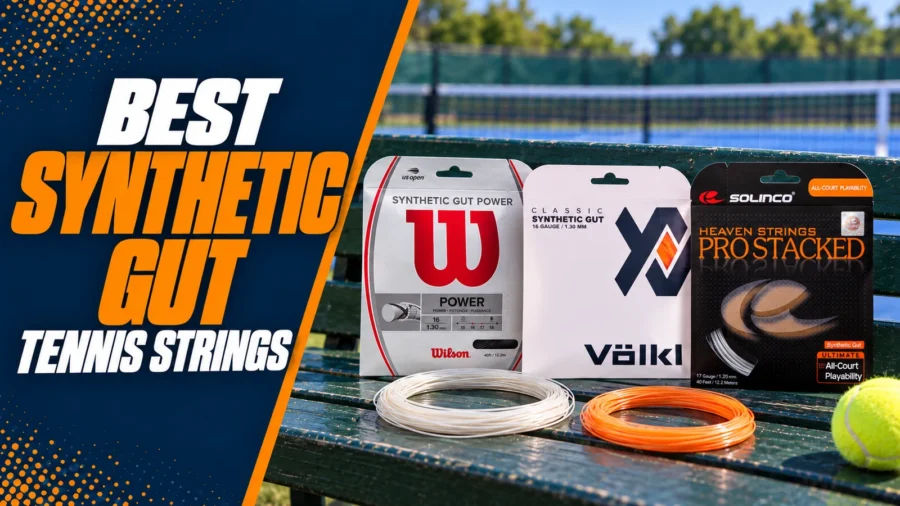
Wilson Synthetic Gut Power, Volkl Classic Synthetic Gut and Solinco Pro Stacked are three useful synthetic-gut strings to compare for value and all-round play. Start with Wilson if you want a straightforward solid-core nylon baseline, Volkl if inexpensive sets and a choice of colors matter, or Pro Stacked if you want to compare different diameters within one core-and-wrap construction.
The best value is the string that provides a suitable response for enough playing time to justify the complete restringing cost. A low packet price is helpful, but does not compensate for a setup that breaks too quickly or makes normal shots difficult to control.
Best Synthetic Gut Strings at a Glance
This shortlist is based on verified manufacturer construction and available product options. It is not a personal playtest ranking, and the recommendations do not imply measured superiority in spin, comfort or lifespan.
| String | Documented construction or option | Strongest buying reason | Main limitation |
|---|---|---|---|
| Wilson Synthetic Gut Power | Solid nylon core with outer wraps; verified 16 gauge, 1.30mm listing | Simple starting point for a conventional nylon full bed | Not a specialist answer to rapid string breakage |
| Volkl Classic Synthetic Gut | Nylon center core with thin wraps; 16 and 17 gauge | Low-cost sets with several color choices | A traditional response rather than an unusually soft or spin-focused construction |
| Solinco Pro Stacked | Central core surrounded by multifibers; listed 1.20mm, 1.30mm and 1.35mm options | Useful diameter range for adjusting the balance of response and wear | Exact gauge and color stock needs checking |
These are all synthetic-gut options, but their product descriptions are not standardized test results. A wrap name cannot tell you how many hours longer one will last than another.
Who Should Use Synthetic Gut?
Synthetic gut makes particular sense for a recreational player who wants an affordable full bed and does not break nylon rapidly. It is also a useful starting point when you are still learning which tension, feel and launch characteristics you prefer.
The construction usually centers on a substantial nylon core, often surrounded by smaller wraps. It is different from natural gut and from a multifilament built mainly around a large bundle of fine fibers. The guide to different tennis string types explains those categories in more detail.
Do not assume an improving player must progress to polyester. If synthetic gut gives you comfortable contact, manageable depth and acceptable life, continuing with it is a valid equipment decision.
Wilson Synthetic Gut Power: A Practical Baseline
Wilson’s verified 1.30mm version uses a solid nylon core and outer wraps intended to add responsiveness. That makes it an uncomplicated candidate for a player who wants to start with a conventional synthetic-gut construction before experimenting with more specialized strings.
Choose it as a full bed when you want a clear reference for future adjustments. If the launch is too high or the impact too firm, you can discuss tension and diameter with a stringer without also having to explain a complicated hybrid.
The Wilson Synthetic Gut Power review covers its individual setup options. For this comparison, its appeal is the straightforward nylon construction, not a claim that it has more power than every competing synthetic gut.
Best fit: players seeking an accessible all-round baseline or a familiar nylon component for a planned hybrid.
Main trade-off: a heavy topspin hitter who cuts through nylon quickly may need a different construction or thicker option. The word “Power” does not establish how lively it will feel in a particular frame.
Volkl Classic Synthetic Gut: Inexpensive Sets and Color Choice
Volkl identifies Classic Synthetic Gut as a nylon center-core string with thin wraps and a traditional crisp feel. Its official range includes 16 and 17 gauge sets in several colors, including white, black, optic yellow, red, neon orange, blue and pink.
The manufacturer’s US store listed both set gauges at $5.99 in September 2026, before shipping, tax and installation. That makes it an easy product to consider when trying a single inexpensive set rather than committing to a reel.
Choose it when local total cost is competitive and you want a conventional nylon response. Color choice can also be useful for identifying rackets in a coaching program, although cosmetics should remain secondary to the setup.
The Volkl Classic Synthetic Gut review provides a fuller look at that model. Its manufacturer’s own numerical ratings should not be compared directly with ratings from other brands or retailers.
Best fit: budget-conscious players, spare rackets and programs that want straightforward sets with color options.
Main trade-off: it does not become a premium multifilament because the price is attractive. Players seeking a particularly plush response should compare constructions as well as brands.
Solinco Pro Stacked: More Room to Experiment With Diameter
Solinco Pro Stacked combines a central core with surrounding multifibers. Solinco classifies it as synthetic gut, so it should not be confused with the company’s Hyper-G or Tour Bite co-polyester families.
Solinco’s current listings identify 1.20mm, 1.30mm and 1.35mm options, alongside sets and reels. This creates a useful path for someone who wants to keep the same product family while trying a thinner or thicker string.
A 1.30mm version is a reasonable starting point. If it breaks too quickly, the listed 1.35mm option is worth discussing with your stringer before assuming that a full polyester bed is the only alternative.
Check the exact variant before ordering. A product page can remain active when a selected gauge or color is sold out, and a price displayed for one variant does not establish the cost of every set or reel.
Best fit: players who want a broader diameter comparison within one synthetic-gut family.
Main trade-off: more available specifications do not establish better performance. You still need to assess the installed string, and local stock may narrow the theoretical choice.
Which Gauge Should You Choose?
For many recreational players, approximately 1.30mm is a useful first trial. It provides a middle ground between a thin string and a thicker option with more material available to wear through.
Choose a thinner version when you rarely break strings and want to explore a different feel or response. Choose a thicker version when central notching and breakage are the main problems, while recognizing that it may change the launch and impact feel.
Gauge numbers alone are not enough. The same printed gauge can correspond to different diameters across brands, so use the millimeter measurement on the exact package whenever possible.
Do not compare one brand’s thinnest string against another brand’s thickest and attribute every difference to construction. Match diameter, racket, tension and string age as closely as you can.
Full Bed or Hybrid?
A full bed is the simplest way to establish whether you like a synthetic gut. It also makes later experiments easier because changing one variable produces a clearer comparison.
Synthetic gut can be used in hybrids, including alongside polyester. However, adding nylon crosses does not make firm polyester mains behave like a full nylon stringbed, and the interaction between the two strings can change wear and movement.
Choose a hybrid to solve a specific problem. If you cannot yet say what the second string should improve, begin with a full bed rather than paying for extra complexity.
Synthetic gut should also not be mistaken for a low-cost version of animal-derived gut. Players specifically seeking that material’s characteristics should compare the natural gut string options instead.
Calculate Value Per Restring, Then Per Usable Hour
The relevant purchase is the completed string job. Add the string cost, labor and any shipping or fees before comparing products.
For illustration, a $6 set with $20 labor costs $26 installed. A $10 set with the same labor costs $30. If both provide the same useful life, the cheaper set saves $4; if their useful lives differ substantially, the calculation changes.
Those figures are examples, not local stringing quotes. Keep a record of playing hours and why each job ended, such as breakage, excessive movement or an unwanted change in response.
A reel can reduce material cost, but only when you will use enough of it and your stringer accepts customer-supplied string. Divide the reel price by the number of complete jobs it can actually supply for your racket, allowing for the lengths needed and waste. Do not assume the reel length divides perfectly into every installation.
When Synthetic Gut Stops Being the Best Value
A frequent string breaker can spend more on repeated labor than the low string price saves. Before changing material, check where breaks occur: repeated failure beside a worn grommet needs inspection of the racket, while central notching points toward a different wear problem.
At the other extreme, a player who rarely breaks strings should not leave a set installed indefinitely simply because it remains intact. Assess whether the response still suits the game you are trying to play.
Use the string tension guide when setting up your first trial. Keep the frame and diameter consistent, use an appropriate reference tension and change one element at a time. A string you can evaluate clearly is more useful than a supposedly perfect choice bought without a baseline.