
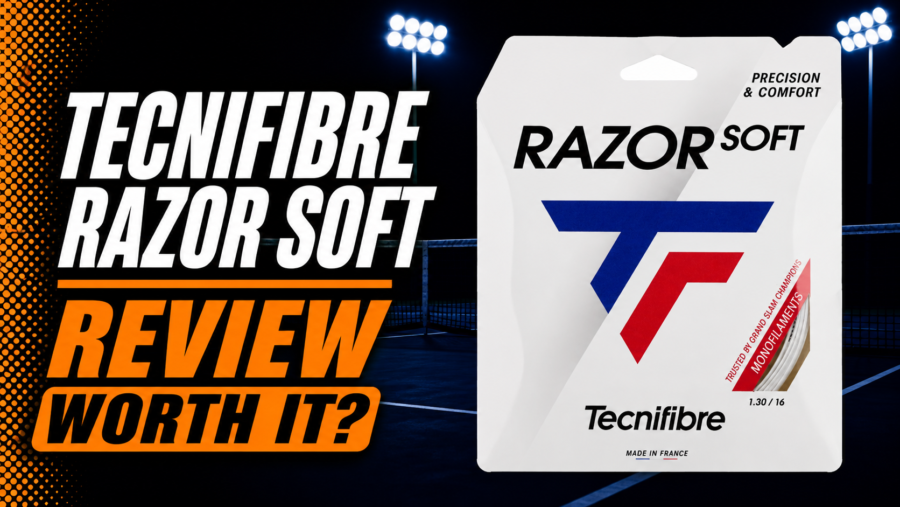
Tecnifibre Razor Soft is a round co-polyester tennis string designed to combine the precision of the Razor family with a more forgiving response than Razor Code. Tecnifibre uses high-modulus co-polyester for control and adds polyurethane to improve comfort and pocketing.
The word “Soft” is relative. Razor Soft remains a polyester monofilament intended for players with developed technique and sufficiently fast swings. It is softer than Razor Code, but it does not provide the elasticity of natural gut or a multifilament.
Razor Soft targets intermediate and advanced players who want controlled acceleration, dependable snapback and clearer touch than a very rigid control poly. The Tennis String Finder can help determine whether polyester suits your game.
Tecnifibre Razor Soft Rating
| Category | Rating |
|---|---|
| Power | 6.5/10 |
| Spin | 8/10 |
| Comfort | 7.5/10 |
| Control | 9/10 |
These ratings consider Razor Soft within the broader string market while accounting for its softer response relative to firm performance polyesters.
Tecnifibre Razor Soft Specifications
| Specification | Details |
|---|---|
| String type | Co-polyester monofilament |
| Composition | High-modulus co-polyester with polyurethane additives |
| Profile | Round |
| Surface | Smooth, with no separately named external coating in the official specification |
| Common gauges | 18 / 1.20mm, 17 / 1.25mm and 16 / 1.30mm |
| Common colors | Carbon, White and Lime, depending on market |
| Set and reel lengths | Approximately 12m sets and 200m reels |
| Made in | France |
Gauge, color and package availability can differ between regions and retailers.
Material and Construction
Razor Soft uses a single high-modulus co-polyester filament. This construction limits excessive stringbed deformation and supports the predictable response expected from a control-oriented polyester.
Tecnifibre adds polyurethane to the compound to make the string more comfortable than Razor Code. The additive is part of the material formulation, not a separate multifilament layer, and it does not turn Razor Soft into a nylon-based soft string.
The profile is round rather than shaped. It does not use edges to grip the felt directly. Its spin potential comes primarily from low-friction string movement, snapback, gauge and the player’s racket-head speed.
Tecnifibre’s current technical listing does not identify a separately named exterior coating for Razor Soft. The surface should therefore be described as smooth without attributing an unsupported coating technology to it.
Tecnifibre Razor Soft Performance
Power
Razor Soft provides moderate power for a control polyester. Its polyurethane-modified construction gives it more pocketing and rebound than a very rigid monofilament, but the response remains restrained in the broader string market.
Players with long, fast swings should receive enough assistance to produce depth without losing the ability to accelerate. Independent retailer evaluation also positions the string as more playable and responsive than standard Razor Code.
Compact swingers should not expect effortless pace. A multifilament such as NRG2 or X-One Biphase will provide more accessible depth at slower swing speeds.
The thinner 1.20mm gauge is the liveliest option. The 1.30mm version creates a calmer, more stable response.
Power rating: 6.5/10
Spin
Razor Soft offers strong spin for a round co-polyester. The smooth surface allows the mains to slide across the crosses and return while the stringbed remains fresh.
Its spin is based more on snapback than geometric bite. Players who accelerate vertically through contact should be able to create heavy rotation without the sharper feel of a shaped string.
The 1.20mm and 1.25mm gauges provide the easiest movement and ball interaction. The thicker gauge favors resistance and trajectory stability.
Players seeking maximum edge-assisted grip may prefer Black Code or 4S. Razor Soft better suits players who combine topspin with flatter drives, returns and all-court patterns.
Spin rating: 8/10
Control
Control is Razor Soft’s defining strength. The high-modulus co-polyester limits launch and supports confident acceleration on groundstrokes, returns and serves.
The round profile also produces a comparatively uniform response across different swing paths. This can benefit players who move between heavy topspin, flatter attacking shots and touch placements.
The polyurethane additive increases pocketing without making the stringbed excessively springy. This balance distinguishes Razor Soft from both rigid control polys and powerful multifilaments.
Control can decline after the string loses elasticity or snapback. A string that has not broken may still need replacement when launch becomes inconsistent.
Control rating: 9/10
Comfort and Feel
Razor Soft is comfortable by performance-polyester standards. The polyurethane additive is intended to reduce the rigid response associated with high-modulus polyester and improve ball pocketing.
The feel should remain direct rather than plush. Players moving from Razor Code may notice more give and touch, while those moving from a multifilament will still experience a firmer impact.
The round construction makes Razor Soft practical for volleys, blocks and hybrid crosses because it does not introduce sharp edges. Its controlled dwell time can provide useful feedback without a highly muted response.
Players with arm discomfort should not interpret the product name as a guarantee of safety. A softer string category is normally the more cautious choice.
Comfort rating: 7.5/10
Durability and Tension Maintenance
Razor Soft has strong physical resistance because it is a co-polyester monofilament. The 1.30mm gauge is the most suitable option for frequent breakers, while 1.20mm prioritizes response over lifespan.
Independent retailer evaluation describes its playability duration as impressive for the category. That does not mean tension, elasticity and snapback remain unchanged until breakage.
Physical durability and useful playability duration are separate. Razor Soft may remain intact after the response becomes firmer, the launch changes or the mains stop returning efficiently.
Players should inspect both notching and behavior. Replacement is appropriate when control, comfort or string movement changes materially, even if the string has not snapped.
Choosing the Right Gauge
Razor Soft is available in three practical diameters.
| Gauge | General characteristics |
|---|---|
| 18 / 1.20mm | Greatest response, feel and spin access, with the least physical resistance |
| 17 / 1.25mm | Best overall balance of control, pocketing, spin and durability |
| 16 / 1.30mm | Maximum stability, control and resistance, with a firmer response |
The 17 / 1.25mm version is the most versatile starting point. Frequent breakers and very open patterns may prefer 16 gauge.
Full Bed or Hybrid Setup
Full Bed
A full bed provides Razor Soft’s intended combination of control, snapback and improved polyester comfort. It best suits experienced polyester users with complete swings.
The setup remains firmer and less powerful than a full bed of multifilament or natural gut.
Tecnifibre Razor Soft in the Mains With Softer Crosses
Razor Soft mains retain its control and snapback. Natural gut or a multifilament cross can add pocketing, power and a softer impact.
The polyester mains can notch and cut a soft cross. The hybrid’s physical lifespan therefore depends on swing style, pattern and materials.
Softer Mains With Tecnifibre Razor Soft in the Crosses
Natural gut or multifilament mains emphasize power, comfort and feel. Razor Soft’s round profile makes it a logical control cross because it is smoother than a shaped polyester.
This orientation is generally more comfortable than placing polyester in the mains, although it remains firmer than a complete soft-string bed.
General Tension Guidance
Razor Soft should generally begin below the reference used for a multifilament or synthetic gut. Its polyester construction already provides a restrained launch and firm response.
Players moving from Razor Code may start near their established polyester reference and adjust according to launch and pocketing. Those new to polyester should avoid copying a professional setup.
Gauge, racket stiffness, string pattern and swing speed all influence the result. A thick gauge in a dense or control-oriented frame may require a different approach from a thin gauge in an open pattern.
Use the Tennis String Tension Calculator for a general starting point, then make small changes within the racket manufacturer’s approved range.
Who Should Use Tecnifibre Razor Soft?
Razor Soft is best suited to:
- Intermediate and advanced players with fast swings
- Experienced polyester users seeking more pocketing
- Aggressive baseliners who prioritize control
- All-court players who mix topspin and flatter shots
- Players who prefer a round string for hybrids
- Frequent hitters who need monofilament resistance
Who Should Avoid Tecnifibre Razor Soft?
Razor Soft is less suitable for:
- Beginners who need easy power
- Players with short or slow swings
- Users seeking multifilament-level comfort
- Players with active arm pain or a history of sensitivity
- Heavy-spin specialists who specifically want shaped edges
- Anyone expecting “Soft” to mean a genuinely soft string category
Pros and Cons
| Pros | Cons |
|---|---|
| Excellent control and precision | Still firm compared with nylon or multifilament |
| Softer and more pocketing than Razor Code | Limited free power |
| Strong snapback for a round string | No geometric edges for direct bite |
| Three useful gauges | Playability can decline before breakage |
| Round profile works well in hybrids | Premium polyester price |
| Good physical resistance | Unsuitable for many beginners and sensitive arms |
Tecnifibre Razor Soft Compared With Other Strings
Razor Soft vs Tecnifibre Razor Code
Tecnifibre Razor Code is firmer and more resistant to deformation. Razor Soft adds polyurethane for greater pocketing and comfort while retaining a control-first response.
Razor Soft vs Tecnifibre Black Code
Tecnifibre Black Code uses a pentagonal profile for more direct ball bite. Razor Soft is round, more uniform and better suited to players who value precision across varied swing paths.
Razor Soft vs Tecnifibre Triax
Tecnifibre Triax combines polyamide and co-polyester fibers in a multifilament. It provides more accessible comfort and power, while Razor Soft offers greater monofilament control and resistance.
Razor Soft vs Tecnifibre Ice Code
Tecnifibre Ice Code is another round co-polyester with more emphasis on power within Tecnifibre’s CODE family. Razor Soft focuses on Razor-style precision with polyurethane-modified feel.
Final Verdict
Tecnifibre Razor Soft is a carefully positioned control polyester. Its high-modulus co-polyester construction preserves precision, while polyurethane additives create more pocketing and comfort than standard Razor Code.
It remains a polyester, so the name should not be interpreted as multifilament softness or easy beginner power. Its strongest qualities are control, round-string snapback, usable touch and physical resistance.
For intermediate and advanced players who like Razor Code’s purpose but want a more forgiving response, Razor Soft is a strong option. The 17 / 1.25mm gauge provides the most balanced starting point.
Frequently Asked Questions
Is Tecnifibre Razor Soft actually soft?
It is softer than Razor Code and several firm performance polyesters, but it remains much firmer than natural gut or a multifilament.
Is Razor Soft shaped?
No. It has a round profile and produces spin primarily through string movement and snapback.
What makes Razor Soft different from Razor Code?
Tecnifibre adds polyurethane to Razor Soft’s high-modulus co-polyester formulation to improve comfort and pocketing.
Which Razor Soft gauge should most players choose?
The 17 / 1.25mm gauge offers the broadest balance. The thinner gauge favors response, while 16 / 1.30mm favors control and resistance.