
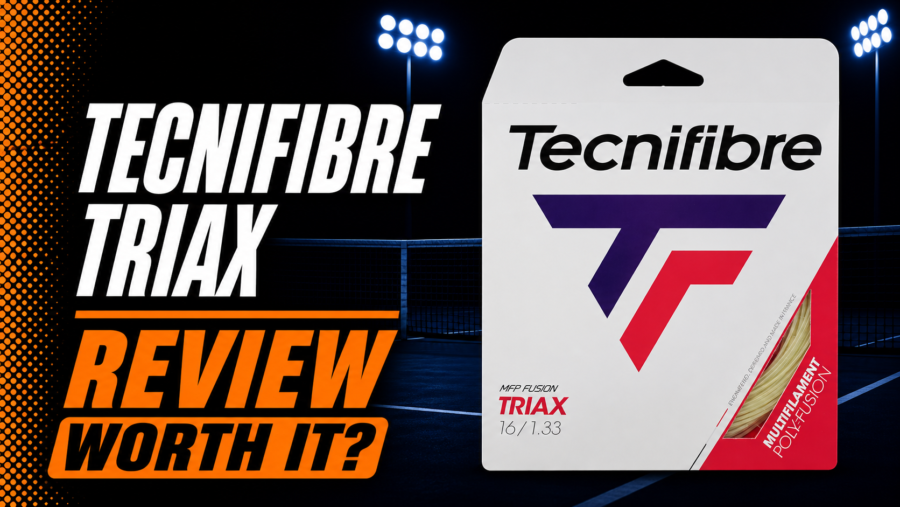
Tecnifibre Triax is a hybrid-construction multifilament tennis string that combines polyamide and co-polyester fibers inside one strand. It is designed to give multifilament users more control, spin and physical resistance while remaining more comfortable than a conventional polyester monofilament.
Tecnifibre identifies Triax as a 50/50 blend of nylon and polyester fibers. The bundle is impregnated with high-density polyurethane and finished with an SPL anti-abrasion coating that supports smooth movement and snapback.
Triax targets intermediate and advanced players who find ordinary multifilaments too powerful or short lived but do not want a full polyester bed. It also suits flatter hitters and all-court players who need controlled depth. The Tennis String Finder can help compare the available material categories.
Tecnifibre Triax Rating
| Category | Rating |
|---|---|
| Power | 8/10 |
| Spin | 8/10 |
| Comfort | 8/10 |
| Control | 8/10 |
These balanced ratings align with independent playtesting. Triax does not maximize a single category; its value comes from combining attributes rarely found together in one multifilament.
Tecnifibre Triax Specifications
| Specification | Details |
|---|---|
| String type | Hybrid-construction multifilament |
| Fiber blend | 50% polyamide and 50% co-polyester fibers |
| Matrix | High-density polyurethane |
| Surface | SPL anti-abrasion coating |
| Profile | Round and smooth |
| Common gauges | 15L / 1.38mm, 16 / 1.33mm and 17 / 1.28mm |
| Common color | Natural |
| Lengths | Approximately 12.2m sets and 200m reels |
Triax is manufactured in France. Its diameters are slightly thicker than the conventional labels used by some competing strings.
Material and Construction
Half of the fiber structure uses polyamide. These softer fibers add tolerance, elasticity and feel, especially on off-center contact.
The other half uses co-polyester fibers. Tecnifibre calls this T.P.I. technology and uses the firmer material to restrain launch, improve resistance and create a more direct response.
High-density polyurethane binds and cushions the mixed fibers. It is less elastic than PU 400 used in the most power-focused Tecnifibre multifilaments, matching Triax’s firmer purpose.
An SPL final coating reduces abrasion and encourages the round mains to slide and return. The design does not have shaped edges; its spin comes from firmness, smooth movement and swing speed.
Tecnifibre Triax Performance
Power
Triax provides useful power but is more controlled than NRG2 or X-One Biphase. The nylon and polyurethane create depth, while co-polyester fibers limit excessive stretch.
Independent testing found enough rebound for defensive shots and all-court play without the string becoming as springy as many full multifilaments.
The 17 / 1.28mm gauge is the liveliest. The 15L / 1.38mm version offers the lowest launch and greatest stability.
Players leaving full polyester will notice more free depth. Players coming from a soft multifilament will experience a firmer, calmer response.
Power rating: 8/10
Spin
Triax offers excellent spin for a multifilament. The SPL coating supports main-string movement, while the co-polyester content keeps the bed firm enough for fast acceleration.
Independent playtesting produced strong spin scores and found that the mains did not require constant straightening while fresh.
The string remains round and does not provide direct geometric bite. It will not reproduce every full-polyester snapback characteristic, especially after fraying and notching develop.
The 17 gauge offers the easiest spin access. Frequent breakers and very open patterns should choose a thicker option even if it produces slightly less response.
Spin rating: 8/10
Control
Control is a defining reason to choose Triax over a conventional multifilament. Co-polyester fibers restrain elasticity and produce a more predictable launch on full swings.
Independent testers found an effective balance between depth and targeting. The string does not feel dead, but it allows more acceleration than NRG2.
The response is crisp and firm for a multifilament. Players who use flat drives, returns and volleys should appreciate the defined connection.
Control can decline after tension loss or surface wear, although independent playability-duration scores were strong. The bed should be replaced when trajectory or string movement changes materially.
Control rating: 8/10
Comfort and Feel
Triax is very comfortable in the broader market but firmer than a traditional premium multifilament. The nylon fibers and polyurethane matrix cushion the co-polyester content.
Independent testers described a crisp, pocketed response rather than a mushy feel. This gives it useful feedback for volleys, returns and touch shots.
Players moving from polyester may find it substantially softer. Players accustomed to NRG2 or Premier Touch may consider it comparatively firm.
No string guarantees protection from injury. Racket stiffness, tension, technique and individual history remain relevant.
Comfort rating: 8/10
Durability and Tension Maintenance
Triax is physically more durable than many conventional multifilaments because co-polyester fibers reinforce the bundle and SPL reduces abrasion.
The 15L / 1.38mm version offers maximum resistance. The 17 gauge prioritizes response and is less suitable for frequent breakers.
Physical durability does not equal a fixed lifespan. Independent and customer reports vary widely, particularly in open patterns and poly hybrids where friction is high.
Tension and playability duration test well for the category. Replace Triax when fraying is deep, launch changes or strings stop returning, even if the reinforced bundle remains intact.
Choosing the Right Gauge
Triax offers three thicker-than-average diameters.
| Gauge | General characteristics |
|---|---|
| 15L / 1.38mm | Maximum resistance, control and stability |
| 16 / 1.33mm | Balanced durability, power and feel |
| 17 / 1.28mm | Greater response, pocketing and spin access |
The 16 / 1.33mm version is the safest general recommendation. Frequent breakers should consider 15L, while dense patterns may benefit from 17 gauge.
Full Bed or Hybrid Setup
Full Bed
A full bed best demonstrates Triax’s integrated design. It provides more control than a conventional multifilament without requiring a separate polyester component.
This is the logical starting point for players leaving full polyester or seeking a durable multi.
Tecnifibre Triax in the Mains With Softer Crosses
Triax mains preserve its controlled hybrid-fiber response. Natural gut or a softer multifilament cross adds depth and pocketing.
The mixed-fiber main can still notch the soft cross. This custom setup reduces some of Triax’s firm balance.
Softer Mains With Tecnifibre Triax in the Crosses
Natural gut or premium multifilament mains emphasize power and feel. Triax crosses add a firmer, more resistant support string.
Triax can also pair with polyester mains, but the two already contain polyester-related firmness. The co-poly main can abrade Triax and shorten its physical life.
General Tension Guidance
Triax should generally use a multifilament or nylon-oriented starting reference rather than an automatically low polyester number. It is more elastic than a monofilament despite the co-polyester fibers.
Players transitioning from full polyester may need a firmer reference to manage the additional power. Those coming from a soft multifilament may begin near their existing range.
Gauge matters substantially. The thick 15L version produces a firmer, lower-launch bed than 17 gauge at the same reference.
Use the Tennis String Tension Calculator for a broad starting point, then make small adjustments within the frame manufacturer’s range.
Who Should Use Tecnifibre Triax?
Triax is best suited to:
- Intermediate and advanced players seeking a controlled multifilament
- Players moving away from full polyester
- Multifilament users wanting more spin and resistance
- Flatter hitters and all-court players
- Users who dislike constant string straightening
- Players who value a crisp, defined soft-string response
Who Should Avoid Tecnifibre Triax?
Triax is less suitable for:
- Players seeking the softest possible multifilament
- Users who want maximum free power
- Extreme string breakers expecting monofilament durability
- Players seeking shaped-polyester bite
- Buyers who prefer a low-cost basic nylon
- Anyone assuming polyester fibers make it identical to full poly
Pros and Cons
| Pros | Cons |
|---|---|
| Excellent control for a multifilament | Firmer than conventional premium multis |
| Strong multifilament spin | Less spin than specialized shaped poly |
| Co-polyester fibers improve resistance | Premium price |
| Comfortable relative to full polyester | Can still fray and break quickly for some players |
| SPL coating supports snapback | Thicker gauge diameters |
| Three useful gauges | Not the easiest source of free power |
Tecnifibre Triax Compared With Other Strings
Triax vs Tecnifibre NRG2
Tecnifibre NRG2 is softer and more powerful. Triax adds co-polyester fibers for greater control, spin and resistance.
Triax vs Tecnifibre X-One Biphase
Tecnifibre X-One Biphase emphasizes premium power and crisp touch. Triax is firmer, more controlled and more durable.
Triax vs Tecnifibre Multifeel
Tecnifibre Multifeel uses a central monofilament core with 985 surrounding fibers. It is less expensive and more traditionally elastic, while Triax integrates polyester throughout the fiber blend.
Triax vs Prince Premier Control
Prince Premier Control uses three interlaced central cores to restrain launch. Both target controlled comfort, but Triax adds actual co-polyester fibers and stronger snapback.
Final Verdict
Tecnifibre Triax is one of the most distinctive controlled multifilaments. Its equal blend of polyamide and co-polyester fibers, high-density polyurethane and SPL coating produces a firm, crisp stringbed with balanced power, spin, comfort and control.
It does not fully reproduce polyester durability or shaped-string bite, and it is not as soft or powerful as NRG2. Those tradeoffs are exactly what make it useful for players caught between the two categories.
For intermediate and advanced players seeking a more forgiving alternative to full polyester, Triax is a strong choice. The 16 / 1.33mm version offers the best general balance.
Frequently Asked Questions
Is Tecnifibre Triax a polyester string?
It is a multifilament containing 50 percent co-polyester fibers and 50 percent polyamide fibers, not a conventional polyester monofilament.
Is Triax comfortable?
Yes. It is more comfortable than typical full polyester but firmer than many traditional multifilaments.
Does Triax provide good spin?
Yes. Its firmness and SPL coating provide strong spin for a round multifilament.
Which gauge should most players choose?
The 16 / 1.33mm version provides the best balance. The 15L gauge favors resistance, while 17 gauge favors response.
Is Triax durable?
It is more resistant than many multifilaments, but heavy hitters can still fray or break it well before a full polyester.
Can Triax replace a full polyester bed?
For players seeking more comfort and power, yes. It will not provide identical low power, spin or break resistance.
Can Triax be used in a hybrid?
Yes. It can be used as a main or cross, although a full bed already delivers a hybrid-style material balance.