
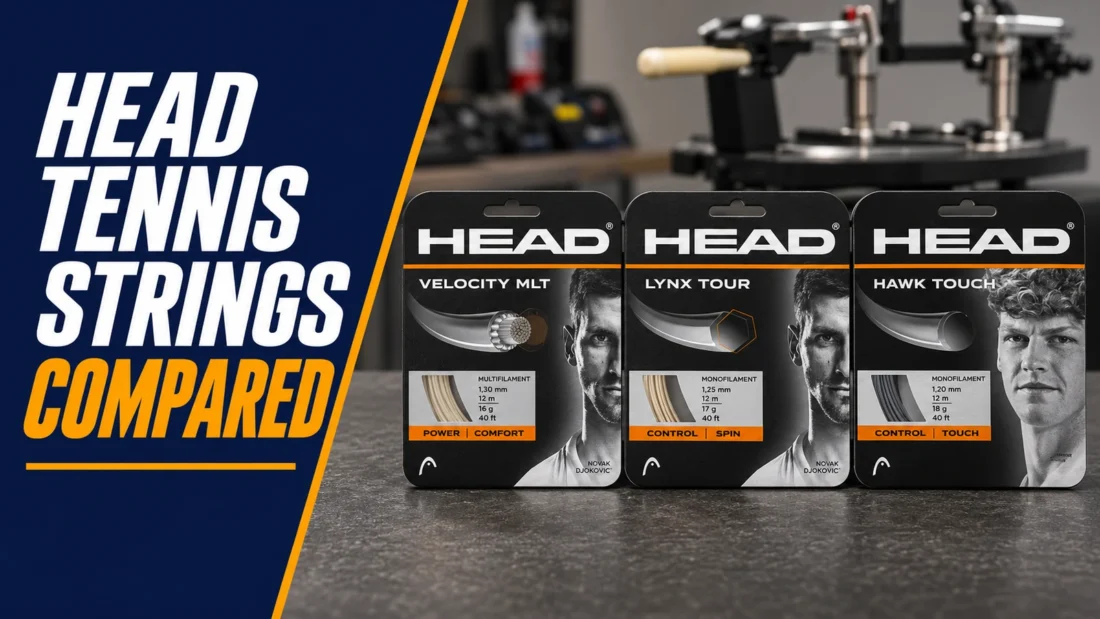
HEAD’s string range becomes easier to navigate when you separate construction from family name. Velocity MLT and RIP Control are multifilaments; Lynx Tour, Lynx Touch, Hawk Touch and Hawk Power are performance monofilaments. For a player seeking comfortable depth, Velocity MLT is a more sensible starting point than choosing Hawk Power simply because it contains the word “Power.”
Established polyester users have a different decision. Lynx Tour offers a shaped profile, while Lynx Touch and the Hawk options provide round alternatives with different intended responses. The best fit depends on what your current strings fail to do, not which professional appears on the packaging.
These recommendations are based on published specifications and product information, rather than personal playtesting.
HEAD tennis strings compared
| String | Construction and profile | Main reason to try it | Who should be cautious |
|---|---|---|---|
| Velocity MLT | Round multifilament | Power and comfort for club play | Heavy string breakers |
| RIP Control | Multifilament | A more control-focused option within the multifilament category | Players expecting maximum free depth |
| Lynx Touch | Round monofilament | Touch and a more accessible performance-string response | Players assuming Touch means nylon-like softness |
| Lynx Tour | Six-sided co-polyester | Spin and control for developed swings | Players with compact strokes who struggle for depth |
| Hawk Touch | Round monofilament | Feedback and placement for fast, technically developed swings | Players seeking an effortless-power string |
| Hawk Power | Round monofilament | A livelier option for strong hitters | Beginners choosing by the name alone |
Velocity MLT: start here for easy depth
Velocity MLT is a multifilament built around power and comfort. It belongs on the shortlist for a recreational player, a doubles player who values touch or someone whose existing polyester setup feels too demanding.
The Velocity MLT review covers its response in more detail. HEAD lists 1.25mm and 1.30mm versions. The thicker option is a reasonable place to start when physical wear matters; the thinner option is an alternative to compare when feel takes priority.
The tradeoff is break resistance under heavy spin. That does not automatically make polyester a better purchase: an unbroken string that gives you poor depth or an unpleasant impact is not useful value. Velocity Power is a separate model in the range, so confirm the full name when buying a replacement set.
RIP Control: a different multifilament direction
RIP Control is worth comparing when you want to remain within multifilament but do not want the liveliest possible response. HEAD identifies control as its main benefit while retaining a multifilament construction intended for club and tournament players.
That makes it a useful alternative to jumping directly from a powerful nylon string to firm polyester. The RIP Control review explains the type of player who may prefer that more restrained direction.
It is still important to judge it in your own racket. A dense string pattern, a small head and a high reference tension can make a control-oriented installation feel very different from the same string in an open-pattern power frame.
Lynx Touch versus Lynx Tour
These are separate designs, not simply a standard and premium version of one string. Lynx Touch has a round profile. HEAD places it in its performance category for club players who need both power and control, with touch as the defining benefit.
Consider the Lynx Touch review if you already use monofilament and want a different blend of feel and response. It remains a monofilament, so a softer-sounding name should not override your actual experience of the stringbed.
Lynx Tour uses a six-sided co-polyester profile and is more explicitly directed toward spin and control. Its current listed gauges are 1.25mm and 1.30mm. The Lynx Tour review is the better reference for a player who accelerates confidently and wants to shape the ball with topspin.
Do not expect the shaped surface to replace technique. Both the swing path and the way the strings move affect spin. A player who prefers the response of a round string need not abandon it solely to chase an edged profile.
Hawk Touch versus Hawk Power
HEAD places both Hawk models in its Tour category, which targets fast swings and developed technique. The names describe a difference within that performance category.
Hawk Touch emphasizes feedback and placement. It is the more relevant comparison when you already supply pace and want a precise response on full groundstrokes and touch shots. The Hawk Touch review examines that role. HEAD lists a broader set of diameters here, from 1.15mm to 1.30mm, so identify the exact gauge before comparing installations.
Hawk Power is positioned as the more power-oriented option, but remains a round monofilament for high-performance players. The Hawk Power review explains why its extra response should be understood relative to other performance polys. It is not a like-for-like substitute for the easier power of Velocity MLT.
Choose a full bed or hybrid for a reason
A full multifilament bed is the clearest way to evaluate the comfort and depth of Velocity MLT or RIP Control. A full polyester bed provides a more direct comparison between Lynx and Hawk models when that material already suits your game.
A hybrid combines two strings. Smooth polyester can be useful alongside a softer string, but the result depends on which string occupies the mains, both diameters and the chosen tensions. The guide to different tennis string types explains why hybrid is a setup, rather than a material.
Start with one set or one hybrid installation. Use a compatible reference tension, keep a note of the stringer and compare the response after normal play as well as immediately after stringing. That gives you a more reliable decision than buying a reel based on a fresh-string impression alone.