
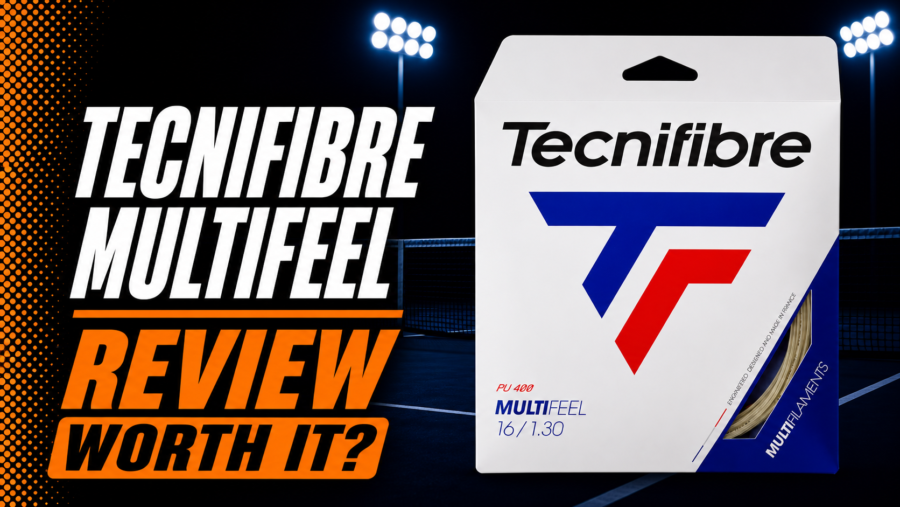
Tecnifibre Multifeel is a value-oriented multifilament tennis string designed to balance comfort, controlled power and improved physical resistance. It sits below NRG2 and X-One Biphase in Tecnifibre’s range but uses several of the company’s core multifilament technologies.
Unlike a uniform multifilament bundle, Multifeel contains one firm P.H.P. central monofilament surrounded by 985 polyamide fibers. The assembly is impregnated with PU 400 polyurethane and finished with an SPL anti-abrasion coating.
This construction targets beginners, intermediates and club players who want more definition than a very soft multifilament without moving to polyester. It is also a useful transition string for players leaving a firm setup. The Tennis String Finder can help compare it with other categories.
Tecnifibre Multifeel Rating
| Category | Rating |
|---|---|
| Power | 8/10 |
| Spin | 7.5/10 |
| Comfort | 8.5/10 |
| Control | 8/10 |
These ratings reflect official construction and independent playtesting. Multifeel provides a particularly balanced combination of power, comfort and control for its price.
Tecnifibre Multifeel Specifications
| Specification | Details |
|---|---|
| String type | Central-core multifilament |
| Central structure | One P.H.P. polymer monofilament core |
| Outer structure | 985 polyamide fibers |
| Matrix | PU 400 polyurethane impregnation |
| Surface | SPL anti-abrasion coating |
| Common gauges | 16 / 1.30mm and 17 / 1.25mm |
| Common colors | Natural and Black |
| Lengths | Approximately 12m sets and 200m reels |
Tecnifibre manufactures Multifeel in France. Color and gauge availability varies by market.
Material and Construction
The P.H.P. central core has a larger diameter than the surrounding fibers and adds firmness, tension support and physical structure. It makes Multifeel more defined than a completely coreless soft multifilament.
Around that center are 985 polyamide fibers. They add elasticity, ball feel and tolerance on off-center contact.
PU 400 liquid polyurethane impregnates the assembly, allowing the core and fibers to work within a flexible matrix. Tecnifibre describes PU 400 through its high elasticity rather than as a surface-only layer.
An SPL final coating protects against abrasion and provides smoothness. It supports better string return than many traditional multifilaments, though wear and fraying eventually reduce that benefit.
Tecnifibre Multifeel Performance
Power
Multifeel provides easy depth but is less explosive than NRG2 and X-One Biphase. The P.H.P. core restrains some of the stretch created by the outer fibers and PU 400.
Independent playtesting still rated power highly. Compact and moderate swings receive useful assistance, while experienced players can manage the launch more easily than with softer premium multis.
The 17 / 1.25mm version is livelier and more responsive. The 16 / 1.30mm gauge produces greater stability and suits open patterns.
Players seeking the lowest-powered response should choose Triax or polyester. Multifeel remains a resilient nylon-based string in the broader market.
Power rating: 8/10
Spin
Spin is surprisingly good for a multifilament. Independent testers found useful main-string return and enough rotation to control depth.
The SPL finish helps the round strings slide while fresh. The central core also prevents the response from becoming excessively soft during faster brushing swings.
Multifeel does not have shaped edges. As the coating wears and fibers fray, snapback declines and mains may remain out of position.
The 17 gauge provides more ball interaction but less resistance. Heavy topspin breakers should still choose polyester or a more durable hybrid.
Spin rating: 7.5/10
Control
Control is one of Multifeel’s most valuable qualities. The P.H.P. core produces a cleaner, firmer response than many soft multifilaments.
Independent testers found an effective middle ground between synthetic gut and a highly elastic premium multi. The power remains accessible without making every full swing unpredictable.
This balance supports all-court play, including directional groundstrokes, touch volleys and defensive slices. It is not as locked in as co-polyester.
Control may change as tension drops and the coating wears. Useful playability should be judged from current trajectory rather than the string merely remaining intact.
Control rating: 8/10
Comfort and Feel
Comfort is excellent. Most of the structure consists of flexible polyamide fibers and polyurethane, which cushion the firmer central core.
The feel is crisp for a multifilament but considerably softer than synthetic gut or polyester. Independent playtesting praised its connection and ability to judge touch shots.
This defined comfort can appeal to players who find NRG2 too plush or powerful. It also makes Multifeel a logical transition from solid-core nylon.
No string prevents injury. Overall comfort depends on frame stiffness, tension, technique and individual history.
Comfort rating: 8.5/10
Durability and Tension Maintenance
Multifeel is designed to outlast a basic soft multifilament through its central core and SPL anti-abrasion coating. Tecnifibre positions it as lasting up to twice as long as a standard string, but individual results vary widely.
Independent testing found typical multifilament fraying, sometimes beginning early. The string can continue playing consistently after visible surface wear, but frequent breakers may still have a short lifespan.
Physical resistance is separate from useful playability duration. Tension maintenance tested well for the category, while coating loss and fraying can reduce spin before the central core breaks.
The 16 / 1.30mm gauge provides the best resistance. Replace the bed when fraying approaches the core, response changes or strings remain displaced.
Choosing the Right Gauge
Multifeel offers two straightforward options.
| Gauge | General characteristics |
|---|---|
| 16 / 1.30mm | Greater stability, resistance and launch control |
| 17 / 1.25mm | Greater response, feel and spin access |
The 16 gauge is the safest general choice. Dense patterns and players who rarely break strings can benefit from 17 gauge.
Full Bed or Hybrid Setup
Full Bed
A full bed presents Multifeel’s intended balance of comfort, power and core-supported control. This is the best starting point for beginners and club players.
Gauge selection can manage launch before adding a second material.
Tecnifibre Multifeel in the Mains With Softer Crosses
Multifeel mains preserve its defined central-core response. Natural gut or a softer multifilament cross adds power and pocketing, though it may make the bed too lively for some players.
An all-soft hybrid does not substantially improve durability.
Softer Mains With Tecnifibre Multifeel in the Crosses
Natural gut or a premium multifilament in the mains emphasizes maximum elasticity. Multifeel crosses add a slightly firmer, lower-cost support string.
Multifeel can also soften polyester mains. The polyester can cut through its outer fibers, and the hybrid remains firmer than a full Multifeel bed.
General Tension Guidance
Multifeel can begin near the middle of the racket manufacturer’s recommended nylon range. Its central core controls power better than NRG2, but it remains more elastic than polyester.
Players seeking greater pocketing can move modestly lower. Those wanting a firmer trajectory can increase slightly or choose 16 gauge.
Open patterns generally favor the thicker gauge. Dense patterns can benefit from 17 gauge and a modestly lower reference.
Use the Tennis String Tension Calculator as a starting point, then adjust one variable at a time within the frame’s approved range.
Who Should Use Tecnifibre Multifeel?
Multifeel is best suited to:
- Beginners and intermediate players seeking balanced performance
- Club players who want comfort with added control
- All-court players who value defined feel
- Players moving from synthetic gut to multifilament
- Users leaving firm polyester
- Value-conscious buyers seeking Tecnifibre technology
Who Should Avoid Tecnifibre Multifeel?
Multifeel is less suitable for:
- Chronic string breakers
- Heavy-spin players seeking shaped-polyester bite
- Players who want maximum free power
- Users seeking the lowest-powered response
- Anyone expecting no visible fraying
- Players who require natural-gut tension stability
Pros and Cons
| Pros | Cons |
|---|---|
| Excellent balance of power and control | Frays like other multifilaments |
| Very good comfort | Physical durability varies greatly by player |
| P.H.P. core adds definition | Coating wear can reduce spin |
| 985 fibers provide pocketing | Less powerful than premium siblings |
| SPL coating supports movement | No shaped edges |
| Strong value | Only two common gauges |
Tecnifibre Multifeel Compared With Other Strings
Multifeel vs Tecnifibre NRG2
Tecnifibre NRG2 is softer, more powerful and more premium. Multifeel’s central core creates more control and a lower price.
Multifeel vs Tecnifibre X-One Biphase
Tecnifibre X-One Biphase provides crisper premium touch and more power. Multifeel is less expensive and uses a distinct central-core design.
Multifeel vs Tecnifibre Triax
Tecnifibre Triax integrates co-polyester fibers for greater control and resistance. Multifeel is softer, livelier and more traditionally multifilament.
Multifeel vs Prince Premier Control
Prince Premier Control uses three interlaced central cores. Both seek multifilament control, while their core structures and feel are different.
Final Verdict
Tecnifibre Multifeel is a well-engineered value multifilament. Its P.H.P. central core, 985 polyamide fibers, PU 400 matrix and SPL finish produce comfort and easy depth without the most uncontrolled premium-multi launch.
Independent testing confirms its balanced power, control, feel and unexpectedly useful spin. Fraying remains the primary limitation, and frequent breakers should not assume the coating makes it polyester durable.
For club players who want a defined and comfortable full bed at a lower price than NRG2 or X-One Biphase, Multifeel is a strong choice. The 16 / 1.30mm gauge provides the best general balance.
Frequently Asked Questions
Is Tecnifibre Multifeel a true multifilament?
It combines a firm central monofilament core with 985 surrounding polyamide fibers, so it is a core-supported multifilament.
What is the P.H.P. core?
It is a larger central polymer monofilament intended to add firmness, resistance and tension support.
Is Multifeel powerful?
Yes. It provides easy depth, though less explosive power than NRG2 or X-One Biphase.
Does Multifeel provide good spin?
It provides good spin for a multifilament while the SPL finish remains smooth, but it does not match specialized polyester.
Which gauge should most players choose?
The 16 / 1.30mm version provides the best balance of stability and lifespan. The 17 gauge favors response.
Does Multifeel fray?
Yes. The outer fibers can fray even though the central core and coating improve structure.
Can Multifeel be used with polyester?
Yes. It can soften a polyester hybrid, but the polyester may accelerate fiber wear.