
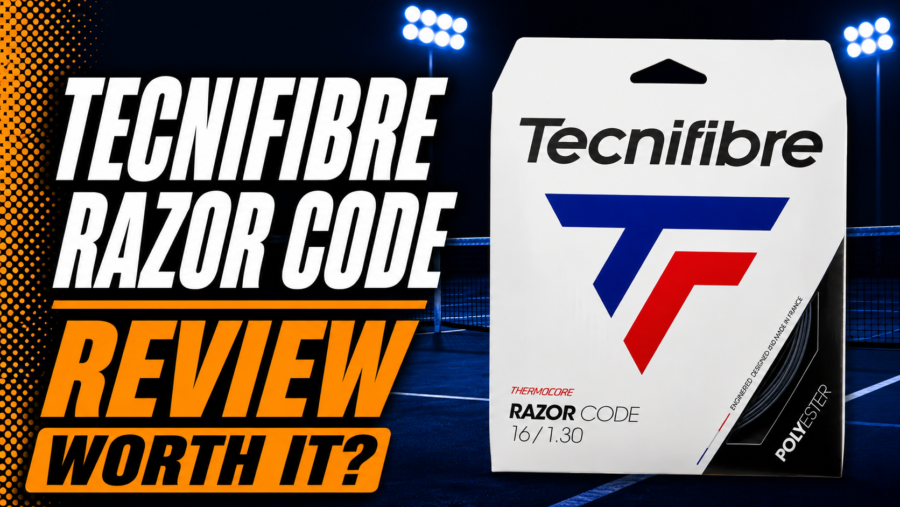
Tecnifibre Razor Code is a round high-modulus co-polyester tennis string designed for control, resistance and a direct response. Within Tecnifibre’s current monofilament range, it is the firmest Razor option and the string the company identifies as the most resistant to deformation.
Razor Code uses Tecnifibre’s Thermocore manufacturing process to add flexibility to an inherently firm polyester material. The result remains control oriented, but independent playtesting found more liveliness, spin and comfort than its rigid construction might suggest.
It targets advanced players and strong intermediates who supply their own racket-head speed and want confidence on full swings. The Tennis String Finder can help compare it with softer polyester and non-polyester alternatives.
Tecnifibre Razor Code Rating
| Category | Rating |
|---|---|
| Power | 6.5/10 |
| Spin | 8.5/10 |
| Comfort | 6.5/10 |
| Control | 8.5/10 |
These ratings combine Razor Code’s official control positioning with independent testing that found above-average polyester liveliness and strong spin.
Tecnifibre Razor Code Specifications
| Specification | Details |
|---|---|
| String type | Co-polyester monofilament |
| Composition | High-modulus co-polyester compound |
| Manufacturing process | Thermocore heating and cooling process |
| Profile | Round |
| Surface | Smooth, with no separately named coating in the official specification |
| Common gauges | 18 / 1.20mm, 17 / 1.25mm and 16 / 1.30mm |
| Common colors | Carbon, Blue and White, depending on market |
| Set and reel lengths | Approximately 12m sets and 200m reels |
| Made in | France |
Color can influence perceived response slightly, and availability varies by gauge and region.
Material and Construction
Razor Code uses a high-modulus co-polyester monofilament. Tecnifibre selects this firm compound to resist deformation and maintain control during fast, aggressive swings.
Thermocore is a multi-stage heating and cooling process used across Tecnifibre’s polyester production. It is intended to reduce the natural rigidity of monofilament without removing the crisp, controlled character.
The string has a round cross-section. It does not rely on geometric edges, so its spin comes from ball pocketing, string movement, snapback and the player’s acceleration.
No separately named exterior coating appears in the current official specification. The smooth round surface remains useful in full beds and as a cross string because it creates less edge-related abrasion than a sharply shaped polyester.
Tecnifibre Razor Code Performance
Power
Razor Code is more lively than many firm control polyesters. Independent playtesting produced a mid-range power score and found both tested colors more responsive than traditional low-powered polyester.
This does not make it a powerful string in the broader market. It still rewards long, committed swings and provides much less easy depth than natural gut or a premium multifilament.
The additional rebound can make Razor Code adaptable rather than dead. It may also create a higher launch than expected for players coming from very low-powered monofilaments.
Gauge, color, racket and reference tension can change the perceived liveliness. The 1.20mm version provides the easiest response, while 1.30mm is more restrained.
Power rating: 6.5/10
Spin
Razor Code provides strong spin despite its round profile. Independent testers reported very good ball grab and snapback, placing it well above an ordinary smooth control string.
The combination of pocketing and a controlled launch lets fast swingers accelerate upward without excessive fear of overhitting. This can translate into heavy topspin and effective slice.
It does not create the same direct edge-assisted bite as Black Code or 4S. The thinner gauges improve string movement and ball interaction for players who want more rotation.
Spin depends on the mains continuing to slide and return. Notching and elasticity loss can reduce that benefit before the string breaks.
Spin rating: 8.5/10
Control
Control is a core Razor Code strength. The firm high-modulus compound resists deformation, helping experienced players direct pace and take full swings.
Independent testing confirmed excellent targeting once the setup matched the player’s racket and preferred response. The review also showed that Razor Code can be livelier than expected, so control is not automatic in every frame.
The round profile produces a consistent feel across flatter drives, topspin strokes, serves and volleys. Players who value uniform response may prefer it to an aggressively shaped string.
As tension and elasticity decline, the launch may become too lively or the string may feel dead. Useful control should determine replacement timing, not breakage alone.
Control rating: 8.5/10
Comfort and Feel
Razor Code has moderate comfort for a firm polyester. Thermocore adds flexibility, and independent testers found better pocketing and comfort than expected from a high-modulus monofilament.
The response is crisp, direct and connected rather than soft. Some players may experience a brief break-in period before the bed becomes more settled.
Razor Code remains substantially firmer than Triax, NRG2 or natural gut. Its relative comfort should always be described within the polyester category.
Players with arm sensitivity should choose a genuinely softer construction or consult a qualified professional instead of relying on Thermocore alone.
Comfort rating: 6.5/10
Durability and Tension Maintenance
Physical resistance is excellent. Tecnifibre describes Razor Code as the most resistant and hardest to deform string in its current range, and independent testing gave it a very high durability score.
The 1.30mm gauge provides the greatest break resistance. Thinner versions trade some physical lifespan for more response, feel and spin access.
Playability duration is a different measure. Independent testers observed gradual changes in liveliness and resilience, with some variation between colors and setups.
Razor Code can remain unbroken after its most useful response has ended. Replace it when the bed becomes unpredictable, excessively firm or unable to snap back consistently.
Choosing the Right Gauge
Three gauges cover a useful range of playing needs.
| Gauge | General characteristics |
|---|---|
| 18 / 1.20mm | Most responsive, easiest spin access and least physical resistance |
| 17 / 1.25mm | Balanced control, liveliness, feel and durability |
| 16 / 1.30mm | Maximum resistance, stability and restrained launch |
The 17 / 1.25mm gauge is the best general starting point. Frequent breakers and open patterns may favor 16 gauge.
Full Bed or Hybrid Setup
Full Bed
A full bed maximizes Razor Code’s controlled, direct character and physical resistance. It is most appropriate for experienced polyester users with fast swings.
Players new to polyester should recognize that Thermocore does not make a full bed equivalent to a soft multifilament.
Tecnifibre Razor Code in the Mains With Softer Crosses
Razor Code mains retain control and snapback. Natural gut or a multifilament cross can add depth, pocketing and impact comfort.
The firm polyester mains will eventually notch a softer cross. A thicker soft string can improve physical resistance but may reduce response.
Softer Mains With Tecnifibre Razor Code in the Crosses
Natural gut or multifilament mains emphasize power and feel. Razor Code’s round profile makes it a practical cross for controlling launch without sharp geometric edges.
The high-modulus cross remains firm and can abrade the soft mains. This orientation is still generally more forgiving than a full Razor Code bed.
General Tension Guidance
Razor Code should usually start below a nylon or multifilament reference because its high-modulus construction already produces firmness and control.
Players coming from another polyester can begin near their established range. Because independent testing found more liveliness than expected, some may prefer a small upward adjustment rather than a major change.
The correct reference depends on frame stiffness, head size, pattern, gauge and swing speed. Copying a professional player’s number is not a reliable starting method.
Use the Tennis String Tension Calculator for broad guidance, then adjust gradually within the racket manufacturer’s range.
Who Should Use Tecnifibre Razor Code?
Razor Code is best suited to:
- Advanced players and strong intermediates
- Aggressive hitters with long, fast swings
- Players seeking a firm and direct response
- Frequent string breakers
- Users who want round-string spin and consistency
- Hybrid users needing a smooth control component
Who Should Avoid Tecnifibre Razor Code?
Razor Code is less suitable for:
- Beginners seeking easy depth
- Players with compact or slow swings
- Users who prioritize plush comfort
- Players with current arm sensitivity
- Anyone wanting maximum shaped-string bite
- Players who leave polyester installed until it breaks regardless of response
Pros and Cons
| Pros | Cons |
|---|---|
| Excellent control on full swings | Firm impact response |
| Very strong physical durability | Less comfortable than soft-string categories |
| Better spin than its round profile suggests | Can feel livelier than expected |
| Thermocore improves category-relative flexibility | Playability may end before breakage |
| Three gauges and several colors | Requires developed swing speed |
| Smooth profile is useful in hybrids | No shaped edges for direct bite |
Tecnifibre Razor Code Compared With Other Strings
Razor Code vs Tecnifibre Razor Soft
Tecnifibre Razor Soft adds polyurethane for more pocketing and comfort. Razor Code is firmer and more resistant to deformation.
Razor Code vs Tecnifibre Black Code
Tecnifibre Black Code has a pentagonal profile and a softer, more muted character. Razor Code feels more direct and provides a more uniform round-string response.
Razor Code vs Luxilon ALU Power
Luxilon ALU Power is another responsive round performance polyester. Both balance control with more liveliness than a dead poly, but their feel and tension evolution differ.
Razor Code vs Babolat RPM Blast
Babolat RPM Blast uses an octagonal profile and surface treatment for edge-assisted spin. Razor Code is round, firmer in purpose and more neutral across shot shapes.
Final Verdict
Tecnifibre Razor Code is a serious control string for accomplished ball strikers. Its high-modulus co-polyester, Thermocore process and round profile produce a firm, durable and consistent platform for aggressive swings.
Independent testing adds useful context: Razor Code is not simply dead and low powered. It provides good pocketing, strong spin and more liveliness than many traditional polyesters, although its setup must be matched carefully.
For advanced players who want resistance and a direct response without shaped edges, Razor Code remains a compelling option. The 17 / 1.25mm gauge offers the most versatile balance.
Frequently Asked Questions
Is Tecnifibre Razor Code a shaped string?
No. It has a round profile and generates spin through movement, pocketing and snapback.
Is Razor Code low powered?
It is controlled in the broader market, but independent testing found it livelier than many traditional polyesters.
What is Thermocore?
Thermocore is Tecnifibre’s staged heating and cooling process intended to add flexibility to polyester monofilaments.
Which Razor Code gauge should most players choose?
The 17 / 1.25mm version balances performance and resistance. The thinner gauge is more responsive, while 16 / 1.30mm is more durable and controlled.