
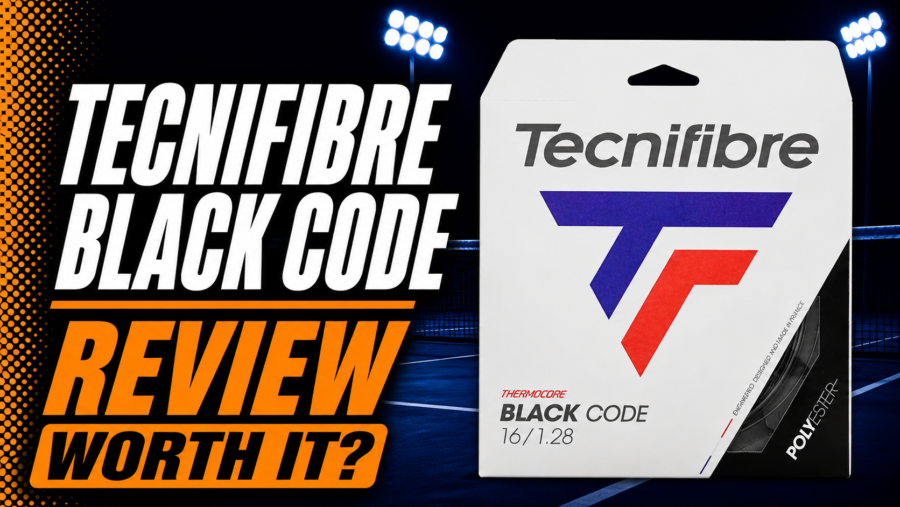
Tecnifibre Black Code is a pentagonal co-polyester tennis string designed for spin, control and a more flexible response than many traditional monofilaments. Its five-sided profile separates it from the round Razor strings and the more extreme four-sided 4S.
Tecnifibre uses its Thermocore manufacturing process to reduce some of polyester’s natural rigidity. Independent testing confirms that Black Code feels comparatively muted and forgiving for the category, but it remains a low-powered performance polyester rather than a genuinely soft string.
Black Code targets intermediate and advanced baseliners who create their own pace and want shaped-string bite without the hardest possible impact. The Tennis String Finder can help compare it with round co-polyester and softer materials.
Tecnifibre Black Code Rating
| Category | Rating |
|---|---|
| Power | 5/10 |
| Spin | 8.5/10 |
| Comfort | 6/10 |
| Control | 8/10 |
These ratings reflect independent playtesting that found high spin and control, low power and category-relative comfort rather than multifilament softness.
Tecnifibre Black Code Specifications
| Specification | Details |
|---|---|
| String type | Co-polyester monofilament |
| Composition | 100% co-polyester |
| Manufacturing process | Thermocore heating and cooling process |
| Profile | Pentagonal, with five sides |
| Surface | Shaped and smooth, with no separately named coating in the official specification |
| Common gauges | 18 / 1.18mm, 17 / 1.24mm, 16 / 1.28mm and 15L / 1.32mm |
| Common colors | Black, Lime and Fire, depending on gauge and market |
| Set and reel lengths | Approximately 12m sets and 200m reels |
| Made in | France |
Not every gauge and color combination is available in every region.
Material and Construction
Black Code is a single co-polyester filament. Tecnifibre blends polyester materials to provide the control and physical resistance expected from a monofilament while allowing some elasticity.
Thermocore uses successive heating and cooling stages during production. Tecnifibre developed the process to make polyester more flexible and reduce harshness without changing it into a soft-string material.
The cross-section is pentagonal. Five edges increase friction with the ball and contribute to Black Code’s direct spin potential, particularly when the player accelerates with an upward swing path.
The official specification does not identify a separate surface coating. Spin comes from the shaped geometry, string movement and snapback rather than a named external treatment.
Tecnifibre Black Code Performance
Power
Black Code is low powered in the broader string market. Independent testing produced a low power score, confirming that the string is designed to let aggressive players supply their own pace.
The response is not completely dead. Thermocore adds some elasticity, and independent testers noted a modestly springy but controlled launch from the stringbed.
Players with fast swings can use the low power to accelerate confidently. Compact swingers may struggle to produce consistent depth, especially with a thick gauge or dense pattern.
The 1.18mm and 1.24mm versions provide more rebound than the thicker options. They still offer much less free depth than a multifilament.
Power rating: 5/10
Spin
Spin is Black Code’s main attraction. The pentagonal profile gives the string five edges that interact with the ball, while the monofilament construction supports snapback.
Independent playtesting found excellent access to topspin and slice. The controlled launch also permits aggressive upward acceleration without sending the ball unpredictably long.
The 1.18mm version provides the easiest ball interaction, while 1.24mm balances bite with resistance. Thick gauges reduce some response but suit open patterns and frequent breakers.
Edges can round with wear, and notching can restrict movement. Spin performance should be judged over the useful life of the bed rather than only when freshly installed.
Spin rating: 8.5/10
Control
Black Code provides strong control through its low power, firm monofilament construction and spin-assisted trajectory management.
Independent testers found that it allowed aggressive baseline swings while maintaining a predictable launch. Its response is slightly more elastic and muted than a very rigid control polyester.
The five-sided profile helps topspin shots dip, but shaped geometry does not guarantee accuracy by itself. Control still depends on racket-head speed, contact quality and a suitable setup.
As the bed loses tension or the strings stop snapping back, launch and direction can become less consistent. Physical survival is not proof that the original control remains.
Control rating: 8/10
Comfort and Feel
Black Code is relatively comfortable within the polyester category. Thermocore gives it a more flexible, dampened response than several traditional firm monofilaments.
Independent testers described a soft or plush category-relative feel but still gave comfort a moderate numerical score. That distinction matters because their comparison group included other polyesters, not only soft strings.
The impact is muted rather than highly crisp. Players who value direct feedback may find some separation from the ball, while others will appreciate the reduced harshness.
Black Code remains much firmer than natural gut or multifilament. Players with arm problems should consider those categories first.
Comfort rating: 6/10
Durability and Tension Maintenance
Black Code offers strong resistance to breakage. Co-polyester construction and four available diameters make it suitable for frequent hitters, with 1.32mm providing the greatest physical lifespan.
The shaped intersections can notch as the mains move. Thinner gauges and open patterns may wear faster despite the durable material.
Independent testing found average-to-good polyester playability duration after the initial tension change. Results vary with swing speed, climate, pattern and frequency of use.
Physical durability and useful playability are different. Replace Black Code when the response becomes unpredictable, excessively firm or unable to snap back, even if no strand has broken.
Choosing the Right Gauge
Black Code’s wide gauge range allows substantial tuning.
| Gauge | General characteristics |
|---|---|
| 18 / 1.18mm | Maximum response, bite and feel, with the least resistance |
| 17 / 1.24mm | Balanced spin, control and physical lifespan |
| 16 / 1.28mm | Added stability and durability for open patterns |
| 15L / 1.32mm | Maximum resistance and lowest launch, with the firmest response |
The 17 / 1.24mm version is the best general starting point. Frequent breakers should consider 16 or 15L gauge.
Full Bed or Hybrid Setup
Full Bed
A full bed maximizes Black Code’s shaped bite, low power and controlled response. It suits experienced polyester users who generate their own pace.
Players should avoid assuming that Thermocore makes a full bed appropriate for every arm or skill level.
Tecnifibre Black Code in the Mains With Softer Crosses
Black Code mains preserve direct spin and control. Natural gut or multifilament crosses add depth, pocketing and comfort.
The pentagonal mains can saw through a soft cross. This orientation may therefore break sooner than a full bed despite feeling more forgiving.
Softer Mains With Tecnifibre Black Code in the Crosses
Natural gut or multifilament mains emphasize power and feel. Black Code crosses reduce launch and add firmness.
Because its five edges can increase abrasion and restrict the soft mains, a round polyester is often the more efficient cross when snapback and soft-string lifespan are priorities.
General Tension Guidance
Black Code should generally begin below the reference used for nylon or multifilament. Its low-powered monofilament construction already provides control.
Players moving from another shaped polyester can start near their established range. Those who find the response too firm can make a modest reduction or choose a thinner gauge.
The racket’s stiffness, head size and pattern matter as much as the printed string name. Thick Black Code in a dense pattern will behave differently from the thin gauge in an open frame.
Use the Tennis String Tension Calculator for general guidance, then adjust gradually within the manufacturer’s approved range.
Who Should Use Tecnifibre Black Code?
Black Code is best suited to:
- Intermediate and advanced players
- Topspin-oriented baseliners
- Players with long, fast swings
- Users seeking a muted shaped polyester
- Frequent hitters who need physical resistance
- Players who want several gauge choices
Who Should Avoid Tecnifibre Black Code?
Black Code is less suitable for:
- Beginners who need easy depth
- Players with compact or slow swings
- Users seeking natural-gut or multifilament comfort
- Players with active arm sensitivity
- Flat hitters who do not benefit from shaped edges
- Hybrid users who specifically need the smoothest possible cross
Pros and Cons
| Pros | Cons |
|---|---|
| Excellent spin potential | Low free power |
| Pentagonal profile adds direct bite | Still firm in the broader market |
| Strong control on fast swings | Muted feel may not suit everyone |
| Thermocore improves polyester flexibility | Shaped edges can abrade soft crosses |
| Four useful gauges | Playability can end before breakage |
| Good physical resistance | Requires developed racket-head speed |
Tecnifibre Black Code Compared With Other Strings
Black Code vs Tecnifibre 4S
Tecnifibre 4S has four sharper sides, lower power and a more extreme control-and-spin purpose. Black Code has five sides and a more moderate, muted response.
Black Code vs Tecnifibre Razor Code
Tecnifibre Razor Code is round, firmer and more uniform. Black Code provides more direct geometric bite and a softer category-relative feel.
Black Code vs Solinco Hyper-G
Solinco Hyper-G is another shaped control polyester for aggressive topspin. Both reward fast swings, but their shape, feel and gauge ranges differ.
Black Code vs Volkl Cyclone
Volkl Cyclone is a gear-shaped co-polyester with similar spin-focused intent. Black Code uses Tecnifibre’s pentagonal profile and Thermocore process.
Final Verdict
Tecnifibre Black Code is a proven shaped polyester for players who build points with topspin and controlled aggression. Its pentagonal geometry creates direct bite, while Thermocore gives the impact a more flexible and muted character than many firm polys.
Independent testing supports the central tradeoff: spin, control and resistance are strong, but power and absolute comfort remain limited. The string suits developed swings far better than beginners or players seeking effortless depth.
For intermediate and advanced baseliners who want shaped performance without the most rigid feel, Black Code remains a useful choice. The 17 / 1.24mm gauge offers the best overall balance.
Frequently Asked Questions
What shape is Tecnifibre Black Code?
It has a pentagonal cross-section with five sides designed to increase ball friction and spin.
Is Black Code a soft string?
It is comparatively flexible and muted for polyester, but it is much firmer than natural gut or multifilament.
Does Black Code provide easy power?
No. Independent testing found low power, so the string works best for players who generate their own pace.
Which gauge should most players choose?
The 17 / 1.24mm version balances spin, control and durability. Thicker gauges improve resistance, while 18 / 1.18mm maximizes response.