
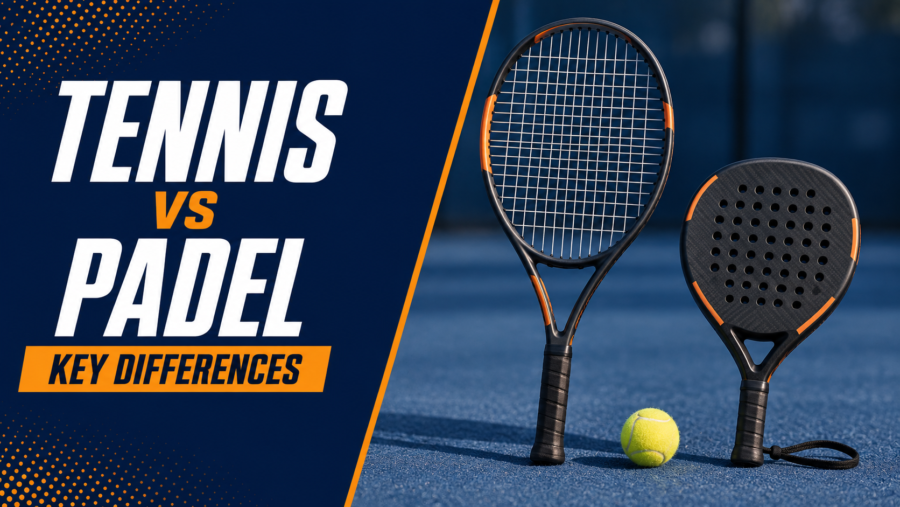
Padel and tennis share a net, a pressurized ball, and a familiar point sequence, but the games are built around different problems. Tennis uses a larger open court, strung rackets, and an overhead serve. Padel is usually played as doubles on a smaller enclosed court, with solid perforated rackets, an underhand serve after a bounce, and walls that remain in play.
Those court designs shape strategy. Tennis players create space with depth, angle, spin, and serve placement. Padel players also use those ideas, but must control the net as a pair and read rebounds rather than treating every wall contact as out.
Padel vs Tennis at a Glance
| Feature | Tennis | Padel |
|---|---|---|
| Standard formats | Singles and doubles | Doubles |
| Court length | 23.77m | 20m |
| Court width | 8.23m singles, 10.97m doubles | 10m |
| Enclosure | Boundaries end the point | Walls and fence can remain in play after a bounce |
| Hitting equipment | Strung racket | Solid perforated racket with safety cord |
| Serve | Hit before the ball bounces, commonly overhead | Hit after one bounce at or below waist level |
| Serve attempts | Two | Two |
| Return of serve | Must bounce in the service court before the return | Must bounce in the service box before the return |
| Common game score | Love, 15, 30, 40 | Love, 15, 30, 40 |
| Net height at center | 0.914m | 0.88m |
For a wider introduction to both families of games, see the overview of tennis, padel, and other racket sports.
Court Dimensions and Boundaries
A tennis court is 23.77m long. It is 8.23m wide for singles and 10.97m wide when the doubles alleys are included. The net is 0.914m high at the center and 1.07m at the posts.
A padel court is 20m long and 10m wide for doubles. Its service lines sit 6.95m from the net, and the surrounding walls and metal fencing form part of the regulated enclosure. The net is slightly lower at the center, measuring 0.88m.
The tennis court dimensions guide explains every tennis line. In padel, the regulated enclosure is equally important because it changes what counts as a playable ball.
Why the Walls Matter
In tennis, a ball that lands correctly and then reaches a backstop has already ended the point because the backstop is a permanent fixture outside the court. In padel, a ball that bounces in the correct court may then rebound from the wall or fence and remain live.
A padel player can also hit a return off the glass or solid wall on the player’s own side before the ball crosses the net. The return must still land in the opponents’ court before reaching their wall or fence. Contact with the player’s own metal fence is not a valid route back.
Rackets and Balls
Tennis rackets have a strung hitting surface and are generally longer than padel rackets. The string material, gauge, pattern, and tension all affect response.
Padel rackets have a shorter solid face perforated with holes, and official play requires the attached safety cord to be worn around the wrist.
Both sports use felt-covered rubber balls within closely related weight ranges, but the approved dimensions, bounce, and pressure specifications differ. A tennis ball is not automatically an official padel ball simply because it looks similar.
New padel players can check the beginner equipment list before buying a racket and balls.
Serving Rules
Tennis Serve
A tennis server begins behind the baseline and strikes a released ball before it touches the ground. The serve travels diagonally into the opposite service court. Players normally use an overhead motion, although the rules do not require one particular swing style.
The server has two attempts. A legal serve that touches the net and still lands in the correct service court is a let and is replayed under standard rules, although an approved no-let procedure can be used in some competitions.
Padel Serve
Unlike tennis, padel begins with a controlled bounce behind a service line and contact no higher than the waist. The ball still travels diagonally and the server still has two attempts, but the receiver must let it land before returning it. The detailed padel serve technique guide explains the motion.
Scoring
Both sports use love, 15, 30, 40, and game in their traditional format. Sets are commonly played to six games with a two-game lead, and a tie-break is often used at 6-6.
The format is not identical in every competition. Tennis can use advantage games, no-ad games, short sets, match tie-breaks, and advantage sets. Padel’s current rules list Advantage, Golden Point, and Star Point methods for resolving deuce, along with alternative set formats.
Do not assume the deuce rule from one league applies everywhere. Check the event rules before the match, especially when moving between club tennis and padel competition. The complete padel rules guide explains each current deuce option.
Rally Rules
In tennis, the receiver must let the serve land in the correct service court before returning it. After the return, a ball may be volleyed or played after one bounce.
Padel similarly requires the serve to bounce before the return. Later rally balls may be volleyed, played after a direct bounce, or played after a bounce and wall rebound. On both courts, a ball on a line is in.
Neither game allows a player to touch the net while the ball is live. A player also loses the point if the ball bounces twice before a legal return.
Technique Differences
Groundstrokes
Tennis groundstrokes often use longer acceleration paths to create pace and spin from the baseline. Court position and incoming ball speed still determine how large the swing should be.
Padel rewards compact preparation because players have less reaction space and may be handling a rebound close to the body. Control, height, and recovery position can be more valuable than trying to hit through the court.
Volleys and Net Play
Net position is valuable in both games. In tennis, a strong passing shot or lob can end the attack because there is no back wall to offer another chance.
In padel, the defending pair may let a lob or passing attempt rebound and continue the rally. The attacking pair must decide when to hold the net, retreat for an overhead, or concede the position and reorganize.
The padel volley technique guide shows why a short, stable action is usually more dependable than a full groundstroke swing near the net.
Overheads
Tennis players use overhead smashes primarily to finish or dominate a high ball. Padel has a wider family of overhead choices because the back glass can return a hard shot into play.
The best option may be a controlled bandeja, a more attacking vibora, a kick smash, or a simple high volley. Shot selection depends on height, balance, court position, and the opponents’ location.
Strategy and Teamwork
Singles tennis asks one player to manage the entire court. Doubles tennis adds team formations, poaching, and coordinated coverage, but singles remains a standard version of the sport.
Official padel is built around a pair. Partners usually defend and attack on roughly the same horizontal line, communicate over lobs, and avoid leaving a large diagonal gap. One player charging forward alone can expose both sides of the team.
Padel also changes the value of power. A hard ball that reaches the back glass cleanly may give an experienced opponent a predictable rebound. Placement at the feet, controlled depth, and changing height can create a better opportunity.
Physical Demands
Tennis and padel both require repeated accelerations, decelerations, direction changes, and rotational strokes. Match demand depends heavily on singles or doubles format, player level, rally style, court surface, temperature, and match length.
Tennis singles generally requires one player to cover a larger open area and may include more running between wide positions. Padel concentrates four players in an enclosure and adds frequent reactions, turns, low defensive positions, overheads, and transitions as a pair.
It is too broad to label one sport universally more demanding or safer. A short high-level match can be intense in either sport, while a controlled beginner session can be moderate. Technique, conditioning, workload progression, and recovery matter more than the sport’s marketing image.
Switching From Tennis to Padel
Tennis experience supplies useful tracking, split-step timing, volleys, lobs, and overhead coordination. The main adjustment is learning not to attack every ball immediately.
Try these changes:
- Let suitable deep balls reach the back glass instead of taking them awkwardly beside your body.
- Shorten groundstroke preparation and prioritize a centered contact.
- Move forward and backward with your partner rather than as an isolated player.
- Treat the serve as a way to establish position, not an overhead weapon.
- Use controlled overheads to keep the net when a full smash would be low percentage.
The guide on how to start playing padel covers booking, lessons, equipment, and first-match preparation.
Which Sport Is Right for You?
Tennis may suit you if you want established singles and doubles pathways, enjoy serving overhead, or prefer constructing points without playable walls. It also has wide availability in many regions.
Padel may suit you if you want a doubles-first game, enjoy cooperative court coverage, and like the tactical possibilities created by glass rebounds. Access can be the limiting factor because a dedicated enclosed court is required.
You do not need to choose permanently. The skills overlap enough to make each game enjoyable, while the differences are large enough that both remain worth learning.
Padel vs Tennis FAQ
Is padel easier than tennis?
Beginners may find it easier to start a cooperative padel rally because the serve is underhand and the court is compact. Advanced wall defense, positioning, and overhead selection still take substantial practice, so easier to begin does not mean easy to master.
Can you use a tennis racket for padel?
No. Official padel requires a compliant solid, perforated racket with a safety cord. A tennis racket is longer and has strings.
Is padel scoring the same as tennis?
The familiar point and set structure is similar, but allowed deuce and match formats can differ. Confirm the competition rules rather than assuming every match uses traditional advantage scoring.
Can you play padel singles?
Narrow singles-style courts and informal variations exist, but the FIP rules describe padel as two pairs on a 20m by 10m court. Standard competition is doubles.